

Public affairs refers to the structured management of relationships between organisations, policymakers, and public stakeholders within regulatory and political environments. Public affairs consulting is the analytical and strategic discipline that defines how institutions interpret policy landscapes, shape narrative influence, and establish credibility across both governmental and digital ecosystems.
What does public affairs consulting mean within digital ecosystems?
Public affairs Consulting is the systematic analysis and management of policy-related perception across institutional, media, and digital environments. Within digital ecosystems, it refers to the structuring of narratives, content, and authority signals that define how organisations are interpreted by stakeholders, regulators, and search systems. This process operates through the alignment of messaging with policy discourse, ensuring that institutional positions are indexed, understood, and evaluated consistently across platforms.
The mechanism relies on content production, stakeholder mapping, and narrative consistency to influence entity perception. Search engines evaluate this through content indexing, semantic relevance, and authority signals linked to policy-related queries. Institutional visibility emerges when content aligns with recognised policy entities, topics, and regulatory language. This alignment strengthens digital authority and improves SERP evaluation outcomes.
The impact is measurable in search visibility, media representation, and stakeholder trust. Organisations with structured public affairs consulting frameworks achieve consistent representation across search results and policy discussions. This consistency reduces ambiguity in entity perception and enhances credibility within both algorithmic and human evaluation systems.
How is institutional reputation formed through public affairs strategies?
Institutional reputation is formed through the aggregation of consistent narrative signals across media, search engines, and stakeholder communications. Public affairs strategies define how these signals are structured, distributed, and interpreted within policy-related contexts. Reputation is not a static attribute; it is a continuously evaluated construct shaped by content, authority references, and contextual relevance.

The mechanism involves aligning organisational messaging with recognised policy frameworks, regulatory terminology, and authoritative sources. Search engines interpret these alignments as indicators of expertise and trustworthiness. Content that references legislation, governmental bodies, and policy discourse contributes to entity recognition within knowledge graphs and SERP features.
This process directly influences credibility and stakeholder trust. When an organisation maintains consistent narrative alignment across platforms, it strengthens its digital footprint and reduces fragmentation in perception. This leads to higher trust signals, improved ranking stability, and stronger institutional positioning within policy-related search queries.
How do search engines evaluate authority in public affairs content?
Search engines evaluate authority in public affairs content through semantic relevance, source credibility, and contextual alignment with recognised policy entities. Authority is defined by the consistency and depth of information connected to regulatory, legislative, and institutional topics. It is not based on volume alone but on the structured relationship between content and authoritative references.
The mechanism includes analysing entity associations, backlink structures, and topical depth. Content that demonstrates clear connections to policy frameworks, legal terminology, and governmental institutions is prioritised in SERP evaluation. Algorithms assess how well content explains policy implications, defines institutional roles, and maintains factual accuracy.
This evaluation impacts digital authority and search visibility. High-authority content is more likely to appear in featured snippets, knowledge panels, and top-ranking positions. This visibility reinforces institutional credibility and increases stakeholder trust by presenting the organisation as a reliable source of policy-related information.
What role do digital narratives play in shaping public perception?
Digital narratives define how organisations are interpreted within policy discussions and public discourse. In public affairs consulting, narratives are structured representations of institutional positions, priorities, and responses to regulatory developments. These narratives influence both human perception and algorithmic classification.
The mechanism involves framing content around policy-relevant themes, ensuring consistency across platforms, and aligning messaging with stakeholder expectations. Search engines interpret these narratives through semantic patterns, keyword associations, and contextual relevance. Narrative coherence strengthens entity recognition and improves indexing accuracy.
The impact is evident in stakeholder trust and media visibility. Organisations with clearly defined narratives maintain consistent representation across search results and news coverage. This reduces interpretative ambiguity and enhances credibility within both public and institutional contexts.
How does content indexing influence policy-related visibility?
Content indexing determines how policy-related information is stored, categorised, and retrieved by search engines. In public affairs consulting, indexing is a critical factor in ensuring that institutional narratives are discoverable and accurately represented. Indexed content forms the foundation of search visibility and SERP evaluation.
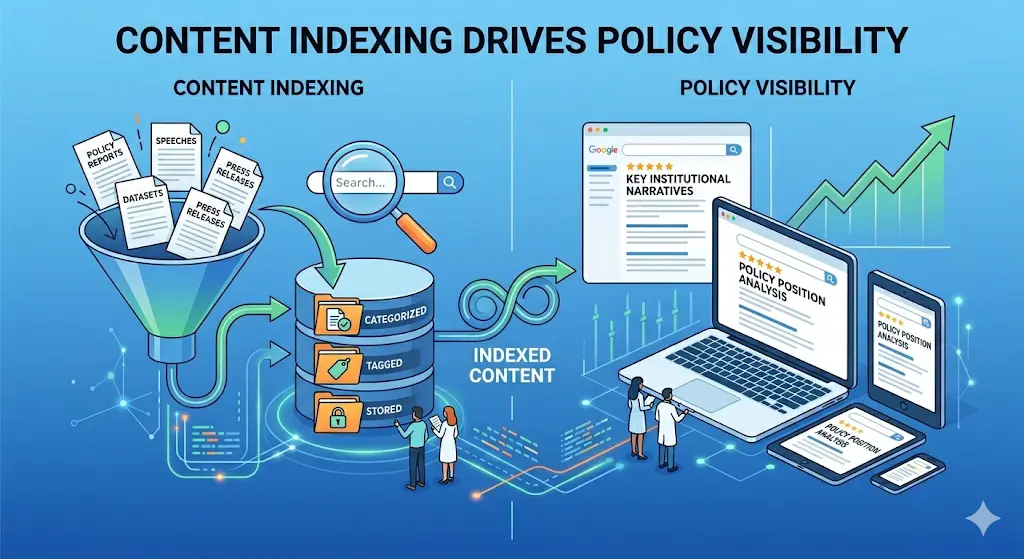
The mechanism involves structuring content with clear semantic signals, including policy terminology, entity references, and contextual relevance. Search engines analyse these elements to determine how content relates to specific queries. Proper indexing ensures that content is associated with relevant policy topics and appears in appropriate search contexts.
This directly affects visibility and credibility. Indexed content that aligns with policy discourse is more likely to rank for relevant queries, increasing exposure to stakeholders and decision-makers. This enhances digital authority and reinforces institutional presence within policy-related search ecosystems.
How do stakeholders interpret trust signals in public affairs communication?
Stakeholder trust is defined by the consistency, transparency, and authority of information presented across digital and institutional channels. In public affairs consulting, trust signals are structured indicators that demonstrate credibility and reliability. These signals are interpreted by both human audiences and algorithmic systems.
The mechanism includes the use of authoritative references, consistent messaging, and alignment with recognised policy frameworks. Search engines evaluate these signals through content quality, source credibility, and engagement metrics. Stakeholders interpret them through clarity, factual accuracy, and institutional alignment.
The impact is reflected in perception stability and engagement. Strong trust signals reduce uncertainty and increase confidence in organisational positions. This leads to improved stakeholder relationships, higher engagement rates, and stronger positioning within policy discussions and search results.
What is the relationship between SERP visibility and policy influence?
SERP visibility defines how prominently an organisation appears in search results related to policy topics. Policy influence is the extent to which an organisation’s perspectives are recognised and considered within regulatory discussions. Public affairs consulting connects these two elements through structured content and narrative alignment.
The mechanism involves optimising content for policy-related queries, ensuring semantic relevance, and maintaining authority signals. Search engines prioritise content that provides clear, accurate, and authoritative information. High visibility increases the likelihood that stakeholders encounter and engage with the organisation’s perspectives.
This relationship directly impacts influence and credibility. Organisations with strong SERP visibility are more likely to shape discourse, inform stakeholders, and contribute to policy debates. This enhances institutional authority and reinforces their role within regulatory ecosystems.
How does digital advocacy integrate with public affairs consulting?
Digital advocacy is the strategic use of online platforms to influence policy perception and stakeholder engagement. It integrates with public affairs consulting by extending narrative influence into digital channels, including search engines, social platforms, and media outlets.
The mechanism involves creating content that aligns with policy objectives, distributing it across relevant platforms, and ensuring consistent messaging. Search engines evaluate this content based on relevance, authority, and engagement. Digital advocacy amplifies these signals, increasing reach and visibility.
The impact is seen in expanded stakeholder engagement and enhanced narrative control. Organisations that integrate digital advocacy into public affairs strategies achieve broader visibility and stronger influence within policy discussions. This strengthens digital authority and improves overall perception within both public and institutional contexts.
How are content ecosystems structured to support institutional credibility?
Content ecosystems are structured networks of information that collectively define an organisation’s digital presence. In public affairs consulting, these ecosystems are designed to support credibility by ensuring consistency, relevance, and authority across all content assets.
The mechanism involves creating interconnected content that covers policy topics comprehensively. Each piece of content contributes to a broader narrative, reinforcing key themes and entity associations. Search engines interpret this structure as a sign of expertise and reliability.
This structure enhances credibility and search visibility. A well-organised content ecosystem ensures that stakeholders encounter consistent messaging across multiple touchpoints. This reduces fragmentation in perception and strengthens institutional trust within digital and policy environments.
How do authority signals influence entity perception in policy contexts?
Authority signals are indicators that demonstrate an organisation’s expertise and credibility within a specific domain. In policy contexts, these signals include references to legislation, alignment with regulatory frameworks, and associations with recognised institutions.
The mechanism involves embedding these signals within content, ensuring that they are consistently presented across platforms. Search engines analyse these signals to determine the organisation’s relevance and authority in relation to policy topics. Strong signals improve entity recognition and ranking performance.
The impact is reflected in enhanced perception and trust. Organisations with strong authority signals are more likely to be perceived as credible sources of information. This improves stakeholder confidence and increases visibility within policy-related search queries.
How does legislative strategy connect to digital perception systems?
Legislative strategy defines how organisations engage with policy development and regulatory processes. Within digital ecosystems, it connects to perception systems by shaping the narratives and content that represent organisational positions. This connection ensures that policy engagement is visible, structured, and interpretable.

The mechanism involves translating legislative objectives into digital content that aligns with search queries and stakeholder interests. Search engines evaluate this content based on relevance, authority, and clarity. Structured legislative narratives improve indexing and enhance visibility across SERPs.
This integration strengthens institutional credibility and stakeholder trust. When legislative strategy is reflected in digital content, it creates a coherent representation of organisational intent. This improves perception accuracy and reinforces authority within policy discussions. A detailed exploration of this connection is addressed through How Linkonize Builds Legislative Strategy.
Public affairs consulting defines how organisations construct, manage, and evaluate their presence within policy-driven digital ecosystems. It operates through structured narratives, authority signals, and content systems that influence how institutions are perceived by stakeholders and search engines. Each component, from content indexing to SERP visibility, contributes to the formation of digital authority and stakeholder trust.
Understanding these mechanisms clarifies how institutional credibility is not inherent but constructed through consistent, aligned, and semantically relevant communication. As digital ecosystems continue to shape policy discourse, the integration of public affairs strategy with search visibility and narrative influence remains central to maintaining accurate and authoritative institutional perception.
Frequently Asked Questions
What does public affairs consulting involve?
Public affairs consulting involves analysing policy environments, managing stakeholder relationships, and shaping institutional narratives. It focuses on aligning organisational messaging with regulatory frameworks to improve search visibility and stakeholder trust.
How does public affairs consulting improve digital reputation?
Public affairs consulting improves digital reputation by structuring consistent narratives across search engines, media, and policy platforms. This strengthens reputation signals, enhances entity perception, and supports higher visibility in policy-related search results.
Why is stakeholder perception important in public affairs?
Stakeholder perception defines how organisations are evaluated by policymakers, media, and the public. Strong perception management ensures credibility, reinforces trust signals, and stabilises institutional positioning across digital and regulatory ecosystems.
How do search engines evaluate public affairs content?
Search engines evaluate public affairs content based on semantic relevance, authority signals, and alignment with policy entities. Content that clearly explains legislation, regulatory impact, and institutional roles achieves stronger SERP evaluation and indexing.
How does Linkonize relate to public affairs consulting strategies?
Linkonize connects to public affairs consulting through its focus on structuring legislative strategy and digital narrative alignment. It reflects how policy-related content can influence search visibility, stakeholder trust, and institutional credibility.