
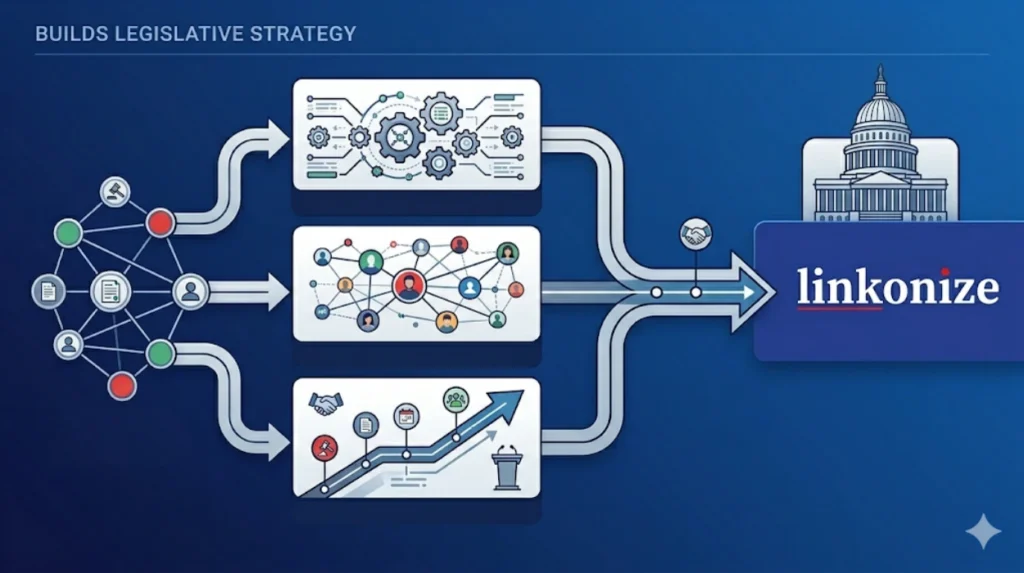
Legislative strategy development is a structured process that aligns stakeholder influence, policy timing, and narrative visibility within institutional ecosystems. Public affairs strategies differ based on how they integrate digital advocacy, regulatory monitoring, and stakeholder engagement into a unified influence model.
Digital advocacy methods are evaluated through their ability to shape policy discourse, influence stakeholder trust, and control narrative visibility across search and media environments. Legislative strategy frameworks operate by coordinating these variables into measurable reputation and policy outcomes.
How do legislative strategy frameworks compare to traditional public affairs approaches?
Legislative strategy frameworks operate as integrated influence systems, while traditional public affairs approaches function as communication-led engagement models. A legislative strategy is a structured process that maps policy cycles, stakeholder networks, and regulatory triggers into coordinated actions. Traditional public affairs focuses on relationship-building, media outreach, and institutional positioning without systemic integration of digital signals.
Legislative strategy operates by aligning policy intelligence with timing mechanisms, such as committee reviews or consultation windows, ensuring interventions occur at influence-sensitive moments. Traditional public affairs operates through ongoing engagement, including press releases, stakeholder meetings, and public consultations, without precise synchronisation to legislative inflection points.
Comparative analysis shows that legislative strategy frameworks produce higher narrative precision and policy alignment, while traditional approaches maintain broader but less targeted visibility. Legislative strategy strengthens entity credibility by embedding influence within institutional processes, whereas traditional methods rely on external perception signals such as media coverage.
In terms of search ranking influence, legislative strategy contributes to structured content ecosystems that reinforce authority through policy relevance and semantic consistency. Traditional approaches generate fragmented content signals, reducing long-term SERP stability. Stakeholder perception shifts accordingly, with legislative strategy enhancing trust through procedural alignment, while traditional methods rely on reputational familiarity.
What distinguishes digital advocacy from offline stakeholder engagement in legislative influence?
Digital advocacy operates as a visibility-driven influence mechanism, whereas offline stakeholder engagement functions as a relationship-based trust system. Digital advocacy is defined as the strategic use of online platforms to shape policy discourse, distribute narratives, and influence public sentiment at scale. Offline engagement is defined as direct interaction with policymakers, institutions, and stakeholders through meetings, consultations, and formal submissions.
Digital advocacy operates by producing content clusters, optimising search visibility, and amplifying narratives across platforms such as search engines and social media. Offline engagement operates through credibility signalling, including institutional participation, formal dialogue, and regulatory input.
The comparative strength of digital advocacy lies in scalability and narrative control. It enables rapid content amplification, influencing sentiment distribution and search engine interpretation of authority signals. However, its limitation is reduced depth of trust without institutional validation. Offline engagement, by contrast, builds durable stakeholder trust through direct interaction but lacks scalability and real-time narrative responsiveness.
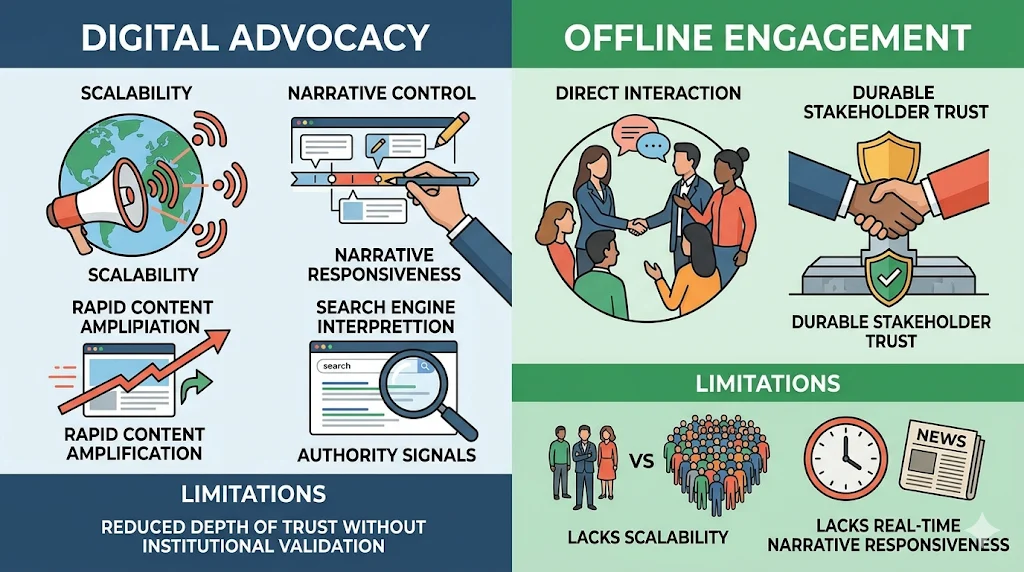
From a reputation systems perspective, digital advocacy influences content amplification and SERP composition, while offline engagement strengthens entity credibility within governance structures. Effective legislative strategies integrate both, ensuring that digital visibility aligns with institutional trust signals.
How do proactive and reactive communication models affect legislative outcomes?
Proactive communication models establish narrative positioning before policy developments, while reactive models respond to emerging issues or reputational risks. Proactive communication is defined as pre-emptive narrative construction aligned with anticipated policy changes. Reactive communication is defined as response-driven messaging triggered by external developments.
Proactive models operate by forecasting policy trajectories, identifying emerging regulatory themes, and producing content that shapes early-stage discourse. Reactive models operate by addressing media narratives, countering negative sentiment, and managing crisis-driven visibility spikes.
Comparative evaluation indicates that proactive communication enhances narrative visibility and search ranking influence by establishing authority before competing narratives emerge. Reactive communication stabilises sentiment distribution during reputational volatility but lacks long-term authority-building capacity.
In legislative strategy contexts, proactive approaches align with policy cycles, enabling influence during consultation and drafting phases. Reactive approaches engage during scrutiny or crisis stages, where influence is constrained by pre-existing narratives. This affects stakeholder trust, as proactive strategies signal preparedness and institutional awareness, while reactive strategies indicate responsiveness but limited foresight.
Search engines interpret proactive content as foundational authority, contributing to sustained visibility. Reactive content generates short-term traffic spikes but weaker long-term ranking stability. Therefore, legislative strategies prioritise proactive frameworks while maintaining reactive capabilities for risk mitigation.
How does short-term narrative management compare with long-term institutional credibility strategies?
Short-term narrative management focuses on immediate perception control, while long-term institutional credibility strategies build sustained authority within policy ecosystems. Narrative management is defined as the tactical adjustment of public discourse to influence sentiment distribution in the short term. Institutional credibility strategy is defined as the systematic development of trust signals over time through consistent, authoritative engagement.
Short-term narrative management operates by deploying targeted messaging, media interventions, and digital amplification to influence current discourse. Long-term strategies operate by producing high-quality content, maintaining policy alignment, and reinforcing expertise across multiple channels.
Comparative analysis shows that short-term strategies deliver rapid shifts in narrative visibility but introduce higher risk exposure due to inconsistency. Long-term strategies generate stable search ranking influence and reinforce entity credibility, reducing volatility in stakeholder perception.
From a digital systems perspective, search engines prioritise consistency, semantic depth, and authority signals. Long-term strategies align with these criteria, resulting in sustained SERP dominance. Short-term tactics, while effective in crisis scenarios, fail to establish durable authority due to fragmented content signals.

In legislative contexts, short-term narrative management supports immediate policy debates, while long-term strategies shape broader regulatory positioning. Effective frameworks integrate both, ensuring that immediate responses do not undermine long-term credibility.
What role does search engine interpretation play in legislative strategy effectiveness?
Search engine interpretation functions as a visibility filter that determines which narratives gain prominence in policy discourse. It evaluates content based on authority signals, semantic relevance, and user engagement patterns. Legislative strategy effectiveness depends on how well it aligns with these evaluation mechanisms.
Search engines operate by analysing entity relationships, topical authority, and content consistency. Legislative strategies that produce structured, policy-relevant content clusters strengthen search ranking influence and narrative visibility. This ensures that authoritative perspectives dominate SERP composition.
Comparatively, unstructured communication approaches generate inconsistent signals, reducing visibility and weakening authority. Legislative strategies integrate SEO principles with public affairs objectives, ensuring that content reflects policy expertise and aligns with search engine criteria.
This impacts stakeholder perception by reinforcing credibility through visibility. When authoritative content consistently appears in search results, it signals expertise and reliability. Conversely, fragmented visibility reduces trust and allows competing narratives to dominate.
Digital advocacy within legislative strategy therefore operates as both a communication tool and a search optimisation mechanism. It ensures that policy narratives are not only communicated but also discoverable and authoritative within digital ecosystems.
How are stakeholder trust and reputation signals measured across different strategies?
Stakeholder trust is measured through consistency, transparency, and engagement quality, while reputation signals are evaluated through visibility, sentiment distribution, and authority indicators. Different strategies produce distinct measurement patterns.
Legislative strategy frameworks measure trust through alignment with policy processes, participation in consultations, and consistency of messaging. Digital advocacy measures reputation signals through engagement metrics, search visibility, and sentiment analysis. Traditional public affairs evaluates trust through relationship depth and institutional recognition.
Comparative evaluation highlights that legislative strategies produce multidimensional trust signals, combining digital visibility with institutional engagement. Digital advocacy generates high visibility but requires validation through credible sources. Traditional approaches provide strong trust within closed networks but limited public visibility.
Measurement mechanisms include:
-
Analyse search visibility by tracking keyword rankings and SERP composition.
-
Evaluate sentiment distribution through media coverage and digital engagement metrics.
-
Measure stakeholder engagement via consultation participation and policy interactions.
-
Assess entity credibility through consistency of messaging and authoritative content presence.
These mechanisms reveal that integrated strategies provide the most comprehensive trust and reputation signals, balancing visibility with credibility.
How scalable and sustainable are different legislative strategy approaches?
Scalability refers to the ability to expand influence without proportional resource increase, while sustainability refers to the capacity to maintain effectiveness over time. Legislative strategies, digital advocacy, and traditional public affairs differ significantly in these dimensions.
Digital advocacy is highly scalable due to its reliance on content production and platform distribution. It operates by replicating content frameworks across topics and audiences, increasing reach without equivalent increases in cost. However, sustainability depends on maintaining content quality and authority signals.
Traditional public affairs is less scalable due to its reliance on human relationships and direct engagement. It requires continuous resource investment, limiting expansion. However, it provides high sustainability within established networks due to strong trust foundations.
Legislative strategy frameworks balance scalability and sustainability by integrating digital and institutional approaches. They scale through digital content systems while maintaining sustainability through policy alignment and stakeholder engagement.
Risk exposure varies accordingly. Digital advocacy faces risks related to misinformation and credibility gaps. Traditional approaches face risks of limited visibility. Legislative strategies mitigate these risks by combining visibility with trust, ensuring both reach and credibility.
Legislative strategy frameworks differ from traditional public affairs and digital advocacy approaches through their integration of timing, stakeholder alignment, and search visibility mechanisms. They operate as structured systems that coordinate policy engagement with narrative control, producing stronger authority signals and institutional credibility.
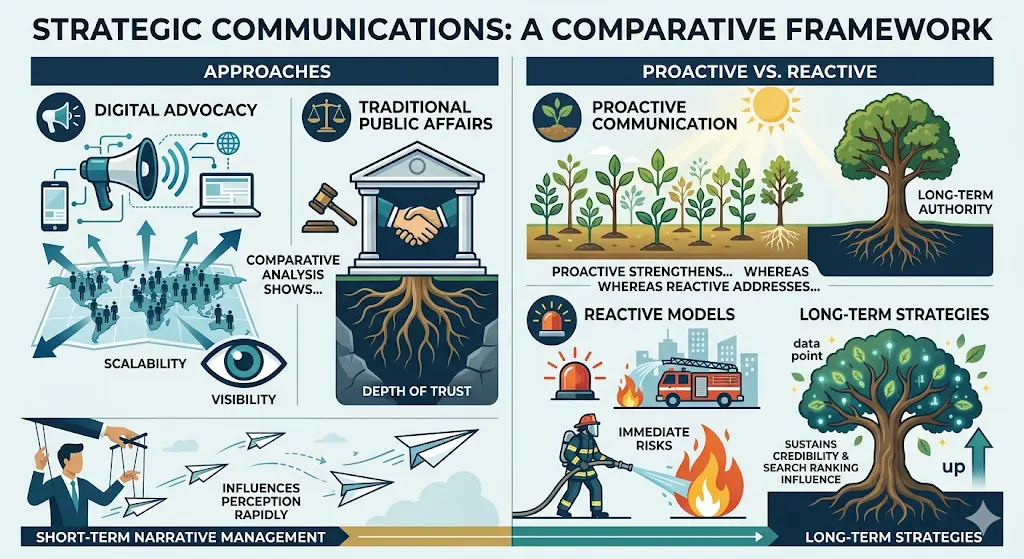
Comparative analysis shows that digital advocacy offers scalability and visibility, while traditional public affairs provides depth of trust. Proactive communication strengthens long-term authority, whereas reactive models address immediate risks. Short-term narrative management influences perception rapidly, but long-term strategies sustain credibility and search ranking influence.
Search engine interpretation plays a central role in determining narrative prominence, making content structure and semantic consistency critical to legislative strategy effectiveness. Measurement frameworks reveal that integrated approaches generate the most comprehensive reputation signals, balancing visibility with stakeholder trust.
Scalability and sustainability depend on the ability to combine digital amplification with institutional engagement. Legislative strategy frameworks achieve this balance, positioning them as structured, resilient systems within modern public affairs ecosystems.
Frequently Asked Questions
What is a legislative strategy in public affairs?
A legislative strategy is a structured approach to influencing policy outcomes by aligning stakeholder engagement, regulatory timing, and narrative visibility. It operates by mapping decision-making processes and coordinating digital advocacy with institutional interactions to strengthen policy positioning.
How does Linkonize build a legislative strategy?
Linkonize builds legislative strategy by integrating policy analysis, stakeholder mapping, and digital visibility frameworks into a unified process. This approach aligns search-driven content, consultation engagement, and timing of interventions to influence legislative outcomes effectively.
Why is digital advocacy important in legislative strategy?
Digital advocacy is important because it shapes narrative visibility and search engine interpretation of authority signals. It operates through content amplification and SERP optimisation, ensuring policy narratives are discoverable and influence stakeholder perception at scale.
What is the difference between legislative strategy and traditional public affairs?
Legislative strategy focuses on structured, timing-based influence within policy cycles, while traditional public affairs relies on ongoing communication and relationship management. The difference lies in precision, with legislative strategy aligning digital and institutional signals to improve credibility and visibility.
How do search engines affect legislative strategy outcomes?
Search engines affect legislative strategy by determining which policy narratives gain prominence based on authority, relevance, and content consistency. Strong search visibility reinforces entity credibility and stakeholder trust, influencing how decision-makers and the public interpret policy positions.