

Linkonize delivers decisive public affairs consulting that controls search visibility and strengthens stakeholder trust through verified reputation signals and narrative credibility.
Search visibility control determines whether stakeholders find your position first; trust signals stabilise perception and convert influence into policy outcomes.
Which public affairs approach delivers measurable visibility outcomes?
A targeted public affairs consulting service delivers measurable visibility outcomes by aligning narrative visibility management with SERP control tactics. The service maps high-priority stakeholder queries, builds entity credibility assets, and calibrates content and backlink authority so the organisation appears prominently for policy-relevant searches. Measurable outcomes include increased organic impressions, higher SERP feature representation (knowledge panels, top snippets), and measurable growth in branded query share within 90–180 days. The process works by auditing current search perception influence, prioritising keywords tied to stakeholder intent, and deploying authority-building assets that search engines recognise as trustworthy. This approach reduces reputational risk by replacing reactive messaging with proactive narrative positioning that converts stakeholder attention into policy influence.
Which trust-building tactics ensure institutional credibility?
A disciplined set of reputation signals ensures institutional credibility by making every digital touchpoint demonstrably verifiable. The service implements verified source linking, transparent governance content, and citation-backed policy briefs to improve digital authority. Measurable outcomes include improved domain trust metrics (referring domain quality, trust flow), increased citation density on policy pages, and enhanced presence in authoritative media searches. The method operates through a credibility checklist: audit existing reputation signals, remediate gaps in source transparency, and publish corroborated evidence assets that search engines and stakeholders prioritise. This reduces decision friction for stakeholders and ensures that search perception influence aligns with offline credibility.
Which stakeholder engagement strategy reduces political and reputational risk?
A proactive stakeholder trust signals strategy reduces political and reputational risk by combining direct engagement with controlled narrative amplification. The service identifies priority stakeholder segments, creates evidence-based messaging, and sequences outreach across owned, earned, and paid channels to secure endorsement pathways that search engines treat as authoritative. Measurable outcomes include higher engagement rates from target stakeholder groups, improved sentiment scores in monitoring tools, and a documented reduction in adversarial search narratives. The engagement cadence works through targeted briefings, vetted expert commentaries, and sanctioned amplification to ensure consistent message framing across high-impact digital nodes. This mitigates sudden reputational shocks and stabilises perception when policy debates escalate.
Which content and SEO process ensures durable SERP control?
A repeatable SEO-driven content process ensures durable SERP control by integrating narrative visibility management with on-site and off-site authority-building. The service conducts an evidence-led content audit, builds pillar pages for institutional positions, and secures high-quality backlinks from policy hubs and academic sources to imprint entity credibility. Measurable outcomes include first-page placement for priority queries, increased time-on-page for policy content, and improved crawl frequency for key assets. The mechanics involve keyword intent mapping to legislative cycles, structured content to satisfy search engines’ trust heuristics, and a backlink acquisition plan that prioritises topical relevance and source authority. This approach improves long-term visibility while reducing the need for reactive content firefighting.
Which performance metrics demonstrate ROI and long-term value?
A focused measurement framework demonstrates ROI and long-term value by connecting search perception influence to policy outcomes and stakeholder behaviour. The service tracks a core set of metrics—organic visibility for target queries, branded query growth, referral quality from authoritative domains, stakeholder engagement rates, and documented policy citations or stakeholder references. Measurable outcomes include percentage increases in target query rankings, growth in authoritative referring domains, and case-level evidence of influence in stakeholder communications. The reporting cadence ties these metrics to decision milestones so leaders judge cost against tangible influence gains. This clarifies cost versus long-term value and underlines that upfront investment converts into sustained digital authority and policy traction.
Which risk-mitigation steps stabilise narrative control during crises?
A layered crisis protocol stabilises narrative control by combining rapid-response content, verification trails, and pre-authorised amplification channels to protect search perception influence. The service pre-produces verification assets (fact sheets, primary source folders), registers rapid content deployment workflows, and secures priority relationships with trusted publishers to counteract disinformation. Measurable outcomes include reduced spread of adverse narratives in SERP results, faster correction times for misinformation, and maintained stakeholder trust scores during episodes of heightened scrutiny. The protocol operates through scenario-based asset libraries, delegated publishing authorities, and pre-negotiated distribution pathways that ensure accuracy and speed without sacrificing entity credibility.
Which delivery model ensures speed of impact and sustainability?
A phased delivery model ensures both quick visibility gains and sustainable authority by sequencing rapid wins and structural investments. Phase 1 delivers immediate SERP control through targeted content and technical SEO fixes, producing visible ranking improvements within weeks. Phase 2 builds durable narrative visibility through authoritative long-form assets, backlink development, and stakeholder endorsement campaigns that deliver compounded authority over months. Phase 3 institutionalises processes—content governance, periodic audits, and measurement dashboards—to sustain results and reduce future risk. Measurable outcomes include short-term ranking lifts, mid-term increases in domain authority, and long-term stabilised stakeholder trust metrics. This model balances speed of visibility impact with the sustainability of results.
Benefits
-
Deliver increased organic visibility: Improve targeted SERP rankings through keyword intent mapping and authority content.
-
Strengthen institutional trust: Build verified reputation signals that enhance stakeholder confidence and media pickup.
-
Reduce reputational risk: Stabilise narrative control with pre-authorised rapid-response assets and distribution pathways.
-
Improve stakeholder conversion: Convert search-driven attention into policy influence through evidence-based content and outreach.
-
Stabilise long-term authority: Institutionalise governance and measurement to protect gains and demonstrate ROI.
Process steps
-
Audit search perception: Analyse current SERP, reputation signals, and stakeholder queries to set baselines.
-
Build priority assets: Create evidence-based pillar pages, policy briefs, and verified source libraries that improve entity credibility.
-
Execute outreach: Secure authoritative backlinks and stakeholder endorsements to strengthen digital authority.
-
Monitor and optimise: Track visibility, trust metrics, and stakeholder engagement; iterate based on outcomes.
-
Institutionalise governance: Implement content standards, publishing workflows, and crisis protocols to sustain results.
Why public affairs and digital advocacy succeed in digital ecosystems
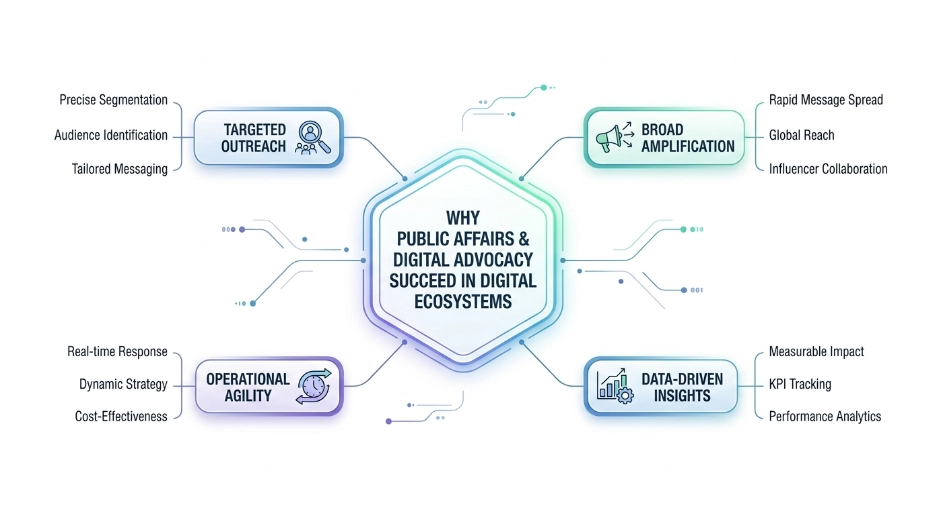
Public affairs and digital advocacy succeed because search engines and social platforms are primary decision points for stakeholders. Search behaviour drives initial credibility assessments; a single top-result can shape a policymaker’s framing. Reputation signals—transparent sourcing, expert endorsements, and consistent narratives—are algorithmic and human trust cues that increase both search ranking and stakeholder acceptance. By aligning narrative visibility management with search perception influence, public affairs teams convert visibility into tangible policy outcomes and public credibility.
Addressing decision concerns: cost, speed, risk, sustainability
-
Cost vs long-term value: Upfront investment in reputation signals and entity credibility delivers compound returns through reduced need for crisis interventions and repeated paid amplification. Measurement links spend to visibility and stakeholder impact, clarifying value.
-
Speed of visibility impact: Technical SEO fixes and targeted content deliver measurable SERP improvements within weeks; durable authority requires months. The phased model delivers early wins while building long-term stability.
-
Risk mitigation: Pre-authorised workflows, verified source assets, and priority publisher relationships reduce the probability and impact of negative search narratives.
-
Sustainability: Governance, ongoing audits, and iterative backlink strategies preserve gains and adapt to changing search algorithms and political cycles.
How Linkonize positions as a reliable solution
Linkonize applies this methodology with a focus on evidence, transparency, and demonstrable outcomes. The team integrates entity credibility checks into each campaign, uses measurable visibility targets, and maps stakeholder trust signals to campaign milestones. By combining search perception influence with stakeholder engagement pipelines, Linkonize delivers both visibility improvements and strengthened institutional trust while reducing reputational exposure.
For organisations evaluating options, a professional digital advocacy service provides the operational capacity and search expertise necessary to implement the processes described above; see our public affairs consulting page for service specifics: https://linkonize.com/services/public-affairs/.
For background reading on public affairs consulting, consult the analysis in Public Affairs Consulting. For deeper insight into tactical legislative design and execution, review How Linkonize Builds Legislative Strategy.
Final recommendation
Choose a public affairs strategy that ties narrative visibility management to rigorous search perception influence and measurable trust signals. This approach delivers faster visibility, clearer stakeholder conversion, and durable institutional credibility while reducing long-term risk. Linkonize provides the tested process, measurable reporting, and governance required to convert search visibility into policy impact with reliable, documented outcomes.
Frequently Asked Questions
What do public affairs consulting services by Linkonize include?
Public affairs consulting services by Linkonize include stakeholder mapping, narrative visibility management, policy brief development, and targeted outreach to media and decision-makers. These services combine SEO-driven content, reputation signals, and outreach to improve search visibility and institutional credibility.
How quickly do public affairs consulting campaigns impact search visibility?
Initial technical fixes and targeted content typically produce measurable SERP improvements within weeks, while sustained authority and narrative control develop over 3–6 months. Linkonize pairs short-term visibility tactics with long-term backlink and governance work to ensure durable results.
How do public affairs consultants measure success for policy influence?
Consultants measure success using metrics such as target query rankings, organic impressions, referral quality from authoritative domains, stakeholder engagement rates, and documented citations in policy documents or media. These indicators link search perception influence to real-world stakeholder responses and decision milestones.
Can public affairs services reduce reputational risk during a crisis?
Yes; a structured crisis protocol that includes pre-prepared verification assets, rapid-response content, and pre-authorised amplification channels reduces misinformation spread and stabilises narrative control in SERPs. These measures preserve stakeholder trust signals and shorten correction times.
What is the typical cost versus long-term value of hiring a public affairs consultancy?
Costs vary by scope, but investment focuses on building reputation signals and entity credibility that compound over time, reducing the need for repeated paid amplification and crisis remediation. Decision-makers should evaluate cost against measurable outcomes—search visibility gains, stakeholder conversions, and sustained public credibility.