

Community management in advocacy is the process of developing structured digital relationships that convert audience attention into coordinated participation. Effective mobilisation depends on trust systems, engagement frameworks, governance mechanisms, and sustained narrative alignment rather than audience size alone.
Public affairs strategies differ based on stakeholder expectations, communication environments, and institutional objectives. Digital advocacy methods are evaluated through participation rates, narrative visibility, stakeholder trust, sentiment distribution, and long-term community resilience.
What distinguishes community management from audience growth in digital advocacy?
Community management is a relationship-centred advocacy framework, whereas audience growth is a visibility-centred communication approach. Audience growth focuses on expanding reach through content distribution, search ranking influence, and platform exposure. Community management operates by creating structured interactions that strengthen stakeholder trust and reinforce participation behaviours over time.
In digital advocacy ecosystems, audience growth mechanisms prioritise impressions, follower acquisition, and content amplification. Community management mechanisms prioritise dialogue, member retention, behavioural consistency, and collective action readiness. These approaches generate different outcomes within advocacy campaigns.
From a reputation strategy perspective, audience growth increases narrative visibility but does not automatically produce mobilisation capacity. A large audience often contains passive observers with limited commitment to advocacy objectives. Community management evaluates stakeholder engagement through participation quality rather than exposure volume.
Institutional credibility is influenced differently by each approach. Audience growth generates awareness signals that improve discoverability. Community management generates reputation signals that strengthen entity credibility, stakeholder confidence, and long-term advocacy stability. Organisations seeking coordinated action require both visibility and engagement infrastructure, although community management provides the stronger foundation for mobilisation.
Which community engagement model produces the strongest mobilisation outcomes?
Structured engagement frameworks generate stronger mobilisation outcomes than open participation models because they establish predictable behavioural pathways. Open participation encourages broad discussion, while structured engagement guides members towards specific advocacy actions.
Open participation communities operate through unrestricted interaction and decentralised discussion. These environments support idea generation and stakeholder expression. However, mobilisation consistency declines when objectives become fragmented across competing narratives and stakeholder priorities.
Structured engagement communities operate by defining participation stages, governance expectations, and action pathways. Members understand how information flows through the community and how collective objectives are translated into advocacy activity. This structure increases coordination efficiency and reduces communication friction.
The comparison highlights a trade-off between flexibility and operational readiness. Open participation increases diversity of viewpoints but weakens mobilisation predictability. Structured engagement increases campaign execution capacity but requires stronger moderation systems and governance oversight. In digital advocacy, mobilisation effectiveness is measured through response speed, participation consistency, and stakeholder alignment rather than discussion volume.
How do participation tiers improve mobilisation readiness?
Participation tiers are engagement frameworks that classify stakeholders according to involvement level. These frameworks operate by creating progression paths from passive observation to active advocacy participation.
A tiered structure commonly evaluates participants through stages such as:
- Identify passive observers through engagement monitoring and interaction frequency.
- Develop contributors through discussion participation and content interaction.
- Activate advocates through campaign involvement and message distribution.
- Coordinate organisers through leadership responsibilities and community governance.
This model improves scalability because communication resources are allocated according to stakeholder commitment levels. It also strengthens stakeholder trust by establishing transparent expectations and responsibilities across the community.
How do organic and reactive communication frameworks compare in advocacy communities?
Organic communication frameworks build stakeholder relationships through consistent engagement, while reactive communication frameworks respond to emerging issues, criticism, or narrative threats. Each framework influences reputation signals and stakeholder perception differently.
Organic communication is a long-term trust-building mechanism. It operates by maintaining regular dialogue, publishing relevant information, and reinforcing institutional transparency. This approach strengthens stakeholder familiarity and increases credibility signals across digital platforms.
Reactive communication functions as a response mechanism during reputation challenges, policy debates, or public scrutiny events. It operates by addressing stakeholder concerns, correcting misinformation, and protecting narrative visibility during periods of heightened attention.
The effectiveness comparison reveals different strengths. Organic communication strengthens sustainability because stakeholder trust accumulates over time. Reactive communication improves responsiveness but often occurs under increased scrutiny and elevated reputational risk. Communities that depend exclusively on reactive communication experience inconsistent engagement patterns and unstable sentiment distribution.
Search engines and digital platforms interpret communication consistency as an authority indicator. Organic frameworks generate stable content ecosystems that reinforce search ranking influence and entity credibility. Reactive frameworks generate temporary visibility spikes but contribute less to long-term authority development.
Which mobilisation channels provide the highest level of stakeholder engagement?
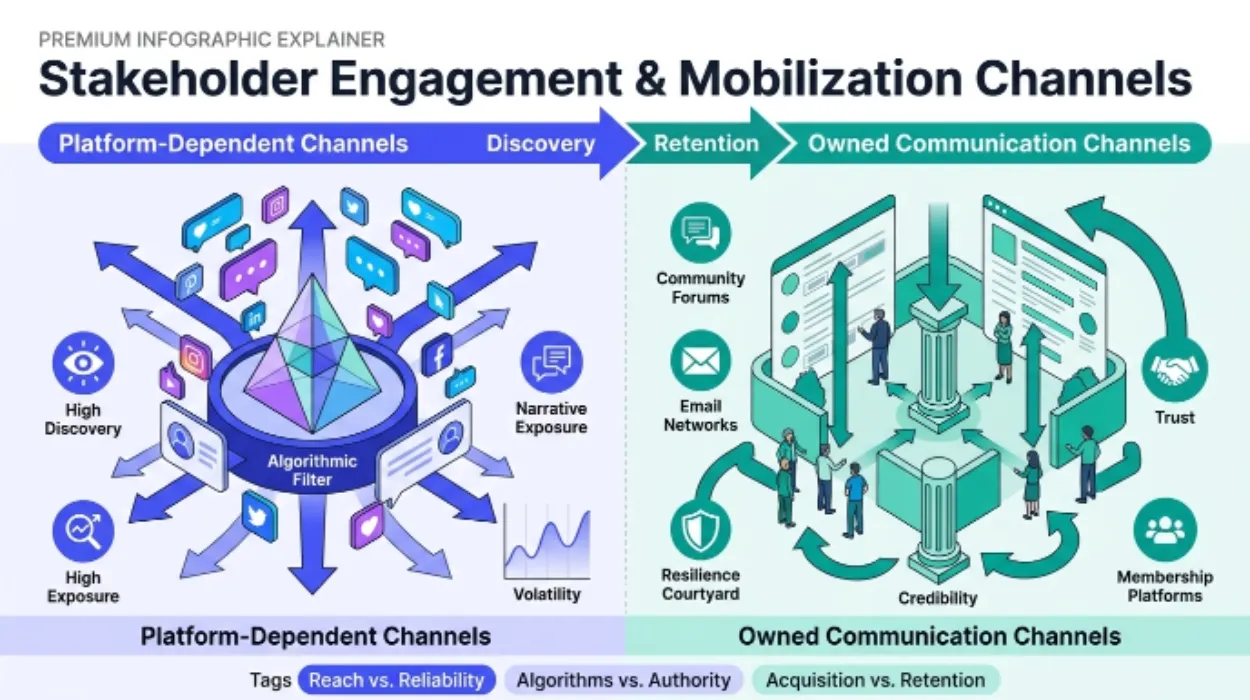
Owned communication channels generally provide stronger mobilisation control than platform-dependent channels. The distinction relates to governance authority, audience accessibility, and communication reliability.
Platform-dependent channels include social media networks where algorithmic systems influence content distribution. These channels provide extensive reach and rapid amplification opportunities. However, narrative visibility remains dependent on platform policies, ranking systems, and engagement algorithms.
Owned communication channels include community forums, email networks, membership platforms, and controlled advocacy environments. These channels operate through direct stakeholder access rather than third-party distribution systems. Communication reliability remains higher because message delivery is not constrained by algorithmic visibility filters.
The comparison demonstrates contrasting strengths. Platform-dependent channels increase discovery and audience acquisition. Owned channels increase retention, trust development, and mobilisation predictability. Advocacy communities seeking long-term resilience benefit from combining visibility-focused channels with controlled engagement environments.
From a reputation strategy perspective, owned channels strengthen institutional credibility because communication occurs within environments governed by transparent participation rules. Platform-dependent channels strengthen narrative exposure but introduce greater volatility into engagement outcomes.
How does content amplification compare with relationship-building strategies?
Content amplification focuses on increasing message reach, while relationship-building focuses on strengthening stakeholder commitment. These approaches operate through different mechanisms and produce distinct advocacy outcomes.
Content amplification strategies often overlap with broader discussions around influencer marketing for advocacy, particularly when organisations evaluate whether authority-driven experts or high-reach personalities generate stronger trust signals and stakeholder engagement outcomes.
Relationship-building is a trust-development strategy. It operates through dialogue, responsiveness, community recognition, and stakeholder involvement. This process strengthens emotional investment in advocacy objectives and increases long-term participation rates.
The evaluation reveals that amplification improves awareness efficiency while relationship-building improves mobilisation efficiency. Awareness without trust generates limited advocacy participation. Trust without visibility limits audience expansion. Effective community management analyses both dimensions rather than prioritising one metric.
Search systems interpret amplification through engagement signals, citation patterns, and content distribution metrics. Stakeholders evaluate relationship-building through transparency, consistency, and credibility indicators. The combination influences both search ranking influence and stakeholder trust simultaneously.
What are the limitations of rapid mobilisation strategies compared with long-term credibility frameworks?
Rapid mobilisation strategies prioritise immediate action, whereas long-term credibility frameworks prioritise institutional trust accumulation. These approaches differ significantly in sustainability and risk exposure.
Rapid mobilisation operates by creating urgency around specific campaigns, events, or policy objectives. The framework encourages concentrated participation within a defined timeframe. Engagement intensity increases quickly, allowing organisations to generate immediate advocacy momentum.
Long-term credibility frameworks operate through continuous trust development, governance transparency, and stakeholder relationship maintenance. The objective is not immediate participation volume but sustained confidence in the institution and its objectives.
The comparative analysis identifies a key limitation. Rapid mobilisation often depends on temporary attention cycles. Participation levels frequently decline after campaign completion. Long-term credibility frameworks generate slower engagement growth but produce more durable stakeholder relationships and stronger community resilience.
Reputation signals are also affected differently. Rapid mobilisation creates temporary content amplification and short-term narrative dominance. Long-term credibility strengthens entity credibility, sentiment stability, and stakeholder trust across extended periods. Public affairs environments characterised by policy complexity and stakeholder scrutiny benefit from credibility-centred approaches because trust remains a persistent influence on participation behaviour.
How do digital platforms evaluate authority within advocacy communities?
Digital platforms evaluate authority through credibility indicators, engagement consistency, and content relevance rather than declared expertise. Authority emerges from measurable trust signals distributed across interconnected digital assets.
Search engines assess authority through entity recognition, citation relationships, content depth, and user engagement patterns. Advocacy communities that consistently produce credible information strengthen their visibility within search ecosystems. This process increases narrative discoverability and improves search ranking influence.
Social platforms evaluate authority through interaction quality, audience retention, engagement frequency, and content relevance. Communities with stable participation patterns generate stronger authority indicators than communities dependent on episodic activity spikes.
Stakeholders evaluate authority differently. Trust is influenced by transparency, accountability, responsiveness, and consistency. Communities that demonstrate governance integrity generate stronger stakeholder confidence than communities focused exclusively on visibility metrics.
The comparison between algorithmic authority and stakeholder authority reveals significant overlap. Both systems reward consistency, credibility, and meaningful engagement. Communities that optimise solely for platform metrics often experience weaker trust outcomes. Communities that prioritise credibility development generate stronger authority signals across both technological and human evaluation systems.
What evaluation criteria determine community management effectiveness in advocacy?
Evaluation frameworks are also examined during procurement and advisory reviews, making a digital advocacy consulting FAQ a useful reference point when assessing governance structures, mobilisation methodologies, measurement systems, and stakeholder engagement models.
A comprehensive assessment framework includes:
- Measure participation consistency across advocacy initiatives.
- Evaluate stakeholder trust through engagement quality and retention patterns.
- Analyse sentiment distribution to identify perception stability.
- Assess governance effectiveness through moderation and conflict resolution outcomes.
- Compare mobilisation speed against community size and engagement levels.
- Examine narrative visibility across search engines and digital platforms.
These indicators provide a more accurate representation of advocacy capacity than reach metrics alone. Mobilisation success depends on coordinated participation, stakeholder confidence, and sustained community engagement.
The strongest evaluation frameworks combine quantitative and qualitative measurements. Participation data reveals behavioural patterns, while sentiment analysis and trust indicators reveal reputational strength. Together, these metrics explain whether a community functions as an active mobilisation network or merely as an information distribution channel.
Conclusion
Community management in advocacy is fundamentally different from audience acquisition because mobilisation capacity depends on stakeholder trust, governance systems, and participation structures rather than visibility alone. The comparison between structured and open engagement models demonstrates a trade-off between flexibility and operational coordination.
Organic communication frameworks provide stronger long-term credibility than reactive communication systems, while owned channels offer greater mobilisation reliability than platform-dependent environments. Content amplification improves narrative visibility, whereas relationship-building strengthens stakeholder commitment and institutional trust.
The evaluation of advocacy communities increasingly focuses on reputation signals, entity credibility, sentiment distribution, search ranking influence, and stakeholder engagement quality. Sustainable mobilisation emerges from the combination of visibility, trust development, governance integrity, and long-term credibility frameworks rather than isolated communication tactics.
Frequently Asked Questions
What is community management in digital advocacy?
Community management in digital advocacy is the process of building, organising, and maintaining relationships with stakeholders across digital platforms. It focuses on engagement, trust development, participation, and mobilisation readiness rather than audience size alone.
How does community management support advocacy mobilisation?
Community management supports mobilisation by creating structured communication channels, participation frameworks, and trust systems. These mechanisms enable advocacy groups to coordinate actions, distribute information efficiently, and maintain stakeholder engagement over time.
What is the difference between audience growth and community building?
Audience growth focuses on increasing visibility and reach through content distribution and platform exposure. Community building focuses on strengthening stakeholder relationships, increasing participation quality, and developing long-term trust that supports collective action.
Which digital channels are most effective for advocacy communities?
Owned digital channels such as community forums, membership platforms, and email networks provide greater control and mobilisation reliability. Social media platforms support audience discovery and content amplification but remain dependent on algorithmic distribution systems.
How can advocacy organisations measure community management effectiveness?
Effectiveness is measured through participation rates, stakeholder retention, sentiment distribution, trust indicators, mobilisation responsiveness, and narrative visibility. These metrics provide a clearer assessment of advocacy capacity than reach or follower counts alone.