

A click-to-call campaign is a digital advocacy mechanism that connects constituents directly with elected representatives through a phone call initiated from a digital interface. It transforms stakeholder engagement into measurable legislative communication by reducing friction between public opinion and policymaker contact.
Public affairs refers to the management and analysis of relationships between institutions, policymakers, stakeholders, and the public within governance ecosystems. Digital advocacy is the use of digital technologies to influence public discourse, stakeholder engagement, and policy-related communication through online channels.
What Is a Click-to-Call Campaign Within Digital Advocacy?
A click-to-call campaign is a digital advocacy framework that enables individuals to contact policymakers through a single digital interaction. It refers to a structured communication system designed to facilitate direct constituent engagement while generating measurable advocacy data.
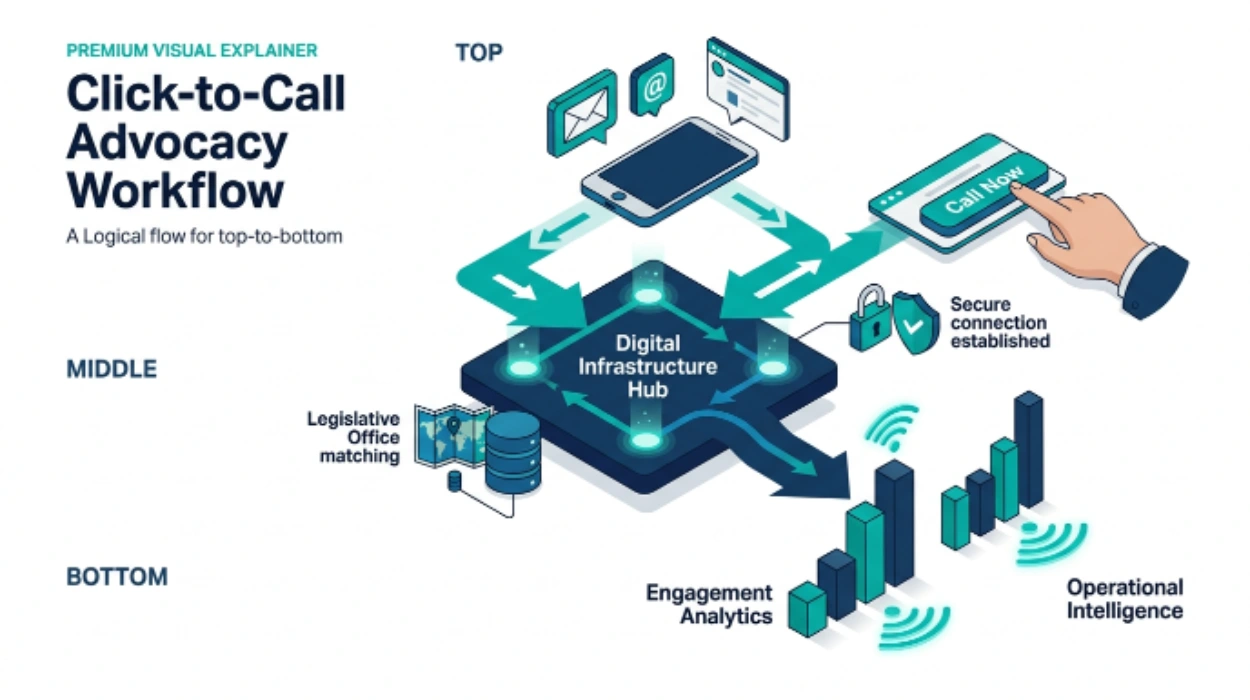
The mechanism operates by integrating web-based interfaces with telecommunication systems. Users submit basic information through a digital platform, and the system connects them directly to a designated legislative office. This process removes communication barriers and standardises participation across stakeholder groups. The resulting interactions become identifiable engagement signals within advocacy programmes. The system creates a documented pathway between public opinion and institutional decision-making.
From a perception perspective, click-to-call campaigns increase the visibility of stakeholder concerns within legislative environments. Direct communication creates stronger recognition of public sentiment than passive content consumption. The volume, frequency, and consistency of constituent calls contribute to institutional awareness of specific policy narratives. This visibility influences how policymakers evaluate issue significance within public affairs ecosystems.
Why Are Click-to-Call Campaigns Considered Powerful Legislative Advocacy Tools?
Click-to-call campaigns are considered powerful because they convert digital attention into direct legislative engagement. They create a measurable bridge between online advocacy and policymaker interaction.
Traditional digital engagement often remains confined to content consumption, content sharing, or social discussion. Click-to-call systems introduce an action-oriented mechanism that moves participants from awareness to direct communication. This shift increases the operational value of advocacy initiatives because legislative offices receive tangible stakeholder input rather than indirect visibility signals. The campaign structure therefore demonstrates issue salience through direct participation metrics.
Institutional perception is strongly influenced by communication volume and consistency. Legislative offices evaluate patterns of stakeholder engagement when assessing public interest around policy topics. A coordinated increase in constituent communication elevates issue visibility within decision-making environments. The resulting narrative influence extends beyond individual interactions and contributes to broader policy awareness.
How Do Click-to-Call Campaigns Function Across Digital Ecosystems?
Click-to-call campaigns function through interconnected digital systems that coordinate communication, data collection, and stakeholder engagement. They transform online participation into structured legislative contact.
How Does the Communication Process Work?
The communication process begins when a participant accesses a digital advocacy asset such as a webpage, email, or social content environment. The participant initiates contact through a dedicated call mechanism. The system identifies the appropriate legislative office and establishes the connection. Communication data is recorded to evaluate engagement outcomes and participation trends. This creates a measurable advocacy infrastructure that links digital visibility with legislative communication.
How Does Data Strengthen Advocacy Visibility?
Data collection defines the operational intelligence of click-to-call campaigns. Every completed interaction generates engagement signals that explain participation levels and stakeholder responsiveness. These signals contribute to campaign evaluation and narrative analysis. Organisations use aggregated communication data to understand issue resonance across stakeholder groups. The resulting insights strengthen public affairs assessment and improve understanding of digital engagement patterns.
How Do Click-to-Call Campaigns Influence Public Perception Systems?
Click-to-call campaigns influence public perception systems by increasing stakeholder participation in policy-related discourse. They transform passive observers into active participants within public affairs environments.
Public perception is shaped by visible engagement, narrative repetition, and institutional response. When advocacy campaigns generate substantial communication activity, they create indicators of public concern. These indicators influence how policymakers, media entities, and stakeholders interpret issue relevance. The campaign therefore contributes to narrative influence through measurable participation rather than symbolic visibility alone.
Digital ecosystems prioritise signals that demonstrate engagement intensity. Advocacy participation generates behavioural indicators that define issue momentum. As engagement increases, institutional actors gain stronger evidence of stakeholder attention. This process contributes to broader perception formation around legislative topics and policy debates.
How Does Digital Advocacy Create Trust and Credibility Signals?
Digital advocacy creates trust and credibility signals through transparency, consistency, and verifiable stakeholder participation. These elements contribute to institutional legitimacy within online environments.
Trust signals emerge when engagement activities demonstrate authentic stakeholder involvement. Click-to-call campaigns produce measurable interactions that validate participation claims. Unlike passive metrics, direct communication reflects deliberate engagement behaviour. This distinction strengthens credibility because participation can be evaluated through observable outcomes. The resulting engagement data contributes to stakeholder trust assessments.
Institutional credibility is closely connected to communication transparency. Digital advocacy ecosystems that clearly document participation levels create stronger confidence in engagement processes. Visibility into advocacy activity enables stakeholders to evaluate campaign legitimacy. This transparency strengthens trust architecture across public affairs environments and improves perception stability.
What Role Do Search Engines Play in Digital Advocacy Visibility?
Search engines play a critical role in organising, interpreting, and ranking information related to public affairs and digital advocacy. They influence how policy narratives are discovered and evaluated.
Search visibility refers to the prominence of information within search engine results pages. Advocacy-related content competes within search ecosystems based on relevance, authority, trustworthiness, and contextual relationships. Search engines analyse content indexing patterns, entity associations, and reputation signals when evaluating information quality. These assessments influence content ranking dynamics across policy-related topics.
Digital advocacy campaigns contribute to broader content ecosystems through the creation of engagement-focused resources. As content becomes indexed and connected to recognised entities, search engines develop stronger contextual understanding of advocacy topics. This process influences SERP evaluation and affects the discoverability of policy narratives.
How Are Authority and Reputation Signals Interpreted Online?
Authority and reputation signals are evaluated through interconnected digital indicators that define credibility within search and information ecosystems. These signals influence both visibility and perception.
Digital authority refers to the recognised credibility of an entity within a defined topic area. Search engines analyse content quality, topical relevance, entity consistency, citation patterns, and engagement indicators when evaluating authority. These factors contribute to the development of reputation signals across digital environments. Strong authority signals improve content discoverability and strengthen stakeholder confidence.
Entity perception refers to how institutions, organisations, or public figures are interpreted across digital ecosystems. Reputation formation occurs through repeated information exposure, content relationships, media references, and stakeholder discussions. Search systems evaluate these signals collectively rather than independently. The resulting interpretation influences both visibility and perceived credibility.
How Do Media Narratives Affect Legislative Advocacy Outcomes?
Media narratives affect legislative advocacy outcomes by shaping issue interpretation and public understanding. They influence how stakeholders perceive policy relevance and institutional response.
Narrative influence refers to the ability of information frameworks to shape interpretation within public discourse. Media ecosystems amplify specific themes, arguments, and perspectives through repeated exposure. This repetition increases issue familiarity and contributes to perception formation. Stakeholders use these narratives to evaluate policy significance and institutional performance.
Digital media environments accelerate narrative distribution through interconnected content channels. Search engines, social platforms, and news publishers collectively influence information visibility. As narratives gain prominence, they affect stakeholder expectations and institutional perception. This relationship demonstrates the connection between communication visibility and public affairs outcomes.
How Does Stakeholder Engagement Strengthen Institutional Reputation?
Stakeholder engagement strengthens institutional reputation by demonstrating responsiveness, participation, and communication accessibility. These attributes contribute to long-term credibility development.
Institutional reputation refers to the collective perception of an entity across stakeholder groups. Reputation formation depends on consistent communication signals, transparent engagement practices, and visible responsiveness. Click-to-call campaigns contribute to this process by facilitating direct interaction between stakeholders and decision-makers. The resulting communication activity increases institutional visibility within public affairs ecosystems.
Engagement mechanisms generate observable evidence of stakeholder participation. These interactions influence how institutions are perceived across digital environments. Consistent engagement contributes to stronger trust architecture and supports reputation stability. The process therefore connects communication accessibility with broader institutional credibility.
How Do Content Ecosystems Shape Advocacy Effectiveness?
Content ecosystems shape advocacy effectiveness by organising information, defining visibility pathways, and influencing stakeholder interpretation. They determine how advocacy narratives are discovered and evaluated.
Content indexing enables search engines to understand relationships between topics, entities, and public affairs concepts. As content accumulates, search systems develop contextual associations that influence ranking decisions. These relationships affect search visibility and contribute to perception formation. Effective advocacy ecosystems therefore depend on structured information architecture and semantic relevance.
Stakeholder trust is influenced by information consistency across digital environments. Content ecosystems that maintain coherent narratives create stronger credibility signals. Search engines interpret consistency as an indicator of reliability and authority. This process demonstrates how content structures contribute to reputation development and advocacy visibility.
How Does Digital Advocacy Compare With Traditional Advocacy?
Digital advocacy differs from traditional advocacy through its use of technology-driven engagement mechanisms, data collection capabilities, and scalable communication systems. Traditional advocacy relies primarily on physical interactions, meetings, and offline communication channels.
Digital ecosystems generate measurable engagement data that enables detailed analysis of stakeholder participation. Traditional advocacy emphasises direct interpersonal relationships and physical presence within policy environments. Both approaches influence public perception, institutional visibility, and stakeholder trust. However, digital advocacy introduces search visibility, content indexing, and online reputation dynamics as central components of influence assessment.
Understanding the distinctions between these approaches provides deeper insight into modern public affairs systems. The relationship between technology, communication, and stakeholder engagement defines contemporary advocacy environments and shapes institutional perception across digital ecosystems.
Within broader public affairs analysis, Digital Advocacy vs. Traditional Advocacy: A Side-by-Side Comparison for Decision-Makers provides additional context for evaluating the structural differences between these advocacy models.
Conclusion
A click-to-call campaign is a digital advocacy mechanism that converts online engagement into direct legislative communication. Its significance extends beyond communication efficiency and into broader systems of public perception, stakeholder participation, and institutional visibility.
Digital advocacy operates within interconnected ecosystems that include search engines, media platforms, content networks, and public affairs environments. These systems evaluate authority, trust, credibility, and reputation through measurable signals and structured information relationships. Click-to-call campaigns contribute to these dynamics by creating direct engagement pathways that strengthen narrative visibility and stakeholder participation.
Understanding click-to-call campaigns therefore requires an understanding of digital perception systems, content ecosystems, search visibility, and institutional reputation. Together, these elements explain how modern advocacy narratives are communicated, interpreted, and evaluated across digital environments.
Frequently Asked Questions
What is a click-to-call campaign?
A click-to-call campaign is a digital advocacy tool that allows individuals to contact elected representatives directly through a phone call initiated from a digital platform. It simplifies stakeholder participation and creates measurable legislative engagement.
Why are click-to-call campaigns effective in digital advocacy?
Click-to-call campaigns are effective because they convert online interest into direct communication with policymakers. This creates stronger engagement signals and increases the visibility of stakeholder concerns within legislative environments.
How do click-to-call campaigns influence public perception?
Click-to-call campaigns influence public perception by demonstrating active stakeholder participation around a specific issue. High levels of engagement increase narrative visibility and contribute to broader awareness within public affairs ecosystems.
What is the difference between digital advocacy and traditional advocacy?
Digital advocacy uses online platforms, content ecosystems, and communication technologies to engage stakeholders and influence public discourse. Traditional advocacy relies on offline methods such as meetings, events, and direct interpersonal communication.
How do search engines relate to digital advocacy campaigns?
Search engines organise and evaluate advocacy-related content through content indexing, authority assessment, and SERP evaluation. Strong digital advocacy ecosystems contribute to search visibility, reputation signals, and institutional credibility across online environments.