

Digital advocacy and traditional advocacy differ in communication channels, stakeholder engagement mechanisms, measurement frameworks, and visibility outcomes. Decision-makers evaluate both approaches based on influence capacity, narrative reach, stakeholder trust, scalability, and long-term reputation impact.
Public affairs strategies differ based on how institutions communicate with stakeholders, policymakers, media organisations, and public audiences. Digital advocacy methods are evaluated through visibility metrics, reputation signals, stakeholder interaction patterns, search ranking influence, and institutional credibility indicators across digital ecosystems.
How Do Digital Advocacy and Traditional Advocacy Differ in Their Core Operating Models?
Digital advocacy is a stakeholder influence framework that operates through digital platforms, search ecosystems, online publications, social networks, and content distribution channels. Traditional advocacy is a relationship-driven framework that operates through direct engagement with policymakers, institutional stakeholders, industry bodies, media representatives, and public sector organisations. Both approaches aim to shape stakeholder perception and influence policy-related outcomes, but their mechanisms differ significantly.
Digital advocacy operates by publishing, amplifying, and distributing content that influences public discourse and online visibility. Organisations often evaluate these mechanisms alongside broader stakeholder engagement frameworks and public affairs communication models.
From a visibility perspective, digital advocacy creates searchable assets that remain discoverable over time. Traditional advocacy creates influence through direct interaction but often leaves limited public evidence of engagement outcomes. This distinction affects narrative persistence, stakeholder awareness, and the distribution of reputation signals across digital and institutional environments.
Which Approach Provides Greater Visibility Across Stakeholder Audiences?
Digital advocacy provides broader visibility because digital content remains accessible through search engines, social platforms, online publications, and institutional websites. Traditional advocacy provides targeted visibility because engagement occurs directly with identified stakeholders and decision-makers. Visibility therefore depends on audience scope rather than communication volume.
Digital advocacy operates by creating content assets that influence search engine results pages (SERPs), social media discussions, and digital publication ecosystems. Every published asset contributes to narrative visibility and entity credibility when search engines identify relevance, authority, and trust signals. Stakeholders encounter these assets during information discovery processes, increasing institutional presence across multiple touchpoints.
Traditional advocacy operates through meetings, consultations, policy briefings, parliamentary engagement, and stakeholder forums. These interactions generate direct influence opportunities but produce limited search ranking influence. Stakeholders outside the engagement network often remain unaware of advocacy activity unless media coverage or public reporting occurs.
The comparison demonstrates that digital advocacy expands audience exposure while traditional advocacy concentrates influence among selected stakeholders. Visibility objectives therefore determine which model aligns with communication priorities.
How Do Both Approaches Influence Stakeholder Trust and Institutional Credibility?
Institutional credibility emerges through consistent communication, transparent information, and authoritative engagement regardless of channel selection. Digital advocacy and traditional advocacy generate stakeholder trust through different trust-building mechanisms.
Digital advocacy establishes trust through content consistency, expert commentary, transparent evidence presentation, and sustained narrative visibility. Search engines interpret authority signals through content relevance, citation patterns, publication quality, and user engagement indicators. Stakeholders evaluate institutional credibility based on the accessibility, accuracy, and consistency of digital information across multiple channels.
Traditional advocacy establishes trust through direct relationship development, stakeholder consultations, policy engagement, and interpersonal communication. Decision-makers evaluate credibility through expertise demonstration, policy understanding, responsiveness, and long-term institutional behaviour. Trust emerges from repeated interactions and demonstrated competence within governance environments.
A comparative evaluation shows that digital advocacy strengthens public-facing trust indicators while traditional advocacy strengthens relationship-based trust indicators. Institutions seeking comprehensive credibility often analyse how both systems contribute to stakeholder trust across different audiences.
Which Strategy Offers Stronger Narrative Control and Reputation Management?
Narrative control depends on the ability to influence information visibility, sentiment distribution, and stakeholder interpretation. Digital advocacy and traditional advocacy approach reputation management through different mechanisms.
Digital advocacy operates by amplifying favourable narratives and increasing the visibility of authoritative content assets. Search ranking influence affects which information stakeholders encounter first during online research. Content amplification improves narrative visibility, while content suppression strategies reduce the prominence of outdated or less relevant information through the publication of higher-authority assets.
Traditional advocacy operates through direct stakeholder engagement designed to clarify positions, explain policy perspectives, and address concerns. Reputation management occurs through controlled communication environments where institutions engage directly with decision-makers and influential stakeholders. This process reduces message distortion during high-value interactions.
Digital advocacy offers greater influence over public narrative visibility because information remains searchable and shareable. Traditional advocacy offers greater influence over stakeholder interpretation during direct engagements. The distinction highlights how reputation management outcomes vary according to communication environment and audience behaviour.
How Do Search Engines and Digital Platforms Evaluate Advocacy Authority?
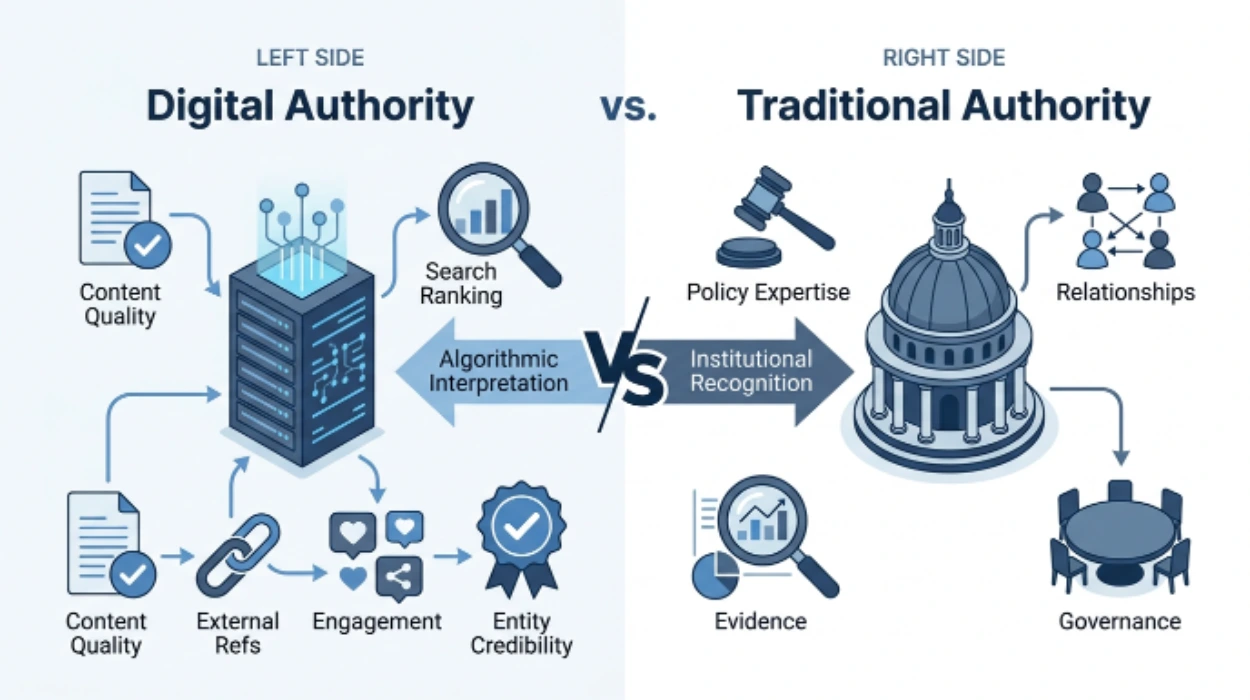
Digital platforms evaluate authority through measurable trust signals that determine visibility and discoverability. Traditional advocacy authority derives from institutional relationships, policy expertise, and stakeholder recognition.
Search engines assess authority by analysing content quality, relevance, topical depth, external references, user engagement patterns, and publisher credibility. Entity credibility develops when institutions demonstrate expertise across interconnected content topics and maintain consistency across digital assets. These authority indicators influence search ranking performance and narrative visibility.
Digital platforms also analyse behavioural signals including engagement rates, sharing activity, content freshness, and audience interaction patterns. These metrics contribute to visibility decisions that determine information exposure among stakeholders. Authority therefore becomes partially algorithmic and partially audience-driven.
Traditional advocacy authority operates through human evaluation processes. Policymakers, regulators, trade associations, and institutional stakeholders assess expertise through engagement quality, evidence presentation, policy understanding, and long-term participation in governance discussions. Authority remains relationship-centred rather than platform-centred.
The comparison demonstrates that digital authority relies on discoverability and algorithmic interpretation, while traditional authority relies on institutional recognition and stakeholder validation.
Which Advocacy Model Delivers Better Scalability and Resource Efficiency?
Scalability measures the ability to expand stakeholder reach without proportional increases in resource expenditure. Resource efficiency evaluates communication outputs relative to investment requirements.
Digital advocacy scales through content distribution systems that enable repeated stakeholder exposure without continuous direct engagement. A single publication can influence search visibility, social distribution, stakeholder research activity, and media discovery processes simultaneously. Digital infrastructure therefore supports ongoing visibility after initial publication.
Traditional advocacy requires continuous stakeholder engagement activities including meetings, consultations, policy discussions, and event participation. Resource requirements increase as stakeholder networks expand. Influence remains dependent on ongoing interaction rather than content persistence.
Decision-makers evaluating scalability often analyse:
- Measure audience reach through search visibility and content distribution metrics.
- Compare stakeholder engagement costs across digital and direct communication channels.
- Evaluate resource allocation against visibility outcomes and influence objectives.
- Analyse content longevity relative to event-based engagement activity.
Digital advocacy demonstrates greater operational scalability because communication assets remain active within digital ecosystems. Traditional advocacy demonstrates greater precision because engagement focuses on identified stakeholders and decision-making communities.
How Do Risk Exposure and Message Governance Compare?
Risk exposure refers to the likelihood of reputational disruption, narrative distortion, or stakeholder misunderstanding. Message governance refers to the ability to maintain communication consistency across channels and audiences.
Digital advocacy operates within highly visible environments where content remains publicly accessible. Search engines archive information, social platforms facilitate rapid distribution, and third-party commentary influences sentiment distribution. Governance challenges emerge when messages spread beyond intended audiences or when competing narratives gain visibility.
Traditional advocacy operates within controlled communication environments where stakeholder interactions occur directly. Governance structures often maintain greater message consistency because communication channels remain narrower and more predictable. However, influence remains vulnerable to limited transparency and reduced public visibility.
Digital advocacy creates higher exposure to public scrutiny but provides stronger opportunities for narrative monitoring through analytics and visibility measurement. Traditional advocacy reduces public exposure but limits real-time visibility into stakeholder perception trends. Effective governance therefore depends on communication objectives, stakeholder expectations, and institutional risk tolerance.
Which Approach Supports Long-Term Institutional Credibility More Effectively?
Long-term institutional credibility depends on sustained trust generation, reputation signal consistency, and ongoing stakeholder engagement. Both advocacy approaches contribute to credibility development through different mechanisms.
Digital advocacy strengthens long-term credibility by creating a persistent body of authoritative content. Search engines continue indexing and evaluating institutional assets over extended periods. Consistent publication patterns reinforce entity credibility and support positive narrative visibility across stakeholder research journeys.
Traditional advocacy strengthens long-term credibility through enduring stakeholder relationships. Policymakers, regulators, industry representatives, and institutional partners evaluate organisations based on repeated engagement quality and demonstrated expertise. Credibility accumulates through experience rather than discoverability.
A comparative assessment shows that digital advocacy excels in maintaining visible authority signals, while traditional advocacy excels in maintaining relationship-based trust signals. Long-term institutional credibility emerges when visibility, trust, expertise, and stakeholder engagement reinforce one another across both digital and governance environments.
How Should Decision-Makers Evaluate Advocacy Strategy Selection?
Advocacy strategy selection is an evaluation process based on stakeholder objectives, visibility requirements, governance considerations, and reputation outcomes. Digital advocacy and traditional advocacy address different dimensions of influence and credibility.
Digital advocacy performs strongly when organisations prioritise narrative visibility, search ranking influence, scalable communication, and measurable stakeholder engagement. Traditional advocacy performs strongly when organisations prioritise direct stakeholder access, policy influence, institutional relationship development, and controlled communication environments.
Organisations comparing implementation models often examine operational requirements, campaign governance structures, measurement frameworks, and execution capabilities. Further evaluation can be informed by reviewing Why Policy Teams Choose Linkonize to Run Their Digital Advocacy Campaigns.
Conclusion
Digital advocacy and traditional advocacy represent distinct approaches to stakeholder influence, institutional visibility, and reputation management. Digital advocacy operates through searchable content ecosystems that shape narrative visibility, search ranking influence, and public-facing reputation signals. Traditional advocacy operates through direct stakeholder engagement that strengthens institutional relationships, policy influence, and governance-based credibility.
The comparison demonstrates that visibility, trust generation, authority development, scalability, and risk exposure differ across both models. Digital advocacy provides stronger discoverability and content persistence, while traditional advocacy provides stronger relationship-centred engagement and direct influence opportunities.
Strategic evaluation therefore focuses on communication objectives, stakeholder expectations, governance requirements, and institutional credibility priorities. Decision-makers analyse how each framework influences stakeholder trust, sentiment distribution, narrative visibility, and long-term reputation outcomes within evolving public affairs environments.
Frequently Asked Questions
What is the main difference between digital advocacy and traditional advocacy?
Digital advocacy uses online platforms, search engines, digital publications, and social media channels to influence stakeholder perception and increase narrative visibility. Traditional advocacy relies on direct engagement with policymakers, institutional stakeholders, media representatives, and industry bodies. The primary difference lies in communication channels and visibility mechanisms.
Is digital advocacy more measurable than traditional advocacy?
Digital advocacy provides measurable performance indicators such as search visibility, engagement metrics, sentiment distribution, content reach, and search ranking influence. Traditional advocacy relies more heavily on relationship outcomes, stakeholder feedback, consultation participation, and policy engagement results. This makes digital advocacy easier to track through data-driven frameworks.
How does digital advocacy influence institutional credibility?
Digital advocacy influences institutional credibility by strengthening reputation signals across search engines, online publications, and digital platforms. Consistent publication of authoritative content improves entity credibility and narrative visibility. Stakeholders often evaluate institutional trust through accessible and verifiable digital information.
Which advocacy approach carries greater reputational risk?
Digital advocacy carries higher public visibility risk because content remains searchable and shareable across digital ecosystems. Traditional advocacy carries lower public exposure risk due to controlled communication environments. However, both approaches require governance frameworks to maintain message consistency and stakeholder trust.
Can digital advocacy and traditional advocacy be used together?
Digital advocacy and traditional advocacy can operate as complementary frameworks within a broader public affairs strategy. Digital channels strengthen visibility, authority signals, and narrative reach, while traditional engagement strengthens stakeholder relationships and policy influence. Combining both approaches creates a more comprehensive influence and credibility framework.