

Social media community building for advocacy refers to the process of creating sustained stakeholder participation around a shared issue, objective, or public interest concern. An audience consumes content, whereas a movement generates collective engagement, narrative reinforcement, and distributed advocacy across digital ecosystems.
Public affairs refers to the management and interpretation of relationships between institutions, stakeholders, public discourse, and policy environments. Digital advocacy is the strategic creation and distribution of information that influences awareness, perception, and stakeholder understanding within online ecosystems.
Why Is an Audience Different from a Movement in Digital Advocacy?
An audience is a collection of observers, while a movement is a network of active participants who contribute to narrative distribution and perception formation.
Within digital ecosystems, audiences primarily consume information through content exposure. Movement participants engage in narrative amplification, issue discussion, content redistribution, and reputation signal generation. The distinction affects how digital platforms interpret authority, trust, and relevance.
Content consumption creates visibility metrics such as impressions, views, and reach. Movement participation creates behavioural signals that demonstrate sustained engagement. These signals include sharing activity, commentary, content creation, and ongoing discussion across multiple channels.
Search visibility is influenced by the breadth and consistency of content interactions surrounding a topic. A movement generates a larger network of interconnected signals that contribute to entity perception and narrative persistence. An audience produces exposure, while a movement produces ecosystem-wide relevance.
Institutional credibility is strengthened when stakeholders actively reinforce narratives through participation. This reinforcement expands the digital footprint associated with an issue, organisation, or public interest objective.
How Does Community Building Influence Stakeholder Perception?
Community building creates structured environments where narratives are interpreted, discussed, and reinforced through repeated stakeholder interaction.
Stakeholder perception refers to the collective understanding that audiences develop regarding an issue, institution, or public entity. This perception is shaped by information accessibility, source credibility, content consistency, and visibility across digital channels.
Digital communities establish recurring engagement patterns that increase narrative familiarity. Familiarity contributes to trust formation because stakeholders encounter consistent information within interconnected content ecosystems.
Search engines evaluate topical relevance through content indexing, entity associations, and behavioural engagement indicators. Communities contribute to these evaluations by creating ongoing content activity surrounding specific topics.
Reputation signals emerge when discussions remain visible across social platforms, media publications, search results, and stakeholder networks. Consistent engagement demonstrates relevance and sustains narrative influence over time.
Community participation strengthens narrative visibility, while expert-led credibility signals introduce additional layers of authority within stakeholder evaluation systems. This relationship becomes particularly important when analysing Influencer Advocacy for B2B Issues as a mechanism for shaping perception among specialised audiences. (INSERT)
The cumulative effect is a more stable perception environment in which stakeholders recognise recurring themes, trusted sources, and established viewpoints.
How Do Digital Narratives Shape Advocacy Outcomes?
Digital narratives define how information is organised, interpreted, and evaluated within public discourse.
A digital narrative is a structured collection of messages, content assets, stakeholder discussions, and media references that establish a shared understanding of a topic. Narratives function as perception frameworks that influence interpretation before stakeholders evaluate individual pieces of information.
Search engines process narratives through content relationships, semantic relevance, citation patterns, and entity associations. The frequency and consistency of related information contribute to SERP evaluation.
Narrative influence expands when content ecosystems reinforce similar concepts across multiple channels. Social platforms, media outlets, industry publications, and stakeholder-generated content all contribute to narrative construction.
A fragmented narrative creates conflicting reputation signals. A coherent narrative creates stronger associations between entities and specific topics, values, or policy discussions.
Institutional visibility depends on how effectively information is connected within these broader narrative structures. Digital advocacy therefore relies on narrative consistency rather than isolated content performance.
How Do Algorithms Interpret Authority and Trust Within Advocacy Communities?
Algorithms interpret authority through measurable indicators of expertise, relevance, consistency, and stakeholder engagement.
Digital authority refers to the perceived reliability and influence of an entity within a defined subject area. Authority is evaluated through content quality, citation patterns, source relationships, engagement activity, and topic consistency.
Search systems analyse content indexing patterns to determine whether an entity demonstrates sustained expertise. Repeated publication around a specific issue strengthens semantic associations and improves topical understanding.
Trust signals emerge from source credibility, stakeholder interaction quality, media references, and consistent information architecture. These signals help algorithms distinguish recognised authorities from low-trust information sources.
Advocacy communities contribute to authority evaluation by generating discussions that reinforce topic relevance. Community-generated engagement creates additional context that supports entity understanding within search ecosystems.
Authority formation is therefore not limited to content publication. It includes the broader network of stakeholder interactions that surround and validate information.
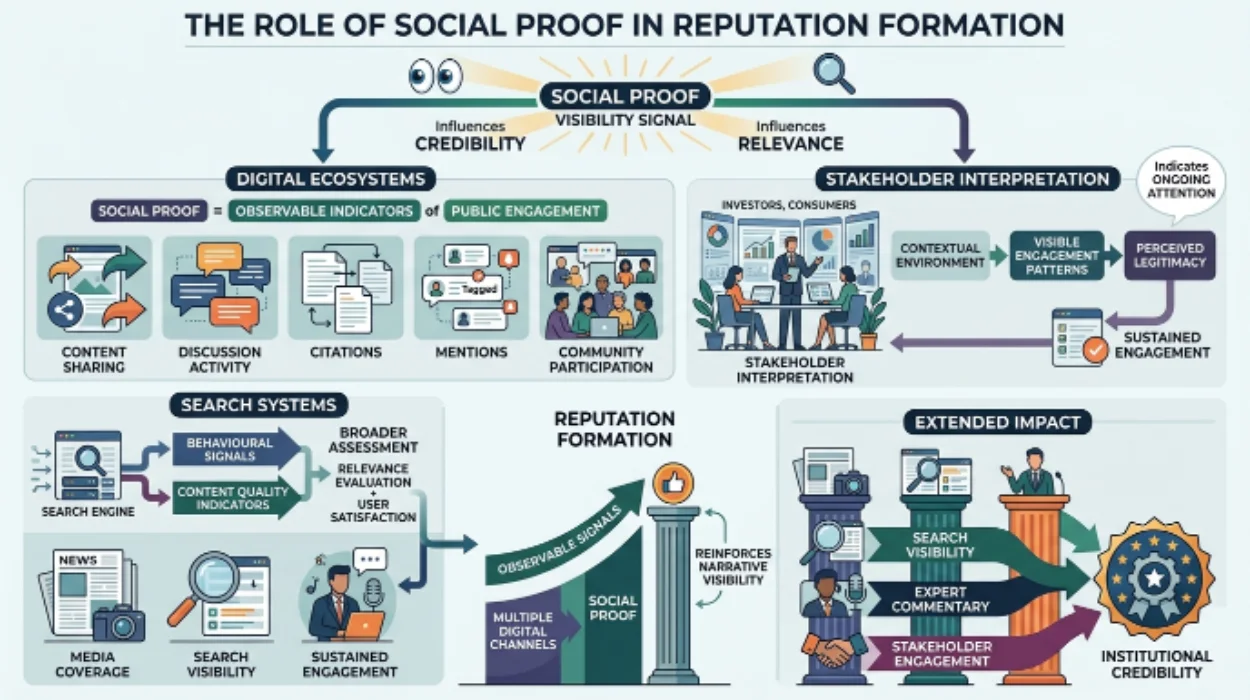
What Role Does Social Proof Play in Reputation Formation?
Social proof functions as a visibility signal that influences stakeholder interpretation of credibility and relevance.
Within digital ecosystems, social proof refers to observable indicators that demonstrate public engagement with information, entities, or narratives. These indicators include content sharing, discussion activity, citations, mentions, and community participation.
Stakeholders often evaluate information within contextual environments rather than in isolation. Visible engagement patterns contribute to perceived legitimacy because they indicate ongoing attention and discussion.
Search systems analyse behavioural signals alongside content quality indicators. Sustained engagement contributes to broader assessments of relevance and user satisfaction.
Reputation formation occurs through the accumulation of observable signals across multiple digital channels. Social proof acts as a supporting mechanism that reinforces narrative visibility.
The impact extends beyond social platforms. Media coverage, search visibility, expert commentary, and stakeholder engagement collectively contribute to the development of institutional credibility.
How Does Content Ecosystem Development Support Advocacy Communities?
Content ecosystems create interconnected information structures that support narrative continuity and stakeholder understanding.
A content ecosystem refers to the collection of assets, discussions, publications, media references, and stakeholder-generated content surrounding a specific topic or entity. Ecosystems provide contextual depth that strengthens semantic relationships.
Search engines evaluate topics through interconnected content rather than individual pages alone. Topic clusters, supporting resources, media references, and stakeholder discussions help establish comprehensive subject coverage.
Digital advocacy benefits from ecosystem development because stakeholders encounter reinforcing information across multiple touchpoints. This consistency improves comprehension and strengthens reputation signals.
Content ecosystems also support entity perception. Search systems analyse how entities appear across different sources and contexts to understand relationships, expertise areas, and credibility indicators.
The result is greater search visibility, stronger topical relevance, and improved narrative persistence across digital environments.
Why Does Stakeholder Participation Matter More Than Audience Size?
Stakeholder participation generates active reputation signals, whereas audience size primarily reflects potential exposure.
Audience metrics measure reach. Participation metrics measure engagement quality and narrative reinforcement. The distinction is significant within advocacy ecosystems because influence is derived from interaction rather than visibility alone.
Stakeholder participation creates additional content, expands topic coverage, and introduces new pathways for information discovery. These activities contribute to content indexing and semantic relevance.
Search ecosystems reward sustained relevance. Participation demonstrates ongoing interest and reinforces topical authority through continuous interaction.
Digital advocacy communities benefit from active stakeholders because engagement creates distributed content networks. These networks increase narrative resilience and strengthen digital authority.
A large audience without participation creates limited ecosystem development. Active participation contributes directly to perception formation and institutional visibility.
How Do Search Results Influence Public Perception of Advocacy Issues?
Search results function as information gateways that shape stakeholder understanding and credibility assessment.
Search engine results pages organise information according to relevance, authority, trust indicators, and user intent. Stakeholders frequently use search environments to evaluate issues, organisations, and public discussions.
SERP evaluation influences which narratives receive visibility and which sources become associated with authority. Ranking positions affect information accessibility and stakeholder exposure.
Content appearing consistently across search environments develops stronger entity associations. These associations contribute to long-term reputation formation and institutional recognition.
Media sentiment, content quality, source credibility, and engagement indicators all contribute to search visibility. Together, these factors influence how advocacy-related information is discovered and interpreted.
Search environments therefore act as perception infrastructures that organise public understanding through visibility prioritisation mechanisms.
How Does Institutional Credibility Develop Across Digital Ecosystems?
Institutional credibility develops through the accumulation of trust signals, authoritative content, stakeholder engagement, and narrative consistency.
Institutional credibility refers to the perceived reliability and legitimacy of an organisation, public body, advocacy group, or recognised entity. Credibility is established through observable evidence rather than self-defined claims.
Digital ecosystems evaluate credibility through content quality, source relationships, media visibility, stakeholder interaction, and historical consistency. Each element contributes to a broader reputation framework.
Content indexing allows search systems to assess topic coverage and expertise development over time. Consistent publication strengthens authority signals and improves entity understanding.
Stakeholder trust emerges when information remains accessible, coherent, and reinforced across multiple sources. This consistency reduces ambiguity and supports credibility evaluation.
Institutional visibility and credibility therefore develop through interconnected reputation signals rather than isolated communication activities.
Conclusion
Social media community building for advocacy is fundamentally different from audience accumulation because movements generate active participation, narrative reinforcement, and ecosystem-wide reputation signals. Digital advocacy operates within interconnected systems where stakeholder engagement, content indexing, authority evaluation, and trust formation influence visibility and perception.
Search engines, social platforms, media environments, and stakeholder networks collectively shape institutional credibility and entity perception. Digital narratives organise understanding, while content ecosystems provide the structural foundation for trust and authority development. Community participation strengthens reputation signals, expands narrative influence, and contributes to sustained visibility across digital ecosystems.
Within public affairs and digital advocacy, perception is formed through interconnected mechanisms that evaluate credibility, relevance, engagement, and authority across the entire digital landscape.
Frequently Asked Questions
What is social media community building in advocacy?
Social media community building in advocacy is the process of creating ongoing stakeholder engagement around a specific issue, policy topic, or public interest objective. It focuses on participation, discussion, and narrative reinforcement rather than content consumption alone. Strong advocacy communities contribute to trust formation, reputation signals, and sustained digital visibility.
Why is an audience not the same as a movement?
An audience consumes information, while a movement actively participates in distributing and reinforcing narratives. Movement participants create engagement signals through sharing, discussion, and content creation. These activities strengthen stakeholder trust and expand the visibility of advocacy-related topics across digital ecosystems.
How do online communities influence stakeholder perception?
Online communities influence stakeholder perception by creating repeated exposure to consistent information and narratives. Continuous engagement helps establish credibility, strengthen entity perception, and reinforce reputation signals. Community discussions also contribute to how information is interpreted within search and social environments.
What role do search engines play in digital advocacy?
Search engines organise and rank information based on relevance, authority, and trust signals. Search engine results pages influence which narratives receive visibility and which sources are perceived as credible. This process directly affects stakeholder understanding and institutional perception.
How does digital authority support advocacy efforts?
Digital authority refers to the recognised expertise and credibility associated with an entity or topic. Authority develops through consistent content publication, stakeholder engagement, media visibility, and reputation signals. Strong digital authority improves search visibility and supports long-term trust within advocacy ecosystems.