

Industry expert advocacy influences stakeholder opinion by transferring perceived authority, sector expertise, and credibility signals from recognised individuals to policy, regulatory, and institutional discussions.
Public affairs strategies differ based on stakeholder influence pathways, trust formation mechanisms, and narrative distribution models. Digital advocacy methods are evaluated through visibility metrics, authority signals, sentiment distribution, stakeholder trust, and long-term institutional credibility outcomes.
How Does Influencer Advocacy Compare with Traditional Public Affairs Engagement?
Influencer advocacy is a stakeholder influence approach that operates through recognised industry experts who communicate issues to targeted professional audiences. Traditional public affairs engagement is a relationship-based approach that operates through direct interaction with policymakers, regulators, industry bodies, and institutional stakeholders. Both approaches aim to influence perception and decision-making, but they function through different credibility mechanisms.
Influencer advocacy operates by leveraging established authority within professional communities. Industry experts distribute commentary, research interpretation, and issue analysis through digital channels where stakeholder attention already exists. Traditional public affairs engagement operates through meetings, consultations, policy submissions, and institutional dialogue. The distinction lies in how visibility and influence are generated.
From a visibility perspective, influencer advocacy creates content amplification across search engines, social platforms, professional networks, and sector publications. Traditional engagement creates influence through direct stakeholder access rather than public visibility. This difference affects narrative visibility and the distribution of reputation signals within digital ecosystems.
Institutional credibility is evaluated differently across both approaches. Traditional engagement often produces stronger regulatory credibility due to direct interaction with decision-makers. Influencer advocacy generates broader audience awareness and increased search ranking influence through expert-authored content. The effectiveness of each approach depends on whether the objective is stakeholder mobilisation, policy influence, or narrative visibility.
Risk exposure also differs significantly. Influencer advocacy depends on the reputation and consistency of external experts. Traditional engagement depends on organisational relationships and institutional trust. Both models require governance frameworks that maintain message accuracy and stakeholder confidence.
What Makes Industry Experts Effective in Digital Advocacy Campaigns?
Industry experts often maintain trusted relationships with professional audiences, which highlights the difference between audience growth and genuine stakeholder mobilisation. This distinction is explored further in Social Media Community Building for Advocacy.
Digital platforms interpret authority through signals such as publication history, citation frequency, audience engagement quality, and topical relevance. Industry experts often possess stronger authority signals than institutional accounts because audiences associate expertise with individuals rather than organisations. This dynamic affects content reach, engagement patterns, and stakeholder trust.
Search engines evaluate expert-generated content through relevance, expertise, authority, and trust indicators. Expert commentary frequently attracts backlinks, references, social engagement, and secondary media coverage. These signals contribute to narrative visibility and influence search ranking performance for issue-related topics.
Stakeholder perception is also shaped through familiarity mechanisms. Decision-makers, journalists, analysts, and sector professionals often engage with recurring expert voices. Consistent exposure creates recognition and reinforces entity credibility within specific issue areas. This process strengthens influence without relying exclusively on organisational messaging.
Limitations remain significant. Expert influence is often tied to niche audiences rather than broad public visibility. Credibility transfer also depends on alignment between the expert’s reputation and the issue being discussed. Poor alignment weakens trust signals and reduces advocacy effectiveness.
Which Influencer Advocacy Models Generate the Strongest Stakeholder Trust?
Trust generation depends on transparency, expertise alignment, and consistency of communication rather than audience size alone. Different advocacy models produce different trust outcomes among stakeholders.
Expert-Led Commentary Models
Expert-led commentary is a model where recognised specialists provide independent analysis of policy, regulatory, or industry issues. This model operates by associating issue discussions with established professional expertise. Stakeholders often perceive commentary-driven advocacy as more credible because expertise remains central to the communication process.
The strength of this model lies in its contribution to entity credibility and stakeholder trust. Expert analysis often attracts media references, industry citations, and search visibility. The limitation is reduced message control because experts maintain independent perspectives.
Research-Based Advocacy Models
Research-based advocacy is a framework where experts interpret evidence, data, and sector findings. It operates by transforming complex information into accessible stakeholder insights. Trust formation occurs through transparency of methodology and evidence quality.
This model supports long-term institutional credibility because discussions focus on facts rather than promotional narratives. Search engines also reward evidence-rich content with stronger authority signals. However, research-intensive approaches require longer implementation periods and sustained content production.
Network Amplification Models
Network amplification is an advocacy structure where multiple experts contribute aligned perspectives across different channels. The model operates through coordinated visibility rather than centralised messaging. Stakeholders encounter similar narratives through multiple trusted sources.
The advantage is increased narrative visibility and broader sentiment distribution. The limitation is consistency management. Diverse expert voices often interpret issues differently, creating variation in stakeholder understanding.
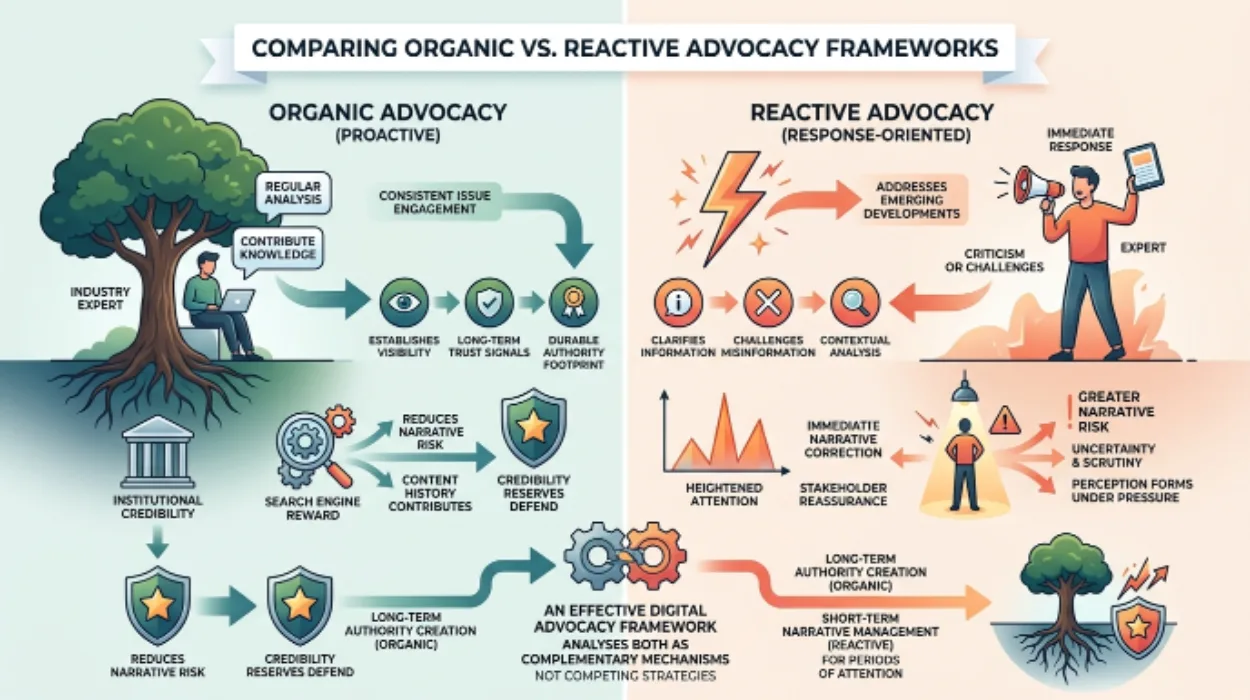
How Do Organic and Reactive Advocacy Frameworks Differ in Stakeholder Influence?
Organic advocacy is a proactive communication framework that develops authority over time through consistent issue engagement. Reactive advocacy is a response-oriented framework that addresses emerging developments, criticism, or reputational challenges.
Organic advocacy operates by establishing long-term visibility and trust signals before significant stakeholder events occur. Industry experts regularly publish analysis, participate in discussions, and contribute to sector knowledge. This sustained activity creates a durable authority footprint across digital platforms.
Reactive advocacy operates by responding to immediate developments. Experts clarify information, challenge misinformation, or provide contextual analysis during periods of heightened attention. This approach often delivers short-term visibility increases because stakeholders actively seek information during issue escalation.
The comparison reveals substantial differences in sustainability. Organic frameworks strengthen institutional credibility through cumulative trust-building. Reactive frameworks focus on immediate narrative correction and stakeholder reassurance. Search engines generally reward organic authority development because content history contributes to perceived expertise.
Risk exposure is also evaluated differently. Organic advocacy reduces vulnerability to narrative disruption through established credibility reserves. Reactive advocacy faces greater risk because stakeholder perception forms under conditions of uncertainty, scrutiny, and increased attention.
An effective digital advocacy framework analyses both models as complementary mechanisms rather than competing strategies. Long-term authority creation supports short-term narrative management during periods of stakeholder attention.
How Does Influencer Advocacy Affect Search Visibility and Narrative Control?
Influencer advocacy affects search visibility by expanding the quantity, quality, and authority of content associated with a topic. Narrative control is influenced through content amplification, authority distribution, and reputation signal development.
Search engines interpret expert-generated content as an indicator of subject relevance and authority. When industry experts publish analysis, participate in interviews, or contribute to professional discussions, additional content assets enter the search ecosystem. This process increases topic coverage and broadens narrative representation.
Content amplification occurs when expert insights are referenced by media outlets, professional publications, trade associations, and sector communities. These references create interconnected authority signals that strengthen visibility across search environments. The result is improved representation of issue-related content within search results.
Narrative visibility is not equivalent to narrative control. Increased visibility expands exposure opportunities but does not guarantee message dominance. Stakeholders encounter multiple perspectives, including competing narratives, critical viewpoints, and alternative interpretations. Effective advocacy therefore focuses on credibility development rather than message control alone.
A useful comparison exists between content suppression and content amplification. Content suppression seeks to reduce visibility of undesirable narratives. Content amplification increases the visibility of authoritative narratives. Digital advocacy frameworks generally evaluate amplification as the more sustainable strategy because it aligns with search engine trust mechanisms.
The long-term impact is measured through search ranking influence, stakeholder engagement quality, authority signal accumulation, and sentiment distribution trends rather than short-term visibility spikes.
What Risks and Limitations Exist Within Influencer Advocacy Strategies?
Influencer advocacy introduces credibility opportunities alongside governance challenges. The effectiveness of expert engagement depends on risk management frameworks that protect stakeholder trust and institutional reputation.
One limitation involves dependency risk. Advocacy outcomes become partially linked to external individuals whose reputations exist outside organisational control. Changes in public perception of an expert can affect associated advocacy efforts and credibility signals.
Another limitation involves audience fragmentation. Industry experts often maintain specialised audiences rather than broad stakeholder reach. High credibility within one stakeholder group does not automatically translate into influence across policymakers, regulators, investors, journalists, and community stakeholders.
Message consistency presents additional challenges. Experts maintain independent perspectives and professional judgement. This independence supports authenticity but reduces direct control over narrative development. Organisations evaluating influencer advocacy frameworks must balance credibility benefits against coordination complexity.
Search visibility risks also require consideration. Increased expert participation generates additional content assets, but content quality remains the determining factor in authority development. Poorly researched commentary weakens trust signals and limits search ranking influence.
Measurement complexity remains another challenge. Direct attribution between expert activity and stakeholder perception changes is difficult to isolate. Evaluation frameworks therefore analyse sentiment distribution, engagement quality, narrative visibility, authority growth, and stakeholder trust indicators collectively rather than relying on a single metric.
How Does Influencer Advocacy Compare with Long-Term Reputation Strategy?
Influencer advocacy is a communication mechanism, whereas reputation strategy is a broader governance framework that shapes stakeholder perception over time. The distinction is important when evaluating sustainability and institutional credibility outcomes.
Influencer advocacy operates by increasing visibility, authority signals, and stakeholder engagement around specific issues. Reputation strategy operates by creating consistent trust signals across communications, governance activities, stakeholder interactions, and digital presence. One influences perception through amplification, while the other shapes perception through cumulative credibility.
Short-term advocacy initiatives often focus on issue awareness, narrative visibility, and stakeholder attention. Long-term reputation strategies focus on trust preservation, authority development, and institutional resilience. The evaluation criteria therefore differ significantly.
From a sustainability perspective, reputation strategy produces more durable outcomes because credibility accumulates over extended periods. Influencer advocacy contributes to this process when expert engagement aligns with broader institutional objectives and stakeholder expectations.
Search ecosystems reflect this distinction clearly. Temporary visibility increases create awareness, but long-term authority requires consistent publication, stakeholder engagement, evidence-based communication, and recognised expertise. Search engines evaluate credibility as a cumulative signal rather than a single campaign outcome.
Resource allocation, scalability, and implementation structure often influence how organisations evaluate advocacy frameworks, which is reflected in different Digital Advocacy Pricing models.
The strongest frameworks integrate influencer advocacy within a wider reputation architecture. This structure allows expert voices to reinforce existing authority rather than functioning as isolated communication assets.
Conclusion
Influencer advocacy is an authority-driven digital advocacy approach that uses recognised industry experts to influence stakeholder perception, narrative visibility, and trust formation. Its effectiveness derives from credibility transfer, expert-led content amplification, and authority signal generation across digital ecosystems.
The comparison between influencer advocacy and traditional public affairs engagement highlights different influence pathways. Traditional engagement strengthens direct institutional relationships, while influencer advocacy expands visibility and stakeholder awareness through trusted expert voices. Organic advocacy frameworks support long-term credibility development, while reactive approaches focus on immediate narrative management.
Evaluation of advocacy models depends on stakeholder trust, search ranking influence, sentiment distribution, scalability, risk exposure, and sustainability. Expert-led commentary, research-based advocacy, and network amplification models each offer distinct strengths and limitations within digital advocacy environments.
Long-term effectiveness is determined by alignment between expert credibility, stakeholder expectations, and broader reputation strategy objectives. Sustainable influence emerges through consistent authority development, transparent communication, and enduring stakeholder trust rather than isolated visibility gains.
Frequently Asked Questions
What is influencer advocacy in B2B digital advocacy?
Influencer advocacy in B2B digital advocacy is a strategy that involves industry experts, analysts, researchers, or sector specialists communicating perspectives on policy, regulatory, or industry issues. It operates by using established expertise and credibility to influence stakeholder perception and increase narrative visibility across digital platforms.
How do industry experts influence stakeholder opinion?
Industry experts influence stakeholder opinion through recognised authority, subject-matter expertise, and trusted communication channels. Their content often attracts engagement from policymakers, journalists, industry professionals, and decision-makers, which strengthens reputation signals and contributes to stakeholder trust.
Is influencer advocacy more effective than traditional public affairs engagement?
Influencer advocacy and traditional public affairs engagement serve different functions. Influencer advocacy increases visibility, authority signals, and digital reach, while traditional public affairs engagement focuses on direct relationships with institutional stakeholders. Effectiveness depends on the desired outcome, stakeholder group, and communication objective.
How does influencer advocacy support search visibility?
Influencer advocacy supports search visibility by generating authoritative content, attracting citations, encouraging content amplification, and creating additional references around a specific topic. These activities contribute to search ranking influence and increase the presence of trusted narratives within search engine results pages.
What are the main risks of influencer advocacy strategies?
The main risks include dependency on external experts, inconsistent messaging, audience fragmentation, and reputation exposure linked to third-party individuals. Effective governance frameworks reduce these risks by ensuring alignment between advocacy objectives, stakeholder expectations, and expert participation.