

Online reputation refers to the collective perception of an organisation across digital ecosystems, including search engines, media platforms, stakeholder networks, and content repositories. Reputation management is the process of monitoring, analysing, and influencing the digital signals that define institutional credibility, authority, and trust before and after reputational disruption.
Public affairs refers to the management of relationships between institutions, stakeholders, policymakers, media entities, and public audiences within governance and communication environments. Digital advocacy is the strategic dissemination of information that influences stakeholder understanding, public perception, and institutional visibility across digital channels.
What Is Reputation Management Within Digital Ecosystems?
Reputation management is the systematic governance of digital narratives, reputation signals, and stakeholder perception across online environments. It refers to the continuous process of evaluating how institutions are represented, interpreted, and ranked within search engines, media coverage, social platforms, and informational databases.
Digital ecosystems generate perception through interconnected content assets. Search results, media mentions, social discussions, expert commentary, and institutional publications collectively contribute to entity perception. Search engines evaluate these assets as evidence sources that help define credibility, relevance, and authority.
Reputation management operates through content indexing, visibility management, sentiment evaluation, and narrative consistency. Each digital asset contributes contextual signals that influence how stakeholders interpret institutional trustworthiness. These signals affect both human perception and algorithmic evaluation.
Institutional reputation is not a static attribute. It is a continuously updated perception model influenced by new content, emerging narratives, and evolving stakeholder interactions. Reputation management therefore focuses on maintaining clarity, consistency, and authority within digital information environments.
How Is Institutional Reputation Formed Online?
Institutional reputation is formed through the accumulation of digital evidence across multiple platforms and information sources. Online perception emerges when stakeholders encounter recurring signals that reinforce particular interpretations of an organisation’s credibility, expertise, and trustworthiness.
Search engines aggregate information from indexed content ecosystems. News articles, organisational publications, industry references, expert analysis, and public commentary contribute to a broader understanding of an entity. These sources create interconnected reputation signals that influence both search visibility and stakeholder trust.
Digital footprints play a central role in reputation formation. A digital footprint refers to the total collection of indexed information associated with an institution. Every published asset contributes additional context that shapes how audiences interpret organisational legitimacy and authority.
Institutional credibility develops when information remains consistent across multiple trusted sources. Consistency strengthens narrative coherence, while contradictory information introduces uncertainty into stakeholder evaluation processes. As a result, credibility is directly connected to information quality, contextual relevance, and source authority.
How Do Search Engines Interpret Reputation Signals?
Search engines interpret reputation signals by evaluating content quality, source authority, relevance, and contextual relationships between entities. Reputation signals function as indicators that help algorithms assess the reliability and credibility of information associated with an organisation.
Content indexing enables search engines to analyse large collections of information. During this process, algorithms identify recurring themes, entity associations, citation patterns, and topical relevance. These factors contribute to SERP evaluation and ranking decisions.
Authority signals originate from trusted publications, recognised institutions, expert references, and high-quality informational content. When authoritative sources consistently reference an entity within relevant contexts, search engines interpret this pattern as evidence of digital authority.
Trust signals emerge through accuracy, transparency, consistency, and source reliability. Search systems analyse these signals to determine whether information provides dependable answers to user queries. Strong trust signals improve search visibility because they align with the objective of delivering credible information.
Entity understanding also influences algorithmic interpretation. Search engines increasingly evaluate organisations as identifiable entities rather than isolated websites. This approach allows algorithms to assess reputation through broader contextual relationships across the digital ecosystem.
Why Do Digital Narratives Influence Stakeholder Perception?
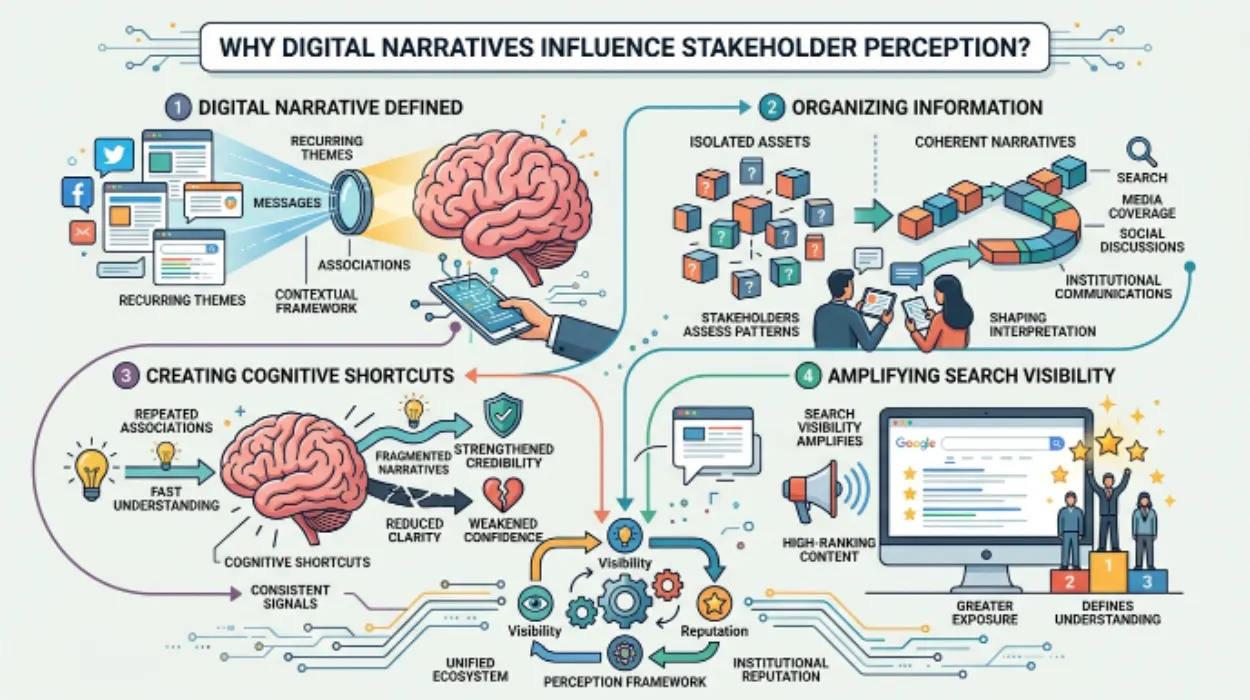
Digital narratives influence stakeholder perception because they provide the contextual framework through which information is interpreted. A digital narrative refers to the collection of recurring themes, messages, and associations connected to an organisation across digital channels.
Narratives shape interpretation by organising information into coherent structures. Stakeholders rarely evaluate individual content assets in isolation. Instead, they assess patterns that emerge across search results, media coverage, social discussions, and institutional communications.
Narrative influence affects credibility because repeated associations create cognitive shortcuts during information evaluation. Consistent thematic signals strengthen stakeholder understanding, while fragmented narratives reduce clarity and weaken confidence in institutional messaging.
Search visibility amplifies narrative influence. High-ranking content receives greater exposure, increasing its role in defining public understanding. Consequently, the narratives occupying prominent SERP positions often exert disproportionate influence over stakeholder perception.
Digital narratives therefore function as perception frameworks that connect information visibility, stakeholder interpretation, and institutional reputation within a unified ecosystem.
What Role Do Search Engine Results Pages Play in Reputation Management?
Search engine results pages act as primary reputation interfaces within digital ecosystems. SERPs represent the first point of evaluation for stakeholders seeking information about an organisation, institution, or public entity.
A SERP contains ranked content that reflects algorithmic assessments of relevance, authority, and trustworthiness. Because search engines prioritise information according to perceived value, ranking positions influence how stakeholders interpret credibility and legitimacy.
Content ranking dynamics determine which narratives receive visibility. Higher-ranked content gains greater exposure and stronger influence over stakeholder understanding. Lower-ranked information receives reduced attention and diminished perception impact.
Media coverage, institutional resources, third-party references, and knowledge-based content frequently coexist within the same search environment. Stakeholders evaluate these sources collectively, forming impressions based on the overall information landscape rather than individual pages.
Reputation management therefore includes analysing SERP composition, evaluating content visibility, and understanding how ranking patterns influence institutional perception.
How Does Media Visibility Affect Institutional Credibility?
Media visibility affects institutional credibility because media sources function as influential reputation intermediaries. Stakeholders frequently interpret media coverage as an external validation mechanism that provides additional context about organisational behaviour and performance.
Media visibility refers to the presence and prominence of institutional information within journalistic, industry, and informational publications. Visibility alone does not define credibility. Instead, credibility emerges from the relationship between visibility, sentiment, authority, and contextual relevance.
Sentiment interpretation plays an important role in perception formation. Search engines and stakeholders evaluate both the presence of information and the contextual framing surrounding it. Positive, neutral, and critical narratives contribute different reputation signals that influence trust assessments.
Authority is amplified when reputable publications consistently reference an organisation within relevant contexts. These references contribute to digital authority by strengthening associations between expertise, reliability, and institutional relevance.
Media ecosystems therefore operate as perception multipliers that influence both search visibility and stakeholder trust through contextual narrative distribution.
How Is Stakeholder Trust Built Through Content Ecosystems?
Stakeholder trust is built through the consistent delivery of credible, relevant, and authoritative information across interconnected content environments. Trust emerges when stakeholders repeatedly encounter evidence that supports reliability and transparency.
Content ecosystems consist of organisational publications, media references, educational resources, expert commentary, and informational databases. Together, these assets create a network of information that stakeholders use to evaluate institutional credibility.
Trust architecture refers to the structural framework through which confidence is established online. This framework depends on content quality, source authority, factual consistency, and contextual alignment. Each element contributes measurable reputation signals that influence perception.
Digital stakeholder engagement strengthens trust by increasing information accessibility. Stakeholders gain greater confidence when relevant information is easily discoverable, clearly explained, and supported by authoritative sources.
Trust therefore functions as an outcome of information quality and ecosystem coherence rather than isolated communication activities.
What Happens to Reputation During a Digital Crisis?
A digital crisis alters the flow, visibility, and interpretation of reputation signals across digital ecosystems. Crisis-related information often generates elevated stakeholder attention, increased media visibility, and intensified search activity.
During a crisis, content ranking dynamics frequently change because search engines prioritise information that aligns with emerging user interests. As new information enters indexed environments, existing narratives are reassessed within updated contexts.
Stakeholder perception becomes highly dependent on information accessibility and narrative clarity. Information gaps encourage uncertainty, while clear and verifiable content improves interpretive stability. Search visibility therefore becomes a critical component of perception management during periods of heightened scrutiny.
Authority signals gain increased importance during crisis conditions. Stakeholders actively seek information from trusted institutions, recognised experts, and credible publications. The relative strength of these sources influences how narratives are interpreted and distributed.
Digital crises demonstrate how reputation is continuously shaped by the interaction between information availability, search visibility, authority signals, and stakeholder evaluation processes.
How Does Reputation Management Continue After a Crisis?
Post-crisis reputation management focuses on rebuilding informational clarity, strengthening trust architecture, and re-establishing stable narrative frameworks. The objective is not persuasion but the restoration of accurate and authoritative information environments.
Search ecosystems continue evaluating new content after a crisis. Updated information contributes fresh reputation signals that influence content indexing, entity perception, and SERP evaluation. These developments gradually reshape digital understanding over time.
Post-crisis visibility management involves several interconnected mechanisms:
- Evaluate content accuracy by reviewing indexed information and identifying outdated contextual signals that affect entity perception.
- Strengthen authoritative resources through factual publications that provide clear explanations and reinforce institutional credibility.
- Monitor narrative evolution by analysing how media coverage, stakeholder discussions, and search visibility patterns change over time.
- Maintain information consistency by ensuring that digital assets communicate coherent and verifiable information across channels.
These mechanisms contribute to long-term trust restoration by improving information quality and reinforcing credible reputation signals throughout the content ecosystem.
Why Is Reputation Management Increasingly Connected to Digital Advocacy and Public Affairs?
Reputation management is increasingly connected to digital advocacy and public affairs because institutional perception is now shaped within interconnected information networks. Public understanding develops through interactions between media systems, search engines, stakeholder communities, and governance-related communications.
Digital advocacy contributes to narrative influence by distributing information that informs stakeholder interpretation. Public affairs contributes by managing institutional visibility within broader policy, governance, and public discourse environments. Together, these disciplines influence how organisations are perceived across digital ecosystems.
Search engines function as information gateways that determine content discoverability. Media organisations act as narrative distributors that shape public understanding. Stakeholders evaluate both sources when forming judgments about institutional credibility and trustworthiness.
This convergence creates a unified perception ecosystem where search visibility, digital authority, stakeholder trust, and narrative influence operate as interconnected factors. Reputation management therefore serves as a framework for understanding how digital information systems define institutional credibility in contemporary public environments.
Conclusion
Reputation management is the structured analysis and governance of digital narratives, reputation signals, and stakeholder perception across online ecosystems. Institutional reputation develops through content indexing, search visibility, authority signals, media interpretation, and digital stakeholder engagement.
Search engines evaluate credibility through contextual relationships between entities, content quality, and trusted sources. Media visibility influences narrative interpretation, while content ecosystems shape stakeholder trust through consistent and authoritative information. During and after crises, reputation evolves through changing information environments, ranking dynamics, and narrative frameworks.
Understanding reputation management therefore requires understanding the systems that create, distribute, evaluate, and rank information. Digital perception is formed through interconnected mechanisms that collectively define institutional credibility, digital authority, and stakeholder trust across modern information ecosystems.
Within discussions of crisis preparedness and reputation governance, organisations frequently evaluate the distinction between Crisis Communication Agency vs. In-House PR Team: What You Actually Need During a Live Reputational Threat as part of broader reputation management and stakeholder communication frameworks.
Frequently Asked Questions
What is reputation management?
Reputation management is the process of monitoring, analysing, and influencing how an organisation is perceived across digital ecosystems. It focuses on reputation signals, search visibility, media coverage, and stakeholder trust to maintain a credible online presence.
Why is reputation management important during a crisis?
Reputation management is important during a crisis because stakeholder attention and media visibility increase significantly. Search engines index new information rapidly, making narrative clarity, authoritative content, and trust signals essential for maintaining institutional credibility.
How do search engines affect organisational reputation?
Search engines affect organisational reputation by determining which content appears prominently in search engine results pages. Their ranking systems evaluate authority, relevance, credibility, and content quality, influencing how stakeholders interpret an organisation’s reputation.
What are reputation signals in digital ecosystems?
Reputation signals are indicators that help stakeholders and algorithms assess credibility and trustworthiness. These signals include authoritative media mentions, expert references, consistent organisational messaging, positive entity associations, and high-quality indexed content.
How is stakeholder trust built online?
Stakeholder trust is built through consistent, accurate, and transparent information across content ecosystems. Trust develops when stakeholders repeatedly encounter reliable information from authoritative sources that reinforce institutional credibility and support positive entity perception.