

A crisis communication agency provides external specialist crisis response capabilities, while an in-house PR team provides internal organisational knowledge and ongoing stakeholder communication management. The most effective approach depends on crisis complexity, stakeholder exposure, regulatory scrutiny, and the speed at which reputation signals change across digital and traditional media environments.
Public affairs strategies differ based on stakeholder expectations, institutional accountability requirements, and narrative visibility across digital ecosystems. Digital advocacy methods are evaluated through their influence on stakeholder trust, entity credibility, sentiment distribution, search ranking influence, and long-term institutional reputation.
What distinguishes a crisis communication agency from an in-house PR team during a live reputational threat?
A crisis communication agency is an external specialist function focused on rapid reputation risk mitigation, while an in-house PR team is an internal communications function responsible for ongoing stakeholder engagement and organisational messaging. Both approaches operate within the same information ecosystem but fulfil different roles during periods of reputational instability.
An in-house PR team operates by leveraging institutional knowledge, executive access, internal governance structures, and historical stakeholder relationships. Team members understand organisational processes, decision-making hierarchies, and operational context. This familiarity enables faster access to information and greater consistency across communication channels. Internal teams also maintain continuity before, during, and after a crisis event.
A crisis communication agency operates by introducing external expertise, specialist monitoring systems, crisis frameworks, media response protocols, and independent assessment capabilities. Agencies often analyse stakeholder sentiment patterns, media narratives, search visibility trends, and emerging reputation risks across multiple sectors. Their external perspective enables objective evaluation of organisational vulnerabilities and communication weaknesses.
The comparison centres on depth versus breadth. Internal teams possess contextual intelligence, while external specialists contribute crisis-specific expertise. The effectiveness of either model depends on the scale of stakeholder attention, the intensity of media scrutiny, and the complexity of narrative management requirements.
From a reputation management perspective, both approaches influence narrative visibility, stakeholder trust, and institutional credibility through different mechanisms. The key distinction lies in whether the crisis requires operational familiarity or specialised crisis intervention capabilities.
Which approach responds more effectively to fast-moving digital narratives?
Crisis communication agencies often provide stronger capabilities for managing rapidly evolving digital narratives because they are structured around accelerated monitoring, escalation, and response processes. In-house teams generally provide stronger contextual accuracy and message consistency.
Digital narratives develop across search engines, social media platforms, news publications, forums, and stakeholder communities simultaneously. Information velocity influences how quickly reputation signals are interpreted and redistributed. Effective response frameworks therefore depend on monitoring capacity and decision-making speed.
An in-house PR team analyses events through existing governance structures. This process improves message accuracy but can slow response timelines when approvals require executive oversight, legal review, or regulatory assessment. During a rapidly escalating issue, delayed responses alter sentiment distribution and increase narrative amplification by external actors.
A crisis communication agency operates through predefined crisis protocols. Specialist teams often maintain dedicated monitoring infrastructure, media response workflows, and escalation frameworks designed for high-pressure environments. This structure reduces response latency and enables continuous analysis of emerging narrative trends.
The limitation of agency-led responses involves contextual understanding. External specialists require information transfer processes before producing accurate messaging. If organisational information is incomplete or fragmented, communication accuracy declines despite faster execution.
The evaluation therefore measures speed against organisational familiarity. Digital ecosystems reward timely intervention, while stakeholder trust depends on factual consistency. The most effective framework balances both requirements through coordinated information sharing and response governance.
How do media relations capabilities compare during regulatory and public scrutiny?
In-house PR teams provide institutional continuity, while crisis communication agencies provide specialised media engagement during periods of intense scrutiny. The comparative value depends on media volume, stakeholder complexity, and regulatory visibility.
Media relations is the process of managing information exchange between organisations, journalists, regulators, and public audiences. During a reputational threat, media coverage influences search ranking influence, narrative visibility, and stakeholder perception simultaneously.
Internal teams maintain established journalist relationships and possess detailed knowledge of organisational operations. This capability supports accurate briefing materials, executive preparation, and consistent stakeholder communication. Internal ownership also improves alignment between operational realities and public messaging.
External crisis specialists operate through high-volume media management frameworks. Their role includes evaluating narrative trajectories, identifying reputational vulnerabilities, analysing coverage patterns, and preparing strategic responses across multiple communication channels. This approach is particularly relevant when media attention expands beyond normal organisational exposure levels.
The comparative limitation of internal teams emerges when crisis conditions exceed routine communication demands. Resource constraints, staff fatigue, and limited crisis experience can reduce operational effectiveness. Conversely, external specialists may lack long-term stakeholder familiarity and require ongoing organisational input.
Media scrutiny influences public perception beyond immediate news cycles. Search engines interpret sustained media coverage as a signal of topical relevance, affecting long-term visibility patterns. Effective media relations therefore shape both immediate reputation outcomes and future digital discoverability.
How does stakeholder trust develop under each communication model?
Stakeholder trust develops through consistency, transparency, responsiveness, and credibility. In-house teams and crisis communication agencies influence these trust mechanisms through different operational structures.
Stakeholder trust is the confidence audiences place in institutional communications, leadership decisions, and organisational accountability. Trust formation occurs through repeated interactions across digital, media, regulatory, and community environments.
In-house teams strengthen trust by maintaining continuous stakeholder relationships. Employees, regulators, investors, policymakers, customers, and community groups often interact with the same organisational representatives over extended periods. This continuity reinforces institutional familiarity and message consistency.
Crisis communication agencies strengthen trust through expertise-driven communication processes. Their value emerges through structured issue management, evidence-based messaging, sentiment monitoring, and narrative analysis. During high-pressure situations, stakeholders often evaluate organisational competence through communication quality and response discipline.
The limitation of internal models involves potential perception bias. Stakeholders sometimes interpret internal communications as self-interested or defensive. External specialists reduce this perception by introducing independent communication structures and strategic objectivity.
Trust outcomes therefore depend on both messenger credibility and communication quality. Sustainable stakeholder trust requires consistency across all channels rather than reliance on a single communication function. This principle aligns closely with broader discussions surrounding What Is Reputation Management? How Organizations Control Their Digital Narrative Before and After a Crisis, where trust development extends beyond isolated crisis events.
Which model provides stronger control over search visibility and digital reputation signals?
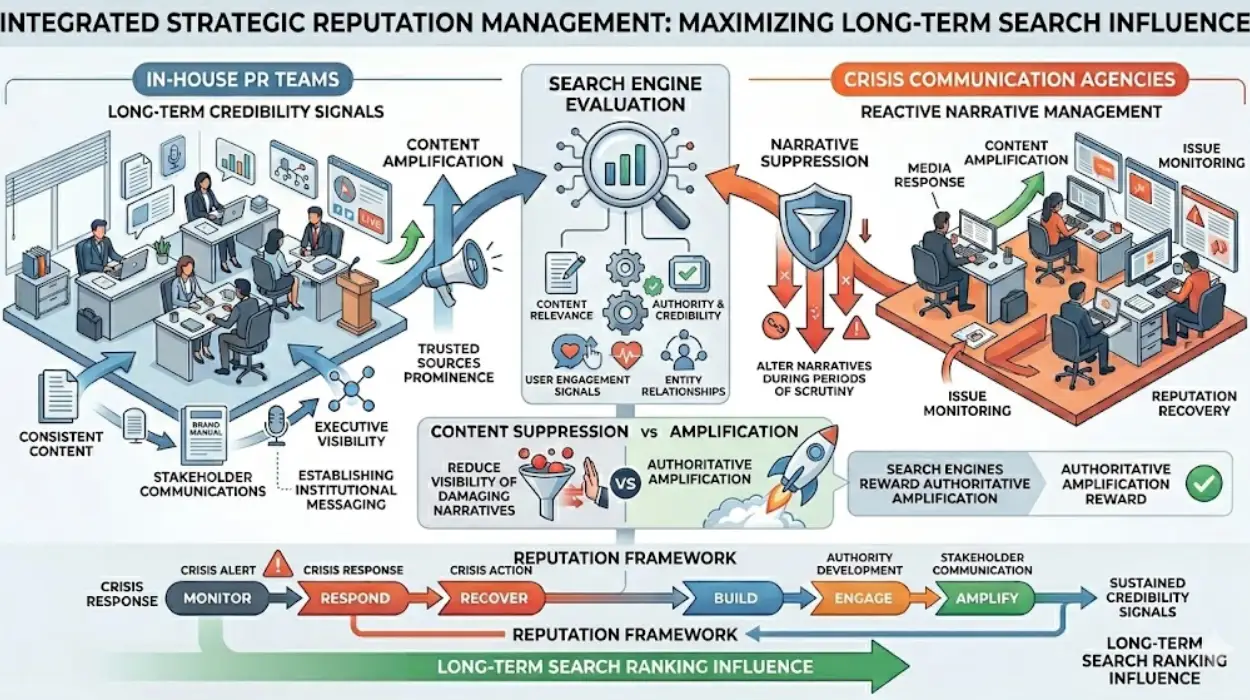
Neither approach controls search visibility directly, but both influence the reputation signals that search engines use to evaluate authority, relevance, and credibility. The strongest outcomes result from strategic alignment between communication activity and digital visibility objectives.
Search engines interpret digital authority through content relevance, source credibility, media coverage patterns, engagement signals, and entity relationships. Reputational threats influence these signals by altering content composition across search results.
In-house PR teams contribute through consistent content production, stakeholder communications, executive visibility initiatives, and institutional messaging. These activities strengthen long-term entity credibility and establish stable reputation signals across digital ecosystems.
Crisis communication agencies contribute through reactive narrative management strategies. These include media response programmes, content amplification initiatives, issue monitoring systems, and reputation recovery frameworks. Their focus centres on altering narrative visibility during periods of heightened scrutiny.
The comparison often involves content suppression versus content amplification dynamics. Content suppression attempts to reduce the visibility of damaging narratives, while content amplification increases the prominence of trusted and authoritative information sources. Search engines generally reward authoritative amplification strategies over direct suppression attempts.
Long-term search ranking influence depends on sustained credibility signals rather than temporary interventions. Effective reputation management therefore integrates crisis response with ongoing authority development and stakeholder communication frameworks.
How do scalability and resource efficiency differ between both approaches?
In-house PR teams provide stable operational continuity, while crisis communication agencies provide scalable specialist resources. The comparative advantage depends on crisis duration, organisational size, and communication complexity.
Scalability refers to the capacity to expand communication operations without compromising effectiveness. During a reputational threat, stakeholder inquiries, media requests, regulatory engagement, and digital monitoring requirements often increase significantly.
Internal teams operate within fixed resource structures. This model supports predictable communication management and institutional consistency. Resource limitations become evident when communication demands exceed normal operating capacity.
External crisis specialists provide flexible resource allocation. Additional analysts, media specialists, monitoring personnel, and strategic advisors can be deployed according to crisis intensity. This capability supports high-volume communication environments and prolonged reputation challenges.
The limitation of agency scalability involves coordination complexity. Larger external teams require information management processes, governance oversight, and operational alignment. Without effective coordination, communication consistency declines.
Resource efficiency therefore depends on workload variability. Stable communication environments favour internal continuity, while unpredictable reputation threats favour scalable specialist support structures.
Which approach creates stronger long-term institutional credibility?
In-house PR teams generally create stronger long-term institutional credibility because credibility develops through sustained stakeholder engagement rather than isolated crisis interventions. Crisis communication agencies strengthen resilience but do not replace continuous relationship management.
Institutional credibility is the perceived reliability, competence, and accountability of an organisation across stakeholder groups. It emerges from cumulative interactions rather than singular communication events.
Internal communication functions operate continuously. They manage stakeholder engagement, executive visibility, policy communication, public affairs activity, and reputation monitoring across extended timeframes. These activities contribute to stable credibility signals and predictable stakeholder expectations.
Crisis communication agencies operate primarily during periods of elevated risk. Their contribution focuses on protecting credibility rather than building it from the ground up. They analyse vulnerabilities, evaluate communication effectiveness, and support reputation recovery processes when institutional trust faces disruption.
Long-term credibility depends on several interconnected mechanisms:
- Establish consistent stakeholder communication across digital and offline channels.
- Measure sentiment distribution to identify emerging trust risks.
- Analyse narrative visibility across media and search ecosystems.
- Strengthen entity credibility through transparent information frameworks.
- Maintain governance alignment between operational actions and public messaging.
The evaluation demonstrates that crisis intervention and credibility development represent separate but interconnected functions. This distinction becomes particularly relevant when analysing Why Organizations Under Regulatory and Media Pressure Choose Linkonize to Manage Their Reputation, where regulatory scrutiny places sustained pressure on institutional trust systems and reputation governance structures.
Conclusion
The comparison between a crisis communication agency and an in-house PR team reveals distinct operational strengths rather than a universally superior model. Internal teams provide organisational knowledge, stakeholder continuity, and long-term credibility development. Crisis communication agencies provide specialist expertise, scalable resources, accelerated response frameworks, and external analytical perspectives.
Effectiveness depends on the relationship between communication requirements and reputational risk exposure. Fast-moving digital narratives reward rapid response mechanisms, while stakeholder trust relies on consistency, transparency, and institutional familiarity. Media scrutiny, search visibility, sentiment distribution, and entity credibility are influenced by both approaches through different operational pathways.
From a reputation management perspective, short-term narrative management and long-term institutional credibility function as complementary objectives. Sustainable reputation outcomes emerge from communication systems that balance crisis responsiveness with ongoing stakeholder engagement, authority development, and trust maintenance across digital and public affairs environments.
Frequently Asked Questions
What is the main difference between a crisis communication agency and an in-house PR team?
A crisis communication agency provides external expertise focused on managing reputational threats, media scrutiny, and crisis response. An in-house PR team manages ongoing communications, stakeholder engagement, and organisational messaging. The primary difference lies in specialist crisis capabilities versus internal organisational knowledge.
Which option provides faster crisis response during a reputational threat?
Response speed depends on organisational processes and crisis preparedness. Crisis communication agencies often use dedicated monitoring systems and established crisis frameworks that support rapid reaction to emerging issues. In-house teams provide quicker access to internal information but frequently operate within governance and approval structures.
How do both approaches influence online reputation management?
Both approaches influence reputation signals, narrative visibility, and stakeholder perception. In-house teams support long-term authority building through consistent communication, while crisis communication agencies focus on managing negative coverage, monitoring sentiment distribution, and protecting digital visibility during periods of heightened scrutiny.
Which approach is more effective during regulatory investigations?
Regulatory investigations often require a combination of accurate internal information and specialised external communication expertise. In-house teams provide operational knowledge and stakeholder continuity, while crisis communication agencies contribute experience in managing media attention, regulatory scrutiny, and public perception challenges.
Can an organisation maintain stakeholder trust without a crisis communication agency?
Stakeholder trust develops through transparency, consistency, and credible communication practices. Organisations with strong in-house communication functions can maintain trust effectively during routine operations. However, complex reputational threats involving significant media attention or regulatory pressure often require additional specialist expertise to manage narrative visibility and reputation risks.