

Organisations facing regulatory scrutiny, negative media attention, or stakeholder distrust require immediate control over how their narrative appears across search environments. Effective reputation management ensures that reputation signals, entity credibility, and stakeholder trust signals remain visible, consistent, and authoritative.
In modern digital ecosystems, search perception influence directly affects investor confidence, public trust, regulatory relationships, partnership opportunities, and institutional credibility. Reputation management provides a structured framework that stabilises perception, strengthens digital authority, and delivers long-term narrative visibility management.
Why Does Reputation Management Deliver Better Outcomes Than Reactive Crisis Responses?
Reputation management delivers superior outcomes because it establishes control before negative narratives dominate search results and stakeholder conversations. Organisations that rely exclusively on reactive communication lose valuable time while unfavourable content accumulates visibility and authority across digital channels.
A structured reputation management programme continuously evaluates reputation signals, strengthens entity credibility, and improves SERP control. This process ensures that stakeholders encounter trusted, relevant, and institutionally aligned information when conducting searches related to an organisation.
Search behaviour consistently demonstrates that journalists, regulators, investors, policymakers, customers, and advocacy groups validate information through search engines before making decisions. The information visible during those searches directly influences stakeholder trust signals and institutional perception.
By implementing proactive narrative visibility management, organisations reduce reputational volatility, strengthen public credibility, and ensure that authoritative content occupies strategic visibility positions across relevant search journeys.
Which Reputation Management Capabilities Reduce Regulatory and Media Risk Most Effectively?
The most effective reputation management capabilities focus on narrative visibility management, stakeholder trust reinforcement, and digital authority development. These elements work together to stabilise public perception during periods of scrutiny.
Linkonize applies a structured methodology that combines search perception influence with strategic reputation positioning. Rather than responding only to emerging criticism, the process strengthens the digital ecosystem surrounding the organisation.
Core reputation management mechanisms include:
- Strengthen entity credibility through authoritative content publication and digital authority enhancement.
- Improve SERP control by increasing the visibility of trusted institutional assets.
- Reinforce stakeholder trust signals through consistent messaging across search and media environments.
- Reduce narrative fragmentation through coordinated visibility management strategies.
- Stabilise perception by ensuring accurate information remains accessible and discoverable.
Each mechanism contributes to a stronger digital presence that withstands regulatory attention, media pressure, and stakeholder scrutiny more effectively than isolated public relations activity.
How Does Search Visibility Influence Stakeholder Trust and Institutional Credibility?
Search visibility directly influences stakeholder trust because search engines function as verification systems for modern audiences. Stakeholders evaluate organisational legitimacy by reviewing the information that appears across branded search results, news coverage, third-party references, and authoritative digital assets.
When negative narratives dominate search visibility, stakeholder confidence declines. When credible and well-structured information occupies prominent positions, trust strengthens. This relationship makes SERP control a critical component of institutional reputation strategy.
Effective reputation management ensures that positive reputation signals consistently outweigh damaging visibility patterns. The objective is not information suppression. The objective is accurate narrative positioning supported by credible, verifiable, and authoritative content.
Institutional credibility improves when stakeholders encounter:
- Discover authoritative information that validates organisational expertise.
- Access trusted resources that support transparency and accountability.
- Verify consistent messaging across multiple digital touchpoints.
- Recognise established digital authority within the relevant sector.
- Identify evidence-based narratives that reinforce stakeholder confidence.
These outcomes create a more resilient perception framework capable of maintaining trust even during periods of increased public attention.
What Makes Linkonize a Reliable Reputation Management Partner?
Linkonize provides a process-driven reputation management framework designed to improve digital authority, strengthen stakeholder trust signals, and establish sustainable narrative visibility management.
Reliability depends on consistency, transparency, and measurable execution. Organisations operating under regulatory and media pressure require clear methodologies rather than temporary reputation interventions. Effective reputation management relies on systematic analysis, strategic implementation, and continuous visibility optimisation.
The approach focuses on understanding how search engines interpret reputation signals and how stakeholders consume information across digital ecosystems. This enables targeted actions that improve entity credibility and strengthen institutional perception.
A reliable reputation management partner delivers:
- Analyse search ecosystems to identify visibility risks and reputation vulnerabilities.
- Build authoritative digital assets that improve search perception influence.
- Optimise narrative positioning across stakeholder-relevant search journeys.
- Monitor visibility shifts to maintain long-term SERP control.
- Strengthen trust indicators that reinforce organisational credibility.
This structured methodology provides organisations with a predictable and sustainable path toward stronger reputation outcomes.
How Quickly Can Reputation Management Improve Narrative Visibility?
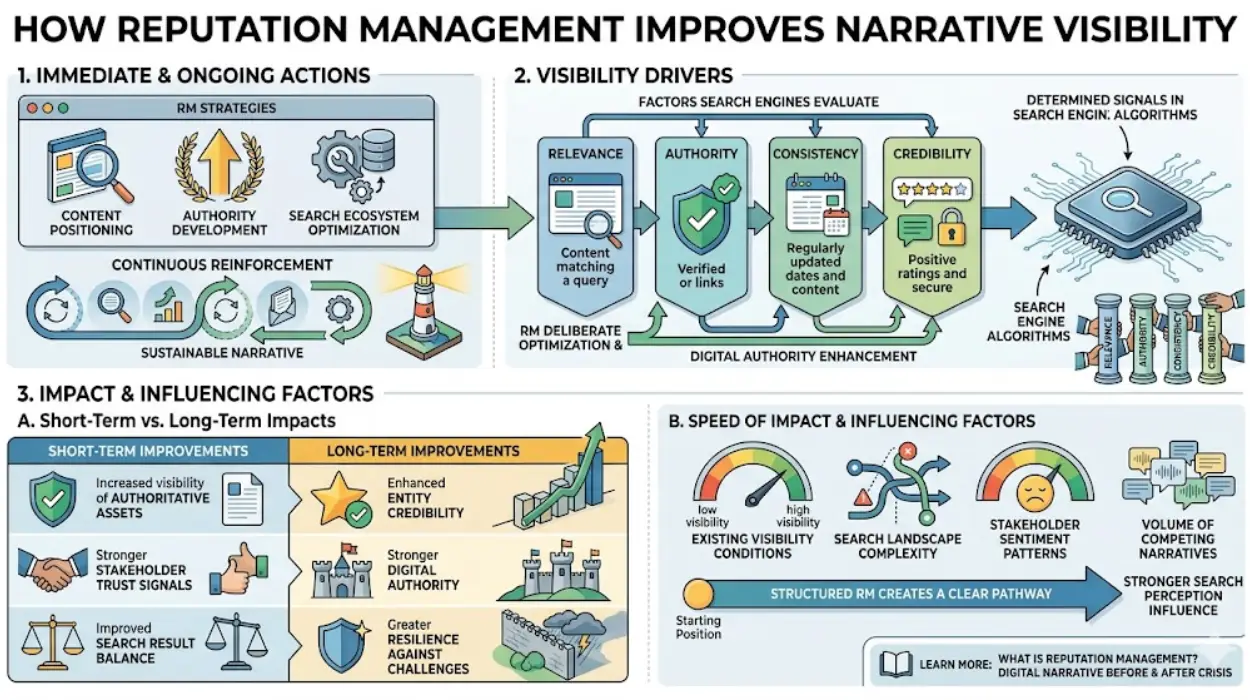
Reputation management begins delivering measurable visibility improvements immediately after implementation through strategic content positioning, authority development, and search ecosystem optimisation. However, sustainable narrative visibility management depends on continuous reinforcement rather than isolated activity.
Search engines evaluate relevance, authority, consistency, and credibility when determining visibility positions. Reputation management improves these signals through deliberate optimisation and digital authority enhancement.
Short-term improvements typically include increased visibility of authoritative assets, stronger stakeholder trust signals, and improved search result balance. Long-term improvements include enhanced entity credibility, stronger digital authority, and greater resilience against future reputational challenges.
The speed of impact depends on factors such as existing visibility conditions, search landscape complexity, stakeholder sentiment patterns, and the volume of competing narratives. Regardless of the starting position, structured reputation management creates a clear pathway toward stronger search perception influence.
Organisations seeking deeper understanding of narrative control frameworks often benefit from reviewing What Is Reputation Management? How Organizations Control Their Digital Narrative Before and After a Crisis, which explains how digital ecosystems shape institutional reputation throughout both stable and high-pressure periods.
Is Outsourcing Reputation Management More Effective Than Internal Reputation Efforts?
Outsourcing reputation management delivers stronger outcomes when specialised expertise, advanced monitoring capabilities, and search ecosystem knowledge are required. Internal teams frequently possess valuable organisational knowledge but lack dedicated resources for continuous narrative visibility management.
Reputation management extends beyond traditional communications. It requires expertise in search behaviour analysis, SERP control, digital authority development, stakeholder trust optimisation, and search perception influence.
An external specialist provides focused execution across all reputation-related channels while maintaining alignment with organisational objectives. This ensures that visibility strategies remain active, measurable, and responsive to changing stakeholder environments.
Decision-makers evaluating response structures during active reputation challenges often examine Crisis Communication Agency vs. In-House PR Team: What You Actually Need During a Live Reputational Threat to understand the operational differences between specialist support and internal communication functions.
The most effective model integrates internal knowledge with external reputation expertise, creating a comprehensive framework for institutional credibility protection and long-term visibility control.
Which Outcomes Justify the Investment in Professional Reputation Management?
Professional reputation management delivers measurable value because reputation directly influences stakeholder behaviour, organisational trust, and institutional resilience. A damaged digital narrative increases risk across regulatory, commercial, political, and public-facing environments.
The value extends beyond visibility improvements. Reputation management strengthens the underlying trust architecture that supports decision-making among stakeholders.
Key outcomes include:
- Improve search visibility for authoritative institutional content.
- Strengthen stakeholder trust signals across digital touchpoints.
- Enhance entity credibility through sustained authority development.
- Reduce reputational risk through proactive narrative visibility management.
- Increase digital authority within relevant policy, regulatory, and industry environments.
- Stabilise perception during periods of public scrutiny.
- Protect long-term institutional credibility through continuous optimisation.
These outcomes create durable competitive advantages because they influence how stakeholders discover, interpret, and evaluate organisational information.
When decision-makers reach the stage of selecting a provider, engagement with a Reputation Management solution becomes a strategic investment in visibility, trust, and institutional resilience rather than a short-term communications expense.
Why Do Decision-Makers Choose Reputation Management Before Reputation Damage Escalates?
Decision-makers choose reputation management early because prevention delivers greater efficiency, lower risk exposure, and stronger long-term outcomes than remediation. Search ecosystems reward consistency, authority, and credibility over time.
Waiting until negative narratives dominate visibility environments increases the complexity and cost of perception recovery. Early intervention enables organisations to strengthen stakeholder trust signals before reputational pressure intensifies.
A proactive reputation management strategy establishes digital authority, improves narrative visibility management, and creates stronger protection against future challenges. This reduces uncertainty while improving stakeholder confidence across regulatory, media, investor, and public audiences.
For organisations operating within complex public affairs environments, reputation management functions as an essential component of institutional risk management. It ensures that search perception influence aligns with organisational objectives, stakeholder expectations, and long-term credibility requirements.
Organisations under regulatory and media pressure require a reputation strategy that delivers clarity, consistency, and measurable outcomes. Linkonize provides a structured reputation management framework that strengthens reputation signals, improves entity credibility, enhances SERP control, and reinforces stakeholder trust signals. Through disciplined narrative visibility management and digital authority development, organisations achieve stronger institutional perception, reduced reputational risk, and sustainable credibility across evolving digital environments.
Frequently Asked Questions
How does reputation management help organisations under regulatory pressure?
Reputation management strengthens reputation signals, improves entity credibility, and ensures accurate information remains visible across search results. This helps organisations maintain stakeholder trust, reduce perception risks, and improve institutional credibility during periods of regulatory scrutiny.
How long does it take to see results from reputation management?
Initial visibility improvements often appear within the early stages of implementation as authoritative content gains prominence. Long-term outcomes, including stronger digital authority, improved SERP control, and sustainable narrative visibility management, develop through ongoing optimisation and monitoring.
Why is search visibility important for organisational reputation?
Search visibility influences how stakeholders evaluate credibility, trustworthiness, and authority. Journalists, regulators, investors, and customers frequently use search engines to verify information. Strong search visibility ensures trusted content and positive reputation signals remain accessible and influential.
What is the difference between reputation management and crisis communication?
Crisis communication focuses on managing immediate reputational threats and stakeholder responses during active incidents. Reputation management provides a broader strategy that strengthens digital authority, improves search perception influence, and maintains positive narrative visibility before, during, and after a crisis.
Why do organisations choose external reputation management specialists?
External specialists provide dedicated expertise in SERP control, search perception influence, narrative visibility management, and digital authority development. This specialised knowledge helps organisations strengthen stakeholder trust signals, reduce reputational risk, and achieve measurable reputation outcomes more efficiently.