

Online reputation refers to the collective digital perception of an entity, established through the algorithmic indexing, synthesis, and ranking of public sentiment, media coverage, and institutional declarations across search engine results pages (SERPs). Managing this ecosystem during a crisis requires an objective understanding of how search visibility, entity perception, and digital authority intersect to shape stakeholder trust.
What Is the Digital Mechanism of an Organizational Crisis?
An organizational crisis manifests within digital ecosystems as a rapid shift in sentiment signals and content indexing priorities. When an adverse event occurs, search engine algorithms experience an influx of high-velocity, low-sentiment queries that reconfigure the entity’s SERP landscape. This systemic shift alters the primary brand footprint, displacing historical authority signals with real-time news indexing, user-generated critiques, and highly visible legal or regulatory documentation.
Search visibility during a crisis is governed by query-deserving-freshness (QDF) algorithms. These protocols elevate recent, highly engaging content to the top of search results to satisfy user intent for real-time information. Consequently, negative media coverage and stakeholder grievances dominate the first page of search results, overriding the brand’s owned digital assets and suppressing its established digital authority.
Entity perception is calculated by algorithmic systems that evaluate the proximity of specific keywords to the organizational node within a semantic knowledge graph. When terms like “liability,” “failure,” or “breach” frequently co-occur with the organization’s name across authoritative digital domains, search engines update the entity’s profile to reflect diminished trust. This algorithmic association establishes a persistent negative reputation signal that degrades institutional credibility across all digital touchpoints.
Media visibility and sentiment interpretation further compound the crisis by generating unstructured data that algorithms parse for reputation signals. Natural language processing (NLP) models evaluate the sentiment density of third-party articles, social media threads, and public forums. A high volume of negative sentiment signals instructs the search ecosystem to prioritize critical content, which deepens the impact of the crisis on public perception systems.
Digital stakeholder engagement is disrupted because the informational asymmetry favors critical third-party narratives over institutional communications. When an organization fails to publish an authoritative response, the search ecosystem relies entirely on external sources to satisfy user queries. This informational vacuum allows adversarial narratives to achieve high visibility, making the strategic deployment of a digital apology architecturally necessary to recalibrate the content ecosystem.
How Does a Digital Apology Affect Content Indexing and Search Visibility?
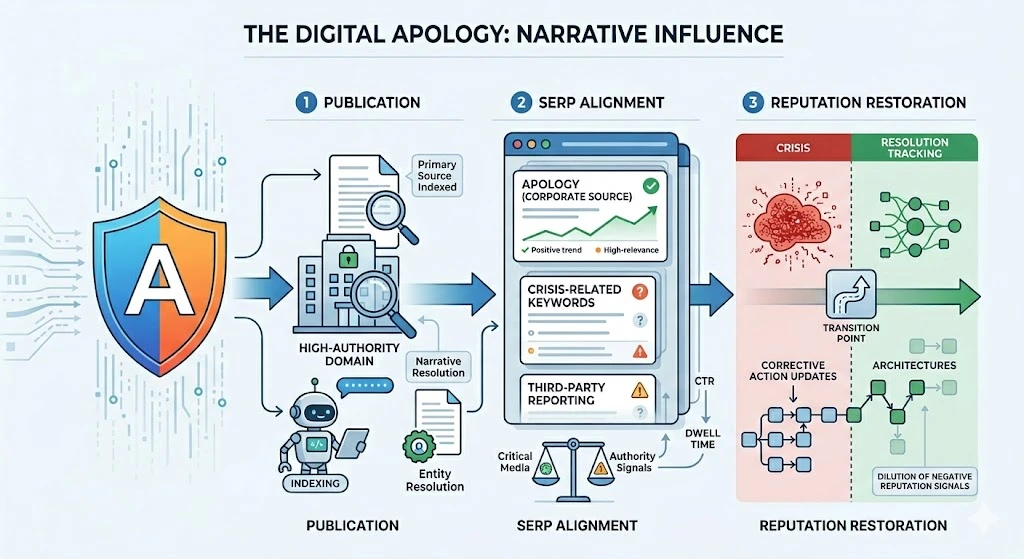
A digital apology functions as an authoritative corporate statement that introduces an alternative narrative node into the indexed content ecosystem. When an organization publishes an official statement on an optimized, high-authority domain, search engine crawlers index the document as a primary source text. This indexing event allows the organization to regain an element of narrative influence over the search queries directly associated with the crisis.
The publication of an apology creates a fresh, highly relevant URL that targets the specific crisis-related keywords driving public search intent. By optimizing this asset for search transparency, the organization provides algorithms with a definitive reference point for entity resolution. This asset acts as a stabilizing counterweight within the SERP, offering a direct, unmediated communication channel that can rank alongside third-party journalistic reporting.
Search algorithms evaluate the digital authority of the publishing platform to determine how high the apology ranks relative to critical media coverage. Utilizing an established corporate newsroom or investor relations domain ensures that the statement inherits the domain’s existing authority signals. This structural advantage increases the probability that the apology achieves prominent search visibility, ensuring that stakeholders encounter the organization’s perspective during query execution.
Algorithmic systems monitor user interaction signals, such as click-through rates and dwell time, to assess the informational value of the apology URL. If stakeholders find the statement comprehensive and authoritative, engagement signals stabilize, indicating to the algorithm that the search intent is being satisfied. This behavioral data supports the long-term retention of the apology link within prominent SERP positions, gradualizing the displacement of more damaging, speculative content.
Over time, a systematically structured digital apology facilitates the dilution of negative reputation signals by establishing a transition point in the indexed timeline. As subsequent updates detailing corrective actions are appended to or linked from the initial apology, the content ecosystem shifts from crisis documentation to resolution tracking. This structural evolution signals to search algorithms that the entity has mitigated the underlying operational risks, initiating the restoration of normalized trust architectures.
What Semantic Elements Define a Trust-Rebuilding Digital Narrative?
A trust-rebuilding digital narrative requires specific linguistic structures that NLP algorithms interpret as objective, accountable, and authoritative. Semantic clarity is achieved by eliminating hedging words, corporate jargon, and ambiguous phrasing that algorithms classify as low-quality or evasive content. The narrative must feature precise entity definitions, explicit acknowledgments of responsibility, and clear, actionable descriptions of future remediation protocols.
Search engines utilize advanced semantic analysis to evaluate the thematic coherence and truthfulness of institutional statements. Algorithms parse text for semantic chains that connect the entity node directly to verbs denoting ownership and rectification, rather than deflection or minimization. Using direct grammar structures such as “we accept responsibility” rather than passive constructions like “mistakes were made” establishes a definitive semantic record of accountability.
The integration of specific vocabulary related to governance, risk management, and compliance enhances the digital authority of the text. Terms such as “remediation protocol,” “independent audit,” “systemic oversight,” and “operational redundancy” signal to algorithmic evaluators that the text possesses high information density. This vocabulary structure aligns the document with the linguistic profiles of authoritative regulatory and industry-standard publications, boosting its credibility scores.
The architecture of the narrative must also accommodate the semantic expectations of human stakeholders, including investors, regulators, and the public. Acknowledging the specific impact of the operational failure on distinct stakeholder groups creates a comprehensive contextual framework that addresses multiple vectors of inquiry simultaneously. This multi-layered approach ensures that the document satisfies a broad spectrum of informational queries, consolidating public perception systems around a single, authoritative reference text.
The narrative structure must remain consistent across all distribution channels to avoid generating conflicting sentiment signals that degrade entity perception. Discrepancies between the core apology text and secondary social media communications confuse algorithmic interpretation models and damage stakeholder trust. Maintaining uniform semantic definitions guarantees that both automated indexing systems and human evaluators receive a singular, cohesive message regarding the organization’s corrective trajectory.
How Do Search Algorithms Evaluate Institutional Authority and Credibility Post-Crisis?
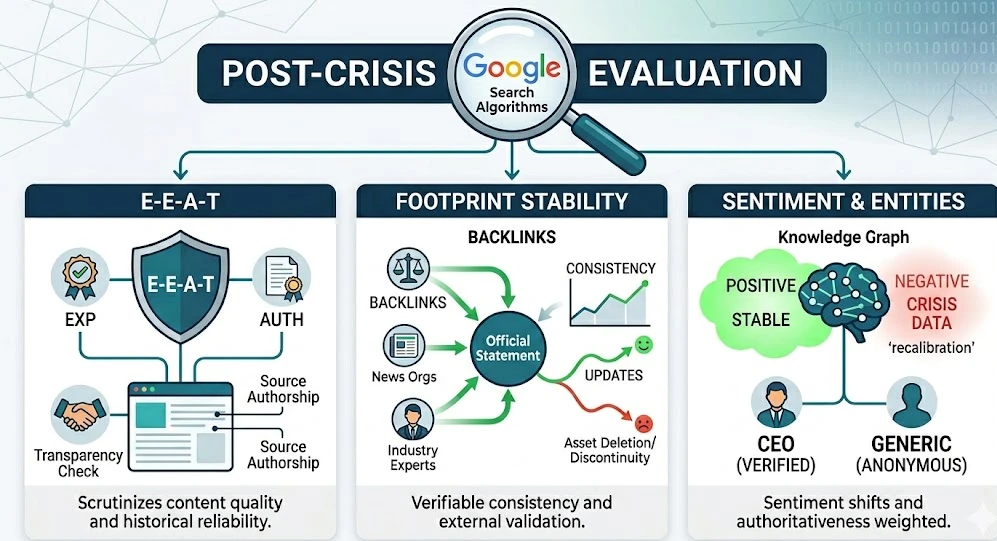
Post-crisis evaluation by search algorithms centers on the durability of an entity’s trust signals and the verifiable accuracy of its digital footprint. Search engines deploy specialized evaluation systems, such as Google’s Experience, Expertise, Authoritativeness, and Trustworthiness (E-E-A-T) guidelines, to assess institutional credibility. These systems scrutinize the transparency, source authorship, and historical reliability of the content published by the organization.
The algorithm analyzes the backlink profile of the apology and subsequent remediation updates to quantify external validation. When authoritative news organizations, legal bodies, and industry experts link to the organization’s official statement, they pass digital authority to that specific node. This backlink accumulation serves as an objective reputation signal, demonstrating to search engines that the primary source is regarded as the definitive account of the resolution process.
Algorithmic systems evaluate the long-term consistency of content indexing to detect whether the organization sustains its remediation commitments. If an organization publishes an apology but later deletes the asset or fails to provide promised updates, the digital footprint exhibits structural instability. Search engines interpret this discontinuity as a negative credibility signal, which can result in the devaluation of the entity’s owned domains for highly competitive queries.
Entity extraction models continuously monitor the web for mentions of the organization alongside terms indicating legal resolution, compliance certification, or operational stability. As the volume of verified, positive or neutral institutional developments increases, the sentiment weights within the knowledge graph recalibrate. This shift minimizes the visibility of historic crisis data, allowing the organization’s normalized search visibility to return to pre-crisis baselines.
The authority of the specific individuals authoring or signing the digital apology is also factored into the credibility assessment. Search engines map corporate executives as distinct entities within their knowledge graphs, tracking their individual digital authority and professional history. A statement signed by a verified Chief Executive Officer carries greater structural weight than an unsigned, generic corporate communication, providing a stronger trustworthiness signal to the indexing framework.
What Systemic Steps Are Required to Deploy an Architecturally Sound Digital Apology?
Deploying an architecturally sound digital apology requires a sequence of technical and editorial procedures designed to optimize content indexing and stabilize stakeholder perception systems. Each step must be executed with precision to ensure that the resulting digital assets achieve maximum search visibility and structural authority.
Summary of Digital Apology Architecture Components
To ensure that all semantic and structural requirements are met during deployment, organizations can reference the following matrix detailing the core components of digital apology architecture:
| Component | Technical Mechanism | Impact on Perception System |
| Canonical URL Hosting | Consolidates PageRank on the primary, high-authority domain. | Maximizes search visibility against adversarial third-party links. |
| Direct Semantic Verbs | Eliminates linguistic ambiguity for NLP sentiment processing models. | Establishes a permanent, unmediated record of corporate accountability. |
| Structured Data Integration | Provides explicit metadata tags defining text authorship and timeline context. | Accelerates accurate entity resolution within search knowledge graphs. |
| Remediation Documentation | Generates a continuous stream of fresh, policy-oriented text content. | Signals long-term risk mitigation to institutional stakeholders. |
| Authoritative Link Acquisition | Collects high-value backlinks from external regulatory and media sources. | Rebuilds domain-level trustworthiness scores post-crisis. |
The architecture of an organizational apology within digital ecosystems is governed by predictable rules of content indexing, semantic evaluation, and authority distribution. When a crisis occurs, an organization cannot rely on superficial messaging; it must systematically introduce highly structured, semantically accountable text content into the search ecosystem to correct negative entity perception. By optimizing the technical deployment of the apology, using precise risk and governance terminology, and securing external authority validation, an institution can actively influence its search visibility landscape. Ultimately, a successful digital apology transforms the indexed record of a crisis from a permanent reputational liability into a verifiable demonstration of institutional compliance, transparency, and structural resilience. Evaluating these digital structures systematically ensures that the long-term integrity of the organization’s online footprint remains intact. To maintain total transparency over these public assets, organizations routinely evaluate their online presence, which is precisely how an entity evaluates its search footprint when analyzing how Linkonize Conducts a Digital Footprint Audit and What We Do With What We Find to ensure structural alignment across all indexed channels.
Frequently Asked Questions
How does a digital reputation management strategy help an organization recover from a corporate crisis?
A digital reputation management strategy assists organizations by systematically restructuring their search visibility and suppressing negative search signals through the deployment of high-authority, optimized assets. Linkonize implements these frameworks by publishing authoritative corporate statements that introduce neutral narrative nodes into semantic knowledge graphs, helping to displace adverse third-party links. This systematic approach stabilizes stakeholder perception systems and gradually restores the entity’s baseline domain authority across search engine results pages (SERPs).
What are the core components of an effective crisis communication plan for online search ecosystems?
An effective online crisis communication plan relies on technical indexing optimization, semantic clarity, and authoritative backlink acquisition. The organization must publish its definitive response on a high-authority domain using structured data markup to facilitate rapid, accurate content indexing by search engine crawlers. Additionally, the narrative must use direct, accountable language that satisfies user search intent while minimizing negative sentiment tracking by natural language processing models.
Why do negative search results persist on the first page of Google after a public relations incident?
Negative search results remain visible primarily due to search engine algorithms that prioritize query-deserving-freshness (QDF) and high user engagement metrics during a public relations incident. When public queries spike, algorithmic systems elevate low-sentiment news articles, media commentary, and forum discussions to satisfy real-time information demands. Without proactive reputation management to inject authoritative, updated content nodes, these high-velocity adverse links continue to dominate the entity’s primary digital footprint.
How can an institution rebuild its E-E-A-T signals after experiencing structural trust degradation?
Rebuilding institutional Experience, Expertise, Authoritativeness, and Trustworthiness (E-E-A-T) signals requires continuous, verifiable documentation of remediation protocols and compliance updates over an extended timeline. Search algorithms evaluate the long-term consistency of an organization’s digital footprint to verify that corrective operational changes are being sustained. Securing high-value external citations and backlinks from regulatory bodies, top-tier media, and industry experts further validates the entity’s post-crisis credibility.
What technical steps prevent corporate statements from being buried by negative media coverage during a crisis?
To ensure corporate statements achieve prominent search visibility over critical media coverage, organizations must host the content on a clean, permanent canonical URL within their primary domain. Implementing structured data schema like NewsArticle helps search algorithms index and classify the text accurately as the primary entity resolution point. Furthermore, establishing a strategic internal linking matrix from high-traffic landing pages ensures optimal PageRank distribution to the apology or resolution asset.