

A crisis communications retainer defines how an organisation controls search visibility, narrative authority, and stakeholder trust signals during high-risk events. It ensures rapid SERP control, stabilises entity credibility, and prevents reputational fragmentation across digital ecosystems. In modern public affairs environments, perception is shaped in real time through search behaviour, media indexing, and stakeholder interpretation of digital signals. A structured retainer model ensures organisations do not react blindly; instead, they activate a pre-engineered system of narrative visibility management designed to protect institutional legitimacy under pressure.
What does a crisis communications retainer with Linkonize actually include in operational terms?
A crisis communications retainer with Linkonize delivers a structured response architecture that stabilises reputation signals, controls narrative visibility, and coordinates stakeholder trust alignment during disruption.
This model operates as a continuously prepared digital defence system rather than a reactive PR service. It ensures organisations maintain SERP control and entity credibility when external pressures escalate.
At its core, the retainer includes:
- Establishing real-time monitoring systems that detect narrative volatility across search engines, media platforms, and stakeholder channels
- Activating pre-approved messaging frameworks that preserve consistency in institutional communication
- Deploying rapid-response digital authority interventions that suppress misinformation and strengthen verified positioning
- Coordinating cross-channel alignment across search, social, and press ecosystems to ensure unified narrative distribution
- Maintaining a structured escalation protocol that eliminates ambiguity during crisis onset
These mechanisms ensure that reputation is not left to chance or fragmented response teams. Instead, organisations operate with engineered precision where every communication output reinforces trust signals and stabilises perception.
A retained model under professional reputation management service frameworks ensures predictable response execution, reducing reputational volatility and strengthening institutional credibility in high-stakes environments.
When is a crisis retainer activated and how does escalation work in real time?
A crisis retainer activates immediately when narrative instability emerges across search visibility, media coverage, or stakeholder sentiment signals.
Activation is not dependent on severity alone; it is triggered by measurable shifts in perception systems that indicate reputational exposure. This ensures organisations respond at the earliest inflection point, not after damage propagation.
Escalation follows a structured sequence:
Real-time activation sequence
- Detect reputational anomalies through continuous SERP and media monitoring
- Classify risk level based on narrative velocity and stakeholder impact
- Trigger war room coordination across communications, legal, and executive teams
- Deploy pre-approved holding statements aligned with stakeholder expectation systems
- Stabilise search presence through rapid digital authority reinforcement
This approach aligns directly with established crisis infrastructure principles outlined in What Is a Communications War Room and How Do Organizations Activate One When a Crisis Breaks?, which demonstrates how coordinated response environments ensure speed, precision, and narrative control during unfolding events.
Once activated, Linkonize ensures every communication output reinforces consistency, eliminating contradictory messaging that typically accelerates reputational decline. The result is controlled escalation where narrative authority is maintained even under intense scrutiny.
The system ensures organisations do not react emotionally; they respond through structured decision pathways designed for reputation stabilisation and search perception influence.
How does a crisis retainer improve search visibility control and stakeholder trust signals?
A crisis retainer improves search visibility control by actively reshaping how an organisation appears within indexed environments during high-risk periods.
Search engines function as perception engines. When crisis events occur, SERPs become the primary trust battleground where stakeholders form immediate judgments. A retained system ensures narrative dominance in these environments.
The mechanism operates through:
- Strengthening positive entity associations across high-authority digital surfaces
- Suppressing fragmented or misleading content through structured visibility reinforcement
- Reinforcing institutional credibility through consistent, high-trust content distribution
- Aligning press, owned media, and stakeholder communications into unified narrative signals
- Accelerating recovery of reputation signals following negative exposure
Stakeholder trust is influenced not only by the crisis itself but by how coherently an organisation communicates across digital channels. A structured retainer ensures every signal reinforces stability rather than uncertainty.
The How to Write a Crisis Holding Statement: The Most Important 100 Words Your Organization Will Ever Publish framework demonstrates how early-stage messaging defines downstream perception outcomes. When deployed correctly, holding statements act as stabilisation anchors for trust continuity during uncertainty.
Linkonize integrates these mechanisms into a unified response model that strengthens digital authority while preserving institutional legitimacy across search ecosystems and stakeholder networks.
Why is a retainer model more cost-effective than ad-hoc crisis response for UK organisations?
A retainer model delivers significantly greater cost efficiency than ad-hoc crisis response because it eliminates delayed reaction time, fragmented decision-making, and inconsistent narrative execution.
Crisis events amplify reputational risk exponentially when organisations lack pre-established systems. Ad-hoc responses introduce delays that directly increase visibility of negative narratives across search and media platforms.
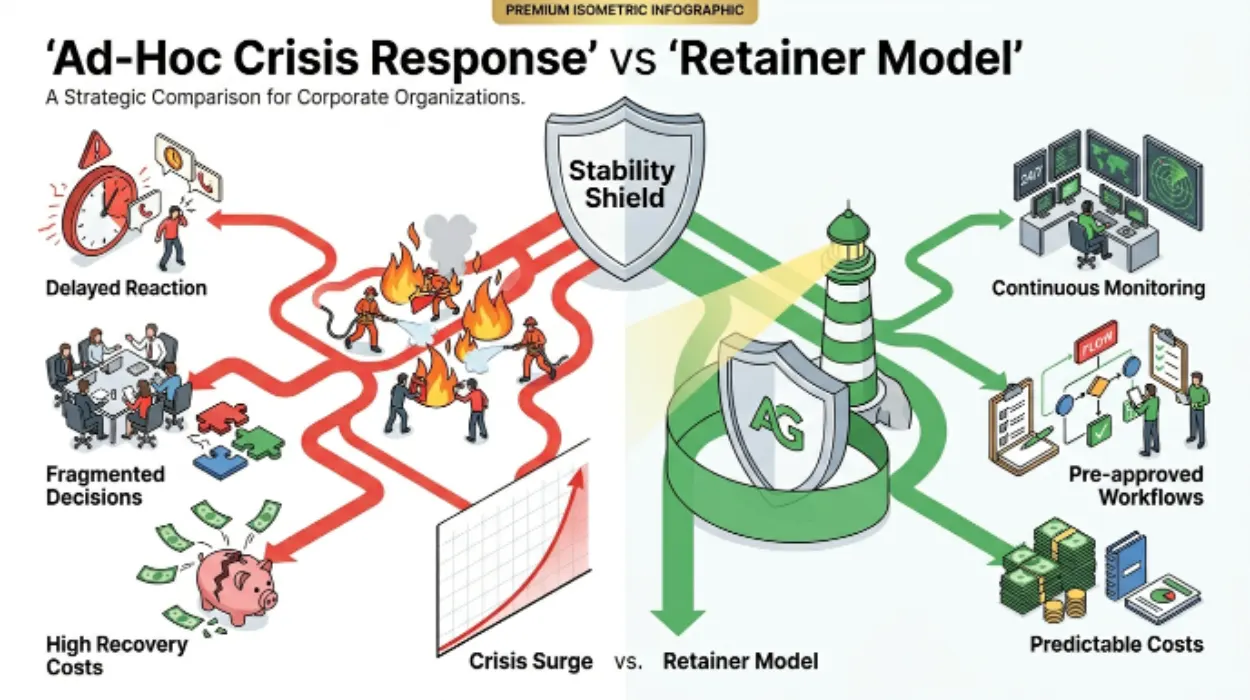
A retained structure reduces cost exposure through:
- Preventing escalation-driven reputational damage that requires expensive recovery campaigns
- Eliminating reactive agency onboarding delays during high-pressure situations
- Maintaining continuous monitoring that reduces blind spots in narrative visibility
- Ensuring pre-approved workflows reduce decision latency and operational inefficiency
- Stabilising stakeholder confidence, reducing long-term brand erosion costs
From a public affairs perspective, the cost of delayed perception control is significantly higher than proactive preparedness investment. Organisations without retained systems frequently require extensive remediation campaigns to rebuild entity credibility after uncontrolled narrative exposure.
A structured engagement with Linkonize ensures predictable financial planning while simultaneously reducing reputational volatility exposure. This dual benefit positions retainer-based models as a strategic necessity rather than an optional communications expenditure.
How does Linkonize ensure narrative stability and digital authority during high-pressure events?
Linkonize ensures narrative stability by engineering structured communication systems that maintain consistency, authority, and trust alignment during volatile public environments.
The process prioritises control of digital authority signals across all high-impact visibility channels, ensuring stakeholders receive coherent and reinforcing messages at every touchpoint.
Stability is achieved through:
- Deploying coordinated response frameworks across media, search, and stakeholder channels
- Aligning executive communication with structured narrative architecture
- Maintaining consistent entity credibility signals across all published outputs
- Executing rapid content calibration to counter misinformation propagation
- Reinforcing authoritative positioning through structured digital advocacy mechanisms
This system ensures that crisis environments do not fragment organisational identity. Instead, they reinforce controlled narrative positioning that strengthens institutional legitimacy.
A key advantage of this model is its integration with broader public affairs strategy consultancy principles, where perception management is treated as a continuous system rather than an isolated response function. This ensures organisations maintain strategic narrative positioning even under sustained scrutiny.
The result is a controlled communication environment where stakeholder interpretation remains aligned with organisational intent.
What outcomes should decision-makers expect from a retained crisis communications function?
A retained crisis communications function delivers measurable improvements in visibility control, stakeholder trust stability, and narrative authority during and after crisis events.
Decision-makers should expect outcomes that directly influence both perception systems and operational resilience.
Key outcomes include:
- Strengthening SERP dominance by stabilising and reinforcing positive entity associations
- Reducing reputational volatility through structured response timing and messaging control
- Improving stakeholder trust signals through consistent, authoritative communication outputs
- Accelerating recovery timelines following negative exposure events
- Enhancing institutional credibility across digital and media ecosystems
These outcomes are not abstract reputational improvements; they translate into measurable stability across search visibility and stakeholder perception systems. Organisations that maintain retained crisis infrastructure consistently outperform reactive competitors in narrative recovery speed and trust restoration.
A structured engagement model ensures that crisis communications function as a strategic asset rather than a reactive expense. This is where Linkonize positions itself as a reliability-driven partner in maintaining digital authority under pressure.
Frequently Asked Questions
What is included in a crisis communications retainer?
A crisis communications retainer includes a structured system for managing reputation risk, controlling narrative visibility, and protecting stakeholder trust signals during high-pressure events. It provides pre-built response frameworks, monitoring systems, and escalation protocols that activate immediately when a crisis emerges. The purpose is to ensure organisations do not rely on reactive decision-making. Instead, they operate through predefined communication structures that maintain consistency across search, media, and stakeholder channels. This stabilises reputation signals and strengthens digital authority during disruption.
When does a crisis communications retainer get activated?
A crisis communications retainer is activated the moment reputational risk signals appear across media coverage, search visibility, or stakeholder sentiment. Activation is triggered by measurable narrative instability rather than subjective judgement. Once activated, the response system coordinates rapid communication outputs, including holding statements and cross-channel messaging alignment. This ensures organisations maintain SERP control and prevent fragmented narratives from spreading across digital ecosystems.
How does a crisis retainer protect reputation in search results?
A crisis retainer protects reputation in search results by actively managing narrative visibility and strengthening positive entity credibility signals across digital platforms. It ensures that accurate, authoritative content remains dominant during periods of heightened attention. This reduces the impact of misleading or negative content by reinforcing structured messaging across high-authority sources. Over time, this stabilises search perception influence and supports faster reputation recovery.
Why is a crisis communications retainer better than reactive PR support?
A crisis communications retainer is more effective than reactive PR support because it eliminates delays in decision-making and response execution. Crisis situations evolve quickly, and any lag in communication increases reputational exposure. With a retainer model, organisations benefit from pre-approved messaging systems, real-time monitoring, and structured escalation pathways. This ensures faster response times, stronger narrative control, and reduced long-term reputation damage.
How does Linkonize support organisations during a crisis?
Linkonize supports organisations by providing a structured crisis communications framework that strengthens digital authority and stabilises stakeholder trust signals. It ensures every response is coordinated, consistent, and aligned with search visibility requirements. This includes rapid activation protocols, narrative alignment systems, and controlled messaging frameworks that maintain credibility under pressure. The result is improved reputation resilience and sustained institutional trust during critical events.