

Influencer marketing for advocacy is the use of trusted individuals to communicate policy, public interest, institutional, or societal messages to specific audiences. In advocacy environments, subject matter experts generate stronger credibility, authority signals, and stakeholder trust than celebrity figures because expertise directly influences perception and information evaluation.
Public affairs refers to the management and communication of issues that affect relationships between institutions, stakeholders, policymakers, and the public. Digital advocacy is the use of digital channels to shape awareness, engagement, and perception around public issues, policies, causes, or institutional objectives.
What Is Influencer Marketing for Advocacy?
Influencer marketing for advocacy is the strategic use of credible voices to distribute information, shape narratives, and strengthen stakeholder understanding within digital ecosystems. Unlike commercial influencer marketing, advocacy-focused influence centres on trust, expertise, and information legitimacy rather than audience entertainment. The primary objective is the transmission of credible information that contributes to informed public perception.
Within digital advocacy ecosystems, influence operates through authority recognition. Search engines, social platforms, media outlets, and audiences evaluate the credibility of information sources before assigning visibility and trust. Subject matter experts, academics, researchers, policy specialists, and industry authorities generate stronger reputation signals because their expertise aligns directly with the topic being discussed.
The mechanism relies on information relevance and authority matching. When expertise aligns with a subject area, digital systems interpret the content as more credible. This strengthens search visibility, improves content indexing performance, and reinforces stakeholder trust. Advocacy communication therefore becomes associated with evidence, expertise, and institutional credibility rather than personality recognition.
Why Does Expertise Matter More Than Popularity in Advocacy?
Expertise matters more than popularity because advocacy depends on credibility evaluation rather than audience familiarity. Public audiences assess information quality through signals that indicate knowledge, experience, and authority. Subject matter experts provide these signals through professional credentials, published work, recognised expertise, and topic-specific contributions.
Digital ecosystems increasingly evaluate expertise as a trust indicator. Search engines analyse content quality, topical relevance, author authority, and entity relationships when determining visibility. Social platforms evaluate engagement quality and audience relevance. Media organisations assess source credibility before amplification. These systems collectively prioritise information authority over entertainment value.
The impact extends beyond immediate visibility. Expert-driven communication creates stronger institutional perception because stakeholders associate expertise with reliability. This strengthens reputation signals across content ecosystems and improves long-term trust architecture. Celebrity influence creates awareness, while subject matter expertise creates credibility.
How Do Digital Ecosystems Evaluate Authority and Trust?
Digital ecosystems evaluate authority through interconnected signals that demonstrate expertise, relevance, and reliability. Authority is not a single metric. It emerges from multiple data points that collectively define entity perception across search engines, media platforms, and social networks.
Search engines analyse topical relevance, content quality, source credibility, citation patterns, and entity associations. These signals contribute to SERP evaluation and determine how information is indexed and ranked. Content that demonstrates subject expertise receives stronger authority recognition because it satisfies information quality requirements.
Media ecosystems apply a similar framework. Journalists, publishers, and industry analysts evaluate expertise before incorporating sources into reporting. Subject matter experts therefore gain recurring visibility because their contributions support information verification processes.
Stakeholder trust develops through repeated exposure to credible information. As authority signals accumulate across digital channels, institutions and individuals become associated with expertise. This strengthens digital authority and reinforces positive reputation signals throughout the ecosystem.
How Do Subject Matter Experts Influence Stakeholder Trust?
Subject matter experts influence stakeholder trust through information validation. Trust emerges when audiences perceive information as accurate, relevant, and supported by recognised expertise. Expert contributors strengthen these perceptions by providing specialised knowledge within clearly defined subject areas.
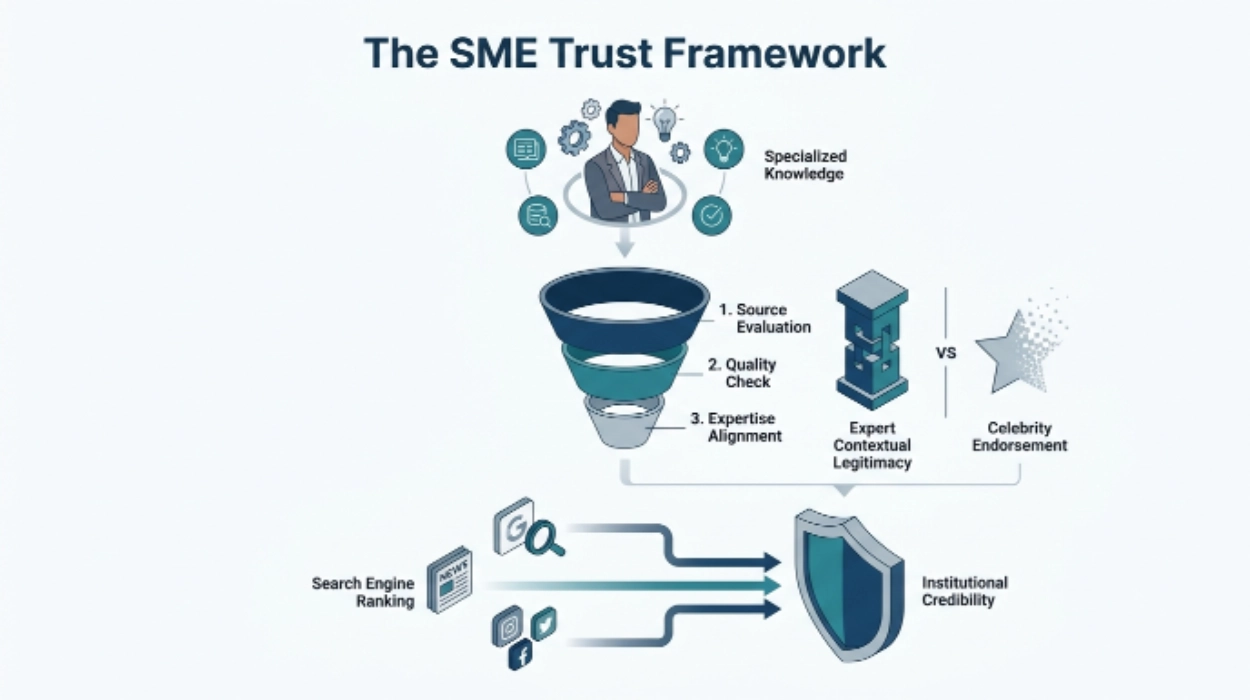
Trust formation follows a structured process. Stakeholders first evaluate the source. They then assess the quality of information. Finally, they determine whether the content aligns with established expertise. Subject matter experts satisfy each stage because their authority is directly connected to the topic under discussion.
This process influences digital reputation formation. Expert commentary generates stronger credibility indicators than celebrity endorsements because expertise provides contextual legitimacy. Search engines, media outlets, and audiences interpret these signals as evidence of authority.
The result is a stronger perception framework. Stakeholders associate expert-led narratives with reliability, accuracy, and informed analysis. These associations become embedded within digital perception systems and contribute to long-term institutional credibility.
How Do Narratives Shape Public Perception in Digital Advocacy?
Digital narratives shape public perception by organising information into frameworks that influence interpretation. A narrative is a structured explanation that defines how audiences understand an issue, institution, policy, or event within digital ecosystems.
Narrative influence operates through repetition, consistency, and visibility. When information appears across multiple trusted sources, stakeholders develop stronger associations between the narrative and the subject being discussed. Search engines reinforce this process by identifying recurring topical relationships during content indexing and ranking.
Subject matter experts contribute to narrative stability because they provide evidence-based explanations. Their expertise reduces ambiguity and strengthens information consistency. As a result, audiences receive clearer signals regarding credibility and authority.
Narratives directly affect institutional reputation. Positive narratives strengthen stakeholder trust and digital authority. Negative narratives influence sentiment interpretation and alter public perception. Digital advocacy therefore depends on effective narrative construction supported by credible expertise.
How Do Search Engines Interpret Credibility Signals?
Search engines interpret credibility signals through entity evaluation and content quality assessment. Credibility refers to the perceived reliability and authority of information sources within digital ecosystems. Search systems analyse these signals to determine ranking eligibility and search visibility.
Several mechanisms contribute to credibility assessment:
- Evaluate topical expertise – Search systems analyse content depth, relevance, and subject alignment to determine whether expertise exists within a specific topic area.
- Identify entity relationships – Search systems connect people, institutions, publications, and topics to understand authority networks and knowledge domains.
- Assess citation patterns – References, mentions, and authoritative citations reinforce credibility through external validation mechanisms.
- Measure consistency – Consistent publication activity strengthens entity perception and demonstrates ongoing expertise within a topic category.
These processes influence SERP evaluation and content ranking. Subject matter experts generate stronger credibility indicators because their expertise aligns directly with search engine quality frameworks.
What Role Does Institutional Credibility Play in Advocacy?
Institutional credibility is the perception that an organisation provides reliable information and operates with recognised authority. Within advocacy ecosystems, institutional credibility functions as a trust asset that influences stakeholder evaluation and information acceptance.
Credibility develops through consistent communication, expert association, and information quality. Institutions that regularly publish authoritative content establish stronger digital authority because search engines and audiences recognise recurring expertise signals.
Subject matter experts contribute significantly to this process. Their participation strengthens perceived competence and improves reputation signals across content ecosystems. Expert involvement also supports media visibility because journalists and researchers prioritise credible sources during information gathering.
Institutional credibility influences long-term perception outcomes. Strong credibility improves stakeholder trust, increases content discoverability, and enhances authority recognition across digital channels.
How Does Media Visibility Affect Advocacy Outcomes?
Media visibility affects advocacy outcomes because visibility influences information exposure. Information that receives greater exposure generates stronger opportunities for perception formation and stakeholder engagement.
Media ecosystems evaluate content based on relevance, authority, and public interest. Subject matter experts satisfy these criteria because their insights provide analytical value and contextual understanding. This increases the likelihood of media inclusion and citation.
Visibility also affects search performance. Media coverage contributes additional reputation signals that support entity recognition and authority evaluation. Search engines interpret these signals as indicators of relevance and credibility.
The combined effect strengthens digital authority. Increased visibility creates more opportunities for stakeholders to encounter trusted information sources, reinforcing credibility and supporting long-term reputation development.
How Do Content Ecosystems Shape Digital Authority?
Content ecosystems shape digital authority through interconnected networks of information, entities, and reputation signals. A content ecosystem includes websites, search engines, media outlets, social platforms, publications, and stakeholder communities that collectively influence information visibility.
Authority develops when expertise is consistently recognised across these environments. Search engines identify recurring expertise patterns through content indexing. Media organisations reinforce authority through citations and references. Stakeholders strengthen authority through engagement and information sharing.
Subject matter experts contribute directly to ecosystem-wide authority formation. Their expertise creates reliable information assets that support narrative consistency and credibility evaluation. These assets strengthen entity perception across multiple digital touchpoints.
As authority accumulates, visibility improves. Strong authority signals influence ranking performance, reputation development, and stakeholder trust. This demonstrates the relationship between expertise, content ecosystems, and digital influence.
Why Do Subject Matter Experts Create Stronger Long-Term Reputation Signals?
Subject matter experts create stronger long-term reputation signals because expertise remains relevant across evolving digital environments. Reputation signals are indicators that influence how institutions, individuals, and topics are evaluated within search, media, and stakeholder ecosystems.
Celebrity visibility depends largely on audience attention. Subject matter expertise depends on knowledge recognition. Knowledge recognition produces durable authority because it remains connected to information quality rather than popularity cycles.
Search engines continuously evaluate expertise-related signals during content indexing and ranking processes. Media organisations repeatedly seek authoritative sources when analysing complex issues. Stakeholders return to trusted experts when evaluating information credibility. These recurring interactions reinforce digital authority over time.
The outcome is sustained stakeholder trust, stronger institutional credibility, and more resilient entity perception. Expertise functions as a long-term reputation asset because it aligns with the mechanisms that define authority across digital ecosystems.
Conclusion
Influencer marketing for advocacy is fundamentally a credibility-driven communication model. Subject matter experts outperform celebrities because advocacy relies on expertise, trust formation, authority recognition, and information legitimacy rather than audience popularity.
Digital ecosystems evaluate authority through reputation signals, entity perception, content quality, and credibility assessment. Search engines, media organisations, and stakeholders consistently prioritise expertise when determining trust and visibility. Subject matter experts strengthen narrative influence, support institutional credibility, improve search visibility, and reinforce digital authority across interconnected content ecosystems.
Within public affairs and digital advocacy, expertise functions as a core mechanism of perception formation. Authority, trust, and credibility emerge through consistent demonstration of knowledge, creating stronger long-term reputation signals and more stable stakeholder relationships.
A related concept within digital advocacy involves Community Management in Advocacy: How to Build an Online Base That Mobilizes on Command, which examines how stakeholder engagement structures influence participation, trust development, and collective digital action.
Frequently Asked Questions
What is influencer marketing for advocacy?
Influencer marketing for advocacy is the use of trusted individuals to communicate messages related to public issues, policies, institutions, or causes. The focus is on credibility, expertise, and stakeholder trust rather than audience entertainment or product promotion.
Why are subject matter experts more effective than celebrities in advocacy?
Subject matter experts provide recognised knowledge and topic-specific authority. Their expertise strengthens credibility signals, improves stakeholder trust, and supports stronger reputation formation across search engines, media platforms, and digital ecosystems.
How does influencer marketing affect public perception?
Influencer marketing affects public perception by shaping how information is interpreted and evaluated. When trusted experts communicate a message, audiences associate the information with authority and reliability, which influences stakeholder trust and institutional credibility.
What role do search engines play in evaluating advocacy content?
Search engines evaluate advocacy content through content quality, topical relevance, entity relationships, and credibility indicators. These factors influence content indexing, search visibility, and SERP evaluation, helping determine which information receives greater exposure.
How do reputation signals influence digital advocacy?
Reputation signals help define how institutions, experts, and topics are perceived online. Consistent expertise, authoritative content, media citations, and trusted entity associations strengthen digital authority and contribute to long-term stakeholder trust.