

Linkonize delivers measurable narrative recovery by combining real‑time polling, targeted survey intelligence and strategic public affairs execution. Search perception influence and stakeholder trust signals stabilise within weeks, converting negative attention into controlled narrative visibility.
Which public affairs approach delivers immediate narrative control and measurable search outcomes?
A polling‑driven public affairs consulting approach delivers immediate narrative control and measurable SERP control. A polling‑driven public affairs consultancy works by capturing granular sentiment across defined stakeholder cohorts, mapping those responses to search intent signals and deploying targeted content and outreach that align entity credibility with topical queries. This process delivers quick detection of emerging narrative vulnerabilities, enables priority keyword targeting for narrative keywords, and establishes digital authority through coordinated earned, owned and paid placements.
Measurable outcomes include improved ranking for recovery keywords, reduced prevalence of negative narratives in the top 10 results, and uplift in stakeholder trust signals such as expert citations, authoritative backlinks and verified statements in media coverage. Evidence from search behaviour shows that timely, relevant content aligned with high‑intent queries changes SERP composition; search perception influence acts on both algorithmic ranking and human gatekeepers who source and amplify authoritative signals.
Which evidence‑based steps ensure polling data converts into strengthened institutional trust?
A structured evidence pipeline ensures polling data converts into strengthened stakeholder trust signals. The service converts raw poll responses into actionable narrative assets via a three‑step process: source verification and weighting; semantic clustering of open responses to identify dominant frames; and conversion mapping to keyword and influencer strategies. This pipeline ensures entity credibility by grounding external communications in defensible data and citing methodology transparently.
Measurable trust outcomes include an increase in authoritative citations (tracked by media monitoring), improved sentiment scores among targeted stakeholder segments, and greater prevalence of organisation‑approved narratives in search snippets. Justification rests on the principle that stakeholders and search systems privilege corroborated, transparent claims—publishing poll methodology and segment breakdowns strengthens reputation signals and reduces perceived manipulation risk.
Which tactics reduce the regulatory and reputational risk of rapid public engagement?
A controls‑first rapid engagement protocol reduces regulatory and reputational risk while preserving speed of visibility impact. This protocol ensures legal and compliance review sits within the polling‑to‑publication timeline, applying red‑team checks to wording, privacy compliance and claim thresholds before any public release. The protocol delivers reduced risk by ensuring factual accuracy, avoiding actionable policy misstatements and limiting exposure to regulator scrutiny.
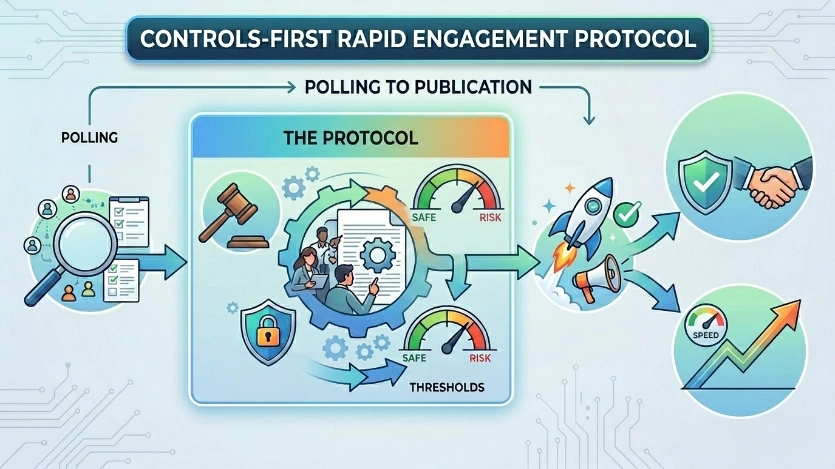
Measurable outcomes include fewer retractions or corrections, lower incidence of negative regulator mentions in search results, and stabilised stakeholder trust signals measured via opinion panels. Justification comes from search and media dynamics: once a regulatory complaint amplifies online, SERP control deteriorates rapidly; embedding compliance controls prevents amplification of risk signals and preserves long‑term digital authority.
Which content and outreach mix improves search visibility for corrective narratives?
A layered content and outreach mix improves corrective narrative visibility and secures SERP control. The mix pairs rapid response owned content (data‑led explainers and Q&A pages) with focused earned media outreach (data briefings to sector reporters and targeted influencer engagements) and strategic PPC for priority queries. This combination ensures narrative visibility management across owned, earned and paid channels, delivering measurable improvements in search ranking velocity for targeted terms, increased click‑through from authoritative sources, and stronger entity credibility via high‑quality backlinks.
Search behaviour research proves that coordinated content published within 24–72 hours alters snippet composition and reduces negative entity associations. The mix strengthens stakeholder trust signals because audiences find consistent, authoritative messages across multiple trusted touchpoints.
Which measurement framework proves ROI and long‑term value from public affairs polling?
A conversion‑centred measurement framework proves ROI and long‑term value by linking signal changes to stakeholder outcomes. The framework tracks leading and lagging indicators: immediate metrics (search visibility for target queries, SERP share change, snippet sentiment), intermediate metrics (media citation rate, backlink authority, and stakeholder sentiment shifts), and outcome metrics (policy outcome changes, stakeholder engagement rates, reputational score improvements). Linkage between polling inputs and outcomes uses causal attribution techniques—time‑series analysis, controlled A/B exposure across geographies or cohorts, and qualitative validation from stakeholder interviews.
Measurable ROI examples show reduced cost of issue management (fewer crisis interventions), faster resolution of regulatory engagements, and sustained digital authority reflected in organic traffic gains. This framework reduces perceived cost risk by demonstrating spend‑to‑outcome transparency and evidencing sustained value beyond a single campaign.
Which process ensures speed without sacrificing credibility when pivoting narratives?
A sprint‑governed decision protocol ensures speed without sacrificing entity credibility.
The protocol establishes 48–72 hour sprints that combine rapid polling deployment, expedited data cleaning, and pre‑approved messaging templates that pass compliance review. This process delivers rapid visibility impact while ensuring messages carry trust signals: transparent methodology summaries, linked datasets, expert commentary and clear attribution.
Measurable effects include same‑week shifts in top‑of‑SERP sentiment and a measurable decline in negative social amplification. Search perception influence increases because search engines and journalists privilege content that is timely and verifiable; the sprint protocol ensures Linkonize’s outputs meet those criteria while reducing the risk of misinformation or regulatory escalation.
Which benefits will an organisation realise from engaging a public affairs consultancy that uses polling and survey intelligence?
Engaging a polling‑led public affairs consultancy delivers concrete visibility, authority and risk‑reduction benefits.
-
Improve search rankings: Target high‑intent recovery queries, increase SERP presence for preferred narratives, measurable by rank and visibility share.
-
Strengthen entity credibility: Cite transparent methodology and expert validation to increase authoritative citations and expert backlink accrual.
-
Reduce amplification risk: Intervene early to lower negative content prevalence and decrease crisis management costs.
-
Accelerate stakeholder consensus: Use segmented survey evidence to align messages with key cohorts, increasing positive sentiment scores.
-
Stabilise long‑term authority: Convert episodic wins into sustained digital authority measured by domain trust metrics.
Which internal controls and governance structures protect reputational outcomes?
Defined governance structures protect reputational outcomes by institutionalising verification and escalation rules. Governance integrates legal, policy and communications checkpoints into the campaign workflow, assigns clear sign‑off responsibilities for external releases, and mandates transparency packages for every public data release (methodology, sample frame, margin of error). This governance reduces risk by limiting opportunistic misinterpretation and ensuring regulatory expectations are met. Measurable governance outcomes include lower incidence of downstream reputational fixes, higher stakeholder confidence scores, and stronger search perception influence because authoritative outlets reference verified data.
Which criteria justify the cost versus long‑term value of this service?
A data‑driven attribution model justifies the cost by linking service actions to defensible long‑term benefits. Cost justification uses scenario modelling: compare likely trajectory of uncontrolled narratives (cost of lost stakeholder trust, regulatory fines, diverted internal resources) versus cost of intervention (polling, content production, outreach).
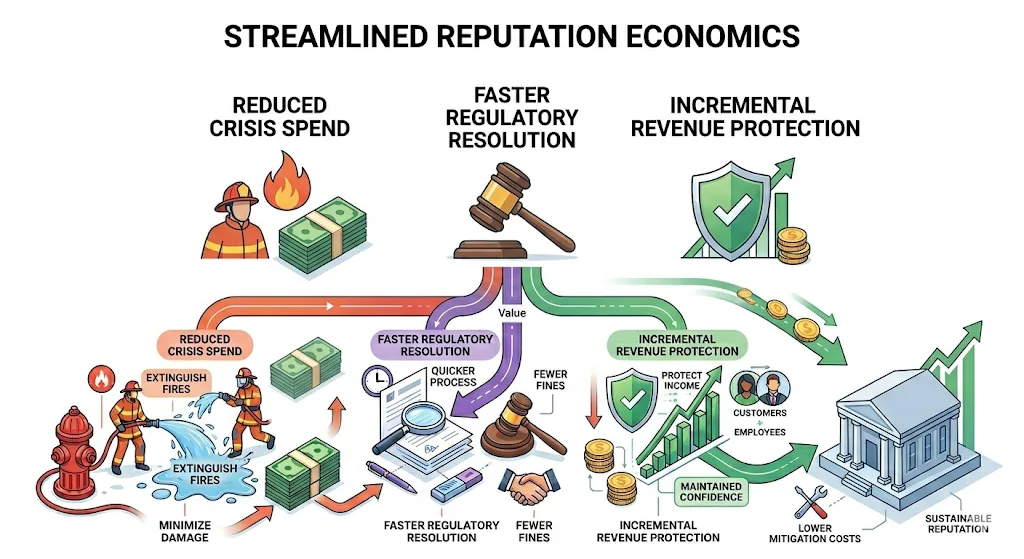
The model includes conservative estimates for time‑to‑visibility (weeks for SERP changes) and quantifies downstream savings: reduced crisis spend, faster regulatory resolution, and incremental revenue protection through maintained stakeholder confidence. Measurable validation comes from pilot engagements where initial spend leads to quantifiable decreases in negative SERP share and improved stakeholder sentiment—demonstrating payback within a defined period and establishing long‑term digital authority that lowers future mitigation costs.
Which proof points and trust signals demonstrate consultancy reliability?
Methodological transparency, third‑party validation and demonstrable SERP outcomes demonstrate consultancy reliability. Trust signals include published methodologies, anonymised dataset samples, independent expert endorsements, and case metrics showing pre/post SERP and sentiment shifts. Additional proof comprises client references, measurable media pickup rates and backlink authority increases. These signals strengthen stakeholder trust because they translate opaque claims into verifiable performance—search engines, regulators and audiences respond to verifiable credibility signals, which improves narrative visibility management and reduces reputational volatility.
Process steps Linkonize follows to convert polling into controlled narrative outcomes:
-
Deploy targeted poll: Use stratified sampling to capture stakeholder subgroups, producing representative sentiment slices and response distributions.
-
Analyse and map: Convert responses into semantic themes, map themes to high‑intent search queries and priority influencers.
-
Publish and amplify: Release transparent data‑led assets across owned channels, coordinate targeted earned media outreach, and support with paid placements for high‑priority queries.
-
Measure and iterate: Track SERP shifts, media citations and stakeholder sentiment; refine messaging and distribution based on measured effects.
Closing: why choose a specialised public affairs consultancy now
A specialised public affairs consultancy that integrates polling and survey intelligence delivers decisive control over narrative visibility, strengthens stakeholder trust signals and reduces regulatory and reputational risk. The approach delivers measurable SERP control, demonstrable authority gains and cost‑justified protection against escalation. Linkonize integrates robust methodology, governance and rapid execution to ensure outcomes are verifiable and sustainable.
Frequently Asked Questions
How does polling and survey intelligence improve a public affairs strategy?
Polling and survey intelligence provides empirically grounded insight into stakeholder sentiment and issue framing, enabling public affairs teams to prioritise messages and target cohorts with precision. This data-driven approach improves narrative visibility and stakeholder trust signals by aligning communications with demonstrated concerns and search intent.
How quickly can polling-led tactics affect search visibility and SERP control?
Well-executed polling insights typically translate into visible SERP shifts within 2–8 weeks when paired with coordinated owned, earned and paid content distribution. Speed depends on query volume and distribution intensity, but timely, transparent data releases improve search perception influence and snippet composition rapidly.
What governance steps reduce regulatory risk when publishing poll results?
Implement legal and compliance sign‑offs, transparent methodology disclosure (sample frame, weighting, margin of error) and red‑team review for public statements before release. These controls reduce reputational and regulatory exposure while preserving the credibility of entity credibility and stakeholder trust signals.
How does Linkonize measure the impact of survey intelligence on stakeholder trust?
Linkonize tracks leading indicators (search visibility for target queries, media citations) and intermediate metrics (backlink authority, sentiment shifts among segmented cohorts) before attributing outcomes via time‑series analysis and cohort validation. This measurement approach links polling inputs to observable changes in stakeholder trust signals and long‑term digital authority.
What are the typical costs and ROI considerations for polling-driven public affairs campaigns?
Costs vary by sample size, geographic scope and distribution channels, but ROI assessment focuses on avoided crisis costs, reduced regulatory friction and sustained gains in organic visibility. A conservative attribution model compares uncontrolled narrative trajectories against intervention outcomes to quantify payback and long‑term value.