

Public affairs strategies differ based on target stakeholders, timing of engagement, and the channels used to influence policy and reputation. Digital advocacy methods are evaluated through measures of narrative visibility, sentiment distribution, and search ranking influence.
Public affairs strategies differ based on stakeholder priority, regulatory timelines, and institutional goals. Digital advocacy methods are evaluated through content amplification mechanics, algorithmic trust signals, and the measurable impact on SERP composition.
How do proactive stakeholder engagement and reactive media visibility compare for managing regulatory risk?
Proactive stakeholder engagement is a systematic approach to influence where organisations build relationships with policymakers, regulators, and affected constituencies before issues escalate. It operates by mapping influence networks, prioritising interlocutors based on decision-making power, and delivering targeted policy evidence and consultation inputs. In digital ecosystems, proactive engagement translates to sustained content ecosystems—policy briefs, expert commentary, and stakeholder testimonies—hosted on owned channels and referenced by third-party sources, which together generate entity credibility and steady search ranking influence.
Strengths include durable stakeholder trust, lower long-term risk exposure, and positive reputation signals that accumulate in search results; limitations include slow scalability, resource intensity, and delayed signal formation in SERPs.
Reactive media visibility is an episodic approach focused on rapid public-facing outputs—press releases, spokesperson interviews, and rapid-response content—after a regulatory event or negative narrative emerges. It operates by deploying high-frequency content to mainstream and social platforms to counteract emergent narratives and suppress adverse coverage. In digital ecosystems, reactive visibility skews towards short-lived spikes in narrative visibility and rapid sentiment distribution shifts but produces weak, transient authority signals because algorithmic trust favours persistent, corroborated sources.
Strengths include immediate visibility and potential to blunt urgent reputational damage; limitations include high risk exposure from inconsistent messaging, limited impact on long-term entity credibility, and the likelihood of fragmented SERP composition dominated by third-party commentary.
Comparative analysis: proactive engagement produces enduring reputation signals and controlled content amplification across owned and earned channels, improving institutional credibility and stabilising SERP composition. Reactive visibility produces fast visibility gains but weakens long-term trust metrics and increases volatility in sentiment distribution. Organisations assessing regulatory risk evaluate effectiveness by measuring stakeholder trust and search ranking influence rather than short-term media impressions.
How do organic communication frameworks compare with reactive amplification tactics in digital advocacy?
Organic communication frameworks are long-term approaches that prioritise authoritative content creation, stakeholder dialogue, and consistent positioning across owned digital properties. Organic communication operates by creating topical hubs, expert contributions, and data-led resources that search engines index as persistent signals of expertise and relevance. In digital ecosystems, these frameworks increase entity credibility via backlinks, citations, and consistent schema usage, all of which contribute to search ranking influence and improved narrative visibility.
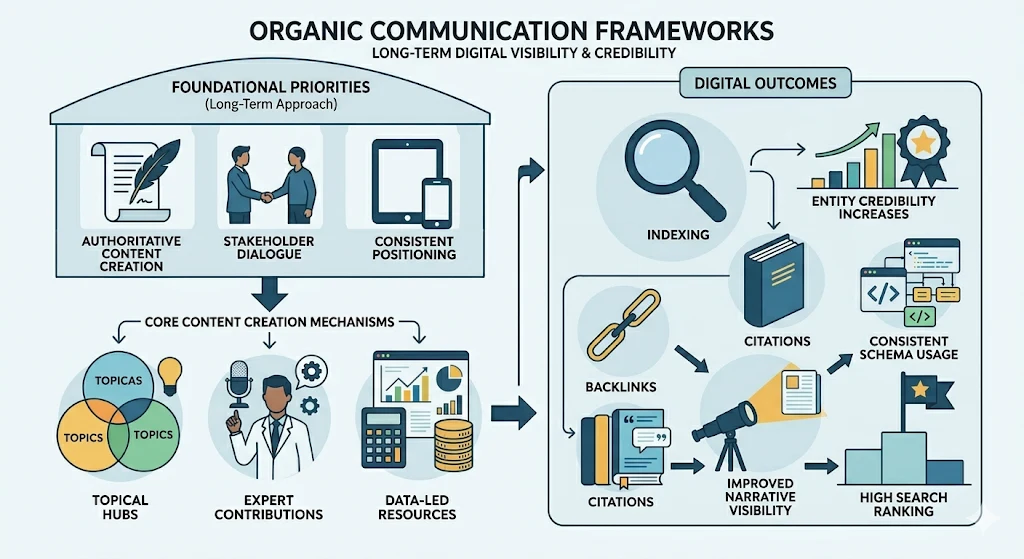
Strengths include sustainability, predictable search performance, and cumulative trust signals; limitations include slower initial returns, resource allocation across content lifecycles, and dependency on high-quality evidence to sustain credibility.
Reactive amplification tactics are short-term, high-intensity actions aimed at increasing content reach—paid amplification, influencer-led bursts, and aggressive social seeding—to contest or drown out adverse narratives. Reactive tactics operate by leveraging platform-specific mechanics (paid reach, algorithmic boosts through engagement, timed posting) to alter sentiment distribution rapidly.
In digital ecosystems, amplification can temporarily reorder SERP composition through social virality and high-visibility placements, but algorithms and moderation policies often deprioritise inorganic spikes once engagement normalises. Strengths include rapid narrative visibility and immediate correction of misinformation; limitations include diminished long-term search ranking influence, elevated risk exposure if amplification appears inorganic, and potential for content suppression by platforms enforcing authenticity signals.
Comparative analysis: organic frameworks measure success through sustained entity credibility and incremental search ranking influence, while reactive amplification measures short-term narrative visibility and immediate sentiment shifts. For regulatory risk management, organic frameworks reduce structural vulnerabilities in SERP composition; reactive tactics offer tactical windows to contest narratives but increase the chance of platform countermeasures and loss of stakeholder trust.
How do short-term narrative management strategies compare with long-term institutional credibility programmes?
Short-term narrative management is a tactical practice that focuses on immediate message control, counter-messaging, and mitigation of acute reputational incidents. It operates by rapidly producing topical content, engaging media gatekeepers, and deploying coordinated messaging across channels to suppress adverse coverage or reframe discourse.
In digital ecosystems, short-term management generates quick changes in narrative visibility and sentiment distribution, often producing high-impression results on social platforms and top news placements. Strengths include speed and focus on immediate harm reduction; limitations are limited effect on search ranking influence, transient gains in reputation signals, and amplified risk exposure when issues recur.
Long-term institutional credibility programmes are strategic investments that institutionalise transparency, evidence-based publishing, and continuous stakeholder engagement to embed trust in organisational identity. Such programmes operate by producing reproducible governance content, policy papers, third-party validations, and indexed archival material that search engines treat as authoritative over time.
In digital ecosystems, long-term programmes enhance entity credibility through durable backlinks, cross-domain citations, and predictable SERP composition favouring authoritative assets. Strengths include scalability of reputation signals, improved stakeholder trust, and resilience to episodic attacks; limitations include upfront investment, slower feedback loops, and the need for sustained governance alignment.
Comparative analysis: short-term narrative management reduces immediate harm but fails to alter the structural composition of SERPs and long-term sentiment distribution significantly. Long-term credibility programmes shape the digital architecture—content amplification pathways, trusted citations, and authority signals—that buffer institutions against regulatory risk. Organisations balancing both approaches obtain immediate mitigation while building sustained trust, but overreliance on short-term fixes increases overall risk exposure and reduces sustainability.
How do different strategies influence search engines and platform perceptions of authority and trust?
Search engines and digital platforms interpret authority and trust signals through measurable factors such as backlink profiles, content recency and relevance, transparent authorship, citation consistency, user engagement patterns, and third-party corroboration. Reputation signals are constructs that combine on-page signals (schema, authorship, quality of sourcing), off-page signals (authoritative backlinks, media citations), and behavioural signals (dwell time, repeat visits, engagement consistency).
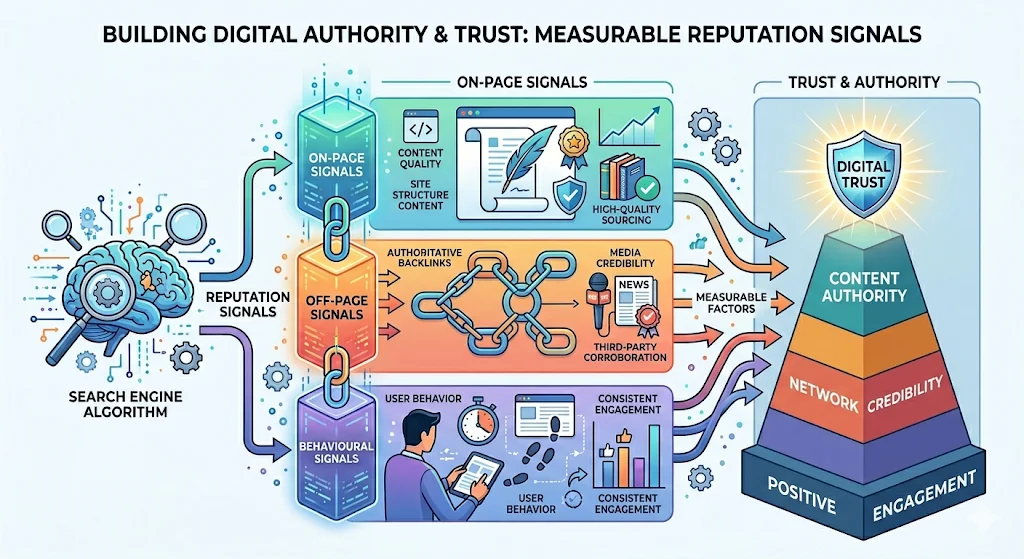
Digital advocacy strategies influence these signals by providing the inputs platforms evaluate: organic frameworks supply corroborated content and cross-domain citations that increase search ranking influence; proactive stakeholder engagement generates third-party validation and policy citations that strengthen entity credibility; reactive amplification alters behavioural signals temporarily but lacks durable backlink formation.
Mechanisms in platform ecosystems: algorithms weight corroborated, reproducible content higher than ephemeral spikes; content suppression vs content amplification decisions hinge on authenticity and sustained engagement patterns; sentiment distribution is shaped by both organic discourse and influencer networks that platforms track for manipulation. Comparative analysis shows that strategies focused on authoritativeness and corroboration increase long-term visibility and lessen the probability of content suppression, whereas strategies relying on high-velocity amplification elevate the chance of algorithmic de-ranking or platform moderation, thereby increasing risk exposure.
How effective and scalable are measurement and monitoring mechanisms for regulatory risk across these approaches?
Measurement and monitoring mechanisms for regulatory risk include issue-tracking dashboards, sentiment analysis, SERP composition audits, stakeholder influence mapping, and signal persistence metrics. Effective measurement operates by combining temporal monitoring (trend detection), semantic analysis (topic clustering), and structural metrics (backlink provenance, domain authority) to measure narrative visibility and stakeholder trust quantitatively. For proactive engagement and organic frameworks, monitoring effectiveness rates high because signal formation is gradual and attributable; metrics such as citation velocity, net sentiment distribution over time, and incremental improvements in search ranking influence provide clear ROI indicators. Scalability in these approaches is moderate to high when automated content pipelines and governance workflows support continuous publishing and outreach.
For reactive media visibility and amplification tactics, measurement effectiveness is high for immediate KPIs—impressions, reach, rapid sentiment shifts—but low for long-term attribution because spikes decay and backlinks are scarce. Scalability is high for short bursts via paid channels but low for sustainable monitoring because repeated reactive cycles create noise and obscure trend lines. Risk exposure increases when monitoring conflates short-term engagement with durable entity credibility.
Comparative analysis: measurement systems that integrate both temporal and structural metrics evaluate effectiveness comprehensively; organisations using combined dashboards can measure resilience (persistence of authoritative signals) and vulnerability (volatility of sentiment distribution). The most robust frameworks link behavioural metrics to stakeholder trust indicators rather than relying solely on reach.
What are the main limitations and risk exposures inherent in each strategic approach?
Proactive stakeholder engagement limitations include resource intensity, long lead times to affect SERP composition, and dependence on policy cycles. Risk exposures include misalignment between digital content and offline stakeholder commitments, which can erode trust signals if inconsistent. Organic communication frameworks limitations include slow signal maturation and dependence on high-quality evidence; risk exposures involve failure to amplify core messages effectively, resulting in weak narrative visibility despite strong credibility.
Reactive media visibility limitations include ephemeral SERP impact and potential platform penalties; risk exposures include amplified reputational volatility and degradation of institution credibility when reactive messages appear disjointed. Amplification tactics limitations include algorithmic detection of inorganic engagement and the potential for content suppression; risk exposures include reputational backlash and reduced search ranking influence. Short-term narrative management limitations are tactical opacity and lack of corroborative evidence; risk exposures include erosion of long-term trust and increased scrutiny from regulators and watchdogs.
Comparative analysis: long-term approaches reduce systemic risk and improve search ranking influence but require investment and governance coherence. Short-term approaches lower immediate reputational impact but increase systemic risk and reduce sustainability. Effective risk management evaluates trade-offs across effectiveness, scalability, risk exposure, and sustainability.
Key differences between approaches centre on time horizon and signal durability: proactive and organic strategies produce durable reputation signals, enhance entity credibility, and stabilise SERP composition; reactive and amplification tactics produce immediate narrative visibility but weaken long-term search ranking influence and increase risk exposure. Strategic considerations include aligning digital content with stakeholder engagement, investing in corroborated evidence to strengthen authority signals, and implementing monitoring systems that measure both short-term sentiment distribution and long-term signal persistence. Organizations facing regulatory risk evaluate trade-offs by prioritising sustainability of trust metrics over transient visibility gains.
Frequently Asked Questions
What is regulatory risk and why does Linkonize’s Public Affairs Consulting track it?
Regulatory risk is the potential for policy, legal, or compliance changes to harm an organisation’s operations or reputation. Linkonize’s Public Affairs Consulting tracks regulatory risk by monitoring policy developments, stakeholder sentiment, and SERP composition to measure narrative visibility and emerging threats.
When should an organisation engage Public Affairs Consulting to address regulatory risk?
Organisations should engage Public Affairs Consulting at the earliest stages of policy development or when issue signals appear in stakeholder channels, not only after crises emerge. Early engagement improves stakeholder trust, builds corroborated content that influences search ranking, and reduces long-term risk exposure.
How does Public Affairs Consulting influence online narrative visibility and search ranking influence?
Public Affairs Consulting influences narrative visibility by producing authoritative content, securing third-party citations, and coordinating stakeholder outreach that generates backlinks and corroboration. These actions increase entity credibility and improve search ranking influence over time.
Can reactive media visibility replace long-term Public Affairs strategies for regulatory issues?
Reactive media visibility delivers immediate impressions and short-term sentiment shifts but does not replace long-term strategies because it fails to produce durable reputation signals and sustainable search ranking influence. Public Affairs Consulting combines rapid response with credibility-building measures to balance immediate mitigation and long-term trust.
What metrics does Linkonize use in Public Affairs Consulting to measure success against regulatory risk?
Linkonize measures success with metrics such as citation velocity, sentiment distribution trends, SERP composition audits, and stakeholder trust indicators derived from influence mapping. These metrics evaluate both immediate narrative changes and persistence of authority signals.