

Policy teams choose professional Digital Advocacy services because they deliver measurable stakeholder engagement, stronger narrative visibility, and greater control over how policy issues are discovered, interpreted, and acted upon online.
In modern public affairs environments, search visibility control, stakeholder trust signals, and narrative credibility directly influence decision-making outcomes. Organisations that maintain strong digital authority and consistent search perception influence gain a strategic advantage in legislative engagement, institutional trust building, and public credibility management.
Which digital advocacy approach delivers the strongest stakeholder engagement outcomes?
A structured Digital Advocacy strategy delivers the strongest stakeholder engagement outcomes because it combines targeted audience activation, narrative visibility management, and measurable advocacy actions within a single framework.
Traditional outreach methods rely heavily on direct contact and offline relationship-building. Digital ecosystems operate differently. Policymakers, journalists, institutional stakeholders, advocacy groups, and citizens increasingly discover information through search engines, social platforms, online publications, and digital communities. Effective advocacy campaigns ensure that key messages appear consistently across these channels, strengthening reputation signals and improving issue visibility.
Digital Advocacy campaigns create measurable engagement pathways that connect awareness directly to action. Rather than relying on passive information dissemination, they encourage stakeholders to participate through structured engagement mechanisms that improve campaign performance and policy visibility.
Key outcomes include:
- Increase stakeholder participation through targeted engagement journeys.
- Strengthen narrative visibility management across search and digital channels.
- Improve stakeholder trust signals through consistent message delivery.
- Generate measurable advocacy actions that support policy objectives.
- Enhance digital authority around priority policy topics.
This approach ensures that policy teams maintain greater control over stakeholder interactions while improving the efficiency of advocacy investment.
Why does digital advocacy create stronger narrative visibility than traditional methods?
Digital Advocacy creates stronger narrative visibility because it influences how information is discovered, indexed, and prioritised across digital ecosystems.
Search engines act as modern information gateways. When stakeholders seek information about legislation, policy proposals, regulatory developments, or institutional positions, search results shape initial perception. Narrative visibility management focuses on ensuring that authoritative, credible, and strategically aligned content occupies prominent positions within the search landscape.
This process improves SERP control by increasing the visibility of trusted information sources while reinforcing entity credibility. Strong entity credibility signals help search engines associate organisations with expertise, trustworthiness, and relevance within specific policy domains.
Policy teams benefit from greater narrative consistency because digital advocacy campaigns establish coordinated messaging across multiple touchpoints. This consistency strengthens search perception influence and reduces the risk of fragmented stakeholder understanding.
For organisations evaluating advocacy solutions, understanding What Is a Click-to-Call Campaign? Digital Advocacy’s Most Powerful Legislative Tool Explained provides useful insight into how digital engagement mechanisms convert stakeholder attention into measurable legislative action.
How does Linkonize improve campaign effectiveness and policy visibility?
Linkonize improves campaign effectiveness by combining strategic advocacy planning, digital authority development, and stakeholder activation mechanisms into a cohesive delivery framework.
Policy campaigns succeed when stakeholders encounter clear, credible, and consistent information throughout their decision journey. Linkonize focuses on building sustainable visibility ecosystems that support advocacy objectives beyond short-term engagement spikes.
The process centres on three critical elements:
Strategic audience identification
Effective campaigns begin with accurate stakeholder mapping. Audience segmentation enables precise message distribution, ensuring advocacy communications reach decision-makers, influencers, institutional stakeholders, and engaged citizens at the appropriate stages of engagement.
Narrative visibility management
Search perception influence depends on visibility consistency. Strategic content distribution strengthens entity credibility while improving SERP control across policy-related search environments. This improves message discoverability and reinforces campaign legitimacy.
Action-driven engagement systems
Digital Advocacy delivers measurable outcomes when engagement pathways are clearly defined. Structured actions create accountability, improve participation rates, and provide transparent performance measurement throughout campaign execution.
By integrating these components, Linkonize helps policy teams strengthen institutional visibility while maintaining message consistency and stakeholder trust.
Which trust signals matter most when selecting a digital advocacy partner?
Process transparency, measurable outcomes, entity credibility, and strategic consistency represent the strongest trust signals when evaluating a Digital Advocacy provider.
Decision-stage buyers prioritise reliability because advocacy campaigns often operate within complex political, regulatory, and reputational environments. Service providers must demonstrate a clear methodology rather than relying on generic marketing claims.
Strong trust indicators include:
- Demonstrate transparent campaign planning and execution processes.
- Provide measurable performance indicators tied to advocacy objectives.
- Establish consistent reputation signals across digital channels.
- Maintain strategic alignment between policy goals and campaign activities.
- Strengthen institutional credibility through authoritative content ecosystems.
These factors reduce operational risk while improving confidence in campaign outcomes.
Stakeholder trust develops through evidence, consistency, and visibility. Digital Advocacy services that systematically strengthen these elements create stronger long-term value than isolated engagement tactics.
How does Digital Advocacy influence institutional reputation and public credibility?
Digital Advocacy strengthens institutional reputation by improving visibility, reinforcing authority signals, and maintaining consistent narrative positioning across stakeholder touchpoints.
Institutional perception increasingly forms through digital discovery experiences. Search engines, media coverage, stakeholder commentary, and online policy discussions collectively shape public understanding of organisations and their positions.
A well-executed advocacy campaign improves reputation signals by ensuring that accurate, authoritative content remains accessible and visible. This process supports narrative visibility management while strengthening stakeholder trust signals.
Public credibility improves because stakeholders encounter consistent evidence of expertise and engagement. Organisations that maintain strong digital authority are perceived as more informed, transparent, and reliable within policy discussions.
Key reputation benefits include:
- Improve search visibility for institutional messaging.
- Strengthen entity credibility across policy-related topics.
- Reduce perception risk through message consistency.
- Enhance stakeholder trust signals through authoritative content.
- Stabilise public understanding of organisational positions.
These outcomes create a stronger foundation for long-term public affairs success.
What measurable results justify investment in Digital Advocacy?
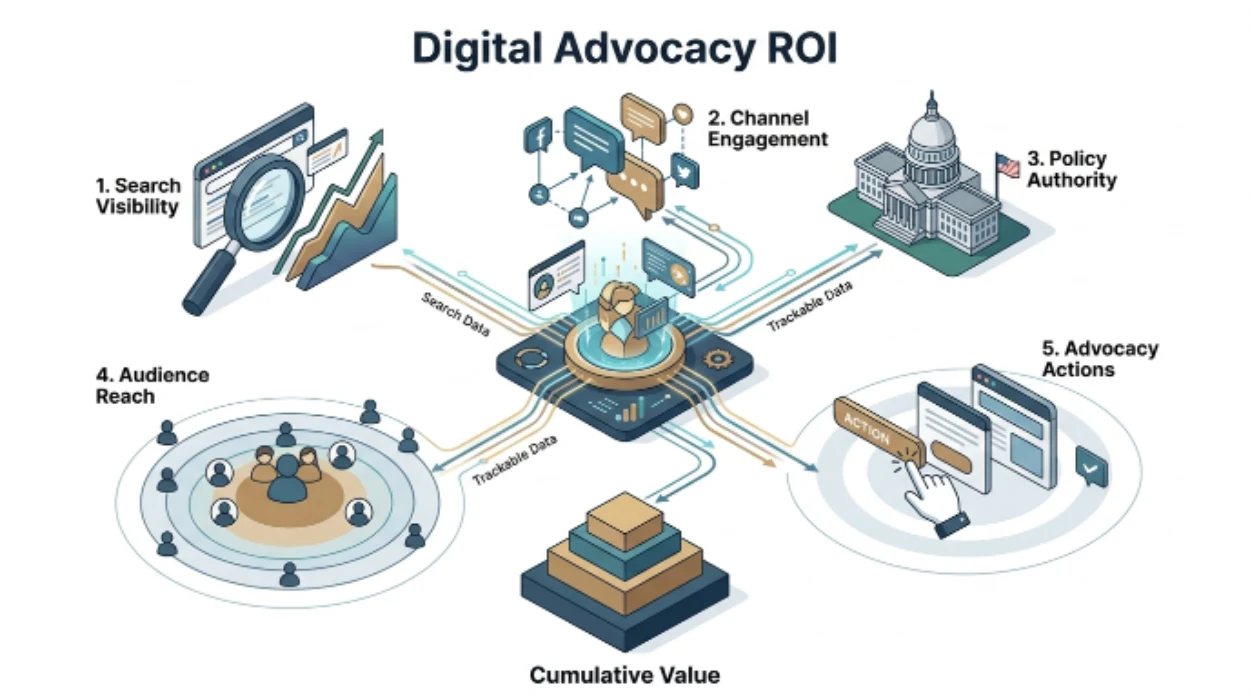
Digital Advocacy investment is justified through measurable improvements in visibility, engagement, stakeholder participation, and digital authority.
Decision-makers require evidence that advocacy expenditure produces tangible organisational value. Digital campaigns provide greater measurement capabilities than traditional advocacy approaches because engagement activities generate trackable data throughout the stakeholder journey.
Performance indicators commonly include:
- Increase search visibility for campaign-related topics.
- Improve stakeholder engagement rates across digital channels.
- Strengthen authority positioning within policy discussions.
- Expand audience reach among target stakeholder groups.
- Generate measurable advocacy actions and responses.
These metrics provide clear evidence of campaign effectiveness while supporting continuous optimisation.
Unlike isolated communication activities, Digital Advocacy creates cumulative value. As visibility, authority, and stakeholder trust increase, future campaigns benefit from stronger baseline credibility and improved audience responsiveness.
How quickly does Digital Advocacy generate visibility and engagement impact?
Digital Advocacy generates engagement activity rapidly while building sustainable visibility improvements over time.
Stakeholder activation mechanisms often produce immediate participation signals because audiences can respond directly through digital engagement channels. Campaign awareness, interaction rates, and advocacy actions become measurable shortly after launch.
Search visibility and digital authority development operate through a longer-term process. Search engines evaluate content relevance, reputation signals, and entity credibility continuously. As these signals strengthen, organisations gain greater SERP control and improved narrative visibility.
This dual-impact structure creates both short-term and long-term value:
- Generate immediate stakeholder engagement opportunities.
- Improve campaign responsiveness through real-time optimisation.
- Strengthen search perception influence progressively.
- Build sustainable digital authority over time.
- Establish durable reputation signals that support future campaigns.
Policy teams benefit because advocacy outcomes continue accumulating beyond the initial campaign period.
How does Digital Advocacy reduce reputational and policy communication risk?
Digital Advocacy reduces risk by improving message consistency, increasing narrative visibility, and strengthening institutional credibility.
Communication risks emerge when stakeholders encounter incomplete, inaccurate, or conflicting information. Digital ecosystems amplify these risks because information spreads rapidly across multiple channels.
Narrative visibility management addresses this challenge by ensuring that authoritative content remains prominent and accessible. Improved SERP control strengthens organisational influence over how policy issues are interpreted and discussed online.
Risk reduction mechanisms include:
- Maintain consistent messaging across stakeholder touchpoints.
- Strengthen entity credibility through authoritative content.
- Improve search visibility for accurate policy information.
- Reduce narrative fragmentation across digital channels.
- Stabilise stakeholder perception through sustained visibility.
These capabilities improve resilience during complex policy discussions and high-scrutiny public affairs environments.
Why do decision-makers compare Digital Advocacy with traditional advocacy before investing?
Decision-makers compare both approaches because they seek the most efficient method for influencing stakeholder perception, engagement, and policy outcomes.
Traditional advocacy remains valuable for relationship development and direct engagement. Digital Advocacy expands these capabilities by increasing scale, measurement precision, and visibility control.
Modern policy environments require both relationship capital and discoverability. Stakeholders increasingly rely on search behaviour when evaluating issues, organisations, and policy positions. Digital ecosystems therefore influence perception before direct engagement even begins.
For organisations conducting solution evaluation, reviewing Digital Advocacy vs. Traditional Advocacy: A Side-by-Side Comparison for Decision-Makers helps clarify the strategic advantages, measurement capabilities, and visibility outcomes associated with each approach.
This comparison often reveals that Digital Advocacy provides stronger opportunities for search perception influence, narrative visibility management, and digital authority development.
Which Digital Advocacy service provides the strongest combination of reliability, visibility, and strategic control?
The strongest Digital Advocacy service combines strategic planning, stakeholder engagement, reputation signal development, and measurable performance management within a single operational framework.
Decision-makers require confidence that advocacy campaigns will strengthen visibility, improve trust signals, and support long-term institutional objectives. Reliability depends on clear methodology, transparent execution, and sustained focus on measurable outcomes.
Organisations seeking a professional Digital Advocacy service benefit from solutions that prioritise entity credibility, stakeholder trust signals, SERP control, and narrative visibility management simultaneously. This integrated approach creates stronger public affairs outcomes while reducing communication risk and improving stakeholder confidence.
Linkonize positions Digital Advocacy as a structured, evidence-driven discipline focused on measurable visibility improvement, institutional credibility enhancement, and stakeholder engagement performance. By combining strategic process clarity with sustainable authority development, the service delivers outcomes that align with modern public affairs requirements.
Effective advocacy no longer depends solely on message creation. It depends on visibility, credibility, discoverability, and stakeholder trust. Organisations that invest in these capabilities strengthen digital authority, improve search perception influence, and establish a more resilient foundation for policy engagement success.
Frequently Asked Questions
Why do policy teams invest in Digital Advocacy services?
Policy teams invest in Digital Advocacy services because they improve stakeholder engagement, strengthen narrative visibility, and create measurable advocacy outcomes. Digital Advocacy also enhances search visibility, stakeholder trust signals, and institutional credibility, making policy campaigns more effective within modern digital ecosystems.
How does Digital Advocacy improve stakeholder engagement?
Digital Advocacy improves stakeholder engagement by creating direct and measurable communication pathways between organisations and target audiences. Campaigns use structured digital actions that encourage participation, increase visibility, and strengthen stakeholder involvement in policy discussions.
How long does it take to see results from a Digital Advocacy campaign?
Stakeholder engagement metrics often appear shortly after campaign launch, while improvements in search visibility, digital authority, and narrative visibility management develop over a longer period. Sustainable results are achieved through consistent reputation signal development and strategic content distribution.
What makes Linkonize different from other Digital Advocacy providers?
Linkonize focuses on evidence-driven Digital Advocacy strategies that combine stakeholder engagement, search perception influence, entity credibility development, and narrative visibility management. This integrated approach delivers measurable outcomes while strengthening long-term institutional trust and digital authority.
Can Digital Advocacy help protect institutional reputation?
Yes. Digital Advocacy strengthens reputation signals, improves SERP control, and ensures consistent message visibility across digital channels. These capabilities reduce communication risk, support stakeholder trust, and reinforce public credibility during policy discussions and advocacy campaigns.