
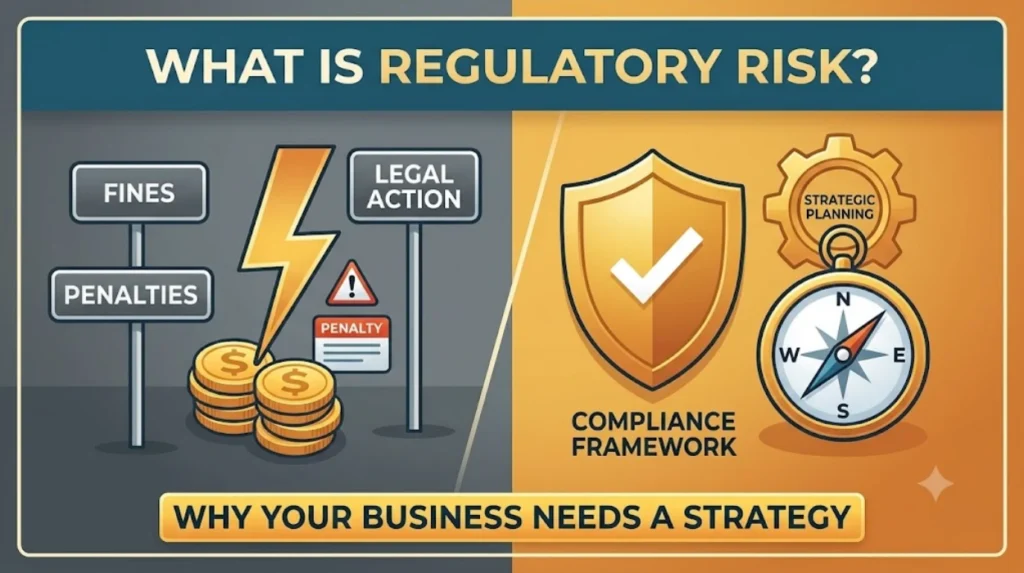
Public affairs refers to engagement between institutions and public policy environments that shapes stakeholder perception. Digital advocacy is targeted communication within online ecosystems that influences narrative influence and search visibility.
Public affairs, reputation strategy, and digital advocacy are the macro topic examined here: regulatory risk and why every business requires a strategy for it. The article explains how regulatory risk becomes a perception problem in digital ecosystems, how algorithms and content systems translate rules into reputation signals, and how institutions must manage digital authority and stakeholder trust.
What is regulatory risk and how does it create reputational exposure online?
Regulatory risk is the probability that changes in laws, enforcement, or regulatory interpretation will negatively affect an entity’s operations or licence to operate. In digital ecosystems, regulatory risk refers to an observable factor that generates reputation signals and alters entity perception across search visibility and media visibility channels. Regulatory risk produces measurable signals—policy citations, enforcement announcements, compliance documentation, and legal filings—that indexing systems, journalists, and stakeholders treat as authority markers.
Mechanism: Regulatory events produce structured and unstructured data (statements, filings, notices) that content indexing systems parse and tag to entities. Algorithms evaluate those tags against historical document weight, source authority, and topical relevance to determine SERP evaluation. The presence of enforcement actions or regulatory scrutiny increases prominence of negative narrative fragments; conversely, proactive regulatory engagement generates positive compliance signals that influence content ranking.
Impact on visibility and trust: Increased regulatory signals alter search visibility by elevating governance-related content for branded queries and sectoral searches. That change modifies stakeholder trust, as third-party sources and media visibility amplify interpretive frames. Institutional credibility declines when adverse regulatory signals dominate top-ranked documents; digital authority increases when authoritative, verifiable compliance resources rank above adverse analysis.
How does search indexing interpret regulatory content as authority or risk?
Search indexing defines authority by cross-referencing source provenance, citation patterns, and topical coherence to existing entity profiles. Regulatory content refers to high-weight source material (government notices, court records, regulator websites) within digital ecosystems, and algorithms prioritise such content for relevance and trustworthiness signals. Indexers evaluate metadata, schema markup, and citation networks to determine signal strength.
Mechanism: Crawlers detect regulatory documents, extract entity mentions, and map those mentions into knowledge graphs. Ranking systems then evaluate link equity, topical authority, and freshness, applying weighting that elevates primary regulator sites and prominent news outlets. Machine-learning classifiers tag sentiment and risk categories, influencing SERP evaluation for queries tied to compliance, enforcement, or licences.
Impact on institutional perception: When indexing systems expose regulatory content prominently, stakeholder perception shifts to view the entity through a governance lens. Digital authority depends on the balance of authoritative compliance records versus adverse regulatory citations. The presence of structured regulatory documentation in top results increases perceived institutional credibility if the documentation demonstrates compliance; otherwise, it increases perceived regulatory risk.
Why does narrative influence matter for regulatory risk in public affairs?

Narrative influence is the capacity of framing, repetition, and networked dissemination to shape entity perception across audiences and search ecosystems. Narrative influence refers to how thematic constructs—regulatory failure, compliance leadership, policy ambiguity—propagate through media visibility and social amplification to become persistent reputation signals. Narratives alter interpretation of regulatory facts and change the salience of risk for stakeholders.
Mechanism: Content producers craft narratives that integrate regulatory facts with interpretive frames. Content ranking dynamics prioritise narratives that receive engagement, backlinks, and cross-platform citations. Semantic relevance models connect narrative elements to entity profiles, causing those frames to surface in entity-centric SERPs and knowledge panels. Repetition across authoritative domains reinforces narrative salience, which indexing systems read as corroborating evidence.
Impact on trust and credibility: Dominant negative narratives increase perceived regulatory risk by converting isolated events into systemic themes. Dominant positive narratives reduce perceived risk by framing regulatory engagement as evidence of good governance. Narrative influence therefore directly changes stakeholder trust metrics and affects digital authority through altered search visibility and sentiment interpretation.
How do authority and trust signals form around regulatory behaviour online?
Authority signals form from verifiable documentation, third-party endorsements, consistent messaging, and structural metadata that indexing systems recognise as reliable. Trust signals form from transparency, traceable compliance histories, and consistent engagement with regulatory institutions. Authority and trust signals refer to measurable elements—document provenance, schema use, citation networks, and cross-domain corroboration—within digital ecosystems.
Mechanism: Algorithms assign higher weight to documents with authoritative attributes: official domains, structured data, legal citations, and reputable backlinks. Trust metrics derive from user engagement patterns, dwell time, and cross-referenced actor credibility in knowledge graphs. Entities that publish verifiable compliance documents, adopt open data practices, and secure backlinks from regulator or academic sites build stronger authority footprints.
Impact on institutional perception: Strong authority signals reduce the amplification of adverse regulatory narratives in SERP evaluation by displacing lower-quality content. Robust trust signals increase stakeholder trust and stabilise entity perception across content ranking dynamics. Weak authority signals produce authority gaps that opponents and neutral scrapers fill with speculative or adversarial content, increasing regulatory risk exposure.
How do content ranking dynamics amplify or dampen regulatory risk?
Content ranking dynamics amplify regulatory risk when high-weight domains and engaged networks prioritise negative regulatory materials. Ranking dynamics dampen risk when authoritative compliance content outranks adverse narratives. Content ranking dynamics refer to the interactions among metadata, backlink profiles, topical authority, and engagement signals that determine visibility on SERPs and within platform feeds.
Mechanism: Ranking algorithms calculate relevance using features such as topical authority, link networks, on-page structured data, and engagement metrics. Regulatory incidents with strong immediate engagement generate spikes that push related content up SERPs. Over time, domain authority and backlink structures determine whether those spikes persist. Remediation content that lacks authoritative provenance fails to displace persistent negative materials.
Impact on stakeholder trust: If adverse regulatory content retains high rank, stakeholder trust erodes because search visibility normalises risk-centric frames. If authoritative compliance documentation ranks higher, stakeholder trust increases because SERP evaluation favours transparent governance signals. The dynamics therefore determine whether regulatory risk becomes a transient news event or a long-term reputational liability.
How does media visibility shape institutional credibility in regulatory contexts?
Media visibility is the degree to which mainstream and specialised outlets cover regulatory events and frame them in relation to an entity. Media visibility refers to the distribution of regulatory narratives across high-authority channels within digital ecosystems. Media choices about framing, headline prominence, and citation selection translate regulatory facts into reputation signals.
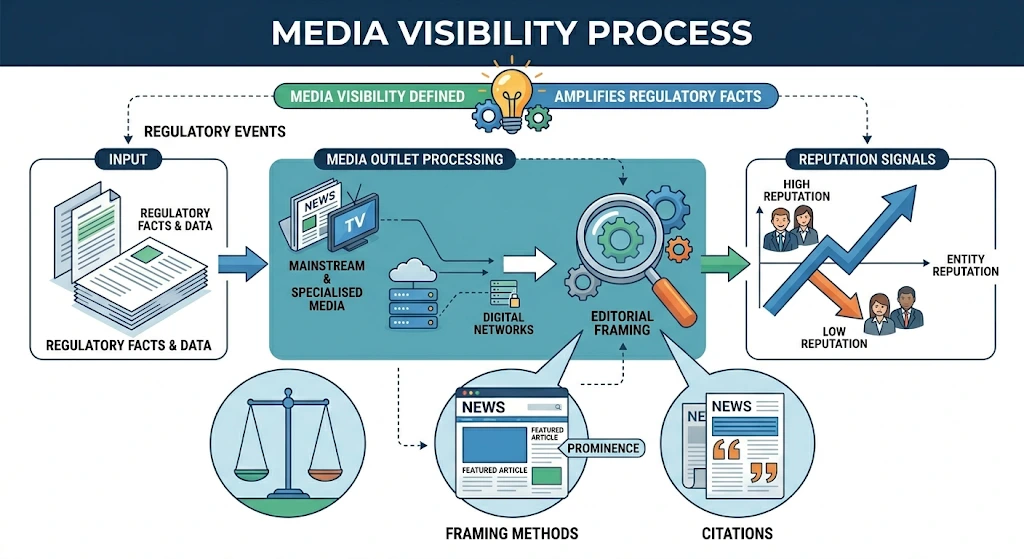
Mechanism: Journalists and sector analysts cite regulatory documents and interpretive sources; their articles acquire backlinks and social shares that feed into ranking systems. Search engines and aggregators index these pieces and tag sentiment. Media outlets with high domain authority amplify whichever regulatory frames align with their editorial and audience dynamics, thereby shaping SERP composition for entity queries.
Impact on public perception: Consistent adverse framing across high-authority media increases perceived regulatory risk and weighs against institutional credibility. Balanced or corrective coverage that references primary regulatory documents and contextual analysis strengthens institutional credibility by supplying accurate signals for indexing and entity perception.
How do digital stakeholder engagement practices affect regulatory risk perception?
Digital stakeholder engagement is active communication that provides verifiable, contextualised regulatory information to audiences. Engagement practices refer to the deliberate publication of structured compliance records, responsive policy explanations, and transparent dialogues with affected stakeholders within digital ecosystems. Effective engagement builds observable trust signals and counters adverse narrative influence.
Mechanism: Publishing compliance documentation with structured metadata, facilitating direct responses on official channels, and securing authoritative third-party citations generate signals that indexing systems attribute to the entity. Engagement activity that links to regulator pages, legal filings, or datasets enhances link equity and topical authority. Engagement also influences social and journalistic amplification, which feeds back into SERP evaluation.
Impact on institutional perception: Proactive digital stakeholder engagement raises institutional credibility by shifting search visibility towards primary sources and verified explanations. Lack of engagement creates information vacuums that amplify speculative content, increasing perceived regulatory risk and weakening digital authority.
How should institutions map their digital footprint to assess regulatory risk exposure?
Institutions must map their digital footprint by inventorying indexed assets, third-party mentions, and knowledge graph associations to identify where regulatory signals appear. A digital footprint map refers to the catalogue of pages, citations, media mentions, and structured data that contribute to an entity’s search visibility and reputation signals within digital ecosystems.
Mechanism: Inventory processes extract site maps, backlink graphs, SERP snapshots, and knowledge panel elements. Analysts tag items for regulatory relevance, sentiment, and authority weight. Mapping reveals concentration of adverse content in high-visibility slots and highlights opportunities for authoritative content insertion.
Impact on mitigation and strategy: A precise footprint map allows targeted interventions—publishing primary compliance documents with schema, securing authoritative citations, and prioritising pages for indexing—to alter SERP evaluation and reduce perceived regulatory risk. Without mapping, institutions cannot reliably convert regulatory management into reputation signals that influence stakeholder trust.
How do algorithms distinguish between compliance evidence and regulatory allegation?
Algorithms distinguish compliance evidence from regulatory allegation by evaluating source provenance, document structure, corroboration patterns, and semantic markers. Compliance evidence refers to verifiable materials (registrations, licences, audited reports); regulatory allegation refers to unverified claims, opinion pieces, or uncorroborated accusations within digital ecosystems.
Mechanism: Classifiers detect structured data markers (schema.org, PDF metadata), domain authority, and cross-reference with official registries. Machine-learning models weigh corroboration—multiple independent authoritative sources reduce false-positive classification of allegations. Sentiment analysis and entity linking further situate documents within the knowledge graph to inform SERP evaluation.
Impact on trust and ranking: Correct classification increases accuracy of reputation signals; misclassification elevates allegation content to undue prominence, increasing regulatory risk. Entities that publish machine-readable compliance evidence improve the probability that indexing systems treat their records as authoritative, thereby strengthening digital authority.
Regulatory risk is both a legal exposure and a perceptual construct inside digital ecosystems. Online reputation refers to the aggregate of signals—indexed documents, media visibility, backlinks, and narrative frames—that algorithms and stakeholders use to form entity perception. Regulatory events create data-rich signals that search indexing, content ranking dynamics, and media framing convert into measurable reputation outcomes. Institutions manage regulatory risk effectively by publishing verifiable compliance evidence, mapping digital footprints, shaping narrative influence through authoritative content, and sustaining stakeholder engagement that generates robust trust signals. These actions change SERP evaluation, strengthen digital authority, and stabilise institutional credibility.
Frequently Asked Questions
What is regulatory risk for businesses?
Regulatory risk is the likelihood that changes in laws, enforcement, or regulator interpretation will affect a company’s operations, licences, or market access. For Linkonize and comparable business services, understanding regulatory risk informs compliance planning, governance documentation, and stakeholder communication.
How does regulatory risk affect online reputation?
Regulatory risk affects online reputation by generating authority signals—regulatory notices, media coverage, and legal filings—that indexing systems and stakeholders interpret as credibility or liability. Organisations that publish verifiable compliance records reduce the prominence of adverse regulatory narratives in search visibility.
What steps should businesses take to assess regulatory risk?
Conduct a digital footprint audit that inventories indexed assets, third-party mentions, and knowledge graph links, then tag items for regulatory relevance and authority weight. Linkonize-style audits prioritise pages for schema markup, authoritative citations, and SERP monitoring to convert regulatory events into verifiable reputation signals.
How can content management reduce perceived regulatory risk?
Publish machine-readable compliance documents, add structured data (schema) to regulatory pages, and secure backlinks from authoritative regulator or sector sites to elevate trustworthy materials in SERPs. Consistent, verifiable content decreases the ranking of speculative or allegation-focused pages and improves stakeholder trust.
Why should businesses include regulatory risk in public affairs strategy?
Including regulatory risk in public affairs strategy aligns policy engagement with digital advocacy, ensuring that regulatory events are contextualised with authoritative content and stakeholder communication. This integration strengthens digital authority, stabilises entity perception, and improves SERP evaluation during regulatory scrutiny.