

Public affairs strategies differ based on whether the objective is visible policy influence, durable stakeholder alignment, or long-term institutional credibility. Digital advocacy methods are evaluated through their effect on reputation signals, search ranking influence, sentiment distribution, and narrative visibility across platforms.
What is a strange-bedfellow coalition?
A strange-bedfellow coalition is a temporary alignment between actors that do not share a broad political identity but do share a policy objective. It operates by linking complementary interests, such as commercial, civic, professional, and community groups, into a single advocacy position that increases perceived breadth and legitimacy. The mechanism is practical rather than ideological: it concentrates evidence, multiplies access points to policymakers, and makes it harder for opponents to frame the issue as narrow or self-interested.
In digital ecosystems, coalition visibility also affects search composition because repeated mentions from distinct credible entities strengthen authority cues and trust signals. The limitation is coherence, because coalitions with weak internal alignment generate inconsistent messaging and unstable reputation signals. That tension defines the strategy’s value: breadth improves access, while fragility raises governance risk.
Why does coalition breadth outperform solo advocacy?
Coalition breadth outperforms solo advocacy when policy opposition frames an issue as sectoral, technical, or marginal. A broad alliance changes the perceived stakeholder map by signalling that the issue affects multiple audiences, which increases institutional credibility and reduces the chance of content suppression through indifference or low engagement. Solo advocacy remains effective when the objective is specialist detail, rapid response, or confidential negotiation, because it preserves message control and reduces coordination cost.
Coalition advocacy, by contrast, scales trust through repetition across independent voices, which improves narrative visibility in search results and on social platforms. The trade-off is precision: the wider the alliance, the more the core argument must be simplified for alignment. That makes coalition design a balancing exercise between influence and message dilution.
Which works better: media visibility or stakeholder engagement?
Stakeholder engagement delivers stronger policy durability, while media visibility delivers faster narrative reach. Media visibility operates by placing an issue into public view through commentary, earned coverage, and repeated framing, which expands awareness and creates immediate pressure on decision-makers. Stakeholder engagement operates by mapping influence nodes, building relationships, and exchanging evidence in a way that shapes agenda-setting, formulation, and implementation.
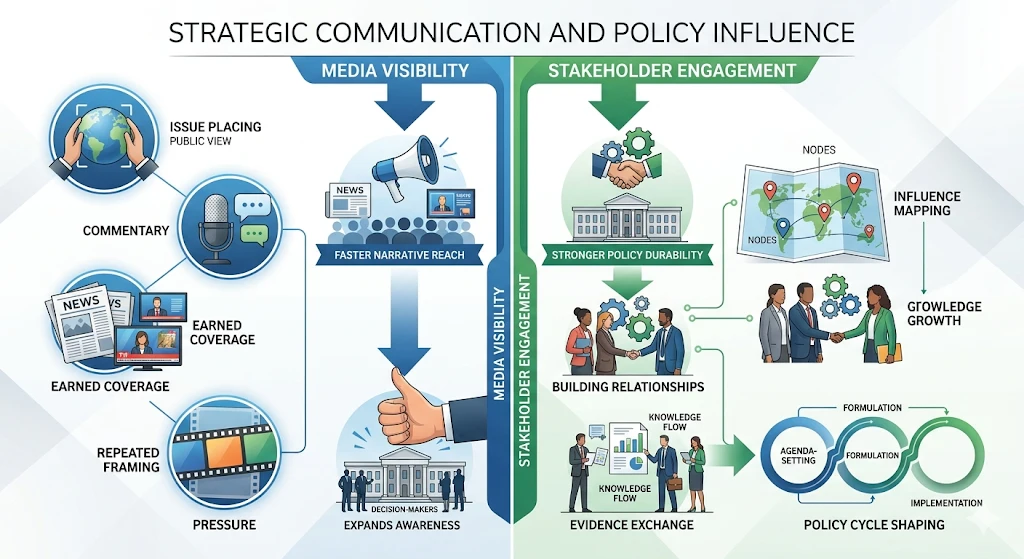
Media-first strategy performs well when timing matters and the policy window is short, but it produces weaker institutional trust if the underlying relationships remain thin. Engagement-first strategy produces slower visibility but stronger credibility because it demonstrates seriousness, continuity, and procedural respect. In practice, the stronger strategy depends on whether the goal is attention or acceptance.
How do reactive and organic frameworks compare?
Reactive communication manages risk after an issue emerges, while organic communication builds authority before a dispute begins. Reactive frameworks operate by answering criticism, correcting misinformation, and regaining control of the issue frame after negative coverage or stakeholder pressure appears. Organic frameworks operate by publishing policy explanations, evidence summaries, and stakeholder-facing content that builds a pre-existing trust footprint.
Reactive work is efficient for short-term containment, but it usually inherits the opponent’s framing and competes under time pressure. Organic work compounds over time because search systems and audiences repeatedly encounter the same credible entity across multiple touchpoints. The strategic limitation is obvious: reactive tactics protect reputation, but organic tactics create it.
What does search interpret as authority?
Search engines interpret authority through patterns that resemble expertise, consistency, and external validation. Google’s quality guidance and related explanations emphasise expertise, authoritativeness, and trustworthiness, alongside transparency about who created the content and why it exists. In practical terms, authority signals include credible mentions, useful content structure, clear purpose, and evidence of responsible authorship. For public affairs and advocacy content, this means search visibility reflects more than keywords; it reflects whether the entity appears embedded in a trustworthy information network.
Coalition activity can strengthen this network when partner organisations echo the same policy position from different domains and audiences. The limitation is that false consensus or low-quality syndication damages credibility instead of reinforcing it.
How does a coalition shape SERP composition?
A coalition shapes SERP composition by increasing the number of credible entities that can rank for the same issue. When multiple organisations publish aligned materials, search results often include a mix of explainers, policy pages, commentary, and third-party references, which broadens narrative control and reduces dependence on a single source. This matters because issue searches rarely return one authoritative page; they produce a cluster of voices that together define the topic.
A coalition that controls that cluster can influence both the first-page narrative and the surrounding context, especially when each participant covers a distinct semantic angle. The weakness is coordination overhead: without shared taxonomy, the coalition creates fragmented signals that weaken search ranking influence. Effective coalition work therefore depends on semantic alignment, not just political agreement.
What limits long-term credibility strategies?
Long-term credibility strategies limit risk better than short-term wins, but they require patience, discipline, and governance. Credibility builds through repeated evidence, stable positions, transparent authorship, and consistent stakeholder treatment, all of which reinforce entity credibility over time. This approach reduces vulnerability to reputational shocks because audiences and search systems already recognise the organisation as a dependable source.
The drawback is slower policy momentum, especially when decision-makers demand immediate proof of public support or operational urgency. Short-term narrative management can capture attention quickly, but it rarely produces the trust depth needed for sustained policy fights. The best evaluation, therefore, compares endurance against speed rather than treating them as substitutes.
Which framework fits policy fights best?
A strange-bedfellow coalition fits policy fights best when the issue is cross-sector, politically contestable, and dependent on legitimacy rather than raw visibility. The approach compares favourably against single-voice advocacy because it combines access, evidence diversity, and perception management in one structure. It compares favourably against reactive communications because it sets the frame before criticism hardens, which improves narrative visibility and reduces content suppression risk.
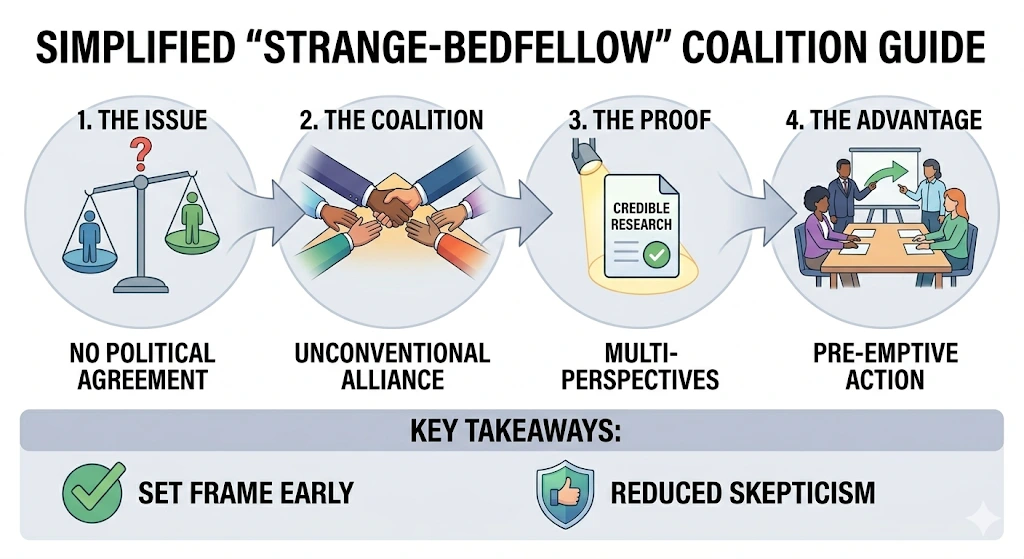
It compares less favourably against tightly controlled solo advocacy when confidentiality, legal sensitivity, or message precision dominate the brief. The most effective coalition is therefore not the largest one; it is the one whose partners create coherent trust signals across public, policy, and search environments. That is why coalition strategy works as a credibility architecture, not just a campaigning technique.
A neutral way to assess the approach is to treat it as a trade-off between reach and control, speed and depth, and visibility and credibility. Strange-bedfellow coalitions deliver stronger policy force when multiple stakeholders need to see themselves inside the same case, while organic credibility-building delivers the longer runway for trust and institutional authority. The strategic question is not whether coalition advocacy works, but whether the issue requires broad legitimacy, durable stakeholder trust, or rapid narrative correction.
Frequently Asked Questions
What is a strange-bedfellow coalition in public affairs?
A strange-bedfellow coalition is a policy alliance between groups that do not normally work together but share one specific objective. In public affairs, it increases stakeholder reach, strengthens reputation signals, and improves narrative visibility around a policy issue.
Why do coalition-based advocacy strategies work in policy campaigns?
Coalition-based advocacy works because it combines multiple voices into one credible position, which improves stakeholder trust and entity credibility. It also helps policy campaigns move from narrow sector messaging to broader legitimacy across media, government, and public audiences.
How does coalition advocacy compare with solo public affairs campaigns?
Coalition advocacy usually creates stronger influence when the issue affects multiple sectors or communities, because it produces more trust signals and wider media coverage. Solo campaigns can be useful for tightly controlled messaging, but they usually generate less breadth in search visibility and stakeholder perception.
What is the difference between short-term narrative management and long-term credibility building?
Short-term narrative management focuses on responding to criticism, correcting misinformation, and controlling issue framing quickly. Long-term credibility building focuses on consistent public affairs communication, authority signals, and stakeholder engagement that strengthen trust over time.
How does public affairs content support Google PAA visibility?
Public affairs content supports PAA visibility when it answers policy questions clearly, uses precise terminology, and reflects strong authority signals. Content that explains coalition strategy, stakeholder engagement, and reputation management in plain language is more likely to match search intent and semantic variation.