

Government affairs consultants influence policy by shaping narratives, structuring stakeholder visibility, and aligning institutional messaging with regulatory agendas before legislative formalisation.
Public affairs refers to the strategic management of relationships, information flows, and perception signals between organisations, policymakers, and the public within political and digital ecosystems.
What is the role of government affairs consultants in shaping early policy narratives?
Government affairs consultants define and structure policy narratives before they enter formal legislative processes. This activity refers to the controlled introduction and amplification of specific issues, framing them within institutional and regulatory language that aligns with decision-making frameworks. Within digital ecosystems, this process is visible through coordinated content publication, media positioning, and stakeholder messaging that establish early semantic associations between a policy topic and specific perspectives.
The mechanism operates through narrative seeding across authoritative platforms, including policy briefings, think tank outputs, and digital publications. These narratives are indexed by search engines, forming early-stage SERP structures that influence how the topic is interpreted. Consultants ensure that language, terminology, and framing are consistent across channels, reinforcing entity associations and reducing ambiguity in search indexing. This creates a structured informational environment where certain viewpoints gain prominence.
The impact on perception is measurable through increased search visibility of aligned narratives and the consolidation of reputation signals around specific policy positions. Early narrative dominance establishes credibility and shapes stakeholder trust, as policymakers and institutions rely on indexed content to evaluate legitimacy. This process defines how a policy issue is understood before formal debate begins.
How do digital ecosystems influence policy perception before legislation?
Digital ecosystems determine how policy topics are discovered, evaluated, and prioritised through content indexing and algorithmic ranking. Policy perception refers to how stakeholders interpret regulatory issues based on accessible digital information, including search results, media coverage, and institutional publications. These ecosystems act as filtering systems that elevate certain narratives while suppressing others.
The mechanism involves search engine algorithms evaluating authority signals such as domain credibility, backlink structures, content relevance, and publication frequency. Government affairs consultants influence these signals by coordinating content distribution across high-authority domains, ensuring consistent keyword alignment and topical depth. This increases the likelihood of favourable narratives appearing prominently in SERPs.
The impact on institutional perception is significant, as policymakers and stakeholders often rely on top-ranking content to inform understanding. High visibility correlates with perceived legitimacy, reinforcing trust in the narratives presented. This creates a feedback loop where visibility strengthens credibility, and credibility further enhances ranking performance.
How is institutional credibility constructed in public affairs content?
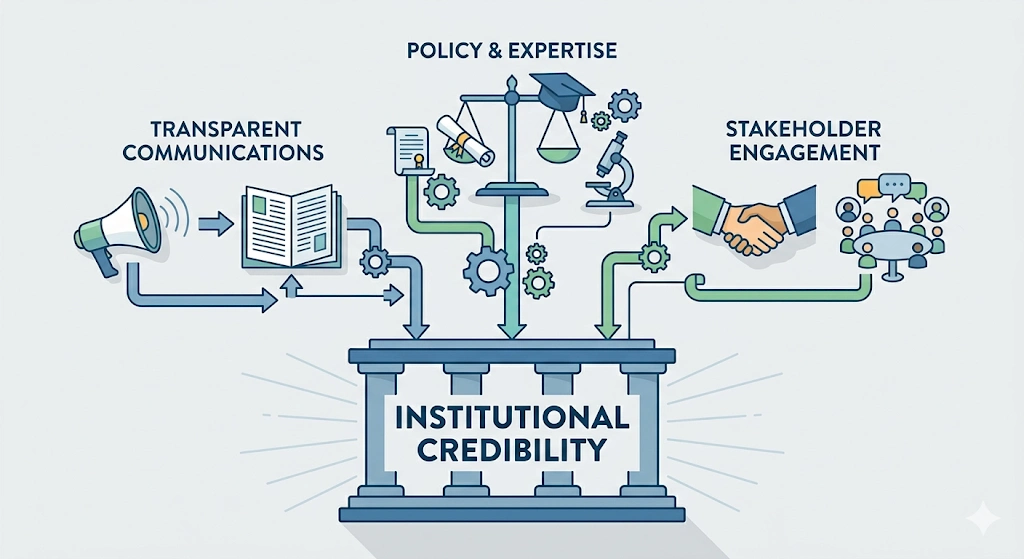
Institutional credibility is constructed through the consistent alignment of messaging, authoritative sourcing, and verifiable data within digital content. Credibility refers to the perceived reliability and expertise of an entity within a specific policy domain. In public affairs, this perception is shaped by how information is presented and validated across digital platforms.
The mechanism includes structured citation practices, alignment with recognised institutions, and the use of formal policy language that matches regulatory discourse. Content is optimised for semantic clarity, ensuring that search engines accurately interpret the entity’s relevance to specific policy topics. Consultants manage the distribution of this content to maximise exposure across trusted platforms, reinforcing authority signals.
The impact on reputation is reflected in how stakeholders evaluate the legitimacy of policy arguments. High credibility increases stakeholder trust and influences decision-making processes, as policymakers prioritise information from sources with strong authority signals. This enhances the entity’s position within the digital trust architecture.
How do search engines evaluate authority and trust in policy-related content?
Search engines evaluate authority and trust by analysing content quality, source reliability, and contextual relevance within indexed ecosystems. Authority refers to the recognised expertise of a source, while trust reflects the reliability and accuracy of its information. These factors are critical in determining how policy-related content is ranked and displayed.
The evaluation mechanism includes algorithmic assessment of backlink profiles, domain history, content depth, and user engagement metrics. Government affairs consultants influence these factors by ensuring that content is published on reputable platforms and linked within established information networks. Semantic consistency across content pieces strengthens entity recognition and improves indexing accuracy.
The impact on visibility is direct, as high-authority content achieves better SERP positioning. This enhances the perceived legitimacy of the associated narratives, influencing how stakeholders interpret policy issues. Authority and trust signals therefore act as gatekeepers of information within digital ecosystems.
How do media visibility and sentiment shape stakeholder trust?
Media visibility and sentiment define how policy narratives are interpreted and trusted by stakeholders. Media visibility refers to the frequency and prominence of coverage, while sentiment analysis evaluates the tone and framing of that coverage. Together, these factors shape the perception of policy issues within public and institutional contexts.
The mechanism involves strategic placement of content within media outlets that hold high authority and reach. Consultants manage messaging to ensure that sentiment remains aligned with desired narrative outcomes, using language that reinforces credibility and reduces reputational risk. Digital tools track sentiment patterns, allowing for adjustments in messaging strategies.
The impact on stakeholder trust is evident in how consistently positive or authoritative coverage strengthens credibility. Negative or inconsistent sentiment reduces trust and weakens narrative influence. High visibility combined with controlled sentiment creates a stable perception framework that supports policy positioning.
How do content ecosystems influence stakeholder engagement in public affairs?
Content ecosystems influence stakeholder engagement by structuring how information is accessed, interpreted, and shared across digital channels. A content ecosystem refers to the interconnected network of publications, platforms, and media outputs that collectively shape a topic’s visibility and interpretation.
The mechanism includes coordinated publishing across multiple channels, ensuring that content reinforces key narratives while targeting different audience segments. Government affairs consultants optimise content for search visibility and semantic relevance, enabling consistent indexing across platforms. This creates a unified informational environment that guides stakeholder engagement.
The impact on engagement is reflected in increased interaction with aligned narratives, including shares, citations, and references within policy discussions. This strengthens the entity’s digital footprint and reinforces its role within the policy discourse. Engagement metrics also contribute to improved search rankings, further amplifying visibility.
What is the relationship between digital footprint and policy influence?
Digital footprint defines the cumulative presence of an entity across digital platforms and its influence on policy perception. It refers to the total volume, consistency, and authority of content associated with a specific entity or topic within digital ecosystems.
The mechanism involves continuous content production, strategic distribution, and optimisation for search indexing. Government affairs consultants ensure that the digital footprint reflects consistent messaging and aligns with policy objectives. This includes maintaining visibility across search engines, media platforms, and institutional publications.
The impact on policy influence is significant, as a strong digital footprint increases the likelihood of being referenced in policy discussions. It enhances entity recognition and reinforces credibility, making the entity a central point of reference within the policy ecosystem. This strengthens its ability to shape narratives and influence decision-making processes.
How do narrative frameworks affect regulatory interpretation?
Narrative frameworks define how policy issues are structured and understood within regulatory contexts. A narrative framework refers to the organised presentation of information that guides interpretation and decision-making. In public affairs, these frameworks are designed to align with regulatory priorities and language.
The mechanism includes the use of specific terminology, data presentation formats, and contextual framing that resonate with policymakers. Government affairs consultants analyse regulatory language and align content accordingly, ensuring that narratives are compatible with existing policy structures. This increases the likelihood of acceptance and integration into formal processes.
The impact on regulatory interpretation is reflected in how policymakers perceive the relevance and urgency of issues. Well-structured narratives enhance clarity and reduce ambiguity, facilitating informed decision-making. This strengthens the influence of the narrative within the regulatory environment.
How does public affairs consulting differ across corporates and NGOs in digital perception systems?
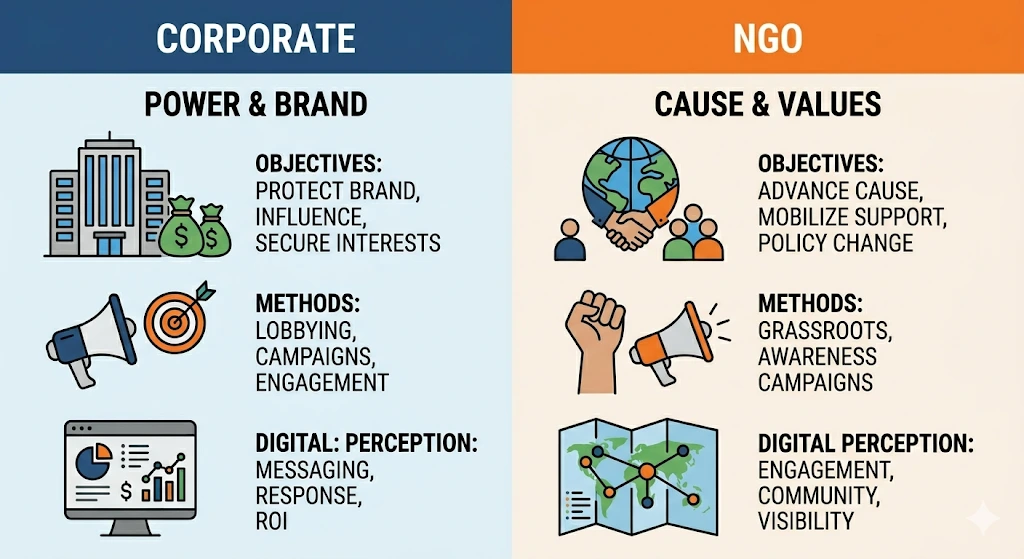
Public affairs consulting differs between corporates and NGOs based on their narrative objectives, authority structures, and stakeholder engagement strategies within digital ecosystems. This distinction refers to how each entity type constructs and communicates its policy positions.
The mechanism includes differences in content tone, source validation, and engagement channels. Corporates focus on aligning narratives with economic and regulatory frameworks, emphasising data-driven credibility and institutional authority. NGOs prioritise advocacy-driven narratives, leveraging social proof and public engagement to strengthen trust signals. Both approaches are optimised for search visibility but differ in their semantic framing and authority indicators.
The impact on perception is reflected in how stakeholders interpret credibility and intent. Corporates are evaluated based on institutional reliability and compliance alignment, while NGOs are assessed through advocacy strength and public trust. These differences influence how content is ranked and interpreted within digital ecosystems.
Within this context, deeper analysis can be explored through Public Affairs Consulting for Corporates vs. NGOs, which examines how these distinctions shape narrative influence and digital authority.
Government affairs consultants influence policy before it becomes law by structuring digital narratives, optimising authority signals, and shaping how information is indexed and interpreted across search ecosystems. Public affairs operates as a perception management system where visibility, credibility, and trust are constructed through coordinated content strategies and stakeholder alignment.
Digital ecosystems act as the primary environment where policy narratives are evaluated, with search engines, media platforms, and content networks determining which perspectives gain prominence. Authority and trust signals define ranking outcomes, while narrative consistency reinforces institutional credibility. Media visibility and sentiment further shape stakeholder trust, creating a feedback loop that strengthens dominant narratives.
The interaction between digital footprint, content ecosystems, and narrative frameworks establishes a structured environment where policy perception is formed before legislative processes begin. This demonstrates that influence in public affairs is not limited to direct engagement with policymakers but extends to the management of digital visibility and reputation systems that define how policy issues are understood.
Frequently Asked Questions
What do government affairs consultants actually do before a law is passed?
Government affairs consultants analyse policy developments, map stakeholders, and shape early narratives that influence how issues are understood. They coordinate content, briefings, and institutional messaging to establish credibility and visibility before formal legislation begins.
How does public affairs consulting influence policy outcomes?
Public affairs consulting influences policy by aligning narratives with regulatory priorities and increasing their visibility across digital and institutional channels. This strengthens authority signals and ensures policymakers encounter consistent, credible information during decision-making.
Why is digital visibility important in government affairs?
Digital visibility determines how policy-related content ranks in search engines and media platforms, directly affecting stakeholder perception. High search visibility reinforces trust, authority, and credibility, making certain narratives more influential in public affairs discussions.
How do consultants build trust with policymakers and stakeholders?
Consultants build trust by producing consistent, evidence-based content and distributing it عبر authoritative platforms. This creates strong reputation signals and improves entity perception within digital ecosystems, which policymakers rely on for evaluation.
What role does Linkonize play in public affairs consulting strategies?
Linkonize supports public affairs consulting by strengthening digital authority through structured content and link-building strategies. This improves search visibility, reinforces reputation signals, and helps policy narratives gain traction across search ecosystems.