

Public affairs strategies differ based on institutional objectives, stakeholder structures, and accountability frameworks across corporates and NGOs.
Digital advocacy methods are evaluated through their impact on narrative visibility, stakeholder trust, and the distribution of reputation signals within search and media ecosystems.
How do strategic objectives differ between corporates and NGOs in public affairs consulting?
Strategic objectives diverge through profit-driven positioning for corporates and mission-driven legitimacy for NGOs, shaping how public affairs consulting is structured and executed. Corporates define public affairs as a mechanism to secure regulatory alignment, market stability, and favourable policy environments. NGOs define public affairs as a mechanism to influence public policy through advocacy, awareness, and coalition-building aligned with social or environmental goals. These differing definitions determine the type of messaging, stakeholder prioritisation, and communication cadence within each model.
Corporates operate by aligning public affairs with commercial risk mitigation and long-term market access. This includes structured engagement with policymakers, industry bodies, and regulators, often supported by data-led narrative framing. NGOs operate by mobilising public opinion and leveraging advocacy networks to influence institutional decisions indirectly. This mechanism relies on issue framing, emotional salience, and campaign-driven visibility rather than sustained regulatory dialogue.
The comparative strength of corporate strategies lies in consistency, access, and resource-backed influence, enabling stable narrative control across multiple channels. NGOs demonstrate strength in agility, grassroots amplification, and public mobilisation, which enhances visibility in moments of policy contention. However, corporate strategies face limitations in perceived authenticity and public trust, particularly when narrative control appears self-serving. NGO strategies encounter constraints in scalability and sustained access to decision-makers, limiting long-term institutional impact.
These differences directly influence stakeholder perception. Corporates generate authority signals through consistency and institutional presence, while NGOs generate trust signals through alignment with public sentiment. Search engines interpret these signals through entity associations, backlink structures, and sentiment distribution, affecting visibility across policy-related queries.
What stakeholder engagement models distinguish corporate and NGO approaches?
Stakeholder engagement differs through structured hierarchy in corporates and network-based mobilisation in NGOs, affecting how influence is generated and measured. Corporate engagement models prioritise direct relationships with policymakers, regulators, and industry stakeholders, forming closed-loop communication systems. NGO engagement models prioritise distributed networks, including activists, media outlets, and community groups, creating open-loop amplification systems.
Corporate stakeholder engagement operates by mapping influence hierarchies and targeting high-authority nodes within governance systems. This includes formal consultations, advisory participation, and policy submissions. NGOs operate by activating decentralised stakeholder groups to create pressure through visibility and public discourse, often using petitions, digital campaigns, and coordinated messaging.
The effectiveness of corporate engagement lies in precision and predictability. Engagement outcomes are measurable through policy alignment, regulatory adjustments, and institutional partnerships. NGOs achieve effectiveness through reach and resonance, measured by engagement metrics, media coverage, and public sentiment shifts. However, corporate models face exposure to reputational risk when stakeholder interactions lack transparency, affecting trust signals. NGO models face fragmentation risk, where inconsistent messaging across networks weakens narrative coherence.
From a digital perspective, stakeholder engagement influences search ranking through entity relationships and topical authority. Corporates benefit from authoritative backlinks and institutional mentions, strengthening domain-level credibility. NGOs benefit from high-volume engagement signals and media amplification, increasing short-term visibility but often lacking sustained authority consolidation.
How do communication frameworks compare between proactive and reactive strategies?
Communication frameworks differ through proactive narrative construction in corporates and reactive issue-driven messaging in NGOs, shaping how each entity manages visibility and perception. Proactive communication is a structured approach where narratives are developed in advance and distributed consistently across channels. Reactive communication is an adaptive approach where messaging responds to emerging events or crises in real time.
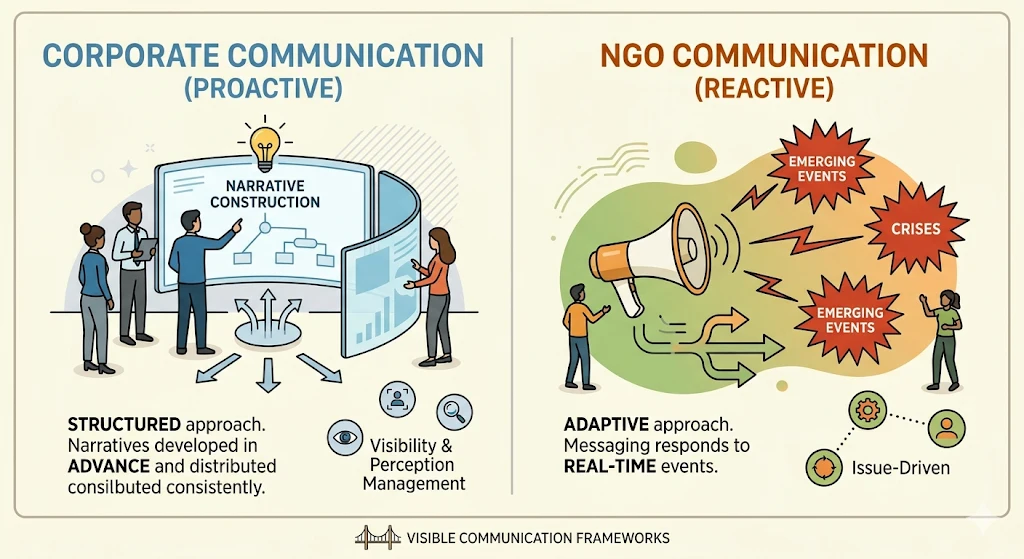
Corporates operate by implementing proactive frameworks that ensure message consistency across owned, earned, and shared media. This includes content calendars, policy briefings, and controlled media engagement. NGOs operate by leveraging reactive frameworks that respond to policy developments, public controversies, or emerging issues, using rapid-response content and advocacy messaging.
The comparative advantage of proactive frameworks lies in narrative stability and reduced volatility in sentiment distribution. Corporates maintain control over messaging, which supports long-term entity credibility and reduces reputational risk. Reactive frameworks provide NGOs with speed and relevance, allowing them to capitalise on news cycles and amplify visibility during critical moments.
Limitations emerge in adaptability and sustainability. Corporate proactive strategies struggle to respond quickly to unexpected events, leading to delayed narrative adjustment. NGO reactive strategies face inconsistency, where frequent shifts in messaging reduce clarity and dilute authority signals. Search engines evaluate these patterns through content freshness, topical consistency, and engagement velocity, influencing SERP composition.
The balance between proactive and reactive communication determines how effectively each entity maintains narrative visibility while managing risk exposure.
How do corporates and NGOs influence search visibility and digital authority?
Search visibility differs through authority consolidation in corporates and amplification-driven exposure in NGOs, reflecting distinct digital advocacy mechanisms. Corporates define digital authority as sustained presence across high-authority domains, including industry publications, regulatory websites, and mainstream media. NGOs define digital authority as visibility through campaign-driven content and social amplification.
Corporate strategies operate by building structured content ecosystems that reinforce entity credibility. This includes publishing policy insights, securing authoritative backlinks, and maintaining consistent brand mentions across trusted domains. NGOs operate by generating high-volume content linked to specific issues, using social platforms and media partnerships to increase reach.
The effectiveness of corporate strategies lies in long-term ranking stability. Search engines interpret consistent authority signals as indicators of trust, resulting in higher rankings for policy-related queries. NGOs achieve effectiveness through rapid visibility spikes, where high engagement and media coverage temporarily elevate rankings.
Limitations differ in persistence and control. Corporate authority-building requires significant time and resource investment, delaying immediate impact. NGO amplification strategies often result in volatile rankings, where visibility declines after campaign cycles end. Additionally, NGOs face challenges in controlling narrative fragmentation across multiple channels.
Search engines evaluate both approaches through entity salience, backlink quality, and user engagement metrics. Corporates benefit from structured semantic networks that reinforce topical authority. NGOs benefit from dynamic engagement signals that influence short-term ranking but lack long-term consolidation.
What are the differences in narrative control and reputation management strategies?
Narrative control differs through content suppression and structured messaging in corporates versus content amplification and discourse shaping in NGOs. Corporate reputation management focuses on controlling negative visibility and reinforcing positive narratives across digital ecosystems. NGO reputation strategies focus on amplifying issues and shaping public discourse to influence institutional perception.
Corporate strategies operate by monitoring search results, identifying negative content, and deploying counter-content to suppress unfavourable narratives. This includes SEO-driven content creation, media engagement, and reputation signal optimisation. NGOs operate by increasing visibility of specific narratives through campaigns, partnerships, and media outreach.
The comparative strength of corporate narrative control lies in precision and containment. Corporates can influence SERP composition by prioritising authoritative content and reducing the visibility of negative signals. NGOs excel in narrative expansion, where amplification increases issue salience and drives public engagement.
Limitations arise in credibility and sustainability. Corporate suppression strategies risk reduced trust if perceived as manipulative, affecting stakeholder perception. NGO amplification strategies risk oversaturation, where excessive messaging reduces impact and leads to audience fatigue.
Search engines interpret these strategies through sentiment distribution and content diversity. Corporates aim to stabilise sentiment across search results, while NGOs aim to shift sentiment by increasing the volume of issue-specific content.
How do risk exposure and accountability structures affect strategy selection?
Risk exposure differs through regulatory accountability in corporates and public accountability in NGOs, influencing how strategies are designed and executed. Corporates operate within formal governance frameworks, where compliance, transparency, and legal risk define public affairs activities. NGOs operate within public scrutiny frameworks, where credibility and trust determine effectiveness.
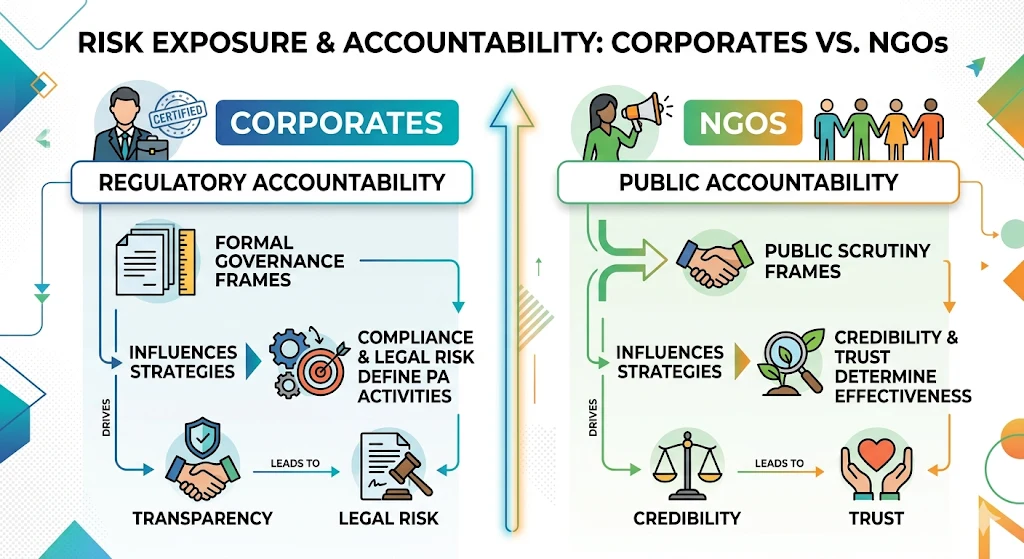
Corporate strategies operate by minimising regulatory risk through controlled communication and documented stakeholder engagement. This includes compliance audits, policy alignment, and structured reporting. NGOs operate by managing reputational risk through transparency, ethical positioning, and consistent messaging aligned with their mission.
The effectiveness of corporate risk management lies in predictability and compliance assurance. Corporates maintain stable operations by aligning with regulatory expectations. NGOs achieve effectiveness through trust-based legitimacy, where credibility enhances influence despite limited formal authority.
Limitations emerge in flexibility and perception. Corporate risk frameworks can restrict innovation and responsiveness, limiting adaptability in dynamic policy environments. NGO accountability structures expose them to reputational volatility, where public perception shifts rapidly based on campaign outcomes.
Digital platforms amplify these risks through visibility mechanisms. Negative sentiment spreads quickly, affecting both corporates and NGOs, but the impact differs based on existing trust signals and narrative control capacity.
How scalable and sustainable are corporate versus NGO public affairs strategies?
Scalability differs through resource-driven expansion in corporates and network-driven growth in NGOs, affecting long-term sustainability. Corporate strategies scale by increasing investment in public affairs infrastructure, including teams, tools, and media partnerships. NGO strategies scale by expanding advocacy networks and leveraging volunteer-driven engagement.
Corporate scalability operates by replicating structured processes across markets, ensuring consistency in messaging and stakeholder engagement. NGOs scale by activating decentralised networks, enabling rapid expansion without proportional resource increases.
The strength of corporate scalability lies in stability and control, supporting long-term sustainability. NGOs demonstrate strength in flexibility and reach, enabling rapid response to emerging issues. However, corporate scalability faces diminishing returns when additional investment does not proportionally increase influence. NGO scalability faces coordination challenges, where decentralised networks lead to inconsistent messaging.
Sustainability depends on maintaining trust and authority over time. Corporates rely on consistent reputation signals and institutional credibility. NGOs rely on ongoing engagement and relevance within public discourse. Both approaches require alignment between strategy and stakeholder expectations to sustain effectiveness.
Understanding these dynamics informs evaluation frameworks such as How We Measure Success in a Public Affairs Engagement, where metrics differ based on objectives, stakeholder models, and communication mechanisms.
Public affairs consulting strategies for corporates and NGOs differ through objectives, stakeholder engagement models, communication frameworks, and approaches to digital authority. Corporates prioritise structured, proactive strategies that enhance long-term credibility and regulatory alignment, while NGOs prioritise reactive, amplification-driven approaches that increase visibility and public engagement.
Strategic effectiveness depends on balancing narrative control, stakeholder trust, and search visibility within digital ecosystems. Corporates achieve stability and authority but face limitations in agility and public perception. NGOs achieve reach and resonance but encounter challenges in sustainability and institutional access.
Evaluating these approaches requires analysing how each model influences reputation signals, search ranking, and stakeholder perception over time, ensuring alignment with organisational goals and accountability structures.
Frequently Asked Questions
What is the main difference between public affairs consulting for corporates and NGOs?
Public affairs consulting for corporates focuses on regulatory alignment, policy influence, and protecting commercial interests, while NGOs prioritise advocacy, public mobilisation, and issue awareness. The difference lies in how each builds stakeholder trust and manages narrative visibility across digital and policy environments.
How do corporates use digital advocacy differently from NGOs?
Corporates use digital advocacy to strengthen entity credibility through controlled messaging, authoritative content, and consistent stakeholder communication. NGOs rely on campaign-driven amplification, using social engagement and media exposure to influence sentiment distribution and public discourse.
Why is stakeholder engagement important in public affairs consulting?
Stakeholder engagement is a core mechanism that shapes policy influence, reputation signals, and institutional credibility. In public affairs consulting, corporates engage directly with regulators, while NGOs activate broader networks to influence decision-making indirectly through visibility and pressure.
How does public affairs consulting impact search visibility and online reputation?
Public affairs consulting influences search visibility by building authoritative backlinks, consistent entity mentions, and positive sentiment distribution across digital platforms. These factors affect how search engines rank content, shaping narrative control and online reputation over time.
What factors determine the success of a public affairs strategy?
Success in public affairs consulting is measured through stakeholder trust, policy impact, narrative visibility, and search ranking influence. Linkonize applies structured evaluation frameworks that analyse engagement quality, sentiment trends, and digital authority signals to assess effectiveness.