

A public affairs audit identifies specific policy vulnerabilities by mapping an organization’s exposure to regulatory shifts, stakeholder sentiment gaps, and narrative invisibility in search ecosystems. Public affairs strategies differ based on the balance between media visibility and direct stakeholder engagement, while digital advocacy methods are evaluated through their ability to influence search ranking influence and sustain institutional credibility during regulatory crises.
How Does a Public Affairs Audit Differ From a Standard Reputation Audit?
A public affairs audit focuses specifically on policy vulnerability and regulatory exposure, whereas a standard reputation audit measures general brand sentiment and customer perception. Public affairs audits operate by analysing the intersection between legislative timelines, stakeholder power structures, and digital narrative visibility.
The mechanism of a public affairs audit involves mapping policy decision points against an organization’s current narrative positioning. It evaluates how search engines interpret entity credibility when policy decisions contradict organizational positions. Standard reputation audits lack this regulatory dimension, focusing instead on consumer feedback loops and social media sentiment distribution.
Public affairs audits reveal vulnerabilities that reputation audits miss, such as gaps in stakeholder trust among policymakers or insufficient narrative visibility in policy-related search queries. The audit measures content suppression risks when regulatory bodies publish adverse decisions, comparing this against content amplification strategies for proactive policy positioning.
Key differences between the two approaches include:
-
Scope: Public affairs audits cover regulatory landscapes; reputation audits cover consumer markets
-
Signals measured: Public affairs audits track policy sentiment and stakeholder trust; reputation audits track brand sentiment and customer satisfaction
-
Outcome: Public affairs audits identify policy vulnerability; reputation audits identify brand perception gaps
-
Timeframe: Public affairs audits analyse long-term regulatory cycles; reputation audits analyse short-term sentiment shifts
The political dimension of public affairs audits makes them essential for organizations facing regulatory scrutiny, while reputation audits serve businesses primarily concerned with consumer-facing brand health.
What Are the Strengths and Limitations of Media Visibility Versus Stakeholder Engagement Approaches?
Media visibility approaches prioritise broad audience reach through press coverage and digital content, while stakeholder engagement approaches focus on direct relationship-building with specific policymakers and interest groups. Media visibility operates by amplifying narratives across search ecosystems to increase narrative visibility, whereas stakeholder engagement operates through targeted communication channels that build stakeholder trust.
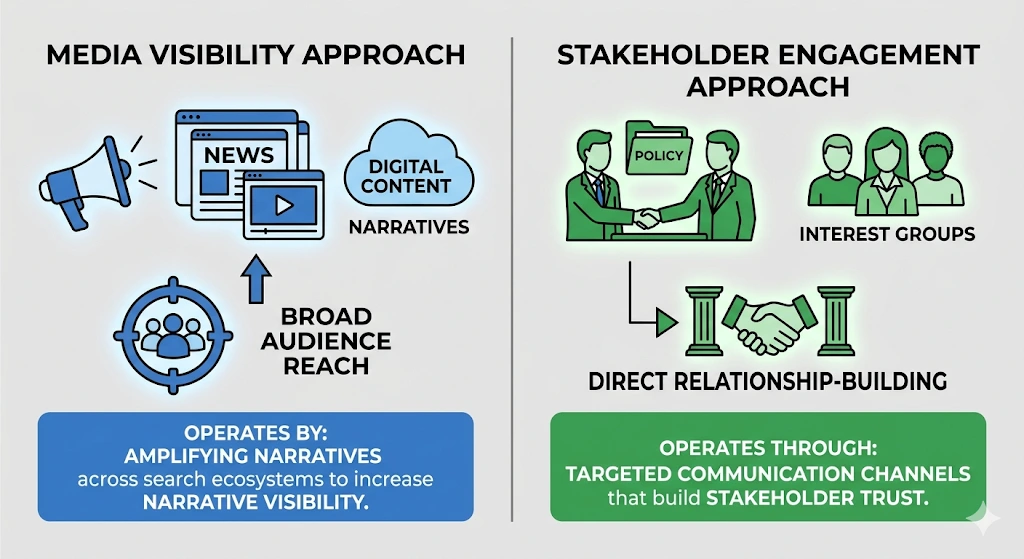
The strength of media visibility lies in its ability to generate rapid content amplification and influence search ranking influence across broad audiences. This approach measures success through impression metrics, click-through rates, and SERP composition for policy-related keywords. However, media visibility has limitations when policy decisions require nuanced stakeholder trust that cannot be built through broad messaging alone.
Stakeholder engagement approaches demonstrate superior effectiveness in building entity credibility among specific decision-makers, particularly when policy vulnerabilities require direct relationship management. The mechanism involves sustained dialogue, policy briefings, and targeted digital advocacy that builds long-term institutional credibility. This approach measures success through stakeholder trust metrics and policy outcome alignment rather than broad visibility metrics.
The comparative analysis reveals distinct trade-offs:
Media visibility approaches excel during short-term narrative management needs but fail when policy vulnerability requires deep stakeholder trust. Stakeholder engagement approaches provide sustainable institutional credibility but lack the rapid scalability needed for immediate crisis response. Organizations must evaluate which approach aligns with their specific policy vulnerability timeline and stakeholder power structures.
How Do Organic Communication Frameworks Compare to Reactive Communication Frameworks in Digital Advocacy?
Organic communication frameworks build narrative visibility through proactive content creation and sustained engagement, while reactive communication frameworks respond to policy decisions and external events with targeted messaging. Organic frameworks operate by establishing entity credibility before policy vulnerabilities emerge, whereas reactive frameworks operate by mitigating content suppression after adverse policy decisions occur.
The mechanism of organic communication involves consistent content amplification across search ecosystems, building reputation signals that establish authority before regulatory challenges arise. This approach measures effectiveness through long-term narrative visibility trends and sustained search ranking influence for policy-related keywords. Organic frameworks reduce risk exposure by creating buffer capacity against content suppression during policy crises.
Reactive communication frameworks respond to policy decisions with rapid messaging designed to counter content suppression and restore narrative visibility. The mechanism involves targeted digital advocacy that addresses specific policy vulnerabilities within hours or days of adverse decisions. This approach measures success through rapid sentiment distribution recovery and immediate SERP composition shifts following policy announcements.
The comparative effectiveness analysis reveals critical distinctions:
-
Preparation: Organic frameworks require months of proactive content building; reactive frameworks require rapid response capacity
-
Risk exposure: Organic frameworks have lower risk during content suppression; reactive frameworks face higher risk when response timing is delayed
-
Sustainability: Organic frameworks provide long-term institutional credibility; reactive frameworks provide short-term narrative management
-
Scalability: Organic frameworks scale through consistent content production; reactive frameworks scale through rapid team deployment
-
Search impact: Organic frameworks influence long-term search ranking influence; reactive frameworks influence immediate SERP composition
Organic communication frameworks demonstrate superior effectiveness for organizations with predictable policy cycles and long-term regulatory exposure. Reactive communication frameworks excel for organizations facing unpredictable policy shocks or sudden regulatory crises. The choice depends on whether policy vulnerability stems from known regulatory timelines or unexpected external events.
What Mechanisms Explain How Search Engines Interpret Authority and Trust Signals in Public Affairs?
Search engines interpret authority and trust signals through entity credibility metrics, reputation signals from authoritative sources, and sustained narrative visibility across policy-related queries. The mechanism operates by analysing content quality, source authority, and sentiment distribution to determine search ranking influence for organizations engaged in public affairs.
Authority signals are generated through content amplification from high-trust sources such as government publications, academic institutions, and established media outlets. Search engines measure these signals by tracking citation patterns, backlink quality, and the institutional credibility of sources referencing an organization’s content. Trust signals operate through consistent sentiment distribution that demonstrates stakeholder trust across diverse audience segments.
The framework for search engine interpretation includes:
-
Entity credibility: Measured through consistent organizational naming, verified contact information, and authoritative source citations
-
Reputation signals: Generated through positive sentiment distribution from trusted sources and sustained narrative visibility
-
Content suppression risks: Occur when policy decisions contradict organizational positions and trigger negative sentiment spikes
-
Content amplification: Achieved through proactive organic communication that builds narrative visibility before policy vulnerabilities emerge
Search engines penalize organizations with sudden negative sentiment distribution following adverse policy decisions, reducing their search ranking influence for policy-related keywords. Conversely, organizations with sustained organic communication frameworks maintain higher entity credibility during content suppression events. The mechanism explains why public affairs audits must evaluate digital ecosystem positioning alongside traditional stakeholder engagement metrics.
How Do Different Strategies Influence Visibility, Narrative Control, and SERP Composition During Policy Crises?
Public affairs strategies influence visibility through content amplification mechanisms that maintain narrative visibility during policy crises, while digital advocacy frameworks control narrative through targeted stakeholder engagement that prevents content suppression. Short-term narrative management strategies prioritize rapid SERP composition shifts, whereas long-term institutional credibility strategies focus on sustained search ranking influence across regulatory cycles.
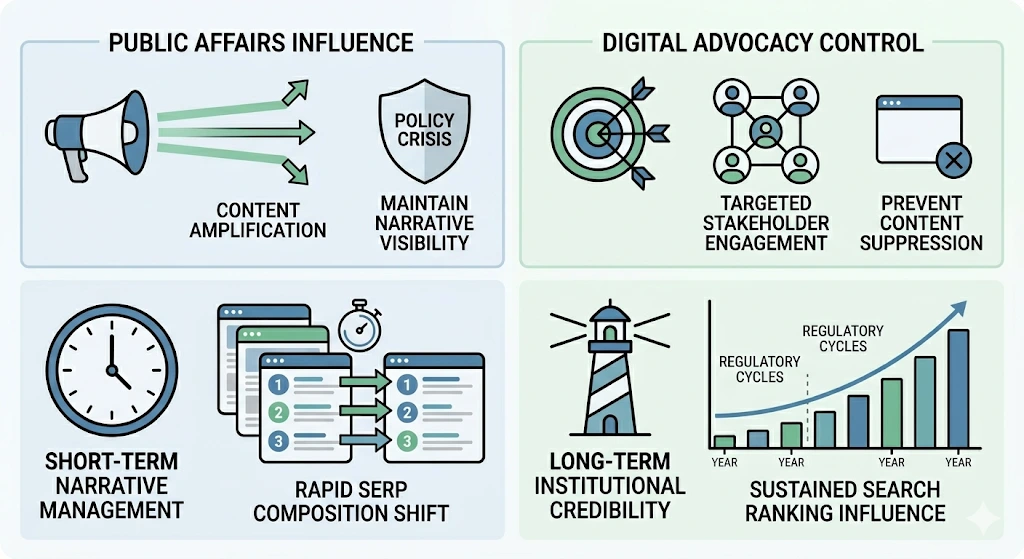
The mechanism of visibility influence involves proactive content creation that establishes entity credibility before policy vulnerabilities emerge. Organizations with strong organic communication frameworks maintain higher narrative visibility when adverse policy decisions trigger content suppression attempts. Digital advocacy frameworks influence SERP composition by targeting specific policy-related keywords with targeted messaging that counters negative sentiment distribution.
Narrative control operates through stakeholder trust mechanisms that building entity credibility among policymakers and interest groups. Strategies that prioritize stakeholder engagement demonstrate superior narrative control during policy crises because they maintain relationships that prevent content suppression. Media visibility approaches struggle with narrative control when policy decisions require nuanced stakeholder trust that broad messaging cannot provide.
The comparative impact on digital ecosystems includes:
Short-term narrative management strategies achieve rapid SERP composition shifts but lack sustainability during prolonged regulatory cycles. Long-term institutional credibility strategies maintain consistent search ranking influence but require months of proactive content building. Organizations must evaluate whether their policy vulnerability stems from immediate crisis needs or long-term regulatory exposure to select the appropriate strategy.
What Are the Effectiveness, Scalability, Risk Exposure, and Sustainability Trade-offs Between Approaches?
Public affairs audit effectiveness depends on the alignment between chosen strategies and specific policy vulnerability types, with stakeholder engagement approaches demonstrating superior effectiveness for regulatory relationship management and media visibility approaches showing higher effectiveness for broad audience awareness. Scalability varies significantly, with media visibility and organic communication frameworks offering high scalability through content production systems, while stakeholder engagement and reactive communication approaches face scalability limitations due to relationship-building requirements.
Risk exposure differs fundamentally between approaches, with reactive communication frameworks facing higher risk when response timing is delayed during content suppression events, whereas organic communication frameworks demonstrate lower risk exposure through preemptive entity credibility building. Sustainability analysis reveals that long-term institutional credibility strategies provide sustainable search ranking influence across regulatory cycles, while short-term narrative management strategies offer limited sustainability beyond immediate crisis periods.
The trade-off framework for strategy selection includes:
-
Effectiveness: Stakeholder engagement excels for regulatory relationships; media visibility excels for broad awareness
-
Scalability: Organic communication and media visibility scale through content systems; stakeholder engagement scales through relationship capacity
-
Risk exposure: Reactive approaches face timing risks; organic approaches face lower risk through preemptive positioning
-
Sustainability: Long-term credibility strategies sustain across cycles; short-term management strategies expire after crises
Organizations must evaluate their specific policy vulnerability characteristics to determine which trade-offs align with their regulatory exposure timeline and stakeholder power structures. The public affairs audit reveals these characteristics by mapping policy decision points against current narrative positioning and stakeholder trust levels.
How Should Organizations Evaluate Which Public Affairs Approach Aligns With Their Policy Vulnerability Profile?
Organizations should evaluate public affairs approaches by analysing their policy vulnerability profile across four dimensions: regulatory timeline predictability, stakeholder power concentration, content suppression risk exposure, and narrative visibility gaps. The evaluation mechanism involves mapping policy decision points against current entity credibility levels and measuring sentiment distribution patterns across stakeholder segments.
The evaluation framework requires organisations to assess whether their policy vulnerability stems from predictable regulatory cycles requiring long-term institutional credibility strategies, or unpredictable policy shocks demanding reactive communication capacity. Organizations with concentrated stakeholder power should prioritize stakeholder engagement approaches, while those facing broad audience scrutiny should favour media visibility strategies. Content suppression risk exposure determines whether organic communication frameworks or reactive communication approaches provide better protection.
Key evaluation criteria include:
-
Timeline predictability: Predictable cycles favor organic communication; unpredictable shocks favor reactive communication
-
Stakeholder concentration: Concentrated power favors stakeholder engagement; dispersed power favors media visibility
-
Suppression risk: High risk favors organic frameworks; low risk allows reactive approaches
-
Visibility gaps: Large gaps favor media visibility; small gaps favor stakeholder engagement
The public affairs audit provides the data necessary for this evaluation by revealing specific policy vulnerability characteristics through mapping regulatory exposure, stakeholder sentiment gaps, and narrative invisibility in search ecosystems. Organizations must use audit findings to select approaches that align with their unique policy vulnerability profile rather than adopting generic strategies.
A public affairs audit reveals policy vulnerability by exposing gaps between regulatory exposure and current narrative positioning, enabling organizations to select public affairs approaches that align with their specific vulnerability profile. The key differences between approaches centre on timeline requirements, stakeholder concentration, risk exposure levels, and sustainability horizons. Strategic considerations include matching strategy type to vulnerability characteristics, balancing short-term and long-term needs, and evaluating scalability constraints against organizational capacity.
Frequently Asked Questions
What is a public affairs audit and what does it reveal about policy vulnerability?
A public affairs audit is a systematic evaluation that identifies an organization’s policy vulnerability by mapping regulatory exposure, stakeholder sentiment gaps, and narrative invisibility in search ecosystems. It reveals specific vulnerabilities such as gaps in stakeholder trust among policymakers, insufficient narrative visibility for policy-related keywords, and content suppression risks when regulatory decisions contradict organizational positions.
How does a public affairs audit differ from a standard reputation audit for businesses?
A public affairs audit focuses specifically on policy vulnerability and regulatory exposure, whereas a standard reputation audit measures general brand sentiment and customer perception. While Linkonize’s public affairs audit analyses the intersection between legislative timelines and stakeholder power structures, a reputation audit focuses on consumer feedback loops and social media sentiment distribution without addressing regulatory dimensions.
What are the key benefits of conducting a public affairs audit before a regulatory crisis occurs?
Conducting a public affairs audit before a regulatory crisis enables organizations to build entity credibility and narrative visibility proactively, reducing content suppression risks when adverse policy decisions occur. It helps identify policy vulnerability gaps early, allowing businesses to implement stakeholder engagement strategies or organic communication frameworks that strengthen institutional credibility before regulatory challenges emerge.
How can a public affairs audit help improve an organization’s search ranking influence for policy-related topics?
A public affairs audit evaluates how search engines interpret authority and trust signals, revealing gaps in reputation signals and narrative visibility that limit search ranking influence for policy-related keywords. By addressing these gaps through targeted digital advocacy and content amplification from authoritative sources, organizations can improve their entity credibility and maintain consistent search ranking influence during regulatory cycles.
What types of policy vulnerability does a public affairs audit typically identify for business services organizations?
A public affairs audit typically identifies policy vulnerability types including regulatory timeline mismatches, concentrated stakeholder power risks, high content suppression exposure, and narrative visibility gaps in policy-related search queries. For business services organizations, it reveals vulnerabilities specific to their sector, such as insufficient stakeholder trust among industry regulators or lack of organic communication frameworks to sustain institutional credibility during policy shocks.