

Stakeholder intelligence processes map influence, relationships, and narrative control to inform public affairs strategy design. Public affairs strategies differ based on how stakeholder data is collected, interpreted, and operationalised within digital and institutional ecosystems, while digital advocacy methods are evaluated through their impact on visibility, trust signals, and sentiment distribution.
How does stakeholder intelligence compare to traditional audience segmentation in public affairs strategy?
Stakeholder intelligence operates as a relational mapping system, whereas traditional audience segmentation functions as a categorical grouping method. Stakeholder intelligence is the process of identifying, analysing, and prioritising entities based on influence, network position, and decision-making power. Traditional segmentation divides audiences by demographics, behaviours, or interests without mapping interdependencies or institutional influence pathways.
Stakeholder intelligence operates by constructing entity relationships across media, policy, and digital platforms, enabling the identification of influence clusters and authority nodes. It evaluates how narratives propagate between stakeholders, including regulators, journalists, advocacy groups, and institutional actors. Traditional segmentation operates by targeting predefined audience groups with tailored messaging, without evaluating how those groups shape broader discourse or policy outcomes.
The comparative strength of stakeholder intelligence lies in its ability to measure narrative visibility and stakeholder trust within interconnected systems. It enhances search ranking influence by aligning content with authoritative entities and recognised sources. Traditional segmentation provides efficiency in message delivery but lacks the structural insight required to influence institutional credibility or long-term narrative positioning.
From a risk perspective, stakeholder intelligence reduces exposure to misaligned messaging by identifying conflicting interests and sentiment distribution patterns. Traditional segmentation increases the risk of fragmented communication strategies, where messages fail to align with broader institutional narratives. In digital ecosystems, stakeholder intelligence supports content amplification through authority alignment, whereas segmentation focuses on reach without ensuring credibility.
Which stakeholder mapping approaches provide stronger influence over narrative visibility?
Network-based stakeholder mapping provides stronger influence over narrative visibility than linear or hierarchical mapping models. Network-based mapping is a system that visualises stakeholders as interconnected entities within influence ecosystems, while hierarchical mapping structures stakeholders in top-down power arrangements without capturing lateral influence flows.
Network-based mapping operates by analysing relationships between entities across digital platforms, including backlinks, co-citations, and social interactions. It identifies central nodes that shape narrative dissemination and determines how information flows through media and policy environments. Hierarchical mapping operates by ranking stakeholders based on perceived authority, without analysing how influence is distributed across networks.
The effectiveness of network-based mapping lies in its alignment with how search engines interpret authority and relevance. Search algorithms evaluate entity relationships, link structures, and co-occurrence patterns to determine content credibility. Network-based mapping directly supports this by identifying authoritative entities that enhance search ranking influence and narrative amplification.
Hierarchical mapping offers clarity in decision-making structures but limits adaptability in dynamic digital environments. It fails to account for emerging stakeholders or shifts in sentiment distribution, which can alter narrative control rapidly. Network-based approaches provide scalability by continuously updating relationships and influence patterns, enabling more responsive strategy adjustments.
In terms of stakeholder perception, network-based mapping enhances trust signals by associating narratives with credible entities and authoritative sources. Hierarchical mapping risks over-reliance on institutional authority, which may not translate into digital visibility or engagement. This distinction becomes critical in public affairs strategies that rely on both policy influence and online reputation management.
How do organic and reactive communication frameworks differ in digital advocacy effectiveness?
Organic communication frameworks prioritise sustained narrative development, while reactive frameworks focus on immediate response to emerging issues. Organic frameworks are structured, long-term approaches that build authority and stakeholder trust over time. Reactive frameworks operate by addressing real-time events, often driven by media cycles or crisis situations.
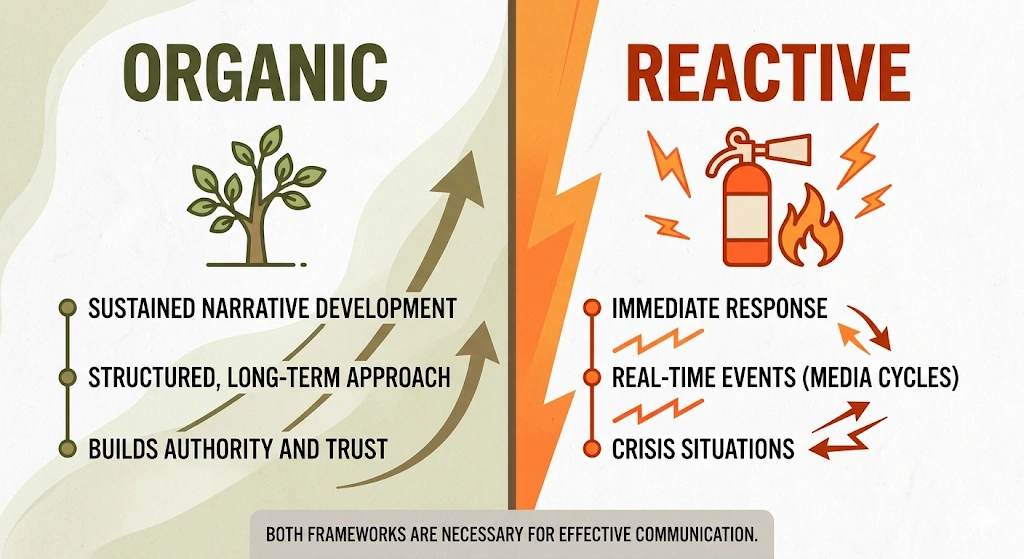
Organic frameworks operate by producing consistent, high-quality content aligned with stakeholder interests and search intent. They strengthen entity credibility by establishing a stable presence across digital platforms and reinforcing key narratives. Reactive frameworks operate by rapidly generating responses to external stimuli, aiming to influence sentiment distribution during critical moments.
The comparative advantage of organic frameworks lies in their sustainability and scalability. They create durable reputation signals that influence search engine interpretation and long-term visibility. Reactive frameworks provide short-term narrative control but lack the structural depth required to maintain authority beyond immediate events.
From a risk perspective, reactive frameworks increase exposure to inconsistencies and misalignment with established narratives. Rapid response mechanisms can lead to conflicting messages, weakening stakeholder trust. Organic frameworks mitigate this risk by maintaining coherence and reinforcing institutional credibility over time.
In digital advocacy, organic frameworks contribute to content amplification through consistent engagement and authority building. Reactive frameworks contribute to content suppression or correction by addressing negative narratives. The balance between these approaches determines the overall effectiveness of a public affairs strategy, particularly in environments where narrative volatility is high.
What distinguishes short-term narrative management from long-term institutional credibility strategies?
Short-term narrative management focuses on controlling immediate perception, while long-term institutional credibility strategies build sustained trust and authority. Narrative management is the process of influencing how events or issues are interpreted in the short term. Institutional credibility strategies operate by establishing consistent reputation signals over extended periods.
Short-term narrative management operates through rapid content deployment, media engagement, and sentiment correction. It aims to shape public discourse during specific events or crises. Long-term strategies operate by aligning messaging, stakeholder engagement, and content production with core institutional values and objectives.
The effectiveness of short-term approaches lies in their ability to influence immediate sentiment distribution and mitigate reputational risks. However, they lack durability and often require continuous intervention to maintain narrative control. Long-term strategies provide stability by embedding trust signals into digital and institutional ecosystems, reducing the need for reactive measures.
Search engines interpret long-term credibility through consistent entity associations, authoritative backlinks, and sustained content relevance. Short-term narrative spikes may influence visibility temporarily but do not significantly impact long-term search ranking influence. This distinction highlights the importance of integrating both approaches within a cohesive strategy.
In terms of stakeholder perception, short-term management can create temporary alignment but does not guarantee trust. Long-term strategies build credibility by demonstrating consistency, transparency, and authority. The interplay between these approaches determines the resilience of a public affairs strategy in both stable and volatile environments.
How do stakeholder intelligence processes influence search engine interpretation of authority and trust?
Stakeholder intelligence processes enhance search engine interpretation by aligning content with recognised entities and authoritative relationships. Search engines evaluate authority based on entity recognition, link structures, and contextual relevance. Stakeholder intelligence provides the data required to optimise these signals.
Stakeholder intelligence operates by identifying authoritative entities within a given domain and mapping their relationships to content and narratives. It informs content strategies that prioritise co-occurrence with credible sources, improving entity credibility and search ranking influence. This process directly impacts how search engines classify and rank content.
The mechanism involves integrating stakeholder data into content production, ensuring alignment with recognised entities and trusted sources. This increases the likelihood of content being associated with authoritative topics and improving visibility. Without stakeholder intelligence, content risks being disconnected from relevant authority signals, reducing its effectiveness.
Comparatively, strategies that do not incorporate stakeholder intelligence rely on generic keyword optimisation, which lacks the depth required for authority building. These approaches may achieve short-term visibility but fail to establish long-term credibility. Stakeholder intelligence provides a structured framework for aligning content with search engine evaluation criteria.
From a risk perspective, misalignment with authoritative entities can lead to reduced visibility and weakened trust signals. Stakeholder intelligence mitigates this by ensuring that content is positioned within credible networks. This enhances both narrative visibility and institutional credibility across digital platforms.
Which stakeholder intelligence mechanisms are most effective for managing sentiment distribution?
Entity-based sentiment analysis provides more precise control over sentiment distribution than keyword-based monitoring. Entity-based analysis evaluates sentiment in relation to specific stakeholders, while keyword-based monitoring tracks general sentiment without contextual understanding.
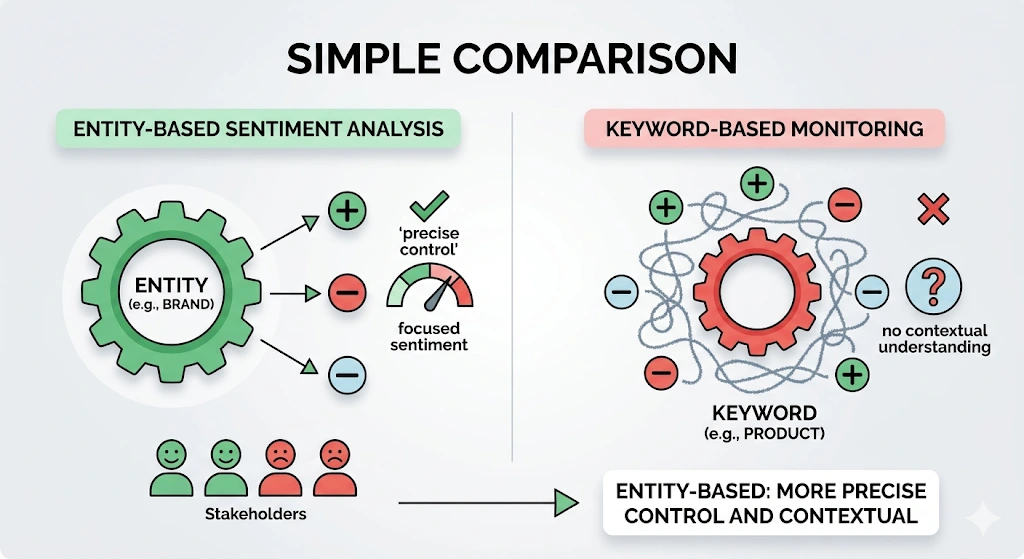
Entity-based sentiment analysis operates by identifying how specific stakeholders are perceived across digital platforms and media sources. It measures sentiment distribution at the entity level, enabling targeted interventions to influence perception. Keyword-based monitoring operates by analysing sentiment associated with specific terms, without linking them to stakeholder relationships.
The effectiveness of entity-based analysis lies in its ability to align sentiment management with stakeholder influence. It enables strategies that prioritise high-impact stakeholders, improving overall narrative control. Keyword-based approaches provide broad insights but lack the precision required for strategic decision-making.
In digital advocacy, entity-based mechanisms support content amplification by reinforcing positive associations with credible stakeholders. They also enable content suppression strategies by addressing negative sentiment linked to influential entities. Keyword-based approaches are less effective in managing these dynamics due to their lack of contextual depth.
From a scalability perspective, entity-based analysis integrates with stakeholder mapping systems, creating a comprehensive framework for managing reputation signals. Keyword-based monitoring operates as a standalone tool, limiting its strategic value. This distinction highlights the importance of integrating sentiment analysis within broader stakeholder intelligence processes.
How should public affairs strategies integrate stakeholder intelligence for optimal outcomes?
Effective integration requires aligning stakeholder intelligence with communication frameworks, content strategies, and institutional objectives. Stakeholder intelligence should function as a central system that informs all aspects of public affairs strategy, rather than operating as an isolated analytical tool.
The integration process involves:
-
Mapping stakeholders by analysing influence networks, identifying authority nodes, and categorising relationships across media and policy ecosystems.
-
Aligning content with entities by producing material that reinforces associations with credible stakeholders and authoritative sources.
-
Monitoring sentiment distribution by tracking perception changes at the entity level and adjusting strategies accordingly.
-
Optimising narrative visibility by ensuring consistent messaging across digital platforms and aligning with search engine evaluation criteria.
This integrated approach enhances scalability by creating a unified framework that supports both organic and reactive communication strategies. It reduces risk exposure by ensuring consistency and alignment across all communication channels. It also improves sustainability by embedding trust signals into long-term institutional strategies.
In practice, stakeholder intelligence enables more precise decision-making, improving the effectiveness of both short-term and long-term approaches. It supports the development of strategies that balance narrative control with credibility building, ensuring resilience in dynamic environments.
Within this context, frameworks discussed in Request a Public Affairs Strategy Consultation with the Linkonize Team illustrate how stakeholder intelligence can be operationalised into structured public affairs consulting methodologies.
Stakeholder intelligence processes redefine how public affairs strategies are developed, shifting focus from audience targeting to influence mapping and entity relationships. Network-based mapping provides superior visibility control compared to hierarchical models, while entity-based sentiment analysis offers greater precision than keyword monitoring. Organic communication frameworks build sustained authority, whereas reactive approaches address immediate narrative risks. Short-term narrative management influences perception temporarily, while long-term institutional strategies establish enduring credibility.
The strategic integration of these approaches determines effectiveness, scalability, and risk exposure. Public affairs strategies that incorporate stakeholder intelligence achieve stronger alignment with search engine interpretation, improved narrative visibility, and enhanced stakeholder trust.
Frequently Asked Questions
What is stakeholder intelligence in public affairs consulting?
Stakeholder intelligence is the process of identifying, mapping, and analysing influential entities, relationships, and sentiment within policy and media ecosystems. In public affairs consulting, it supports decision-making by revealing how stakeholder networks shape narrative visibility and institutional trust.
How does stakeholder mapping improve campaign strategy outcomes?
Stakeholder mapping improves campaign strategy by identifying authority nodes, influence pathways, and relationship dynamics across digital and policy environments. This enables more precise targeting of narratives, improving search ranking influence, stakeholder trust, and message alignment.
What is the difference between stakeholder intelligence and audience segmentation?
Stakeholder intelligence focuses on influence, relationships, and entity credibility, while audience segmentation groups people by demographics or behaviours. The former enhances narrative control and institutional positioning, whereas segmentation mainly supports message delivery efficiency.
How do digital advocacy strategies use stakeholder data to influence visibility?
Digital advocacy strategies use stakeholder data to align content with authoritative entities, improving relevance and credibility in search engines. This increases narrative visibility, strengthens reputation signals, and shapes sentiment distribution across digital platforms.
Why is stakeholder intelligence important for reputation and trust management?
Stakeholder intelligence is important because it tracks how key entities are perceived and how narratives spread within influence networks. For firms like Linkonize, it enables structured reputation management by aligning communication with credible stakeholders and reducing risk exposure.