

Coalition building is the structured process of aligning multiple stakeholders, entities, and narratives to produce unified influence within policy environments. It functions as the core mechanism through which authority, legitimacy, and visibility are aggregated across digital and institutional systems.
Public affairs refers to the strategic management of relationships, narratives, and information flows between institutions, stakeholders, and policy environments within both physical and digital ecosystems.
What is coalition building in public affairs and digital advocacy?
Coalition building is the coordinated alignment of organisations, interest groups, and institutional actors to consolidate influence and shape policy outcomes through shared narratives and collective authority. It defines how distributed actors create a unified perception of legitimacy within digital and political ecosystems. This process operates by integrating messaging, synchronising content outputs, and reinforcing consistent reputation signals across multiple platforms.
Coalitions function as semantic networks where each participating entity contributes authority signals that search engines and stakeholders evaluate collectively. When multiple credible sources publish aligned narratives, algorithms interpret this as corroboration, increasing search visibility and trust signals. This mechanism transforms fragmented advocacy into a cohesive entity perception that ranks more prominently within SERPs.
The impact on institutional perception is direct: coalitions elevate credibility by demonstrating consensus, which search systems interpret as authority reinforcement. This increases media visibility, strengthens stakeholder trust, and stabilises narrative control across digital channels.
How does coalition building influence digital authority and search visibility?
Coalition building influences digital authority by aggregating reputation signals from multiple entities into a single, coherent narrative cluster. Digital authority refers to the measurable trust and credibility assigned to an entity based on content consistency, backlink structures, and semantic relevance across indexed environments. Coalition activity enhances this by increasing the density and consistency of supportive signals.
Search engines evaluate authority through entity relationships, content interlinking, and topical depth. When coalition members publish interconnected content with aligned keywords and references, they create a reinforced semantic field that improves indexing accuracy. This leads to higher SERP positioning because the system identifies a unified topic authority rather than isolated contributions.
The visibility impact emerges through cumulative signal strength. Each additional coalition participant amplifies the reach and credibility of the shared narrative, resulting in broader coverage, improved ranking stability, and stronger resilience against competing narratives.
Why is coalition building central to stakeholder trust formation?
Coalition building is central to stakeholder trust formation because it signals consensus, validation, and institutional alignment. Stakeholder trust refers to the perceived reliability and credibility of an entity based on consistent, corroborated information across trusted sources. Coalitions operationalise this by ensuring multiple actors communicate aligned messages.
Trust formation occurs through repetition and verification. When stakeholders encounter the same narrative across independent yet connected entities, the perception of accuracy increases. Search systems reinforce this by prioritising content that demonstrates consistency and cross-referencing between authoritative sources.
The outcome is a strengthened trust architecture. Coalitions reduce informational ambiguity, enhance message clarity, and establish a stable narrative environment that stakeholders can rely on when forming opinions or making decisions.
How do digital narratives within coalitions shape public perception systems?
Digital narratives within coalitions shape public perception by structuring how information is framed, distributed, and interpreted across content ecosystems. A narrative refers to the organised presentation of facts, arguments, and perspectives that influence how stakeholders understand an issue. Coalition-driven narratives ensure alignment across multiple publication points.
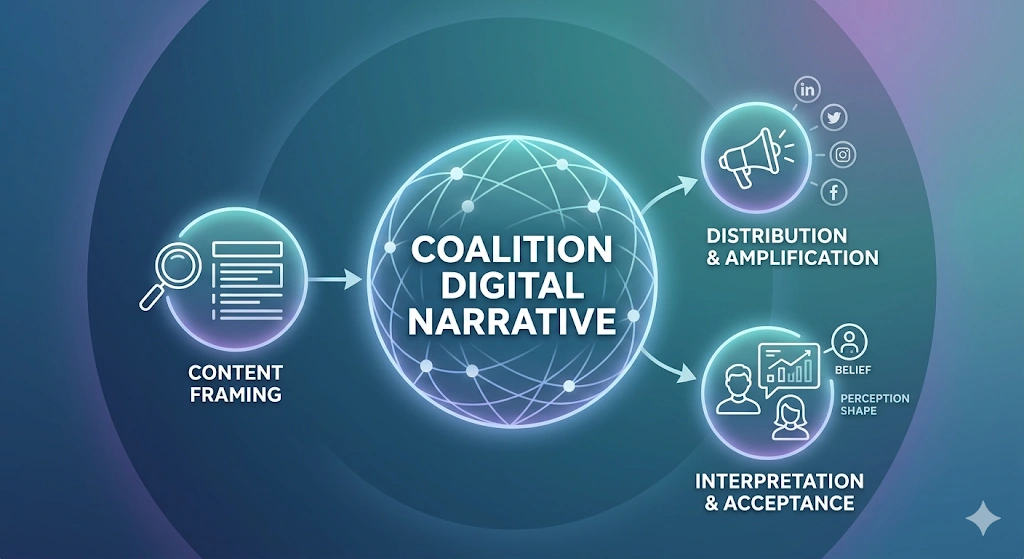
Narrative influence operates through semantic consistency. When coalition members use shared terminology, framing, and data references, they create a dominant interpretation layer that search engines prioritise. This affects content indexing by reinforcing specific entities, relationships, and themes within the algorithmic model.
The effect on perception systems is measurable: dominant narratives achieve higher visibility, suppress competing interpretations, and guide stakeholder understanding. This establishes a controlled informational environment where the coalition’s perspective becomes the primary reference point.
What role do SERPs play in evaluating coalition strength?
Search engine results pages (SERPs) function as evaluation environments where coalition strength is measured through visibility, ranking distribution, and content dominance. SERPs reflect how algorithms interpret authority, relevance, and trustworthiness across competing narratives. Coalition activity directly influences these metrics.
Evaluation occurs through clustering and ranking. When coalition members occupy multiple positions within SERPs for the same query, they create a perception of dominance and credibility. This multi-position visibility signals to both users and algorithms that the coalition represents the authoritative perspective on the topic.
The impact extends to click-through behaviour and engagement signals. High SERP coverage increases exposure, reinforces narrative familiarity, and strengthens the feedback loop that further boosts ranking performance. This creates sustained visibility and entrenched authority within the search ecosystem.
How does coalition building affect institutional credibility in digital environments?
Coalition building affects institutional credibility by aligning multiple trusted entities to reinforce shared reputation signals. Institutional credibility refers to the perceived legitimacy and authority of an organisation within policy and public discourse. Coalitions enhance this by demonstrating endorsement and alignment across recognised actors.
Credibility is constructed through association and validation. When credible institutions participate in a coalition, their authority transfers across the network, strengthening the overall perception of legitimacy. Search engines detect these associations through link structures, co-citations, and entity relationships.
The resulting effect is a consolidated credibility profile. Institutions within coalitions benefit from increased trust signals, improved ranking performance, and enhanced recognition within both algorithmic and human evaluation processes.
How are reputation signals amplified through coalition networks?
Reputation signals are amplified through coalition networks by increasing the volume, consistency, and distribution of authoritative content. Reputation signals include backlinks, mentions, citations, and sentiment indicators that search engines use to evaluate credibility. Coalitions expand these signals through coordinated activity.
Amplification occurs through network effects. Each coalition member contributes additional content, links, and references that reinforce the shared narrative. This creates a dense signal environment where the same entities and themes are repeatedly validated across multiple sources.
The impact on digital ecosystems is significant. Amplified signals improve indexing accuracy, increase ranking stability, and enhance the perceived authority of the coalition. This results in stronger positioning within SERPs and greater influence over stakeholder perception.
How does content coordination within coalitions improve indexing and ranking?
Content coordination within coalitions improves indexing and ranking by ensuring semantic alignment, keyword consistency, and structured interlinking across multiple sources. Content indexing refers to how search engines process and categorise information, while ranking determines its position within SERPs.
Coordination ensures that all coalition members use consistent terminology, metadata, and topical focus. This reduces ambiguity in the indexing process and allows algorithms to clearly identify the subject and relevance of the content. Interlinking between coalition members further strengthens this by signalling relationships and reinforcing authority.
The ranking benefit emerges through clarity and consistency. Search engines prioritise content that demonstrates strong semantic alignment and corroboration, leading to higher visibility and improved performance across targeted queries.
What mechanisms enable coalition-driven narrative dominance?
Coalition-driven narrative dominance is enabled by structured content distribution, semantic reinforcement, and authority consolidation. Narrative dominance refers to the ability of a particular perspective to occupy the majority of visible and authoritative positions within digital ecosystems.
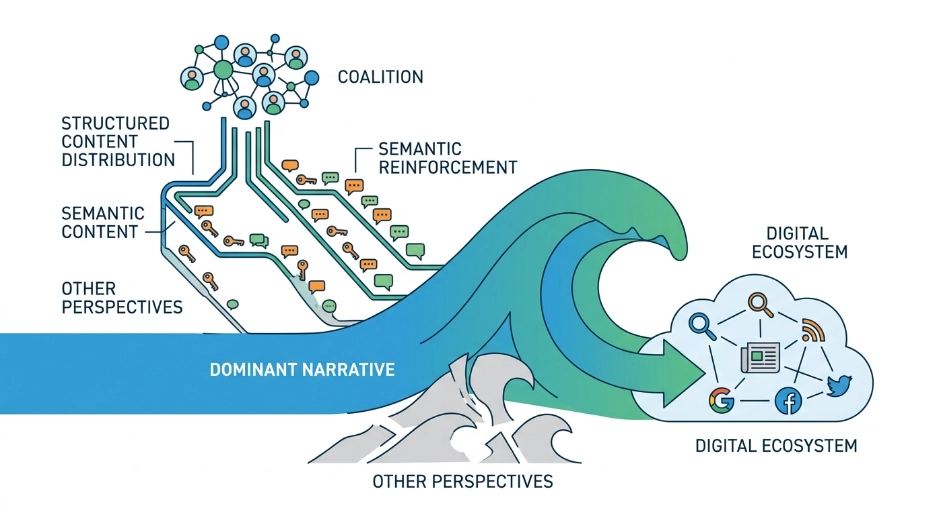
Three key mechanisms define this process:
-
Align messaging across entities, ensuring consistent terminology and framing; for example, using identical policy language across organisational publications to reinforce indexing signals.
-
Distribute content across multiple platforms, increasing visibility and reach; for example, publishing coordinated articles, reports, and commentary across partner websites and media outlets.
-
Reinforce authority through interlinking and citations, strengthening entity relationships; for example, linking between coalition members to signal credibility and relevance to search algorithms.
These mechanisms create a unified narrative structure that dominates search results and shapes stakeholder interpretation. The outcome is a controlled perception environment where alternative narratives receive reduced visibility.
How does coalition building integrate with digital advocacy systems?
Coalition building integrates with digital advocacy systems by providing the structural framework through which influence is coordinated and scaled. Digital advocacy is the use of online platforms, content strategies, and data-driven insights to shape public policy and stakeholder perception.
Integration occurs through synchronised content strategies and shared data analysis. Coalitions use coordinated publishing schedules, aligned messaging, and performance tracking to optimise visibility and engagement. This ensures that advocacy efforts are amplified across multiple channels simultaneously.
The impact is increased efficiency and effectiveness. Coalition-based advocacy achieves broader reach, stronger authority signals, and more consistent narrative control, resulting in enhanced influence over both policy discourse and public perception.
How does mapping influence networks improve coalition effectiveness?
Mapping influence networks improves coalition effectiveness by identifying key entities, relationships, and authority pathways within digital ecosystems. Influence mapping refers to the analysis of how information flows between stakeholders and how authority is distributed across networks.
This process enables coalitions to target high-impact nodes within the network, ensuring that content and messaging reach the most influential entities. By understanding these relationships, coalitions can optimise their structure and maximise the effectiveness of their advocacy efforts.
A detailed explanation of this process is explored in How Linkonize Maps Power: The Stakeholder Intelligence Process Behind Our Campaign Strategy, which examines how network analysis reveals authority structures and optimises strategic positioning.
The result is a more efficient coalition that leverages data-driven insights to enhance visibility, credibility, and influence across digital environments.
Coalition building defines the structural foundation of successful policy campaigns by aligning authority, narratives, and reputation signals across interconnected entities. It operates as a system for aggregating credibility, reinforcing trust, and dominating search visibility within digital ecosystems. Through coordinated content, semantic consistency, and network amplification, coalitions transform fragmented advocacy into unified influence.
The analysis demonstrates that coalition strength is measured through SERP dominance, stakeholder trust formation, and institutional credibility. By shaping digital narratives and optimising content ecosystems, coalitions establish stable perception environments that guide both algorithmic evaluation and public interpretation. These mechanisms position coalition building as a central component of modern public affairs and digital advocacy systems.
Frequently Asked Questions
What does coalition building mean in public affairs?
Coalition building refers to aligning multiple stakeholders, organisations, and institutions to present a unified policy position. It strengthens digital authority and stakeholder trust by creating consistent narratives across media, search engines, and advocacy platforms.
Why is coalition building important for policy campaigns?
Coalition building is important because it consolidates influence and amplifies reputation signals across digital ecosystems. This improves search visibility, reinforces credibility, and ensures a policy narrative is consistently recognised by both stakeholders and algorithms.
How does coalition building improve online reputation and authority?
Coalition building improves online reputation by generating consistent mentions, backlinks, and co-citations across trusted sources. These signals help search engines evaluate entity credibility, increasing rankings and strengthening overall digital authority.
How does Linkonize support coalition building strategies?
Linkonize supports coalition building by mapping relationships between entities, content, and authority signals within digital ecosystems. This allows organisations to identify influence networks, optimise narrative alignment, and improve search visibility through structured data insights.
How does coalition building influence search engine rankings?
Coalition building influences rankings by creating interconnected content and consistent keyword usage across multiple authoritative sources. Search engines interpret this alignment as a strong trust signal, leading to improved indexing, higher SERP positions, and sustained visibility.