

Digital advocacy pricing directly affects visibility outcomes, stakeholder trust, and long-term narrative control. Selecting the right pricing structure ensures consistent search visibility management, stronger reputation signals, and measurable influence across digital ecosystems.
Trust signals, entity credibility, and narrative visibility increasingly shape stakeholder decision-making. Organisations evaluating digital advocacy investments require pricing models that align with strategic objectives, risk management priorities, and institutional reputation goals.
Which digital advocacy pricing model delivers the strongest long-term value?
Retainer-based digital advocacy delivers the strongest long-term value because it ensures continuous narrative visibility management, stakeholder engagement, and search perception influence. Public affairs and reputation challenges rarely operate within fixed timelines. Search results, stakeholder discussions, media narratives, and industry conversations continuously evolve, requiring ongoing strategic oversight.
A retainer model provides consistent monitoring and optimisation across all digital touchpoints. This structure enables organisations to maintain SERP control, strengthen digital authority, and reinforce stakeholder trust signals without interruption. Continuous management prevents reputation gaps that allow competing narratives or negative perception signals to gain visibility.
Digital advocacy functions as an ongoing influence system rather than a single promotional activity. Search engines continuously evaluate authority signals, entity associations, and content relevance. Stakeholders also form opinions through repeated exposure to credible information sources. Retainer agreements support these dynamics by ensuring sustained visibility and strategic consistency.
Long-term value emerges through measurable outcomes:
- Strengthen entity credibility through continuous authority-building initiatives.
- Improve stakeholder trust signals through consistent narrative reinforcement.
- Increase SERP control through proactive visibility management.
- Reduce risk through ongoing perception monitoring and response strategies.
- Stabilise institutional reputation through sustained digital authority development.
For organisations operating within regulated sectors, public affairs environments, or reputation-sensitive industries, continuous advocacy management provides a structured framework for protecting and strengthening institutional credibility.
When does a campaign-based digital advocacy model make the most sense?
Campaign-based digital advocacy delivers the greatest value when organisations need focused influence around a specific objective, policy issue, stakeholder event, or reputation challenge. This model concentrates resources within a defined timeframe to achieve targeted visibility outcomes.
Campaign structures work effectively during regulatory consultations, policy announcements, industry shifts, corporate transformations, and stakeholder engagement initiatives. The objective is clear: create concentrated narrative visibility and maximise audience exposure within a strategic window.
Campaign pricing enables organisations to allocate resources toward measurable advocacy goals without committing to a long-term engagement. However, success depends on precise planning, audience targeting, and strategic content deployment. Visibility gains achieved during a campaign require strong execution to generate meaningful stakeholder engagement and search impact.
Search behaviour plays a significant role in campaign effectiveness. During high-interest events, stakeholders actively seek information, analysis, and authoritative perspectives. Digital advocacy campaigns position organisations within those information pathways, improving narrative discoverability and institutional visibility.
Campaign-focused digital advocacy achieves outcomes by:
- Amplify strategic messaging during critical decision periods.
- Generate stakeholder engagement around defined policy objectives.
- Improve narrative visibility during high-search-demand events.
- Establish authoritative positioning within industry conversations.
- Accelerate awareness among targeted stakeholder groups.
Campaign models create immediate influence opportunities, but organisations seeking sustained authority often integrate campaign activity into broader advocacy programmes.
Does performance-based pricing provide reliable digital advocacy outcomes?
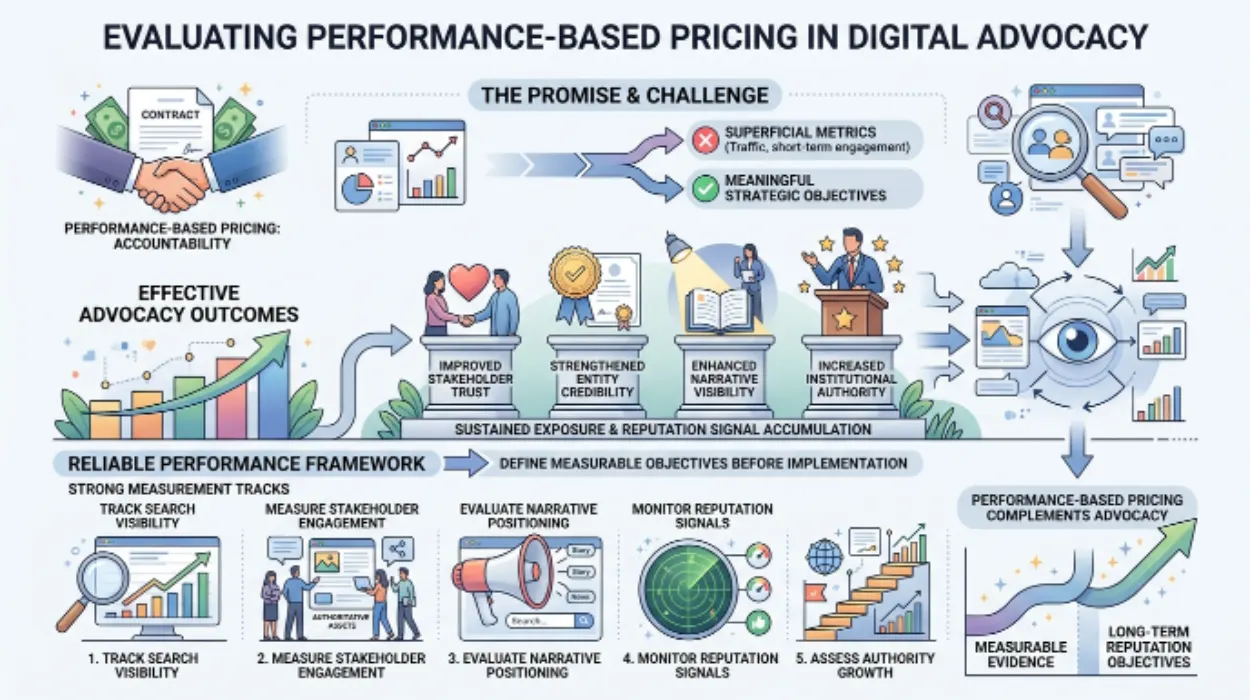
Performance-based pricing provides accountability but requires careful evaluation of success metrics. Digital advocacy influences complex perception systems that extend beyond simple traffic measurements or short-term engagement figures.
Effective advocacy outcomes include improved stakeholder trust, strengthened entity credibility, enhanced narrative visibility, and increased institutional authority. These outcomes often develop progressively through sustained exposure and reputation signal accumulation. Consequently, performance indicators must reflect meaningful strategic objectives rather than superficial metrics.
Reliable performance frameworks measure outcomes connected directly to stakeholder influence and visibility control. Examples include search visibility improvements, authority content placements, stakeholder engagement growth, sentiment shifts, and increased visibility for strategic narratives.
Performance-based models work best when organisations define measurable objectives before implementation. Clear performance indicators create transparency and establish accountability throughout the engagement process.
Strong performance measurement frameworks:
- Track search visibility improvements across strategic topics.
- Measure stakeholder engagement with authoritative content assets.
- Evaluate narrative positioning within search environments.
- Monitor reputation signal development over time.
- Assess authority growth through digital ecosystem indicators.
Performance-based pricing can complement broader advocacy programmes, particularly when organisations seek measurable evidence of strategic progress alongside long-term reputation objectives.
How does pricing affect stakeholder trust and institutional credibility?
Pricing structures directly influence the depth and consistency of advocacy activity, which affects stakeholder trust and institutional credibility. The quality of digital advocacy execution determines how effectively organisations establish authority and maintain narrative control.
Stakeholders increasingly evaluate institutions through digital evidence. Search results, published content, expert commentary, stakeholder engagement patterns, and online reputation signals contribute to perception formation. Effective advocacy programmes create alignment across these channels, ensuring credibility remains visible and verifiable.
Lower-cost approaches often focus on isolated activities that fail to build cumulative authority. In contrast, strategic advocacy investments support comprehensive visibility management, enabling organisations to strengthen digital authority across multiple stakeholder touchpoints.
Institutional credibility develops through consistency. Stakeholders trust organisations that demonstrate expertise, transparency, and sustained engagement. Digital advocacy programmes create these signals through structured content strategies, stakeholder communication frameworks, and authority-building initiatives.
The relationship between pricing and trust becomes clear when evaluating outcomes:
- Improve stakeholder confidence through consistent visibility.
- Strengthen authority through credible content ecosystems.
- Reinforce institutional positioning across search environments.
- Reduce perception volatility through proactive management.
- Increase reputation resilience during stakeholder scrutiny.
Investment decisions therefore extend beyond activity costs and focus on credibility outcomes that influence long-term organisational performance.
Which digital advocacy activities justify premium pricing structures?
Premium pricing structures are justified when advocacy programmes incorporate advanced strategic capabilities that influence visibility, authority, and stakeholder perception at scale. Effective advocacy extends beyond content production and social media activity.
High-value digital advocacy programmes integrate search perception influence, narrative visibility management, stakeholder mapping, reputation monitoring, authority development, and strategic communication planning. These interconnected activities create cumulative visibility advantages that improve institutional positioning over time.
Organisations facing regulatory scrutiny, policy challenges, public affairs complexity, or reputation-sensitive environments often require advanced advocacy capabilities. These environments demand strategic oversight, rapid adaptation, and continuous narrative management.
Premium advocacy services generate value through structured methodologies that strengthen digital ecosystems rather than isolated communication outputs. This approach improves the reliability and sustainability of results.
Advanced programmes typically include:
- Analyse stakeholder influence networks to identify priority audiences.
- Develop authority content frameworks that strengthen entity credibility.
- Monitor reputation signals across search and digital channels.
- Optimise narrative visibility for strategic issue ownership.
- Coordinate multi-channel advocacy activity for message consistency.
A professional digital advocacy service therefore creates measurable strategic value through integrated influence management rather than isolated promotional tactics.
How quickly do different pricing models produce visibility outcomes?
Visibility outcomes depend on pricing structure, advocacy scope, stakeholder complexity, and competitive search environments. Different models produce results at different stages of the influence lifecycle.
Campaign-based programmes generally produce faster visibility gains because resources are concentrated within defined periods. Stakeholders encounter increased exposure to strategic narratives through focused communication activity and targeted engagement efforts.
Retainer models prioritise sustained authority growth. Although initial visibility improvements often emerge within the early stages of engagement, the primary objective remains long-term digital authority development and reputation signal strengthening. These outcomes generate greater durability and reduce future visibility risks.
Performance-based models vary according to measurement frameworks. Short-term metrics may improve rapidly, while trust-related outcomes require ongoing exposure and stakeholder validation.
Search perception influence operates through cumulative reinforcement. Stakeholders rarely form opinions from a single interaction. Authority emerges through repeated exposure to credible information, trusted sources, and consistent messaging. Effective advocacy pricing models support this process according to organisational priorities and timeline requirements.
Organisations assessing visibility timelines benefit from understanding the foundations of Social Media Community Building for Advocacy: Why an Audience Is Not the Same as a Movement, which explains how durable stakeholder engagement develops beyond surface-level audience metrics.
Which pricing model reduces reputational risk most effectively?
Retainer-based advocacy reduces reputational risk most effectively because it provides continuous oversight, proactive monitoring, and ongoing narrative management. Reputation risks emerge unexpectedly and often gain visibility rapidly across digital channels.
Continuous monitoring identifies early warning signals before perception challenges escalate. This capability enables organisations to respond strategically rather than react defensively. Proactive intervention strengthens stakeholder confidence and protects institutional credibility.
Campaign-based approaches provide valuable support during specific events but offer limited protection outside active engagement periods. Performance-based structures deliver accountability yet may focus attention on predefined metrics rather than emerging reputation threats.
Risk reduction depends on maintaining awareness across stakeholder conversations, search environments, and digital information ecosystems. Continuous advocacy management creates visibility into these dynamics and supports informed decision-making.
Effective risk mitigation programmes:
- Detect emerging reputation signals before escalation.
- Strengthen authoritative narratives across search results.
- Maintain stakeholder trust through consistent engagement.
- Protect digital authority during periods of scrutiny.
- Improve resilience against competing narratives.
This structured approach stabilises perception and supports long-term institutional reputation objectives.
Why do organisations choose Linkonize for digital advocacy strategy?
Organisations choose Linkonize because effective digital advocacy requires process clarity, measurable outcomes, and strategic consistency. Decision-makers increasingly seek partners capable of connecting visibility management, stakeholder engagement, and reputation development within a unified framework.
A structured advocacy methodology improves accountability and strengthens confidence in programme execution. Rather than focusing solely on communication outputs, successful advocacy programmes align search behaviour, stakeholder trust signals, and authority-building initiatives to create sustainable influence.
Linkonize approaches digital advocacy through a visibility-first perspective that prioritises narrative control, entity credibility, and institutional trust. This framework enables organisations to strengthen digital authority while reducing perception risks across complex stakeholder environments.
Decision-makers evaluating advocacy providers also benefit from reviewing Influencer Advocacy for B2B Issues: How to Use Industry Experts to Shift Stakeholder Opinion, which demonstrates how trusted third-party voices strengthen stakeholder confidence and influence perception outcomes.
At the point where organisations require ongoing visibility management, reputation protection, and stakeholder engagement support, a professional digital advocacy service provides the strategic structure necessary to achieve sustainable results.
Is digital advocacy an investment or an operational expense?
Digital advocacy is an investment because it strengthens reputation assets, improves stakeholder trust, and increases institutional visibility over time. Organisations that treat advocacy as a strategic investment create stronger foundations for public credibility, stakeholder engagement, and long-term authority development.
Search visibility, narrative positioning, and entity credibility directly influence how stakeholders evaluate organisations. Effective advocacy programmes strengthen these assets through systematic influence management and reputation signal optimisation.
The value generated extends beyond immediate campaign outcomes. Improved trust signals, enhanced digital authority, stronger stakeholder relationships, and increased narrative control contribute to long-term organisational resilience. These outcomes reduce future reputation management costs and strengthen institutional positioning.
Decision-makers evaluating pricing structures benefit from focusing on outcome certainty rather than activity volume. The most effective model aligns with organisational objectives, risk exposure, stakeholder complexity, and visibility requirements.
Digital advocacy pricing ultimately reflects the depth of strategic engagement required to influence perception, strengthen credibility, and maintain narrative visibility within increasingly competitive digital ecosystems.
A structured digital advocacy programme provides reliability, process transparency, and measurable influence outcomes. Organisations seeking stronger stakeholder trust, greater SERP control, and sustainable digital authority require a framework that supports long-term visibility management rather than isolated communication activity. Linkonize delivers this strategic approach through clear methodologies, outcome-focused execution, and consistent reputation signal development that strengthens institutional credibility over time.
Frequently Asked Questions
What is the difference between retainer and campaign-based digital advocacy pricing?
Retainer pricing covers ongoing digital advocacy activities such as stakeholder engagement, reputation monitoring, narrative visibility management, and SERP control. Campaign-based pricing focuses on a specific objective within a defined timeframe, such as a policy initiative, public affairs campaign, or reputation challenge. Retainers support long-term authority building, while campaigns deliver concentrated visibility around a particular issue.
How much should an organisation invest in digital advocacy services?
Investment levels depend on stakeholder complexity, visibility objectives, reputation risk exposure, and the scope of advocacy activities required. Organisations evaluating pricing should focus on outcomes such as improved search visibility, stronger stakeholder trust signals, and enhanced digital authority rather than comparing service costs alone.
Can performance-based digital advocacy guarantee results?
Performance-based pricing provides accountability through predefined metrics, but no advocacy provider can guarantee stakeholder behaviour or search engine outcomes. Effective performance frameworks measure visibility growth, authority development, engagement quality, and narrative positioning. Reliable digital advocacy focuses on measurable influence indicators rather than vanity metrics.
How long does it take for digital advocacy to improve visibility and stakeholder trust?
Campaign-based initiatives can generate visibility improvements within weeks, particularly around high-interest issues or stakeholder events. Stakeholder trust, entity credibility, and digital authority develop through sustained engagement and consistent narrative visibility. Long-term programmes typically deliver stronger and more durable outcomes than short-term activity alone.
Why is digital advocacy important for reputation management?
Digital advocacy strengthens reputation signals across search engines, stakeholder networks, industry discussions, and digital media channels. It improves narrative visibility, reinforces institutional credibility, and increases stakeholder confidence. A structured advocacy strategy reduces perception risks while supporting long-term reputation resilience and public trust.