

Strategic communication planning structures how narratives are designed, tested, and distributed to shape stakeholder perception and search visibility. It defines how segmented audiences receive calibrated messages that influence trust signals and institutional credibility across digital ecosystems.
Public affairs refers to the management of relationships between institutions and their stakeholders through controlled communication, policy alignment, and reputation signalling within digital and media environments.
What is strategic communication planning in digital public affairs?
Strategic communication planning is the systematic design of message frameworks aligned with audience segmentation, narrative positioning, and measurable perception outcomes. It defines how institutions organise communication assets to influence entity perception across search engines, media platforms, and stakeholder networks. Within digital ecosystems, this process integrates content indexing, authority signalling, and visibility optimisation into a unified structure. It operates through coordinated messaging across owned, earned, and shared channels, ensuring narrative consistency and contextual relevance. Algorithms evaluate this consistency as a credibility indicator, reinforcing institutional authority across SERPs. The absence of structured planning fragments narrative signals, weakening trust architecture and reducing discoverability.
How does audience segmentation influence narrative control and stakeholder trust?
Audience segmentation refers to the classification of stakeholders based on behavioural data, informational intent, and engagement patterns within digital environments. It defines how institutions tailor messaging to align with specific perception triggers and informational needs. Segmentation operates through data clustering mechanisms, including search intent mapping, demographic profiling, and interaction analysis. These clusters inform content structuring, keyword targeting, and narrative framing. Search engines interpret segmented relevance as topical authority, increasing content ranking for defined queries. Stakeholder trust strengthens when messaging aligns with expectations, reducing informational friction and reinforcing credibility signals.
Why is message testing critical for narrative validation in digital ecosystems?
Message testing is the evaluation of communication effectiveness through controlled variation and performance measurement across digital channels. It defines how institutions validate narrative clarity, engagement efficiency, and perception impact before large-scale dissemination. Testing mechanisms include A/B content comparisons, sentiment analysis, and engagement metrics evaluation. These processes identify which message structures generate higher interaction rates and stronger authority signals. Algorithms prioritise content that demonstrates consistent engagement and relevance, improving search visibility. Without testing, communication strategies rely on unverified assumptions, weakening narrative influence and reducing SERP performance.
How do search engines interpret communication signals as authority and trust?
Search engines interpret communication signals as measurable indicators of credibility, relevance, and institutional reliability. These signals include content consistency, backlink profiles, semantic relevance, and user engagement metrics. Authority is defined through structured content networks that demonstrate expertise across interconnected topics. Trust is evaluated through source credibility, content accuracy, and historical performance within indexing systems. Algorithms assess these signals collectively to determine ranking positions on SERPs. Strong alignment between communication planning and algorithmic evaluation enhances digital authority and stabilises institutional reputation. Misaligned signals create inconsistencies that reduce visibility and weaken stakeholder confidence.
What role do content ecosystems play in shaping institutional visibility?
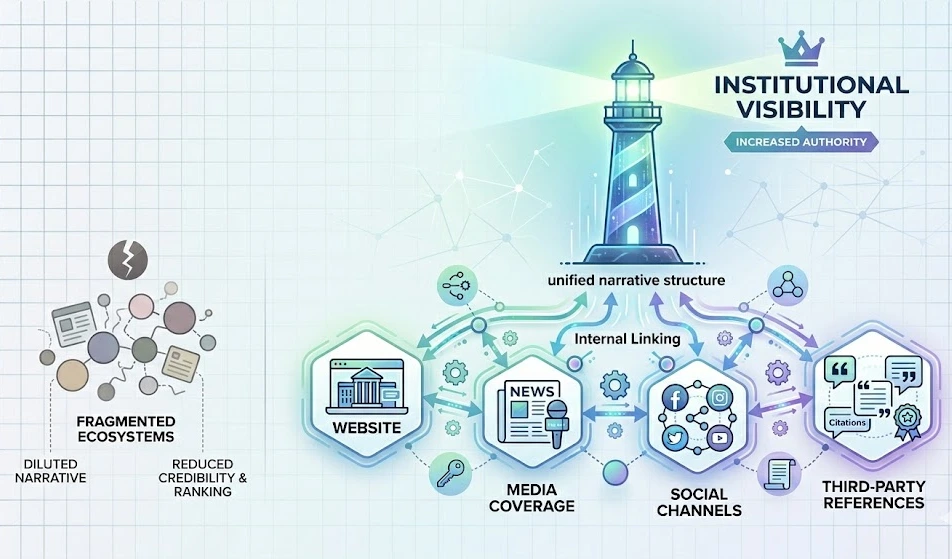
Content ecosystems refer to interconnected digital assets that collectively define an institution’s presence across platforms and search environments. These ecosystems include websites, media coverage, social channels, and third-party references. Each component contributes to a unified narrative structure that search engines index and evaluate. The ecosystem operates through internal linking, semantic consistency, and topical depth, reinforcing authority signals. Visibility increases when content nodes support each other through contextual relevance and keyword alignment. Fragmented ecosystems dilute narrative coherence, reducing both ranking performance and perceived credibility.
How does narrative consistency affect digital reputation and perception systems?
Narrative consistency is the uniform alignment of messaging across all communication channels and formats. It defines how institutions maintain a stable perception framework within dynamic digital environments. Consistency operates through controlled language, repeated key themes, and aligned semantic structures. Search engines interpret consistent narratives as indicators of reliability and expertise, strengthening ranking signals. Stakeholders interpret consistency as transparency, reinforcing trust and reducing reputational risk. Inconsistent messaging introduces ambiguity, weakening both algorithmic evaluation and stakeholder confidence.
How does media visibility contribute to institutional credibility in public affairs?
Media visibility refers to the presence and frequency of institutional narratives within digital news and information platforms. It defines how external validation influences perception and authority signals. Media coverage acts as an external trust layer, reinforcing credibility through third-party endorsement. Search engines integrate media signals into ranking algorithms, increasing visibility for entities with consistent coverage. Sentiment analysis further refines these signals, distinguishing between positive, neutral, and negative narratives. High-quality media visibility strengthens institutional authority, while negative or inconsistent coverage disrupts perception systems.
What is the relationship between digital advocacy and stakeholder engagement systems?
Digital advocacy is the structured dissemination of narratives to influence stakeholder perception, policy understanding, and institutional positioning within digital environments. It defines how organisations engage audiences through targeted messaging and platform-specific strategies. Engagement systems operate through interactive content, feedback mechanisms, and real-time communication channels. These systems generate measurable signals, including engagement rates, content sharing, and user interaction patterns. Search engines interpret these signals as indicators of relevance and authority. Effective digital advocacy aligns engagement metrics with communication objectives, reinforcing both visibility and trust.
How do SERP dynamics shape narrative influence and perception outcomes?
SERP dynamics refer to the ranking, positioning, and presentation of content within search engine results pages. They define how narratives compete for visibility and attention within constrained digital spaces. Ranking mechanisms prioritise content based on relevance, authority, and user engagement signals. Featured snippets, knowledge panels, and top-ranking pages act as dominant perception drivers. Institutions that control high-ranking positions influence how information is interpreted and trusted. Lower visibility reduces narrative impact, limiting the ability to shape stakeholder perception.
What mechanisms define institutional credibility in digital communication?
Institutional credibility is defined by the alignment of accuracy, authority, and transparency within digital communication systems. It refers to how stakeholders and algorithms evaluate the reliability of information sources. Credibility mechanisms include factual consistency, citation integrity, and authoritative content structuring. Search engines prioritise credible sources through quality scoring and trust signal evaluation. Stakeholders rely on these signals to assess institutional legitimacy. Weak credibility indicators reduce both ranking performance and trust levels, affecting long-term reputation stability.
How does data-driven communication improve perception management?
Data-driven communication is the use of measurable insights to refine messaging strategies and optimise narrative performance. It defines how institutions adapt communication based on real-time analytics and behavioural data. Mechanisms include performance tracking, audience analysis, and predictive modelling. These tools identify patterns in engagement, search behaviour, and content interaction. Search engines reward data-optimised content with improved visibility due to higher relevance and engagement metrics. Data-driven strategies reduce uncertainty, ensuring that communication aligns with both algorithmic requirements and stakeholder expectations.
How does omnichannel structuring strengthen communication ecosystems?
Omnichannel structuring is the coordinated distribution of messages across multiple digital platforms to maintain narrative coherence and maximise reach. It defines how institutions integrate communication channels into a unified perception system. This structure ensures that content maintains consistency while adapting to platform-specific formats. Algorithms recognise cross-platform consistency as a strong authority signal, improving indexing and ranking outcomes. Stakeholders encounter aligned narratives across touchpoints, reinforcing trust and recognition. A structured omnichannel approach connects strategic communication planning with execution frameworks such as Omnichannel Communication Rollout: How to Ensure Your Message Lands Consistently Across Every Platform, ensuring that message distribution aligns with both search visibility and engagement metrics.
What risks emerge from unstructured communication strategies?
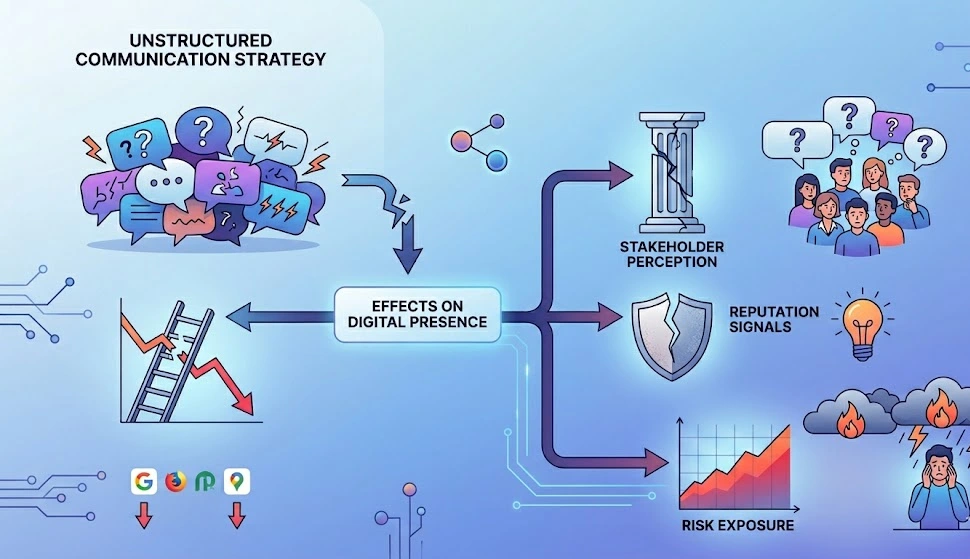
Unstructured communication strategies refer to the absence of coordinated planning, segmentation, and message validation. They result in fragmented narratives and inconsistent perception signals across digital ecosystems. These inconsistencies weaken search engine evaluation, reducing ranking positions and visibility. Stakeholders encounter conflicting information, leading to reduced trust and credibility. Reputation signals become diluted, making it difficult to establish authority. Risk exposure increases as negative narratives gain prominence due to lack of controlled messaging.
How do reputation signals influence long-term digital authority?
Reputation signals are measurable indicators of trust, credibility, and authority within digital ecosystems. They include backlinks, media mentions, engagement metrics, and content consistency. These signals accumulate over time, forming a stable digital authority profile. Search engines use this profile to determine ranking reliability and content prioritisation. Strong reputation signals create resilience against negative content and algorithmic fluctuations. Weak or inconsistent signals result in unstable visibility and reduced stakeholder confidence.
Strategic communication planning defines how institutions structure narratives, segment audiences, and validate messaging to influence perception systems within digital ecosystems. Audience segmentation and message testing operate as core mechanisms that align communication with stakeholder expectations and algorithmic evaluation criteria. Search engines interpret consistency, engagement, and credibility as authority signals, directly impacting SERP positioning and institutional visibility.
Content ecosystems, media presence, and omnichannel structuring reinforce narrative coherence, strengthening trust architecture and digital authority. In contrast, unstructured strategies generate fragmented signals that weaken both perception and ranking performance. Understanding these systems provides a framework for analysing how narratives are created, evaluated, and sustained across digital environments.
Frequently Asked Questions
What is strategic communication planning in media relations?
Strategic communication planning in media relations refers to structuring messages, audience targeting, and content distribution to influence public perception and search visibility. It aligns narrative development with stakeholder expectations and digital authority signals. Linkonize applies this approach by integrating audience segmentation and message testing into communication frameworks.
How does audience segmentation improve communication effectiveness?
Audience segmentation improves communication effectiveness by grouping stakeholders based on search intent, behaviour, and engagement patterns. This allows messages to match specific informational needs, increasing relevance and trust signals. In media relations, segmented messaging enhances both stakeholder perception and SERP performance.
Why is message testing important in digital communication strategies?
Message testing evaluates how different versions of content perform across channels using metrics like engagement rates and sentiment analysis. It ensures that communication delivers clear narratives and generates strong credibility signals. This process supports data-driven optimisation in media relations and digital advocacy.
How does strategic communication influence online reputation?
Strategic communication influences online reputation by controlling how narratives appear across search engines, media platforms, and content ecosystems. Consistent messaging and authoritative content improve trust signals and entity perception. This directly impacts how institutions are ranked and interpreted in digital environments.
What role does omnichannel communication play in media relations?
Omnichannel communication ensures that messages are consistently distributed across multiple platforms, including search, media, and social channels. This strengthens narrative coherence and reinforces authority signals across digital touchpoints. In media relations, it supports unified stakeholder engagement and improved search visibility.