

Omnichannel communication rollout ensures message consistency by aligning narrative, timing, and platform-specific formats across all digital and media channels.
Public affairs strategies differ based on how communication frameworks distribute authority signals, manage stakeholder perception, and sustain narrative visibility across fragmented ecosystems.
Digital advocacy methods are evaluated through their ability to synchronise messaging across owned, earned, and shared channels while maintaining coherence in search results, media coverage, and stakeholder discourse.
How do omnichannel communication frameworks compare with single-channel or siloed messaging strategies?
Omnichannel communication frameworks operate through integrated message distribution across platforms, while siloed strategies isolate communication within individual channels. Omnichannel systems align messaging across press releases, social platforms, search results, and stakeholder communications to maintain consistent narrative signals. Siloed approaches function independently, often producing fragmented messaging that weakens entity credibility and creates conflicting interpretations. The mechanism of omnichannel rollout relies on synchronised publishing schedules, unified messaging guidelines, and cross-platform amplification loops. In contrast, siloed messaging lacks coordinated reinforcement, reducing cumulative visibility and weakening search ranking influence.
From a comparative perspective, omnichannel strategies strengthen narrative visibility by ensuring repetition and coherence across high-authority domains. This repetition reinforces reputation signals within search engine indexing systems, improving SERP consistency. Siloed approaches limit this reinforcement effect, leading to dispersed sentiment distribution and reduced control over narrative framing. However, omnichannel systems require higher operational coordination and governance oversight, increasing complexity in execution. Siloed models present lower coordination demands but introduce higher risk exposure in reputation misalignment and message dilution.
In terms of stakeholder perception, omnichannel communication enhances trust by presenting a unified institutional voice across media and digital touchpoints. Siloed strategies generate inconsistencies that weaken stakeholder confidence and reduce perceived transparency. This difference directly impacts institutional credibility, particularly in high-stakes public affairs environments where consistency functions as a proxy for reliability.
What distinguishes organic communication frameworks from reactive communication models in digital advocacy?
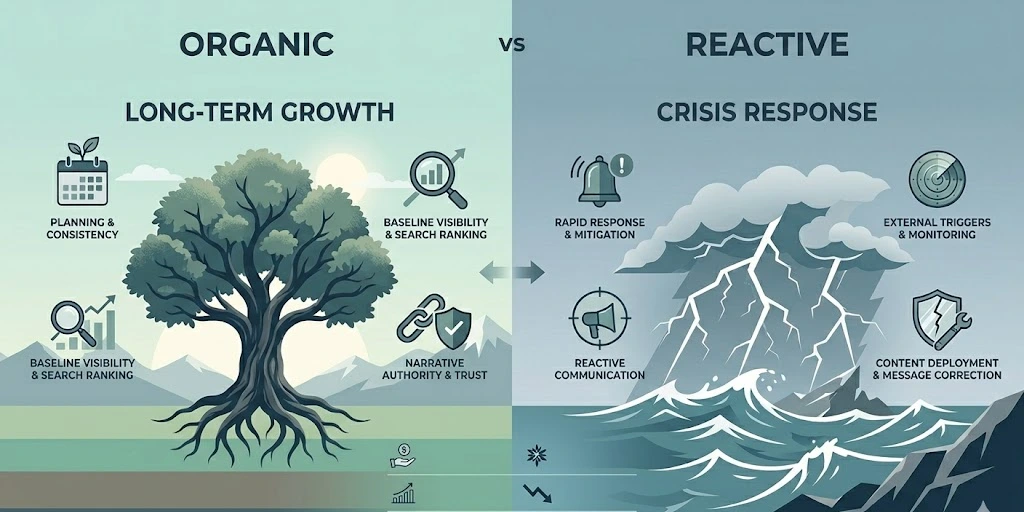
Organic communication frameworks build narrative authority over time through planned, consistent content dissemination, whereas reactive models respond to emerging issues or external stimuli. Organic systems operate by establishing baseline visibility across search engines, media outlets, and stakeholder channels before issues arise. Reactive frameworks activate in response to crises, media scrutiny, or shifts in public sentiment, prioritising rapid response over long-term coherence. The mechanism of organic communication involves structured content calendars, keyword alignment, and continuous narrative reinforcement across platforms. Reactive models depend on monitoring tools, rapid content deployment, and targeted message correction.
The effectiveness of organic frameworks lies in their ability to shape search ranking influence and narrative visibility before competing narratives emerge. This pre-emptive positioning reduces reliance on content suppression strategies, as authoritative content already occupies prominent SERP positions. Reactive models, by contrast, often engage in content suppression or counter-narrative deployment after negative sentiment has gained traction. This reactive positioning introduces higher volatility in sentiment distribution and reduces control over narrative framing.
From a scalability perspective, organic communication systems provide sustainable growth in entity credibility, as each content asset contributes to cumulative authority signals. Reactive models scale inconsistently due to their dependence on external triggers and unpredictable issue cycles. However, reactive frameworks offer immediate responsiveness, which is essential in mitigating short-term reputational risks. Organic systems, while stable, require sustained resource allocation and long-term planning.
In terms of stakeholder trust, organic communication fosters predictability and transparency, reinforcing institutional reliability. Reactive models can maintain trust during crises if executed with precision, but inconsistent or delayed responses increase risk exposure and weaken credibility.
How do media visibility strategies compare with stakeholder engagement approaches in public affairs?
Media visibility strategies prioritise exposure through high-authority publications, while stakeholder engagement approaches focus on direct interaction with targeted audiences. Media visibility operates by securing placements in recognised outlets, amplifying institutional narratives through third-party validation. Stakeholder engagement functions through direct channels such as consultations, social platforms, and targeted communications, enabling dialogue and feedback loops. The mechanism of media visibility relies on editorial alignment, timing, and newsworthiness to achieve coverage. Stakeholder engagement operates through continuous interaction, sentiment monitoring, and message adaptation.
In comparative terms, media visibility strengthens reputation signals through association with authoritative domains, enhancing search ranking influence and perceived legitimacy. This approach contributes to strong narrative visibility within SERPs, particularly when media coverage is indexed and linked. Stakeholder engagement, however, generates deeper trust signals by demonstrating responsiveness and inclusivity. It influences sentiment distribution more directly, as stakeholders participate in shaping the narrative.
Limitations emerge in each approach. Media visibility depends on external editorial control, reducing message precision and increasing risk of misinterpretation. Stakeholder engagement requires sustained interaction and resource investment, limiting scalability in large or diverse audiences. From a risk perspective, media strategies expose institutions to public scrutiny, while engagement strategies risk inconsistency if messaging is not tightly coordinated.
The combined impact on institutional credibility depends on balance. Media visibility establishes authority, while stakeholder engagement reinforces trust. Over-reliance on one approach creates asymmetry in perception, either appearing distant or lacking authority.
How does content amplification compare with content suppression in managing narrative control?
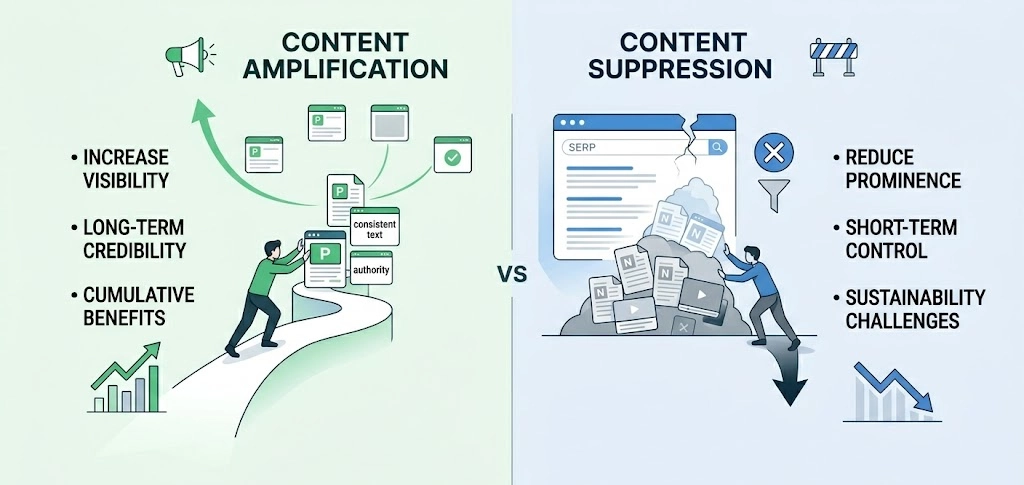
Content amplification increases the visibility of positive or neutral narratives, while content suppression seeks to reduce the prominence of negative or competing information. Amplification operates by distributing content across multiple platforms, leveraging backlinks, keyword optimisation, and cross-channel promotion to enhance search ranking influence. Suppression functions through strategic content creation designed to outrank or displace negative content within search results. The mechanism of amplification relies on volume, consistency, and authority signals, whereas suppression depends on targeted keyword competition and SERP displacement tactics.
From an effectiveness standpoint, amplification builds long-term narrative visibility by strengthening the presence of aligned content across digital ecosystems. This approach enhances entity credibility by demonstrating consistent messaging and reinforcing positive reputation signals. Suppression, in contrast, provides short-term control by reducing the accessibility of negative content, but does not inherently improve underlying sentiment distribution. As suppressed content can resurface, this strategy introduces sustainability challenges.
In terms of scalability, amplification offers cumulative benefits, as each additional content asset contributes to overall authority. Suppression requires continuous monitoring and intervention, increasing operational demands over time. Risk exposure differs significantly between the two approaches. Amplification maintains transparency and aligns with ethical communication standards, while suppression risks undermining stakeholder trust if perceived as manipulative.
The impact on stakeholder perception reflects these differences. Amplification supports credibility by promoting consistent narratives, whereas suppression may create gaps in transparency that weaken trust if discrepancies become visible.
How do platform-specific adaptations affect consistency in omnichannel communication?
Platform-specific adaptations modify content formats and delivery mechanisms while maintaining core messaging consistency. This approach operates by tailoring communication to the technical and behavioural characteristics of each platform, such as search engines, social media, and traditional media outlets. The mechanism involves adapting tone, length, and structure without altering the underlying narrative framework. In contrast, uniform messaging without adaptation risks misalignment with platform expectations, reducing engagement and visibility.
Comparatively, adaptive omnichannel strategies enhance narrative visibility by aligning with platform algorithms and user behaviours. Search engines prioritise structured, keyword-rich content, while social platforms emphasise engagement metrics and shareability. Adapting content ensures that each platform contributes effectively to overall communication goals. Uniform strategies fail to optimise for these differences, leading to reduced search ranking influence and weaker reputation signals.
However, adaptation introduces complexity in maintaining message consistency. Without strict governance, variations can lead to inconsistencies that fragment narrative coherence. This risk requires centralised messaging frameworks and quality control mechanisms. Uniform strategies avoid this complexity but sacrifice effectiveness across diverse platforms.
The impact on institutional credibility depends on execution. Effective adaptation preserves core messaging while enhancing accessibility and relevance. Poor adaptation creates discrepancies that undermine stakeholder trust and dilute narrative clarity.
What role does media relations play within omnichannel communication ecosystems?
Media relations functions as a central mechanism for distributing authoritative narratives through external validation channels. It operates by facilitating coverage in recognised media outlets, contributing to reputation signals and search ranking influence. Within an omnichannel ecosystem, media relations integrates with digital platforms to reinforce messaging across multiple touchpoints. This integration ensures that media coverage aligns with owned content and stakeholder communications.
Comparatively, media relations provides higher authority signals than owned channels due to third-party validation. This authority enhances narrative visibility within search results and strengthens institutional credibility. However, reliance on media relations introduces dependency on editorial decisions, limiting message control. Owned channels offer full control but lack equivalent authority signals.
The effectiveness of media relations depends on its integration within broader communication strategies. When aligned with digital advocacy and stakeholder engagement, it amplifies consistent messaging and reinforces trust signals. When isolated, it creates fragmented narratives that weaken overall coherence.
From a risk perspective, media relations exposes institutions to public scrutiny and potential misrepresentation. Effective governance and message alignment mitigate these risks. In terms of sustainability, media relations contributes to long-term authority building when consistently integrated with omnichannel strategies.
A detailed evaluation of how media relations aligns with high-stakes communication environments can be explored through Why Communications Directors Choose Linkonize for High-Stakes Media Campaigns, which contextualises its role within broader narrative control frameworks.
Anchor text used for BOFU: Why Communications Directors Choose Linkonize for High-Stakes Media Campaigns
How do short-term narrative management strategies compare with long-term credibility building?
Short-term narrative management focuses on immediate perception control, while long-term strategies prioritise sustained institutional credibility. Short-term approaches operate through rapid content deployment, media responses, and targeted messaging to address specific issues. Long-term strategies function through continuous content development, stakeholder engagement, and authority signal accumulation. The mechanism of short-term management emphasises speed and precision, whereas long-term strategies rely on consistency and cumulative impact.
In comparative analysis, short-term strategies provide immediate control over narrative visibility, particularly during crises or high-intensity media cycles. However, they do not inherently strengthen underlying reputation signals. Long-term strategies build durable authority, influencing search ranking and stakeholder trust over extended periods. This distinction affects sustainability, as short-term gains often require repeated intervention.
Risk exposure varies between the two approaches. Short-term strategies carry higher risk due to potential inconsistencies and reactive decision-making. Long-term strategies reduce risk by establishing stable communication frameworks and predictable messaging patterns. However, long-term approaches require sustained investment and organisational alignment.
The impact on stakeholder perception reflects these dynamics. Short-term management addresses immediate concerns but may appear inconsistent if not supported by long-term credibility. Long-term strategies reinforce trust by demonstrating stability and transparency, enhancing institutional reputation over time.
Omnichannel communication rollout operates as a coordination system that aligns messaging across platforms to reinforce narrative visibility, stakeholder trust, and institutional credibility. The comparison of strategies reveals distinct trade-offs between integration and simplicity, responsiveness and sustainability, and authority and engagement. Omnichannel frameworks outperform siloed approaches in maintaining coherence, while organic communication models provide stronger long-term authority than reactive systems.
Media visibility and stakeholder engagement contribute complementary strengths, with authority signals and trust signals functioning as interdependent components of effective public affairs strategies. Content amplification demonstrates greater sustainability than suppression, while platform-specific adaptation enhances effectiveness when governed by consistent messaging frameworks. Short-term narrative management provides immediate control, but long-term credibility building determines enduring reputation outcomes.
Strategic consideration involves balancing these approaches to optimise visibility, minimise risk exposure, and maintain consistent reputation signals across digital and media ecosystems.
Frequently Asked Questions
What is an omnichannel communication rollout?
An omnichannel communication rollout is a strategy that delivers a consistent message across multiple platforms, including media, social channels, and search engines. It operates by aligning content, timing, and narrative to strengthen visibility and maintain unified reputation signals.
How does omnichannel communication improve brand consistency?
Omnichannel communication improves consistency by ensuring that messaging remains aligned across all digital and media touchpoints. This reduces conflicting narratives and strengthens stakeholder trust through coherent and repeated communication signals.
What are the key components of a successful omnichannel communication strategy?
A successful omnichannel communication strategy includes centralised messaging frameworks, platform-specific content adaptation, and coordinated publishing schedules. These elements work together to enhance narrative visibility and improve search ranking influence.
How do organisations measure the effectiveness of omnichannel communication?
Effectiveness is measured through metrics such as media coverage quality, search engine visibility, sentiment distribution, and stakeholder engagement levels. These indicators reflect how well the communication strategy maintains consistency and authority across platforms.
What role does Linkonize play in omnichannel communication rollout?
Linkonize contributes to omnichannel communication rollout by supporting media relations and digital advocacy efforts that align messaging across platforms. This integration helps reinforce authority signals and ensures consistent narrative distribution in search and media ecosystems.