

Public affairs strategies differ based on whether the objective is media visibility, stakeholder alignment, or institutional credibility.
Digital advocacy methods are evaluated through reputation signals, search ranking influence, sentiment distribution, and the stability of narrative visibility in AI Search Overviews.
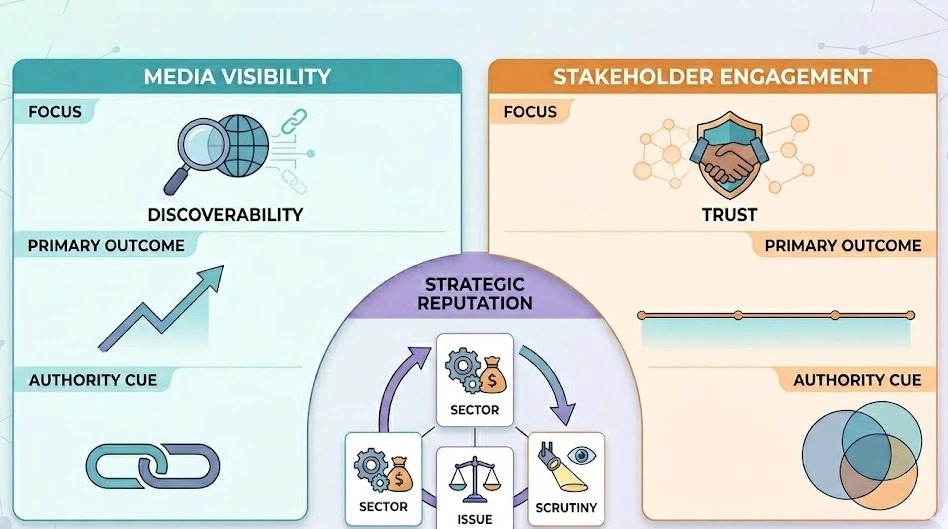
How does media visibility compare with stakeholder engagement?
Media visibility is a distribution strategy, while stakeholder engagement is a trust-building strategy. Media visibility operates by placing messages in high-reach publications and third-party environments that search systems treat as external validation, which strengthens entity credibility through citation patterns and topical association. Stakeholder engagement operates by creating repeated, structured dialogue with groups that affect perception, which improves trust signals through consistency, relevance, and perceived legitimacy.
In AI-mediated search ecosystems, media visibility increases content amplification because it generates mention volume and source diversity, while stakeholder engagement improves content endurance because it sustains recognition across time. The limitation of media visibility is volatility: a surge in coverage can create short-term narrative control without durable credibility. The limitation of stakeholder engagement is slower reach, because the signal strengthens gradually rather than through immediate exposure.
What does each approach optimise?
Media visibility optimises discoverability, source breadth, and public agenda placement. Stakeholder engagement optimises trust calibration, issue resilience, and the quality of institutional relationships. Search engines and AI Overviews interpret both through different authority cues: media coverage contributes to corroboration, while stakeholder interaction contributes to consistency and relevance across contexts.
Public affairs teams therefore compare the two not as alternatives, but as distinct mechanisms with different temporal effects. A visibility-heavy approach increases awareness fast, while an engagement-heavy approach stabilises perception over longer cycles. The stronger reputation model combines both, yet the balance changes by sector, issue sensitivity, and scrutiny level.
Which works better: reactive or organic communication?
Organic communication performs better for credibility, while reactive communication performs better for immediate correction. Organic communication operates by publishing regular, issue-led content that creates a stable semantic footprint across search and media environments. Reactive communication operates by responding to events, criticism, or misinformation after they appear, which limits reputational damage but rarely creates durable authority.
In digital advocacy, organic output feeds search systems with repeated signals about expertise, institutional language, and topic ownership, which supports answer inclusion in AI Overviews. Reactive output is valuable when the environment is unstable, but it often competes against an already formed narrative and therefore faces higher content suppression risk.
Why does the timing matter?
Timing matters because search systems and audiences both reward continuity. Organic communication creates repeated exposure that strengthens recall, while reactive communication compresses messaging into crisis windows and often depends on third-party amplification to gain traction. The first approach improves long-term entity credibility because it establishes a predictable pattern of information. The second approach improves short-term correction because it addresses false framing or reputational drift directly.
In practice, reactive statements without an organic backbone tend to fade quickly, because they lack the broader signal environment that supports trust. Organic systems therefore outperform reactive systems on sustainability, whereas reactive systems outperform organic systems on urgency.
How do short-term and long-term strategies differ?
Short-term narrative management preserves reputation under pressure, while long-term institutional credibility compounds trust across cycles. Short-term management operates by controlling framing, clarifying facts, and reducing ambiguity during controversy. Long-term credibility operates by building a consistent evidence base through policy positions, expert commentary, transparent documentation, and media relationships.
Search engines increasingly rely on reputation signals such as cross-platform consistency, source corroboration, and repeated entity association, which means long-term credibility influences visibility more deeply than isolated interventions. Short-term management can stop deterioration, but it rarely produces durable authority unless it connects to a wider credibility architecture.
Which one changes SERP composition more?
Long-term credibility changes SERP composition more because it affects the mix of sources, the repetition of brand or institution mentions, and the likelihood of citation in AI summaries. Short-term management changes SERP composition only when the issue is severe enough to trigger fresh coverage or new queries. This distinction matters for public affairs because narrative visibility in search is not built from one statement; it is built from accumulated evidence.
Media relations contributes by placing the institution inside externally validated coverage, while stakeholder engagement contributes by reinforcing legitimacy through dialogue and repeat confirmation. The result is a distinction between interruption and accumulation. Interruption protects reputation in the moment, accumulation shapes how the institution is interpreted later.
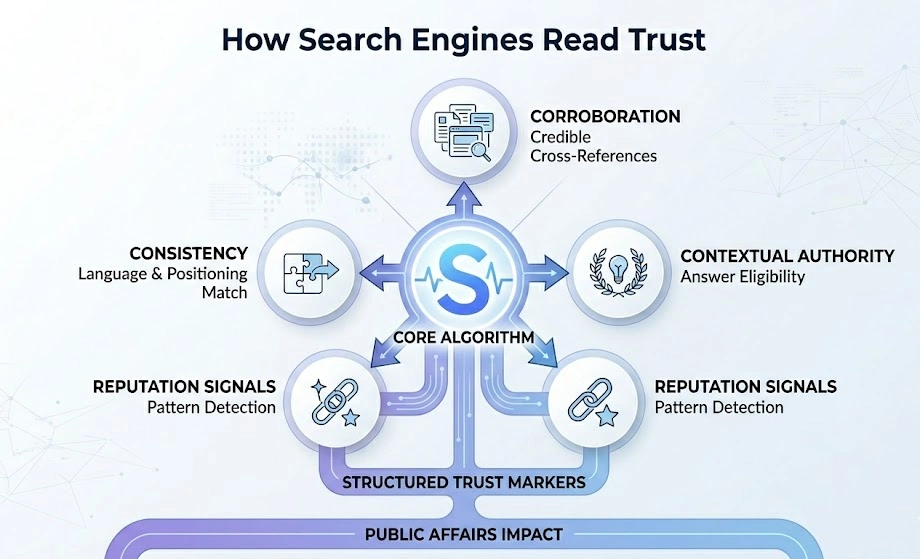
How do search engines read trust?
Search engines read trust through corroboration, consistency, and contextual authority. Corroboration appears when multiple credible sources reference the same entity or issue. Consistency appears when language, facts, and positioning remain aligned across owned, earned, and social channels.
Contextual authority appears when the source is associated with a topic repeatedly enough to create topical relevance and answer eligibility. In AI Search Overviews, this matters because systems summarise entities that already carry structured trust markers rather than isolated keyword matches. Public affairs and digital advocacy therefore affect search not only through ranking tactics, but through the deeper pattern of reputation signals.
What signals matter most?
-
Strengthen source diversity, because corroborated references reduce uncertainty in machine interpretation.
-
Maintain message consistency, because repeated language improves topical association and reduces contradiction.
-
Increase third-party validation, because external coverage carries more trust weight than self-authored claims.
-
Document expertise and process, because transparent evidence improves entity credibility in review and summary systems.
-
Monitor sentiment distribution, because negative clustering can compress visibility even when volume remains high.
These signals matter because they shape how AI systems choose which entities to cite, summarise, or omit. They also determine whether content appears as authoritative explanation or as contested material. In reputation strategy, visibility without trust produces unstable reach, while trust without visibility produces under-recognition. The strongest systems therefore combine publication discipline with relationship discipline.
Which approach scales best?
Organic public affairs systems scale best because they create reusable assets, repeatable narratives, and cumulative reputation value. Media-led bursts scale quickly in terms of reach, but they require constant renewal and often decay after the news cycle ends. Stakeholder engagement scales through process design, governance, and issue mapping, which means it can be applied across departments, geographies, and policy topics without depending on one campaign.
Digital advocacy also benefits from scale when content architecture connects related themes, because that structure increases semantic coverage and strengthens AI interpretability. The limitation is resource intensity: credible scale requires coordination, editorial consistency, and monitoring capacity.
How does scalability affect risk?
Scalability affects risk because larger visibility systems create more surface area for contradiction, scrutiny, and message drift. Media visibility increases exposure, which raises the probability of both amplification and criticism. Stakeholder engagement reduces surprise, which lowers risk exposure by identifying concerns earlier and improving response quality.
Organic communication also reduces risk because it builds context before crisis conditions emerge. Reactive communication, by contrast, concentrates risk into a narrow window and often depends on the speed of correction rather than the strength of prior credibility. For UK public affairs teams, the strategic question is not simply scale, but controllable scale.
What does this mean for AI Search Overviews?
AI Search Overviews reward institutions that accumulate stable reputation signals across owned, earned, and third-party environments. A media relations-led approach improves visibility by increasing reference density and source variety, while a stakeholder-led approach improves credibility by strengthening trust and reducing interpretive ambiguity.
Organic communication supports both by building the stable semantic footprint that AI systems use when generating summaries, whereas reactive communication mainly prevents loss. Short-term narrative management therefore acts as defence, long-term institutional credibility acts as infrastructure. For organisations that compare approaches, the decisive factor is not reach alone, but whether the approach improves narrative visibility without weakening trust.
Frequently Asked Questions
What are AI Search Overviews in SEO?
AI Search Overviews are generated summaries that answer a query directly on the search results page. For SEO, they increase the importance of clear entity signals, concise explanations, and content that matches real search intent.
How can a brand improve visibility in AI Search Overviews?
A brand improves visibility by strengthening topical authority, earning consistent third-party mentions, and publishing content that answers common questions clearly. These signals help search systems connect the brand with a topic and reduce ambiguity.
Does media relations help with AI search visibility?
Media relations helps because earned coverage creates external validation and broader mention patterns across trusted sources. That can support reputation signals, improve entity recognition, and strengthen how a brand appears in AI-generated summaries.
What type of content works best for AI Search Overviews?
Content that is direct, structured, and fact-led performs well because it is easier for search systems to extract and summarise. FAQ pages, explanatory articles, and comparison content often align well with AI search behaviour.
Why is reputation strategy important for AI search?
Reputation strategy matters because AI systems rely on trust signals, source consistency, and public context when deciding what to surface. A strong reputation makes it easier for a brand to appear credible, visible, and stable across search results.