

ChatGPT does not “tell the truth” in an absolute sense; it generates responses based on indexed content, authority signals, and probabilistic language modelling. Its outputs reflect how your brand is represented across digital ecosystems rather than an independently verified reality.
Online reputation refers to the structured set of signals, narratives, and content associations that define how an entity is interpreted, ranked, and trusted across search and AI-driven interfaces.
How do AI systems determine what is “true” about a brand?
AI systems define “truth” as a function of consistency, authority, and prevalence within indexed content ecosystems. This refers to how frequently and credibly specific narratives appear across high-authority sources, structured data, and semantically related content clusters.
The mechanism relies on large-scale content ingestion and ranking signals derived from search indices, knowledge graphs, and entity recognition models. AI systems process co-occurrence patterns, domain authority, citation frequency, and sentiment alignment to construct an entity profile. These systems do not validate factual accuracy through independent verification; instead, they evaluate informational dominance within the available corpus.
This directly impacts search visibility and stakeholder trust. When a narrative achieves high repetition across trusted domains, it becomes reinforced as an authoritative representation of the entity. As a result, institutional credibility is shaped by the density and quality of digital signals rather than by official statements alone.
What is online reputation in AI-driven search environments?
Online reputation is the measurable perception of an entity formed through aggregated digital signals across search engines, media platforms, and AI interfaces. It refers to how algorithms interpret and rank an entity’s credibility, authority, and trustworthiness.
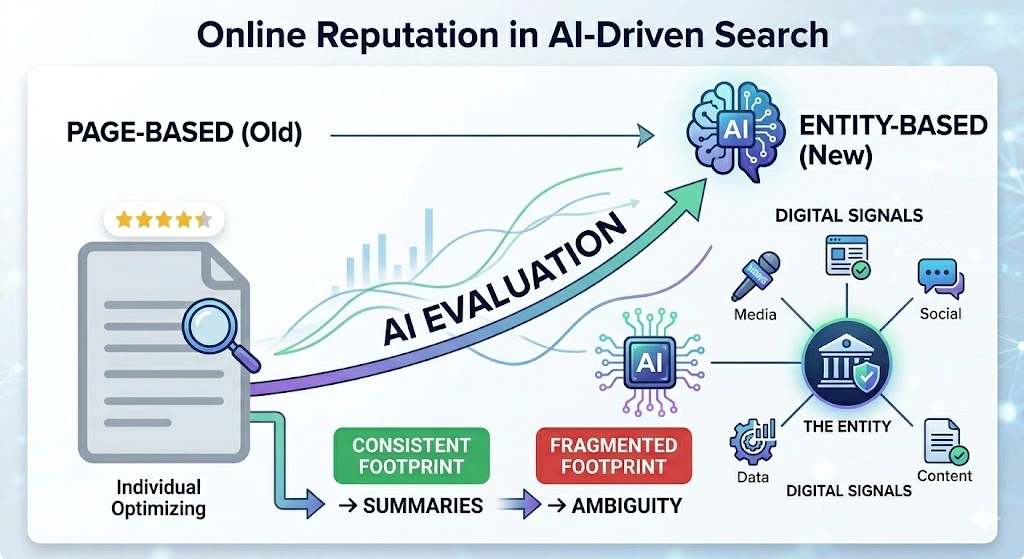
The system operates through continuous indexing, where content is categorised, linked, and evaluated against ranking criteria such as relevance, expertise, and reliability. AI models extend this by synthesising information into direct answers, reducing reliance on traditional click-based navigation. This shifts reputation from page-level optimisation to entity-level perception modelling.
The impact is structural. Reputation signals influence whether a brand appears in summaries, knowledge panels, or AI-generated responses. A fragmented or inconsistent digital footprint leads to ambiguity, which weakens authority signals and reduces visibility in high-trust search features.
How do narratives influence brand perception across digital ecosystems?
Narratives define the contextual framing of an entity and determine how information is interpreted within search and AI outputs. This refers to the thematic consistency and semantic alignment of content associated with a brand.
The mechanism is based on narrative clustering. Search engines and AI systems group related content into topic clusters, identifying dominant themes through keyword relationships, sentiment markers, and contextual relevance. When a narrative is consistently reinforced across authoritative domains, it becomes a primary lens through which the entity is understood.
This influences stakeholder perception by prioritising certain attributes over others. For example, if a brand is consistently associated with governance issues in high-authority media sources, that narrative becomes a defining reputation signal. This affects not only search rankings but also how AI-generated summaries describe the entity.
What role do authority signals play in AI-generated responses?
Authority signals determine which sources are prioritised and amplified within AI-generated outputs. These signals refer to measurable indicators of credibility, including domain authority, backlink profiles, editorial standards, and institutional affiliations.
The mechanism involves weighted ranking systems. Content from high-authority domains is assigned greater importance during indexing and retrieval processes. AI models then rely on this prioritised dataset when generating responses, effectively amplifying sources that meet established credibility thresholds.
This creates a hierarchy of influence. Entities associated with authoritative publications, verified data sources, and consistent expert commentary achieve stronger digital authority. This directly affects how often and how prominently they appear in AI responses, shaping both visibility and perceived trustworthiness.
How is stakeholder trust constructed through search visibility?
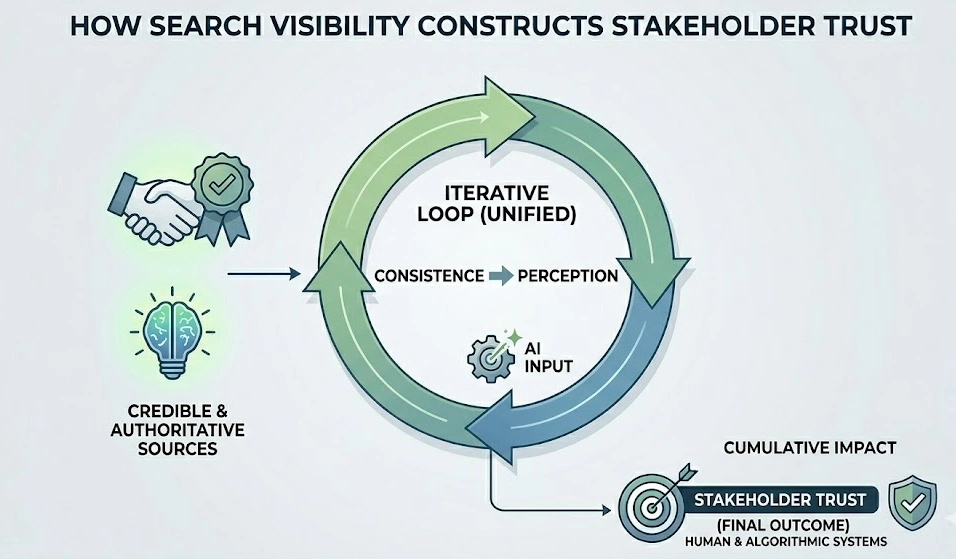
Stakeholder trust is constructed through repeated exposure to consistent, credible, and authoritative content across search interfaces. This refers to the alignment between what users encounter and what is recognised as reliable information within the search ecosystem.
The mechanism is iterative. Each interaction with search results reinforces or challenges existing perceptions. High-ranking content with clear attribution, factual consistency, and institutional backing strengthens trust signals. AI systems accelerate this process by presenting synthesised answers that reduce ambiguity.
The impact is cumulative. Trust is not established through a single interaction but through sustained visibility across multiple touchpoints. Entities that maintain consistent messaging across media coverage, structured data, and owned content achieve stronger trust alignment within both human and algorithmic evaluation systems.
How do search engines and AI interpret credibility and expertise?
Search engines and AI systems interpret credibility and expertise through structured evaluation frameworks that analyse content quality, authorship, and contextual relevance. This refers to the application of ranking criteria that prioritise demonstrable knowledge and reliable sourcing.
The mechanism includes entity recognition, authorship validation, and topical authority assessment. Content is evaluated based on its alignment with known entities, the expertise of its creators, and its consistency with established knowledge domains. AI systems further refine this by analysing semantic coherence and factual alignment across multiple sources.
This affects institutional perception by distinguishing between authoritative and non-authoritative content. Entities associated with expert-driven content and verified information ecosystems achieve higher credibility scores, which translates into stronger visibility in both traditional SERPs and AI-generated summaries.
What is the relationship between media visibility and reputation signals?
Media visibility is a primary driver of reputation signals within digital ecosystems. It refers to the frequency, prominence, and sentiment of an entity’s presence across editorial platforms and news sources.
The mechanism operates through content amplification and signal propagation. Media coverage generates backlinks, increases search queries, and contributes to narrative formation. Search engines index this content and integrate it into ranking algorithms, while AI systems use it as a reference point for generating summaries.
This relationship directly impacts digital authority. Positive, high-authority media coverage strengthens credibility signals, while negative or inconsistent coverage introduces conflicting narratives. The balance and quality of media visibility determine how an entity is positioned within search and AI outputs.
How does content indexing shape institutional credibility?
Content indexing shapes institutional credibility by determining which information is stored, categorised, and retrieved within search systems. This refers to the process through which digital content becomes part of the searchable knowledge base.
The mechanism involves crawling, indexing, and ranking. Search engines collect content from across the web, assign it to relevant categories, and evaluate its importance based on predefined criteria. AI systems then draw from this indexed content to generate responses, effectively transforming indexed data into perceived knowledge.
This creates a dependency between content structure and credibility. Well-structured, semantically rich content with clear entity associations is more likely to be indexed accurately and retrieved effectively. This enhances institutional visibility and strengthens reputation signals across digital interfaces.
How do digital footprints influence AI perception of brands?
Digital footprints define the totality of an entity’s presence across online platforms and serve as the foundation for AI-driven perception modelling. This refers to the accumulation of content, interactions, and signals associated with a brand.
The mechanism is based on data aggregation and pattern recognition. AI systems analyse the breadth and consistency of a digital footprint, identifying recurring themes, authoritative sources, and sentiment patterns. A coherent footprint reinforces a stable entity profile, while fragmented signals create ambiguity.
This influences both visibility and trust. A strong digital footprint with aligned narratives and authoritative associations leads to higher confidence in AI-generated representations. Conversely, inconsistencies reduce the reliability of the entity profile, affecting both ranking and perception.
How can brands structure content ecosystems for AI interpretation?
Brands structure content ecosystems by aligning narratives, authority signals, and semantic relevance across all indexed assets. This refers to the deliberate organisation of content to support consistent entity recognition and reputation signalling.
The mechanism can be understood through three core actions:
-
Define entity consistency: Establish uniform naming conventions, structured data, and clear topic associations across all platforms; for example, aligning metadata, schema markup, and editorial references ensures accurate entity recognition.
-
Strengthen authority pathways: Secure placements in high-authority publications and maintain strong backlink networks; this increases the weight of reputation signals during SERP evaluation and AI content synthesis.
-
Align narrative clusters: Produce content that reinforces key themes and eliminates conflicting messaging; this ensures that AI systems identify a dominant, coherent narrative when generating responses.
These actions directly affect how AI systems interpret and rank brand-related information. A structured ecosystem reduces ambiguity, enhances credibility, and improves visibility within both search results and AI-generated outputs. This aligns closely with strategies discussed in 3 ways to optimize your brand for AI Search Overviews, where content structuring directly influences AI summarisation accuracy.
AI systems do not independently verify truth; they construct representations of brands based on the structure, authority, and consistency of available digital information. Online reputation functions as a system of signals that define how entities are interpreted within search and AI environments. Narrative influence, authority signals, and content indexing collectively determine visibility and stakeholder trust.
Institutional credibility is therefore not static; it is continuously shaped by how content ecosystems are structured and maintained. Search engines and AI interfaces evaluate entities through measurable indicators, including media visibility, semantic alignment, and digital footprint consistency. These systems prioritise clarity, authority, and coherence when generating outputs.
Understanding these mechanisms enables a more precise interpretation of how brands are represented in AI-generated responses. It also clarifies that perception is not controlled by a single platform but emerges from the interaction between content, algorithms, and stakeholder engagement across the digital landscape.
Frequently Asked Questions
What is ChatGPT saying about my brand?
ChatGPT summarises a brand from the content it can access across search results, news coverage, and other indexed sources. It does not verify truth in the human sense; it reflects the strength, consistency, and authority of the information available online.
Why does ChatGPT give different answers about the same brand?
Different answers appear when the brand’s digital footprint is inconsistent across websites, articles, and structured data. AI systems weigh source quality, repetition, and context, so conflicting reputation signals can produce different summaries.
How can I check whether AI search is accurate about my brand?
Compare AI-generated statements with your official pages, reputable media coverage, and trusted third-party references. Look for mismatches in facts, tone, and entity naming, because those gaps often reveal where search visibility and credibility signals are weak.
What affects a brand’s visibility in AI overviews?
Visibility in AI overviews depends on content indexing, topical authority, and how clearly the brand entity appears across trusted sources. Stronger authority signals, clearer narrative consistency, and better semantic coverage improve the chance of being represented accurately.
How does Media Relations help with AI search reputation?
Media Relations strengthens reputation signals by placing accurate brand information in credible publications and editorial environments. This helps AI systems interpret the brand with more confidence and reduces the risk of misleading or outdated summaries.