

Public affairs refers to the organised interaction between institutions and publics to shape policy, perception, and legitimacy.
Online reputation refers to the composite of signals, narratives, and indexed content that determine an entity’s perceived credibility within digital ecosystems.
What happens when a viral TikTok damages reputation and revenue?
A viral TikTok can remove 30% of revenue by rapidly amplifying negative reputation signals across multiple indexing and social aggregation systems.
Definition: A viral short-form video is a high-engagement content item that becomes widely shared and indexed across social platforms and search engine caches. Mechanism: Viral videos generate concentrated engagement metrics (views, shares, comments) that trigger platform distribution algorithms and produce derivative content (reposts, commentary, news aggregation). Those signals feed into search engine indexing and social listening systems, producing amplified reputation signals and negative sentiment markers.
Impact on visibility, credibility, trust, and institutional perception: Search visibility degrades as negative content occupies high-ranking positions in SERPs and social feeds, content ranking dynamics prioritise recency and engagement so negative narratives persist, and stakeholder trust declines as authoritative sources and influencers echo the content, reducing conversion and revenue. The economic effect occurs via decreased stakeholder confidence, reduced patronage, and algorithm-driven exposure reductions for neutral or positive content.
How is institutional reputation formed online?
Institutional reputation is the aggregate of distributed reputation signals, indexed content, and stakeholder interactions that define an entity’s digital authority.
Definition: Institutional reputation is a measurable set of reputation signals (content quality, backlinks, sentiment scores, verified entity data) that indicate credibility within digital ecosystems. Mechanism: Reputation forms through systematic content production, third-party citations, authoritative backlinks, verified metadata (schema, knowledge panels), and ongoing engagement metrics tracked by search and social algorithms.
These inputs form an entity profile used in SERP evaluation and content indexing. Impact on visibility, credibility, trust, and institutional perception: Strong reputation signals increase digital authority and search visibility, improving the likelihood that trusted content ranks higher in SERPs. Conversely, weak signals allow adversarial narratives to occupy prominent positions, degrading stakeholder trust and institutional credibility across public affairs channels.
How do algorithms interpret authority, trust, and credibility?
Algorithms evaluate authority, trust, and credibility by combining content signals, provenance markers, and engagement patterns into weighted relevance scores.
Definition: Algorithmic authority refers to a platform’s computed score that ranks an entity’s content based on signals of provenance, expertise, and user validation. Mechanism: Algorithms ingest structured data (schema, verified profiles), unstructured signals (textual content quality), provenance markers (domain reputation, authoritativeness), and behavioural metrics (dwell time, repeat visits).
Machine-learning models cross-reference entity graphs and knowledge panels to resolve ambiguous references and adjust ranking weights. Impact on visibility, credibility, trust, and institutional perception: Algorithms that prioritise provenance and third-party validation amplify content from recognised authorities, increasing search visibility for such entities. When algorithms detect trust deficits—contradictory metadata, low-quality backlinks, or concentrated negative engagement—they downgrade content ranking, decreasing institutional credibility within search and social ecosystems.
How do digital narratives influence public perception?
Digital narratives influence public perception by encoding interpretive frames into shareable content that shapes stakeholder interpretation and reframes institutional identity.
Definition: A digital narrative is a coherent storyline created across content nodes (posts, videos, commentary) that assigns causality, intent, and moral valence to an entity’s actions. Mechanism: Narratives propagate via high-engagement content and networked amplification—influencers, aggregators, and comment threads accelerate the narrative’s reach.
Natural language processing systems and sentiment analysis index narrative valence and feed those metrics into media visibility algorithms, amplifying or suppressing narratives based on engagement and perceived relevance. Impact on visibility, credibility, trust, and institutional perception: Dominant narratives create semantic anchors in SERP snippets and knowledge panels, altering entity perception during stakeholder evaluation. Narrative dominance reduces the effectiveness of corrective content and causes long-term shifts in stakeholder trust and entity reputation.
How do content ecosystems shape stakeholder trust?
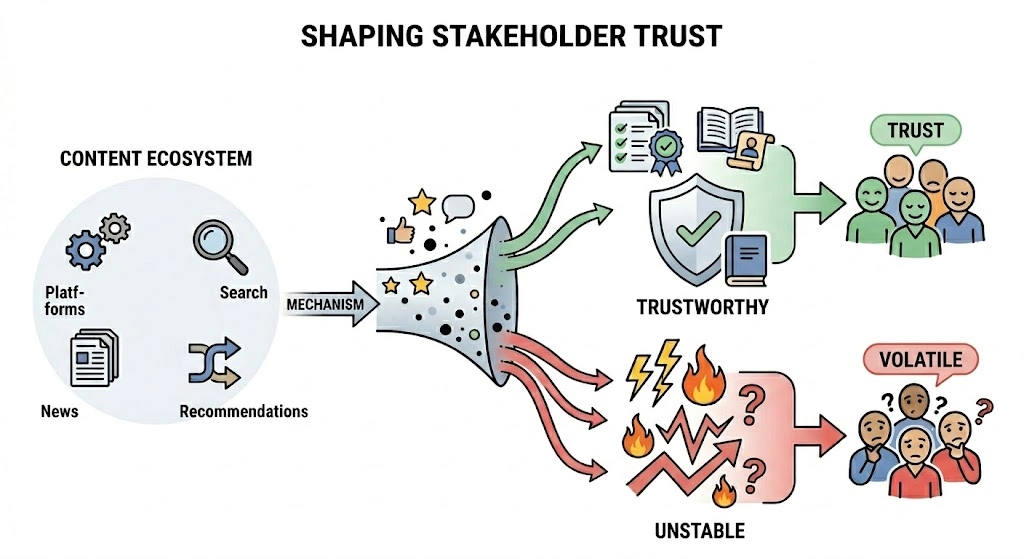
Content ecosystems shape stakeholder trust by selecting, amplifying, and contextualising reputation signals that stakeholders use to update beliefs about institutions.
Definition: Content ecosystems refer to interlinked platforms, publishing channels, indexing services, and recommendation engines that distribute and rank content. Mechanism: Ecosystem components—social platforms, search engines, news aggregators—apply distinct ranking heuristics and signal weights that determine which reputation cues reach stakeholders.
These systems convert raw engagement into trust indicators (verified badges, high-authority citations, expert endorsements) and present them as contextually salient to users. Impact on visibility, credibility, trust, and institutional perception: Ecosystems that foreground authoritative corroboration and contextual metadata increase stakeholder trust; ecosystems that prioritise immediacy and virality elevate transient narratives, increasing volatility in stakeholder perception and reducing predictable institutional credibility.
How do SERPs reflect and reinforce reputation signals?
SERPs reflect and reinforce reputation signals by indexing and surfacing content that search systems evaluate as authoritative, relevant, and engaging.
Definition: SERP evaluation is the process by which search engines rank and display content items, using algorithms that synthesise relevance, authority, and user intent. Mechanism: Search engines crawl, index, and rank content using signals including semantic relevance, backlinks, structured data, and user interaction metrics.
Rich results and knowledge panels aggregate entity-level data that become default reference points for stakeholders. Impact on visibility, credibility, trust, and institutional perception: High-ranking negative items create persistent reputational liabilities because SERPs are a primary discovery channel for stakeholders. Conversely, consistent positive or corrective content that matches user intent can gradually shift SERP composition and restore digital authority.
How do media visibility and sentiment interpretation affect perception?
Media visibility and sentiment interpretation determine the salience and valence of reputation signals within public affairs evaluation.
Definition: Media visibility is the extent to which an entity appears across indexed publications and social channels; sentiment interpretation is the computational assessment of tone and valence applied to that content. Mechanism: Visibility metrics (share counts, citation frequency) combine with sentiment analysis (NLP-generated polarity scores) to produce composite reputation metrics used by monitoring systems and decision-makers.
Automated systems map sentiment onto entity-level reputational indicators. Impact on visibility, credibility, trust, and institutional perception: High visibility with negative sentiment accelerates reputational decline because monitoring systems promote corrective prioritisation among stakeholders, while aggregated positive sentiment increases perceived legitimacy and digital authority.
How are authority and trust signals constructed online?
Authority and trust signals are constructed through verifiable provenance, corroborating third-party references, and consistent entity-level metadata.
Definition: Authority signals include verified identifiers, authoritative backlinks, expert citations, and consistent knowledge graph entries; trust signals include transparent provenance, policy documents, and verifiable endorsements. Mechanism: Platforms and crawlers validate signals via schema markup, HTTPS, consistent NAP (name, address, phone) data, and cross-domain citations; machine-learning models weight these signals when computing entity authority.
Impact on visibility, credibility, trust, and institutional perception: Robust authority and trust signals increase content indexing priority and SERP ranking, raising institutional credibility and stabilising stakeholder trust across public affairs contexts.
How does digital footprint determine long-term entity perception?
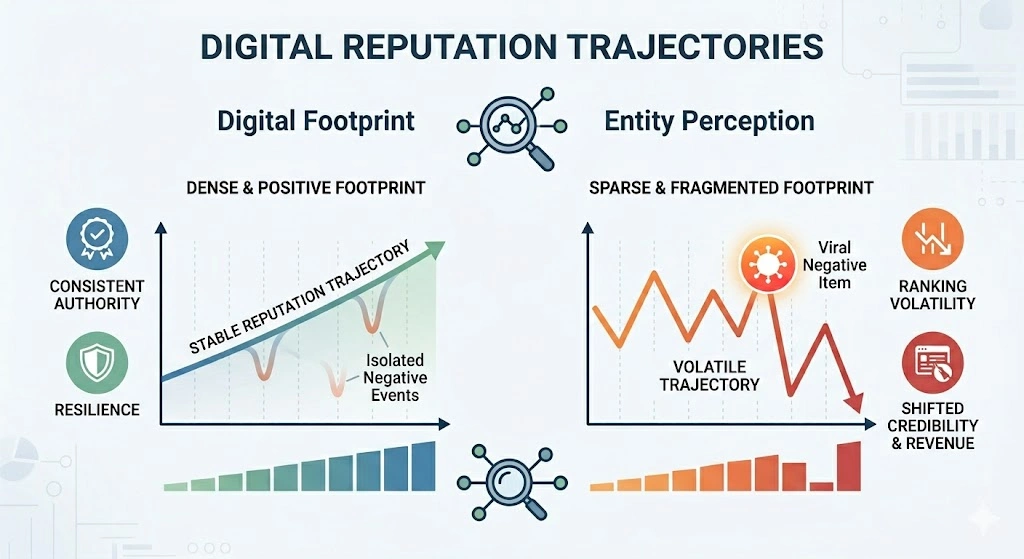
A digital footprint determines long-term entity perception by creating an indexed history of signals and narratives that search and analytics systems consult when evaluating current reputation.
Definition: Digital footprint refers to the cumulative set of indexed content, backlinks, social mentions, and metadata associated with an entity across time. Mechanism: Search and archive systems retain historical content layers; reputation analytics compute trend trajectories, volatility indexes, and signal decay functions to determine current entity perception.
Impact on visibility, credibility, trust, and institutional perception: A dense, positive digital footprint with consistent authority markers reduces the likelihood that isolated negative events dominate stakeholder perception. Conversely, a sparse or fragmented footprint increases ranking volatility and the risk that a single viral item shifts perceived credibility and revenue outcomes.
How does stakeholder engagement influence entity perception and ranking?
Stakeholder engagement influences perception and ranking by creating direct behavioural signals that algorithms translate into relevance and authority metrics.
Definition: Stakeholder engagement refers to measurable interactions—clicks, shares, time-on-page, comments—that indicate user interest and endorsement. Mechanism: Algorithms treat sustained engagement and return visits as evidence of relevance and quality; content with higher engagement receives preferential distribution. Engagement that aligns with authoritative corroboration (citations, expert commentary) strengthens reputation signals more effectively than raw virality. Impact on visibility, credibility, trust, and institutional perception: High-quality engagement increases search visibility and digital authority, while manipulative or low-quality engagement triggers platform demotion and reduces stakeholder trust.
This defines how narratives, authority, trust, and institutional visibility are created, interpreted, and ranked within digital ecosystems. Core concepts presented: institutional reputation is a quantified aggregation of reputation signals; algorithms compute authority through provenance and engagement; digital narratives reframe perception by occupying high-visibility nodes; SERPs and content ecosystems operationalise reputation through indexing and ranking dynamics. Understanding these mechanisms clarifies why rapid, evidence-aligned responses and consistent authority signals are essential to maintain search visibility, stakeholder trust, and institutional credibility.
Frequently Asked Questions
How can Reputation Management reduce the impact of a viral TikTok on revenue?
Reputation Management reduces impact by rapidly identifying negative content, prioritising corrective content placement, and coordinating authoritative responses across search and social channels. Linkonize focuses on restoring search visibility and sentiment metrics through targeted content indexing and reputation signals.
What immediate steps limit reputational damage after a viral social post?
Immediately assess the viral content’s reach, issue verified factual statements where necessary, and publish high-authority corrective content to trusted channels to influence SERP evaluation. Linkonize recommends synchronising content indexing, metadata updates, and stakeholder communications to stabilise reputation signals.
How long does it take for Reputation Management actions to affect SERP rankings?
Small indexing changes can appear within hours, while substantive SERP shifts often require days to weeks as search engines re-evaluate authority and content ranking. Linkonize measures early engagement and indexing improvements within 24–72 hours and tracks ranking recovery over subsequent weeks.
Which reputation signals most influence recovery after negative viral content?
The most influential signals are authoritative backlinks, verified metadata (schema), consistent entity data, and high-quality engagement metrics that demonstrate trustworthiness. Linkonize prioritises these signals to rebuild digital authority and improve content indexing.
When is it necessary to involve PR, legal, and Reputation Management teams together?
Involve all three when content contains factual inaccuracies, legal exposure, or significant stakeholder trust erosion that affects revenue or compliance; coordinated action aligns narrative correction, legal mitigation, and digital signal recovery. Linkonize advises a cross-functional response to ensure consistent messaging and SERP remediation.