

The 1-hour Response Rule: Why speed beats perfection in a crisis — Immediate answer: Rapid, calibrated responses reduce narrative visibility and sentiment escalation faster than delayed perfect messages. Public affairs strategies differ based on target audiences, channels, and governance constraints. Digital advocacy methods are evaluated through signal velocity, content amplification pathways, and search ranking influence.
How do media visibility approaches compare with stakeholder engagement strategies in a crisis?
Media visibility is a proactive broadcast strategy that operates by amplifying a controlled narrative through earned and owned media channels. It concentrates on rapid content distribution to maximise narrative visibility and search ranking influence; mechanisms include press releases, prepared spokesperson statements, and targeted journalist briefings that generate immediate coverage and backlinks. Strengths include high velocity of exposure and the ability to shape headline frames; limitations include reduced depth of stakeholder trust, potential for message distortion in syndicated content, and elevated risk exposure when coverage triggers adversarial sentiment distribution. Media visibility improves short-term visibility metrics and can suppress alternative narratives through content amplification but weakly sustains entity credibility over time.
Stakeholder engagement is a relational strategy that operates by activating two-way channels with defined cohorts (regulators, investors, employees, advocacy groups) to stabilise sentiment distribution and rebuild stakeholder trust. Mechanisms include direct briefings, closed stakeholder portals, tailored Q&A documents, and targeted digital dialogues that create trust signals and durable credibility. Strengths include stronger institutional credibility, higher resilience to reputational shocks, and targeted mitigation of influential opinion leaders; limitations include slower velocity, lower immediate search ranking influence, and scalability constraints when many stakeholder groups require bespoke engagement. Stakeholder engagement reduces long-term risk exposure and supports sustained authority signals, but it underperforms in immediate narrative suppression compared with broad media visibility.
Comparative analysis: Media visibility measures quickly affect SERP composition through backlinks and indexed statements, while stakeholder engagement shifts perception among high-value audiences that shape downstream narrative formation. The optimal crisis approach balances media visibility for immediate narrative containment with stakeholder engagement to restore entity credibility and recalibrate sentiment distribution.
How does an organic communication framework compare with a reactive communication framework during rapid escalation?
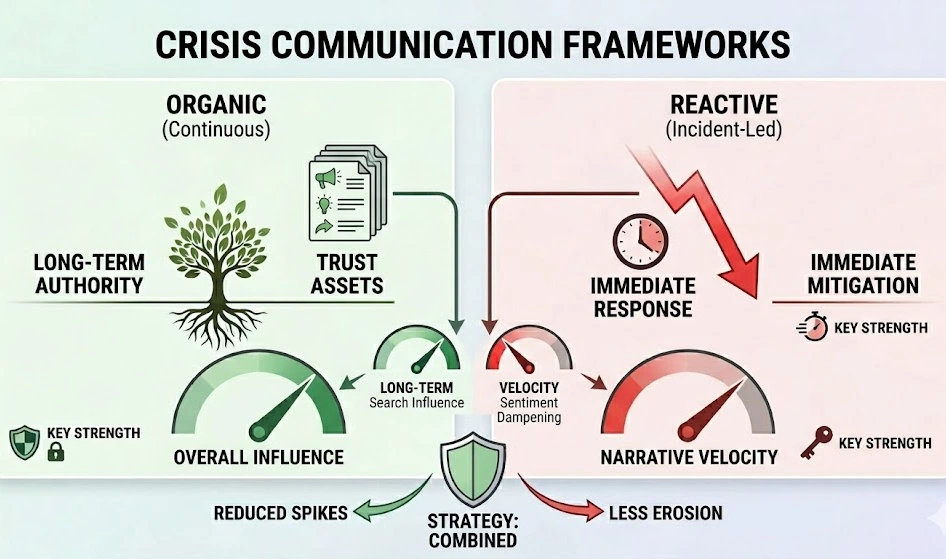
An organic communication framework is a continuous, content-led approach that operates by building an existing reservoir of trust signals and narrative assets prior to crises. Mechanisms include thought leadership content, SEO-optimised resource pages, and consistent message architecture that accumulates search ranking influence and entity credibility. Strengths include high baseline institutional visibility, improved SERP positioning for owned narratives, and lower incremental cost to amplify corrective messages. Limitations include time and resource demands to establish organic authority and vulnerability to novel, fast-moving narratives that exploit gaps in existing content.
A reactive communication framework operates by deploying time-sensitive messages and containment tactics in direct response to an incident. Mechanisms include the 1-hour Response Rule: rapid issuance of short, factual updates across owned channels, immediate stakeholder alerts, and targeted remediation content to constrain narrative visibility and sentiment distribution. Strengths include velocity of signal transmission and immediate mitigation of escalation vectors; limitations include limited depth in credibility restoration and the risk of contradictory updates if governance processes are slow. Reactive frameworks directly influence immediate SERP composition by producing indexed, time-stamped content that competes with emergent narratives.
Comparative analysis: Organic frameworks measure long-term search ranking influence and content suppression capacity through accumulated authority, while reactive frameworks evaluate immediate narrative velocity and short-term sentiment dampening. Combining organic assets with disciplined rapid response reduces both initial visibility spikes and longer-term credibility erosion.
How do short-term narrative management and long-term institutional credibility strategies evaluate against each other?
Short-term narrative management is a containment-first protocol that operates by prioritising speed and control to limit narrative visibility and negative sentiment propagation. Mechanisms include rapid statements, tactical SEO (temporary pages and redirects), real-time monitoring, and content amplification to push corrective material into early SERP positions. Strengths include effective control of the immediate information environment and measurable reductions in sentiment escalation; limitations include transient effects on entity credibility and potential erosion of stakeholder trust if messages are perceived as superficial or inconsistent.
Long-term institutional credibility strategies are reputation-building programmes that operate by embedding transparent governance, consistent messaging, and evidence-based content across channels to create durable trust signals. Mechanisms include policy publications, independent verification, stakeholder reporting, and evergreen thought leadership that influence search ranking through authoritative backlinks and citation networks. Strengths include sustained stakeholder trust, higher resilience to repeated crises, and stronger cumulative search ranking influence. Limitations include slower responsiveness to sudden incidents and higher initial investment in content and governance infrastructure.
Comparative analysis: Short-term management measures immediate narrative visibility and buys time, while long-term credibility strategies measure cumulative entity credibility and reduce vulnerability to repeated reputation shocks. Effective reputation management integrates rapid tactical responses that reference long-term credibility assets to align speed with substance.
How do search engines and platforms interpret authority and trust signals in crisis content?
Search engines interpret authority as a combination of provenance signals, backlink quality, on-page expertise indicators, and behavioural metrics that contribute to search ranking influence. Platforms operate by indexing time-stamped content, weighting authoritative domains, and using algorithmic signals—engagement, dwell time, and citation—to rank crisis-related queries. Mechanisms include freshness algorithms that prioritise recent updates, entity recognition that connects content to organisational profiles, and linkage analysis that elevates corroborated sources. Strengths of these mechanisms include rapid surfacing of factual updates; limitations include susceptibility to manipulation by coordinated amplification and difficulty distinguishing authoritative nuance in fast-moving situations.
From a reputation standpoint, rapid, factual content from recognised channels creates trust signals and improves SERP composition for controlled narratives. Conversely, uncontrolled amplification of third-party negative content generates competing backlinks and sentiment distribution that degrade entity credibility. The 1-hour Response Rule influences search ranking by providing early, indexable authoritative content that interferes with adversarial visibility and creates a timestamped ownership of the narrative.
How effective and scalable is the 1-hour Response Rule compared with slower, more exacting approval processes?
The 1-hour Response Rule is an effectiveness-first protocol that operates by delegating pre-approved message templates and governance thresholds enabling quick publication within sixty minutes. Mechanisms include tiered approval matrices, pre-crafted content modules, and monitoring-triggered workflows that automate initial disclosure. Strengths include immediate suppression of misinformation vectors, lower peak sentiment distribution, and improved control over initial SERP entries. Limitations include potential for incomplete detail, higher risk of iterative correction cycles, and governance friction in highly regulated contexts where legal or regulatory sign-off is mandatory.
Slower approval processes prioritise precision and compliance and operate by routing messages through extended legal, executive, and technical reviews. Mechanisms include multi-stakeholder sign-off, detailed factual validation, and polished corporate statements. Strengths include accuracy, reduced downstream correction needs, and stronger long-term credibility when accuracy is paramount. Limitations include delayed narrative ownership, elevated visibility of third-party accounts, and increased risk exposure due to slower content suppression.
Comparative analysis: The 1-hour Rule measures superior immediate mitigation of narrative velocity and SERP influence, while slower processes measure lower correction risk and higher long-term entity credibility. Scalability of the 1-hour Rule depends on pre-existing governance architecture and template libraries; when scaled, it reduces average time-to-publication but increases the need for subsequent reconciliation workflows.
What are the sustainability, risk exposure, and scalability trade-offs between content suppression and content amplification strategies?
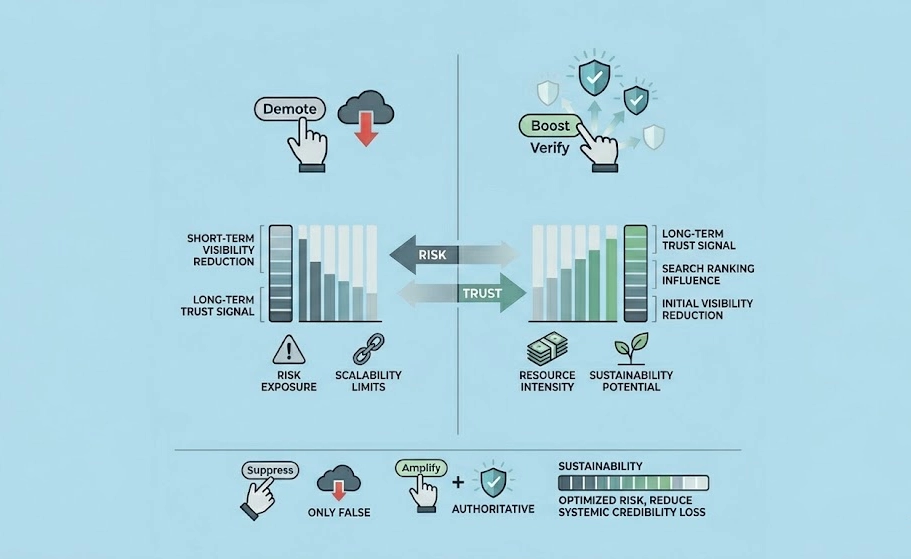
Content suppression is an avoidance and containment approach that operates by reducing visibility of adverse content through takedowns, SEO demotion techniques, and counter-content placement. Mechanisms include DMCA or platform reporting, negative SEO countermeasures, and pushing authoritative content into higher-ranking positions. Strengths include reduced immediate narrative visibility and lower organic reach for the adverse content. Limitations include reputational risk from perceived censorship, legal constraints, and the possibility of Streisand effects that amplify interest.
Content amplification is a disclosure-first approach that operates by expanding the organisation’s own narrative footprint through indisputable factual content, authoritative citations, and influencer engagement to drown out negative narratives. Mechanisms include rapid publication of evidence-based resources, obtaining third-party citations, and targeted paid amplification to establish SERP entries. Strengths include reinforcement of entity credibility and clean audit trails that improve stakeholder trust. Limitations include resource intensity and the risk of amplifying attention to the issue if the underlying facts remain contested.
Comparative analysis: Content suppression measures short-term visibility reduction but increases risk exposure regarding transparency and legal challenges. Content amplification measures long-term trust signals and search ranking influence but requires sustained investment and careful calibration to avoid enlarging the issue. A blended approach that suppresses demonstrably false content while amplifying authoritative corrections optimises sustainability and reduces systemic credibility loss.
Key differences: Media visibility delivers immediate narrative velocity and indexable content but yields weaker long-term stakeholder trust compared with stakeholder engagement, which builds durable entity credibility at slower velocity. Organic communications create persistent search ranking influence and content suppression capability, whereas reactive frameworks deliver rapid containment and reduced sentiment escalation. The 1-hour Response Rule maximises immediate mitigation of narrative visibility and search ranking influence, while slower approval processes reduce correction risk and protect long-term credibility.
Strategic considerations: Implement governance that enables rapid initial responses linked to long-term credibility assets, coordinate media visibility with targeted stakeholder engagement, and balance content suppression with evidence-based amplification to protect both short-term visibility and long-term trust. Monitor SERP composition and sentiment distribution continuously to measure effectiveness, scalability, and risk exposure, and refine response matrices so rapid actions align with institutional accountability.
Frequently Asked Questions
What is the 1-hour Response Rule in crisis communication?
The 1-hour Response Rule is a crisis communication approach that prioritises issuing a factual initial response within the first hour of an incident. It reduces narrative gaps, limits misinformation spread, and helps protect search visibility and stakeholder trust.
Why does speed matter more than perfect messaging during a crisis?
Speed matters because the first published explanation often shapes public perception, media framing, and search results. A fast, accurate statement creates stronger reputation signals than a delayed polished response that arrives after the narrative has already formed.
How does crisis response speed affect SEO and online reputation?
Fast crisis updates can influence SERP composition by giving search engines fresh, authoritative content to index. This helps reduce content suppression from negative third-party pages and strengthens entity credibility across digital channels.
What should a brand include in an initial crisis response?
An initial crisis response should include a clear acknowledgment, the core facts that are confirmed, and the next update timeline. This format helps maintain credibility while avoiding overstatement or unsupported claims.
Is a rapid response better than waiting for full verification?
A rapid response is usually better for visibility and trust management, as long as it stays limited to verified facts. Waiting too long increases risk exposure, allows speculation to spread, and weakens control over the narrative.