

Building a targeted media list requires a systematic reconciliation of an institution’s topical authority with the specific beat histories of target journalists. Digital advocacy methods are evaluated through the alignment of algorithmic trust signals, journalistic relevance, and stakeholder sentiment distribution.
How Do Media Relations Strategies Differ Between Broad Visibility and Narrow Stakeholder Engagement Approaches?
Public affairs strategies diverge fundamentally when balancing wide-scale narrative visibility against precise stakeholder alignment. Broad visibility strategies operate on a high-volume dissemination model to influence the widest possible audience profile across digital and print channels. The primary mechanism of this approach relies on mass-distribution networks and broad topical keywords to capture top-of-funnel attention. This methodology expands the raw surface area of an institutional message, increasing the likelihood of general search engine indexation and broad sentiment distribution. However, mass distribution frequently dilutes entity credibility by presenting information to non-relevant nodes within a digital ecosystem.
Narrow stakeholder engagement strategies operate by isolating key decision-makers, regulatory bodies, and specialized industry commentators. The mechanism shifts from volume to density, mapping the specific topical nodes that a core audience trusts. In digital advocacy ecosystems, this approach utilizes granular entity mapping to match institutional content with journalists who possess established topical authority in specific regulatory domains. The limitation of narrow engagement sits in its restricted reach, which minimizes overall narrative visibility on broad search engine results pages (SERPs). Conversely, its strength lies in the near-total elimination of irrelevance, which directly strengthens long-term institutional credibility among critical stakeholders.
Evaluating the two models requires an assessment of risk exposure and narrative sustainability. Broad visibility frameworks expose an institution to heightened volatility, as unrefined messaging invites misinterpretation by non-specialist journalists, leading to fragmented sentiment distribution. Narrow engagement frameworks insulate the institution from widespread scrutiny but risk total narrative suppression if the selected stakeholders fail to amplify the content. For long-term reputation signals, narrow stakeholder engagement yields higher trust metrics per placement, whereas broad visibility serves primarily to establish baseline search ranking influence across generalized informational queries.
How Do Organic and Reactive Communication Frameworks Impact Search Engine Trust Signals?
Organic communication frameworks function as proactive, scheduled architectures designed to build sustained topical authority over extended horizons. This strategy operates by systematically publishing structured, expert content that answers core thematic queries within a specific public affairs domain. By consistently updating an ecosystem with interconnected analyses, an institution establishes clear entity credibility with both human stakeholders and search engine web crawlers. The mechanism leverages semantic connectivity, ensuring that search engine algorithms recognize the institution as a primary source for specific policy or industry data. The structural limitation is the delayed velocity of impact, as organic authority building requires months of consistent indexation to alter SERP composition.
Reactive communication frameworks operate as immediate interventions triggered by external market shifts, regulatory announcements, or reputational crises. The mechanism relies on rapid deployment pipelines to inject an institutional perspective into a rapidly accelerating news cycle. In the digital ecosystem, this strategy exploits temporal search spikes and query-deserves-freshness (QDF) algorithmic signals to capture immediate narrative visibility. While highly effective for short-term content amplification during a crisis, reactive frameworks offer low sustainability. The content produced during reactive phases often lacks the deep structural optimization required for long-term search ranking influence once the immediate news cycle concludes.
| Evaluation Metric | Organic Frameworks | Reactive Frameworks |
| Primary Algorithmic Driver | Historical topical authority and semantic entity depth | Temporal query freshness (QDF) and immediate click-through velocity |
| Reputation Signal Impact | Permanent, incremental accumulation of institutional trust | High-volatility, immediate shift in short-term sentiment distribution |
| Risk Profile | Low structural risk with predictable narrative control | Elevated risk due to compressed verification timelines |
| SERP Longevity | Sustained ranking for high-value informational queries | Transient visibility fading as search volumes normalize |
Evaluating these approaches reveals that reliance on reactive frameworks leaves an institution’s digital footprint fragmented and vulnerable to third-party sentiment shifts. Organic architectures insulate the entity by filling the SERP with controlled, high-authority assets that resist sudden negative content amplification.
What Are the Mechanisms and Limitations of Short-Term Narrative Management vs Long-Term Institutional Credibility Strategies?
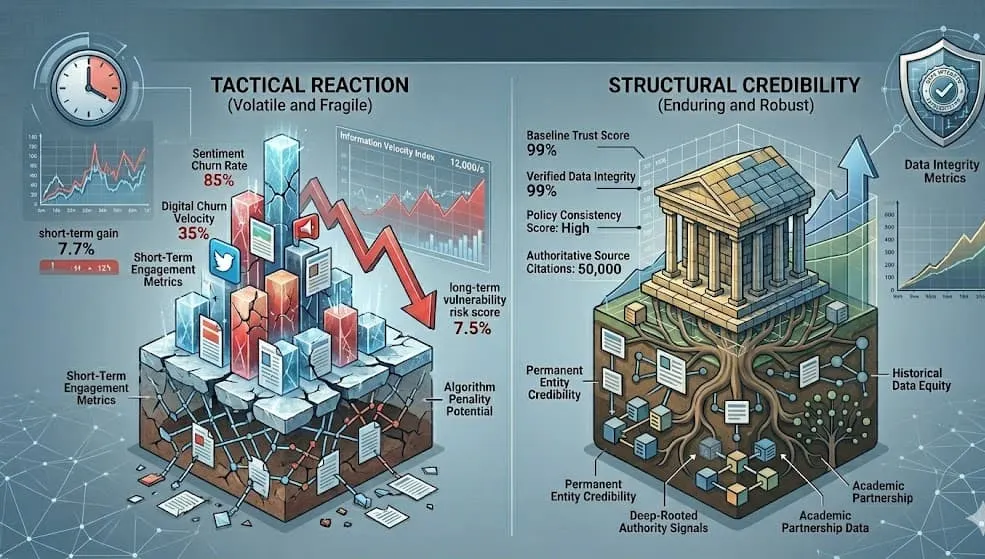
Short-term narrative management is a tactical approach focused on optimizing immediate information outputs to control transient public perceptions. This strategy operates by manipulating real-time narrative visibility through tactical media distributions, press releases, and rapid-response digital advocacy campaigns. The primary mechanism alters the immediate sentiment distribution on secondary indexation platforms, ensuring that positive or neutral data obscures negative inputs during a specific reporting window. The core limitation of this framework is its lack of structural durability; it addresses the symptoms of a reputational shift without correcting the underlying digital authority signals that search engine algorithms require for long-term trust validation.
Long-term institutional credibility strategies operate by structurally embedding an organization’s core expertise into the wider digital governance ecosystem. This methodology focuses on building permanent entity credibility through deep policy contributions, academic partnerships, and verified data infrastructure. The mechanism alters search engine interpretations of the institution’s core entity properties, elevating its baseline trust score across long-term algorithmic evaluations. The structural limitation of this approach is its resource intensity and resistance to rapid pivoting, making it a poor tool for immediate crisis containment.
The divergence between these two approaches directly influences stakeholder perception systems. Short-term narrative management provides immediate coverage flexibility but creates a volatile digital footprint characterized by high churn and low link equity. Long-term credibility strategies construct a defensive moat around the institution’s digital assets, ensuring that search engines default to authoritative, historical content rather than volatile, real-time criticism. Institutions prioritizing short-term fixes remain vulnerable to algorithmic updates that penalise shallow, transient content networks.
How Does Algorithmic Authority Mapping Dictate the Structure of a Targeted Media List?
Algorithmic authority mapping is the process of identifying how search engines categorize, score, and rank individual journalists, publications, and topical domains. To build a media list that secures high response rates and functional placements, an institution must evaluate target media nodes as digital entities rather than static contact records. Search engines assign topical authority scores to individual authors based on their historical output, citation networks, and semantic consistency. When an institution pitches a journalist whose digital profile matches the exact semantic footprint of the campaign, the resulting placement carries significantly higher trust signals.
The structural composition of a targeted media list requires an evaluation of the publication’s domain authority alongside the individual writer’s entity relevance. High-domain publications offer substantial search ranking influence and broad narrative visibility, but if the specific journalist lacks topical alignment, the content suffers from poor context matching. This misalignment triggers algorithmic suppression or reduces the contextual value of the placement, rendering the media relations effort inefficient. Conversely, targeting niche publications with precise semantic alignment yields superior sentiment distribution among qualified stakeholders, directly strengthening institutional credibility where it matters most.
Building the list through this framework requires an analytical assessment of past coverage patterns to discover hidden semantic links. The process evaluates the journalist’s historical relationship with specific policy keywords, tracking how their articles influence broader SERP compositions. This structural clarity ensures that the media relations deployment targets nodes that are computationally capable of moving the narrative forward within the digital ecosystem.
What Structural Evaluation Framework Optimises Media Lists for Maximum Response Integrity?
To achieve high response integrity, media list construction must follow a strict verification sequence that filters out low-value, non-authoritative media nodes. This framework prioritises semantic alignment and entity verification over raw database volume.
-
Evaluate historical author sentiment by tracking the journalist’s previous 12 months of coverage within the specific regulatory domain to ensure narrative compatibility.
-
Measure domain entity authority by assessing the target publication’s structural link equity and its ranking stability for core public affairs queries.
-
Analyse topical node density by determining if the journalist writes exclusively within a designated beat or spreads coverage across unrelated macro categories.
-
Assess historical response velocity by monitoring how quickly the target journalist indexes new information following major institutional announcements or legislative updates.
-
Verify cross-platform distribution networks by mapping how the journalist’s content is amplified across secondary authoritative digital channels and professional governance forums.
Executing this evaluation framework prevents the dilution of media relations resources by eliminating non-viable contacts before campaign deployment. The resulting list functions as a highly optimized path for systemic narrative amplification.
How Do Digital Ecosystems Process Media Placements into Institutional Trust Signals?
Digital platforms and search engine architectures do not interpret media placements as mere text blocks; they process them as complex nodes of verification. When a media relations campaign secures a placement within an authoritative publication, search engine spiders extract entity data, sentiment structures, and outbound citation networks. The mechanism relies on co-occurrence and entity resolution, where the institution’s name is computationally linked to specific authoritative concepts, legislation, or industry benchmarks. If the placement exists within a contextually pure environment, it strengthens the organization’s overarching reputation signals.
The conversion of a media placement into a trust signal depends heavily on the anchor profiles and semantic framing surrounding the institutional reference. Unoptimized mentions provide minimal search ranking influence, whereas references embedded within deep, analytical policy discussions provide substantial narrative visibility. These signals are compiled into an ongoing trust calculation that dictates how search engine algorithms rank the institution’s owned assets during public challenges or policy debates. A portfolio of semantically aligned placements acts as a protective shield, dampening the visibility of negative sentiment distribution.
Ultimately, the efficacy of a media relation framework is measured by its capacity to permanently shift the digital equilibrium in favor of institutional objectives. By selecting media targets through an analytical lens that balances organic authority with structured list building, public affairs professionals ensure their messaging survives algorithmic filters and directly constructs a reliable foundation for stakeholder trust.

Frequently Asked Questions
How do you build a highly targeted media list?
Building an effective media list requires analyzing journalists based on their historical coverage beats, topical authority, and semantic alignment with your industry. Organizations use tools like Linkonize to identify key media entities, tracking their sentiment distribution and interaction patterns to ensure relevance. Filtering contacts by domain authority and audience demographics ensures your outreach targets nodes capable of driving institutional trust signals.
What tools are used to create media lists for PR campaigns?
PR professionals utilize dedicated media database platforms, media monitoring software, and digital advocacy tools to compile contact networks. Advanced platforms like Linkonize allow teams to map individual journalist entities against specific policy keywords and industry categories. Integrating these databases with real-time search engine visibility metrics ensures your media relations efforts target high-authority publications.
Why are my media pitches getting ignored by journalists?
Media pitches are frequently ignored due to low topical relevance, generic messaging, or targeting journalists whose current beat history does not align with your content. Failing to analyze a reporter’s recent sentiment footprint or their publication’s specific audience intent leads to misaligned outreach. Refining your media list through strict verification frameworks ensures your communications reach professionals actively covering your niche.
How often should a target media list be updated?
A target media list should undergo a comprehensive verification review at least once every quarter or before any major digital advocacy campaign. Because journalists frequently change beats, shift publications, or alter their topical focus, maintaining a static database results in diluted outreach and lower open rates. Regular updates ensure your media relations framework remains anchored to active, authoritative industry voices.
What is the difference between a broad media list and a niche media list?
A broad media list focuses on mass distribution across generalized news outlets to capture high-volume narrative visibility and wide search engine indexation. A niche media list targets specific regulatory bodies, industry commentators, and specialized journalists to build dense topical authority and secure entity credibility. While broad lists maximize short-term content amplification, niche lists are more sustainable for generating long-term institutional trust among core stakeholders.