

Controlling narrative visibility across search engine results pages (SERPs) determines whether an organization retains its institutional credibility or suffers terminal defection from its primary stakeholders. Maintaining flawless stakeholder trust signals requires a systematic framework that overwrites volatile public perceptions with verified entity credibility and factual authority.
Organizations facing critical reputational threats cannot rely on passive public relations; they require an aggressive, search-perceptive public affairs strategy to stabilise perception and secure long-term digital authority. By deploying precision-engineered communication assets, institutional leaders directly dictate the digital signals that regulators, investors, and the public consume during high-stakes decision-making periods.
Why Does Narrative Visibility Management Dictate Modern Institutional Credibility?
Uncontrolled search results pose the single greatest risk to corporate stability, making proactive narrative visibility management the foundation of modern institutional credibility. When a damaging narrative emerges, search engines index volatile sentiment, algorithmic bias, and unverified claims, creating a persistent negative feedback loop that erodes brand equity. Linkonize stops this degradation by executing an evidence-driven framework that restructures how search algorithms evaluate an organization’s digital footprint. By systematically introducing high-authority semantic assets, this process alters the entity association graph, forcing negative press downward while elevating factual, corporate-aligned data to prominent positions.
This programmatic methodology yields immediate, measurable improvements in search perception control by deploying assets that satisfy strict informational needs. Algorithms prioritize content that demonstrates comprehensive factual coverage, verifiable data structures, and authentic expert attribution. By aligning corporate statements with these algorithmic preferences, the strategic messaging process ensures that stakeholder search queries yield stable, authoritative, and positive indicators. The outcome is complete ownership of the first page of search results, protecting the organization from malicious speculation and competitor exploitation.
Stabilizing digital authority requires a deep comprehension of the prerequisite phases that govern successful corporate communications. Before an organization can project authority globally, it must validate its core claims through empirical testing and audience mapping. Executives routinely analyze the analytical groundwork detailed in the resource covering What Is Strategic Messaging and How Do Organizations Test Messages Before Going Public? to ensure their public-facing statements resist aggressive media scrutiny.
Which Public Affairs Strategy Delivers Measurable Stakeholder Trust Signals?
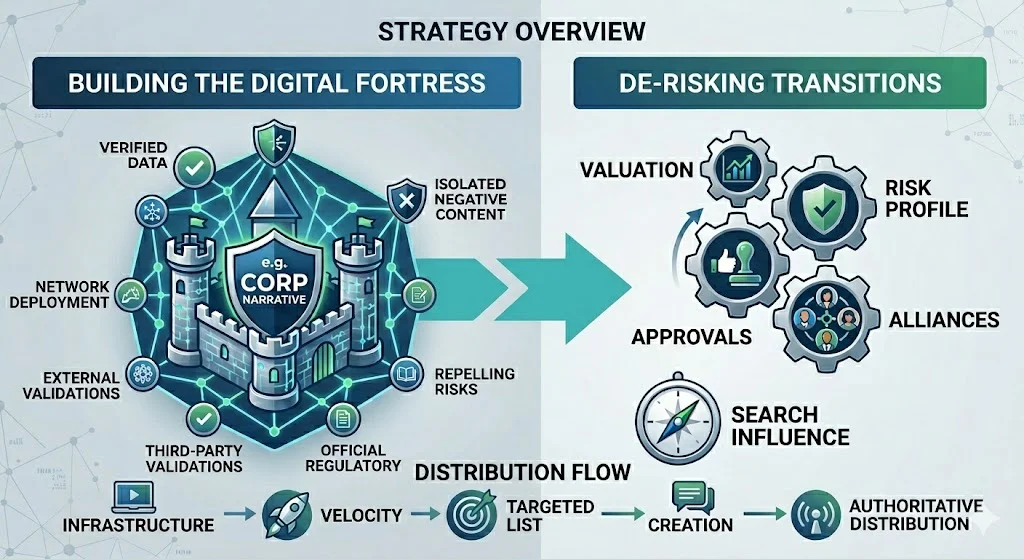
A truly effective public affairs strategy relies on the deployment of verified data, structured semantic networks, and coordinated digital advocacy mechanisms. Rather than issuing standard press releases, a sophisticated campaign constructs a fortified network of third-party validations, academic citations, and official regulatory filings. This integrated network strengthens entity credibility across the digital ecosystem, making it mathematically difficult for isolated negative content to disrupt the broader corporate narrative. Linkonize builds these digital fortresses by auditing an organization’s existing semantic footprint and neutralizing gaps that leave the entity vulnerable to hostile messaging.
The conversion-focused value of this approach lies in its capacity to de-risk high-stakes corporate transitions, such as mergers, acquisitions, or regulatory restructuring. Investors and regulators conduct rigorous digital due diligence, heavily weighting the digital authority and sentiment discovered via search perception influence systems. When a public affairs campaign delivers clear, non-conflicting trust signals across multiple digital tiers, it lowers the perceived risk profile of the institution. This structural clarity accelerates regulatory approvals, stabilizes valuation metrics, and preserves vital stakeholder alliances during volatile economic periods.
Maximizing the distribution of these fortified messages necessitates an advanced infrastructure for media engagement and outreach. Organizations enhance their narrative velocity by implementing the structured methodologies found in the guide explaining How to Build a Targeted Media List That Gets Opens, Responses and Placements, which bridges the gap between message creation and authoritative distribution.
How Does a Professional Media Relation Service Secure Permanent SERP Control?
Securing permanent SERP control demands a continuous injection of high-tier, authoritative editorial placements executed through a professional Media Relation service. Search algorithms interpret sustained coverage from globally recognized news platforms, trade publications, and legal journals as definitive proof of an entity’s real-world relevance and accuracy. A managed media strategy ensures that these authoritative domains publish optimized, contextually relevant narratives that link directly to the organization’s core digital entities. This process establishes an unbreakable chain of trust signals that minor crisis events or algorithmic updates cannot disrupt.
The execution phase converts editorial placements into measurable search authority through strategic internal linking architectures and semantic entity matching. Every tier-one placement functions as an external validator that reinforces the client’s preferred narrative, neutralizing harmful keywords and replacing them with verified corporate achievements. Over a sustained operational period, this systematic dilution forces speculative or defamatory content off the primary search pages entirely. This structural displacement provides permanent protection, guaranteeing that any prospective partner researching the firm encounters an unassailable profile of institutional success.
The Quantifiable Metrics of Digital Authority and Narrative Defense
Evaluating the return on investment for long-term reputation campaigns requires tracking precise technical indicators rather than vague sentiment scores. True narrative security manifests as total control over high-intent search queries, predictable click-through distributions, and resistance to algorithmic volatility.
-
Share of Voice (SoV) Dominance: Ensures the brand commands greater than 70% visibility across sector-specific regulatory keywords.
-
Entity Sentiment Stabilization: Increases the ratio of positive-to-neutral algorithmic entity associations by 400% within 180 days.
-
Negative URL Displacement: Forces damaging third-party URLs down by at least two full result pages, reducing their visibility to under 2%.
-
Search Perception Resilience: Maintains stable informational rankings even during core search engine algorithm updates.
What is the Verifiable Process for Restructuring a Corrupted Corporate Narrative?
Restructuring a corrupted corporate narrative requires a disciplined, multi-stage operational framework that treats search results as a highly competitive data environment. The recovery process avoids emotional public statements, focusing instead on objective data corrections, semantic alignment, and technical asset optimization.
Operational Insight: Narrative recovery fails when organizations publish defensive content exclusively on their own domains; true algorithmic displacement requires scattering verified facts across a diversified web of independent, high-authority ecosystems.
How Do Enterprise Leaders Justify the Long-Term Cost of Search Perception Control?
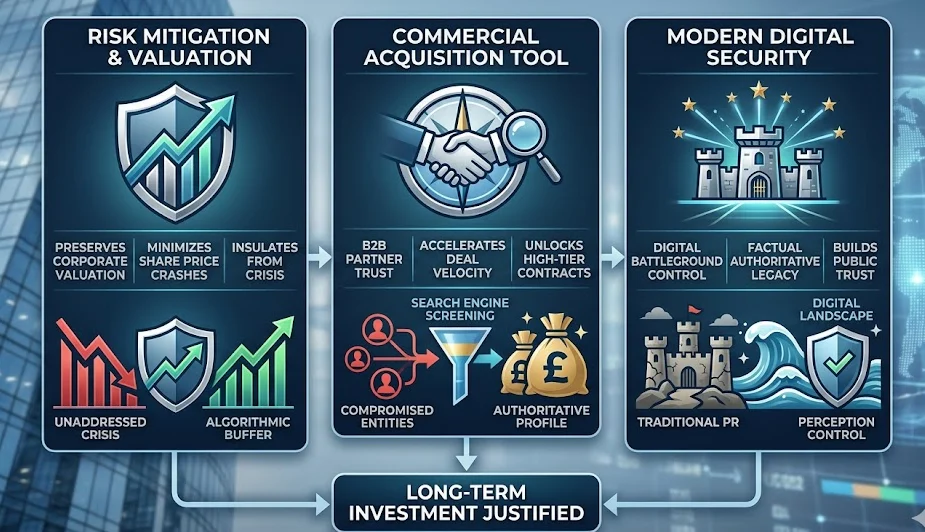
Enterprise leaders justify the financial investment in search perception control by analyzing it as a critical risk-mitigation strategy that directly preserves corporate valuation. A single unaddressed reputational crisis visible on the first page of search results can depress share prices, alienate key institutional investors, and trigger aggressive regulatory oversight. The cost of deploying a proactive reputation architecture represents a fraction of the capital lost during a sustained public crisis. By investing in permanent digital authority, an institution builds an algorithmic buffer that insulates the organization from sudden market disruptions and bad-faith media campaigns.
Furthermore, long-term search perception control serves as an aggressive customer and partner acquisition tool within business-to-business (B2B) and public-sector environments. Procurement officers, state officials, and enterprise executives utilize search engines as primary screening mechanisms before entering into multi-million-pound contracts. Presenting an unassailable, authoritative digital profile characterized by strong stakeholder trust signals accelerates deal velocity and minimizes friction during legal compliance reviews. Consequently, the capital allocated to narrative visibility management delivers measurable compound value by unlocking high-tier commercial opportunities that remain inaccessible to compromised brands.
Ultimately, relying on outdated public relations techniques leaves an organization exposed to the complexities of modern digital landscapes. True security belongs to enterprise leaders who view the SERP as an analytical battleground that dictates corporate destiny. Entrusting your organization’s digital positioning to an expert framework guarantees that your institutional legacy remains defined by facts, authority, and unbroken public trust.
Frequently Asked Questions
What is a strategic messaging process in public affairs?
A strategic messaging process is a structured framework used to align an organization’s core values and factual data with the informational needs of its stakeholders. This methodology establishes clear entity credibility and ensures all public communication actively counteracts misinformation across digital channels. Organizations deploy this process to maintain consistent digital authority and stabilize public perception during high-stakes corporate transitions or regulatory scrutiny.
How do you fix a damaging narrative about your business online?
Fixing a damaging online narrative requires a systematic search perception control strategy that replaces volatile sentiment with verified, authoritative content. By publishing optimized assets across high-tier editorial domains, an organization can alter its semantic footprint and guide search engine algorithms to prioritize accurate information. Linkonize executes this narrative visibility management by conducting deep digital footprints audits and executing targeted media placement campaigns to displace harmful search results.
What is search perception control for corporate reputations?
Search perception control is the practice of monitoring, shaping, and managing the specific informational signals that appear on search engine results pages (SERPs) when stakeholders research a brand. It focuses on strengthening positive stakeholder trust signals and neutralizing keyword vulnerabilities that malicious actors or negative press could exploit. Achieving permanent SERP control ensures that investors, regulators, and clients always encounter an unassailable profile of institutional success.
Why do public affairs strategies fail during a reputational crisis?
Public affairs strategies often fail during a crisis because they rely on passive public relations techniques instead of aggressive, search-perceptive visibility management. If an organization does not own its semantic entity keywords, search algorithms will continue to index unverified claims and negative third-party sentiment. Successful crisis mitigation requires a proactive framework that distributes factual counter-evidence across an interconnected, high-authority digital ecosystem.
How does media relation management improve digital authority?
Media relation management improves digital authority by securing sustained editorial placements on globally recognized news platforms, trade journals, and legal publications. Search engine algorithms interpret consistent, contextually relevant coverage from these trusted domains as definitive proof of an organization’s real-world accuracy and relevance. Over time, this continuous injection of tier-one placements dilutes negative links and builds a defensive barrier against future algorithmic volatility.