

A great media pitch is a structured communication asset that aligns editorial relevance, information value, and source credibility with a journalist’s coverage priorities. Journalists say yes when a pitch demonstrates newsworthiness, authority, and contextual relevance within an existing information ecosystem.
Public affairs refers to the management and communication of issues that influence relationships between institutions, stakeholders, policymakers, media organisations, and the public. Digital advocacy is the strategic creation and distribution of information that influences stakeholder understanding, narrative visibility, and institutional perception across digital ecosystems. Within this context, media pitching functions as a mechanism for shaping information discovery, authority recognition, and narrative distribution across search environments, news ecosystems, and stakeholder networks.
What is a media pitch within digital perception systems?
A media pitch is a targeted information proposal designed to introduce a newsworthy narrative, insight, announcement, or perspective to a journalist.
Within digital ecosystems, a media pitch represents more than a communication tool. It acts as an input mechanism that contributes to narrative formation and information distribution. Journalists operate as authority validators who evaluate whether submitted information deserves visibility within editorial channels. This evaluation process influences how information enters search ecosystems, news databases, content archives, and public discourse.
Media pitches contribute to entity perception because media coverage functions as a reputation signal. Search engines evaluate references, citations, mentions, and contextual relationships between entities and authoritative publications. When journalists accept a pitch, the resulting coverage becomes part of a wider digital footprint that influences visibility and credibility assessments.
The effectiveness of a pitch depends on relevance rather than volume. Editorial environments prioritise information that aligns with audience interests, publication objectives, and current information demand. As a result, successful pitches demonstrate a clear connection between the proposed narrative and the journalist’s existing editorial framework.
Why do journalists evaluate relevance before authority?
Journalists evaluate relevance before authority because editorial value determines whether information serves a publication’s audience.
Relevance refers to the degree of alignment between a story and the editorial objectives of a publication. Authority refers to the credibility, expertise, or recognised position of a source. While authority strengthens a pitch, relevance determines whether the information enters the editorial consideration process.
Journalists receive a constant flow of communication requests. Editorial filtering systems therefore prioritise topic alignment as an efficiency mechanism. Information that lacks relevance is removed from consideration regardless of source credibility. This process reflects how information ecosystems maintain editorial focus and audience trust.
Within digital perception systems, relevance functions as a primary trust signal. Publications protect institutional credibility by selecting information that supports editorial consistency. Consistent topic alignment reinforces audience expectations and strengthens stakeholder trust in media institutions.
The relationship between relevance and authority demonstrates how information visibility emerges through contextual fit rather than source prominence alone. Journalistic evaluation depends on the intersection of editorial demand, information value, and audience significance.
How is newsworthiness defined and interpreted?
Newsworthiness is the editorial assessment of whether information deserves public attention and publication.
Newsworthiness refers to a set of evaluation criteria used to determine the significance of information. Journalists analyse whether a proposed story contributes new knowledge, explains emerging developments, clarifies public interest issues, or advances understanding of an important topic.
The mechanism of newsworthiness relies on comparative assessment. Journalists compare incoming information against existing coverage, current narratives, audience demand, and editorial priorities. Information that introduces a distinct perspective receives greater consideration because it expands the informational value available to readers.
From a search visibility perspective, newsworthy content often generates stronger indexing opportunities because it attracts editorial publication, external references, and citation pathways. Search engines evaluate these signals as indicators of content significance and authority.
Newsworthiness also influences narrative influence. Stories that achieve publication enter broader information networks where they become discoverable through search engines, news aggregators, social platforms, and institutional archives. This expanded visibility contributes to long-term entity perception and reputation formation.
How do journalists assess credibility and trust signals?
Journalists assess credibility through verifiable evidence, source transparency, expertise indicators, and information consistency.
Credibility refers to the perceived reliability and accuracy of information within a communication ecosystem. Journalists evaluate whether claims are supported by evidence and whether sources can withstand editorial scrutiny. This process protects both publication integrity and audience trust.
Trust signals function as indicators that reduce uncertainty during information evaluation. Data sources, documented research, expert commentary, institutional affiliations, and transparent methodologies all contribute to credibility assessment. These elements allow journalists to verify information independently.
Digital ecosystems use similar evaluation frameworks. Search engines analyse reputation signals, citation networks, source consistency, and contextual authority when assessing content quality. The overlap between journalistic evaluation and algorithmic evaluation highlights the interconnected nature of trust architecture online.
Institutional credibility develops through repeated demonstrations of accuracy and transparency. Every published reference contributes to a cumulative reputation profile that influences future assessments by journalists, stakeholders, and search systems.
What role does authority play in media acceptance?
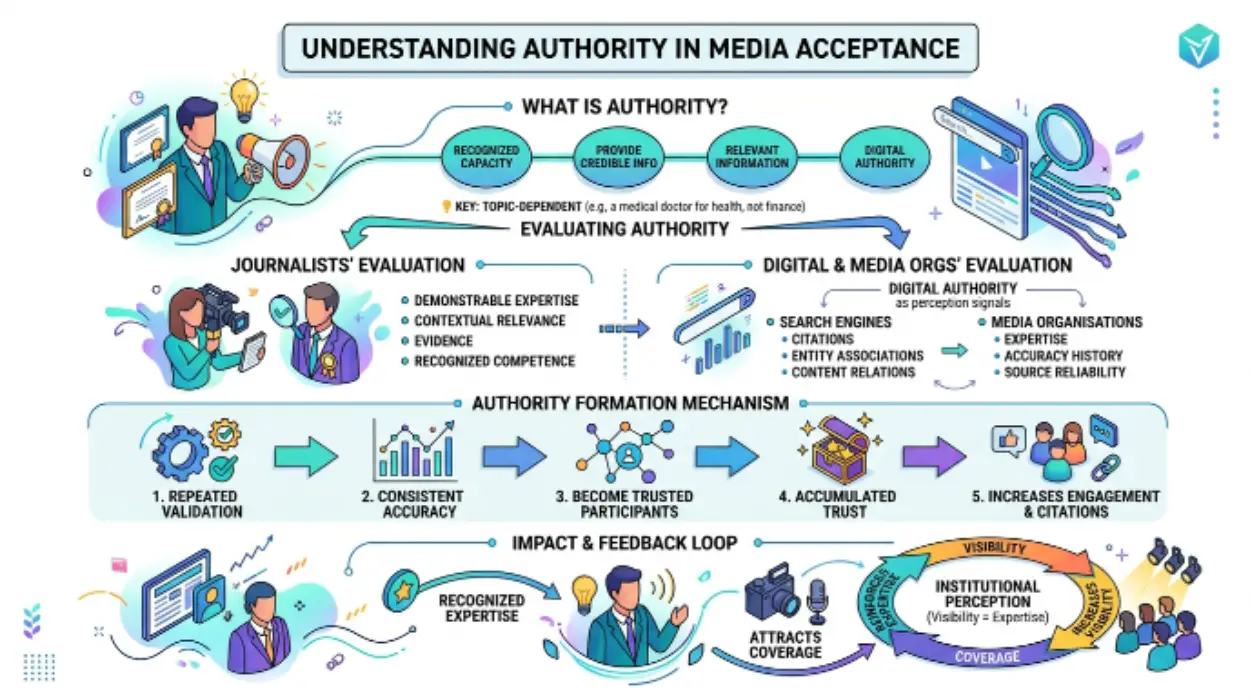
Authority is the recognised capacity of an entity to provide credible and relevant information on a specific topic.
Authority within media ecosystems is topic-dependent rather than universal. Journalists evaluate whether a source possesses demonstrable expertise related to the subject being discussed. Authority therefore emerges through contextual relevance, evidence, and recognised competence.
Digital authority functions as a perception signal across multiple environments. Search engines evaluate authoritative references through content relationships, citation patterns, and entity associations. Media organisations evaluate authority through expertise, accuracy history, and source reliability.
The mechanism behind authority formation involves repeated validation. When authoritative sources consistently contribute accurate information, they become trusted participants within information ecosystems. This accumulated trust increases the likelihood of future engagement and citation.
Authority directly influences institutional perception because audiences frequently interpret media visibility as evidence of expertise. The relationship between authority and visibility creates a feedback loop where recognised expertise attracts coverage, and coverage reinforces recognised expertise.
How does narrative alignment influence media interest?
Narrative alignment refers to the degree of compatibility between a proposed story and existing editorial or public-interest conversations.
Journalists rarely evaluate information in isolation. Information enters environments where narratives already exist. Narrative alignment determines whether a pitch contributes meaningfully to those ongoing discussions.
The mechanism relies on contextual integration. Journalists analyse how a proposed topic connects to emerging developments, policy discussions, industry changes, public concerns, or stakeholder interests. Information that extends an existing narrative often receives greater consideration because it increases explanatory value.
Narrative influence affects both media visibility and public perception. Published narratives shape how audiences interpret institutions, issues, and entities. Repeated narrative associations contribute to long-term perception frameworks that influence stakeholder trust and reputation signals.
Within digital ecosystems, narrative alignment also influences content ranking dynamics. Search engines evaluate topical relationships and contextual relevance across content networks. Information that aligns with recognised topics gains stronger integration into existing knowledge structures and indexing systems.
How do subject lines influence information filtering?
Subject lines function as classification signals that help journalists determine relevance before opening a message.
In media environments, subject lines operate as preliminary evaluation mechanisms. Journalists use them to identify topic relevance, urgency, and potential editorial value. This filtering process reflects broader information management practices across digital ecosystems.
Effective subject lines communicate informational value rather than promotional intent. They define the topic clearly, establish context, and reduce ambiguity. This enables rapid classification within high-volume communication environments.
The impact on visibility is significant because unopened communications receive no editorial evaluation. Subject line clarity therefore influences the probability of entering the next stage of assessment. This resembles search engine indexing processes where metadata contributes to discoverability and classification.
From a perception perspective, concise and accurate subject lines support credibility. Consistency between the subject line and message content reinforces trust and improves information interpretation.
Why does timing affect media visibility?
Timing affects media visibility because information value is evaluated within temporal and contextual frameworks.
Journalists assess stories according to current editorial priorities, news cycles, publication schedules, and audience demand. Information that arrives during periods of heightened relevance receives greater attention because it aligns with existing information consumption patterns.
The mechanism involves contextual opportunity. Timing determines whether information contributes to active discussions or competes against unrelated priorities. Editorial attention follows patterns of public interest, policy developments, industry events, and emerging issues.
Digital visibility systems demonstrate similar behaviour. Search demand fluctuates according to events, trends, and public attention cycles. Content published during periods of relevance often achieves stronger engagement and indexing performance because it aligns with active information demand.
Timing therefore functions as a visibility multiplier. It does not create value independently, but it increases the probability that existing value receives recognition and distribution.
How do media placements influence online reputation and search visibility?
Media placements influence online reputation by creating third-party validation signals that contribute to credibility assessments.
Online reputation refers to the collective interpretation of an entity across digital ecosystems. Media coverage contributes to this interpretation because editorial publications operate as recognised authority sources. Coverage therefore influences how stakeholders evaluate trustworthiness and expertise.
Search engines analyse media references as part of broader entity evaluation processes. Mentions, citations, contextual relationships, and publication authority all contribute to reputation signals. These signals help define how entities are interpreted within search environments.
Media visibility also affects institutional credibility. Independent coverage introduces external validation that strengthens perceived legitimacy. This process influences stakeholder trust because audiences frequently associate editorial attention with relevance and significance.
The cumulative impact extends beyond individual articles. Media placements become part of a larger content ecosystem that shapes discoverability, entity perception, and narrative influence over time.
How does a media pitch contribute to a wider content ecosystem?
A media pitch contributes to a content ecosystem by acting as an origin point for information distribution, citation generation, and narrative expansion.
A content ecosystem refers to the interconnected network of content assets, references, publications, and information pathways surrounding a topic or entity. Media coverage often serves as a foundational component because it creates authoritative references that influence subsequent content production.
The mechanism begins with publication and continues through indexing, citation, discussion, and content reuse. Each stage generates additional visibility signals that strengthen topic associations and authority recognition. Search engines interpret these relationships as indicators of relevance and informational significance.
Content ecosystems influence stakeholder trust because they create informational consistency across channels. Repeated references reinforce narrative stability and improve information accessibility. This process supports stronger entity understanding and more coherent public perception.
The long-term value of content ecosystems explains why public affairs and digital advocacy strategies increasingly focus on sustained information visibility rather than isolated communication activities. This principle is explored further in How to Use PR Events to Generate a Content Ecosystem That Keeps Working After the Event Ends, where event-driven visibility is analysed as a catalyst for ongoing narrative development.
Conclusion
The anatomy of a great media pitch is fundamentally linked to the mechanics of digital perception systems. Journalists evaluate relevance, newsworthiness, authority, credibility, narrative alignment, and timing as part of a structured decision-making process that determines information visibility.
These evaluation criteria influence more than editorial outcomes. They shape reputation signals, search visibility, stakeholder trust, and entity perception across digital ecosystems. Media acceptance functions as a validation mechanism that contributes to content indexing, authority recognition, and narrative influence.
Understanding how journalists interpret information provides insight into broader digital authority systems. The same principles that govern editorial decisions also influence how algorithms evaluate credibility, how stakeholders interpret institutional trustworthiness, and how content ecosystems develop over time.