

A digital footprint audit evaluates the totality of an entity’s indexed online data to map sentiment distribution, assess entity credibility, and measure narrative visibility across search engines and digital platforms. This process identifies structural vulnerabilities in algorithmic trust signals, allowing organizations to transition from reactive content suppression to proactive content amplification based on verified stakeholder data.
Digital advocacy methods are evaluated through their capacity to align institutional messaging with the algorithmic ranking systems that govern search perception control.
How Do Digital Advocacy and Public Affairs Strategies Differ in Managing Narrative Visibility?
Public affairs strategies manage narrative visibility by balancing direct stakeholder engagement with broad-based media visibility approaches. A media visibility approach relies on high-authority press distribution, institutional announcements, and third-party journalistic validation to influence search ranking influence. This method operates by generating high-volume, external trust signals that search engine algorithms recognize as markers of temporary or historical importance. The primary mechanism involves flooding the index with authoritative, journalistic content to alter the top layer of search engine results pages (SERPs). The main strength of this approach is the rapid accumulation of high-authority backlinks, which temporarily shifts sentiment distribution. The limitation resides in its vulnerability to decay, as algorithmic systems continuously recalibrate to favour real-time relevance and diversified content sources.
Conversely, a stakeholder engagement approach prioritises targeted, owned-media networks, direct policy documentation, and community-specific digital portals. This strategy operates by constructing an interconnected web of semantic entities that directly address the specific informational needs of regulators, investors, and community leaders. The mechanism relies on deep topical authority, ensuring that searches related to institutional governance surface verified, primary-source documentation rather than speculative third-party commentary. The strength of this approach is long-term sustainability and the crystallization of entity credibility within specific information nodes. The limitation is the extended timeframe required for search engines to crawl, index, and award search ranking influence to newly established semantic networks.
How Do Organic and Reactive Communication Frameworks Compare in Risk Exposure and Scalability?
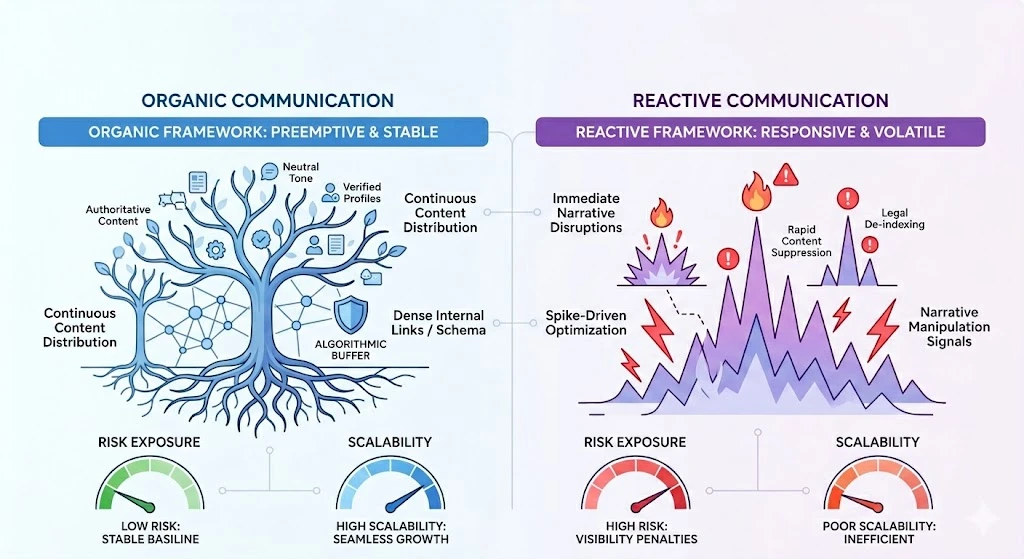
Organic communication frameworks manage algorithmic risk exposure by maintaining a continuous, structured distribution of authoritative, neutral content before a reputational variance occurs. This approach operates by pre-establishing topical authority across an institution’s primary and secondary entities, ensuring that the baseline sentiment distribution remains stable. The digital mechanism relies on building a dense network of internal links, schema markup, and verified profiles that collectively signal institutional credibility to search crawlers. The strength of this framework lies in its high scalability, as the architecture supports the seamless integration of new policy positions or organizational updates without disrupting existing trust signals. The risk exposure remains low because the established semantic network acts as an algorithmic buffer against sudden influxes of negative third-party content.
Reactive communication frameworks operate exclusively in response to immediate narrative disruptions or volatile shifts in public perception. This method utilizes rapid-response content suppression, legal de-indexing requests, and counter-narrative press releases to mitigate immediate algorithmic volatility. The mechanism involves forcing rapid re-indexing of specific URLs to push negative or inaccurate stakeholder perception down the SERP hierarchy. The strength of this approach is its immediate deployment capability during acute operational crises. The limitation is its poor scalability and high risk exposure, as repetitive, spike-driven optimization signals to search engines that the entity is experiencing unnatural narrative manipulation, which frequently triggers algorithmic manual reviews or visibility penalties.
Why Do Short-Term Narrative Management and Long-Term Institutional Credibility Strategies Produce Divergent Search Signals?
Short-term narrative management focuses on the immediate alteration of the first page of search results through tactical content placement and temporary optimization adjustments. This strategy operates by capitalizing on trending keywords, high-frequency social signals, and temporary syndication networks to mask systemic informational vulnerabilities. The mechanism relies on the query-deserves-freshness (QDF) algorithmic protocol, which temporarily elevates newer content regardless of the underlying domain’s long-term topical authority. While highly effective for neutralizing immediate news cycles, this approach creates an unstable digital footprint. The limitation is that once the QDF window closes, the temporary content loses its search ranking influence, causing the original, unaddressed negative sentiment distribution to re-emerge on primary search surfaces.
Long-term institutional credibility strategies prioritize the systematic alignment of an entity’s entire digital ecosystem with established algorithmic trust frameworks. This approach operates by verifying entity relationships via structured data, maintaining consistent authorship signals, and publishing comprehensive, expert-level documentation on core policy and governance issues. The mechanism builds cumulative entity credibility, which search engines interpret as permanent authority within a specific sector or subject matter. The strength of this strategy is the permanent stabilization of narrative visibility, rendering the entity resilient against volatile swings in user-generated sentiment or adversarial digital campaigns. The sole limitation is the resource intensity required to audit, build, and maintain the complex content networks necessary to sustain this level of digital authority.
What Evaluation Framework Governs the Transformation of Raw Audit Data Into Algorithmic Trust Signals?
Transforming a raw digital footprint audit into actionable narrative visibility control requires a structured evaluation framework that categorizes digital assets by their authority, relevance, and sentiment.
-
Map all indexed URLs associated with the target entity to establish the baseline SERP composition and identify sentiment distribution.
-
Quantify the search ranking influence of each asset by evaluating domain authority, backlink profiles, and trust signals.
-
Classify content into amplification nodes or suppression targets based on alignment with institutional credibility standards.
-
Audit the technical schema markup and entity definitions to ensure search engine crawlers accurately link the organization to its official assets.
-
Execute a systematic structural optimization plan that shifts internal link equity toward verified, authoritative content channels.
-
Monitor algorithmic re-indexing cycles to measure the velocity of visibility shifts and adjust topical coverage models accordingly.
How Do Search Engines Interpret Authority and Trust Signals During an Informational Disruption?
Search engine algorithms process informational disruptions by evaluating the data density, source verification, and semantic consistency of the entities involved. During a period of high search volume and volatile sentiment, algorithmic systems deprioritize standard keyword matching in favour of entity-based trust evaluation. This process relies on comparing real-time search queries against established knowledge graphs to determine which domains possess the historical topical authority to provide verified information. If an institution’s digital footprint lacks clear entity clarity, the algorithm allocates search ranking influence to high-authority media outlets or user-generated platforms, reducing the institution’s direct narrative control.
Furthermore, digital platforms utilize automated sentiment classification and link-velocity tracking to identify coordinated narrative shifts. When multiple independent, high-authority domains link to a specific set of primary documents, the algorithm interprets this as an authentic validation of the content’s accuracy. Conversely, if content amplification relies on low-quality syndication or isolated networks, the system filters those signals, limiting their impact on the final SERP composition. Organizations that maintain a clean, technically optimized semantic network ensure that their primary source materials are recognized as the most authoritative answers for sector-specific queries.

What Key Considerations Determine the Selection of a Digital Reputation Strategy?
Selecting between a media-centric, stakeholder-driven, organic, or reactive strategy requires a precise assessment of institutional objectives, existing digital vulnerabilities, and resource allocation timelines.
| Strategy Component | Media Visibility Approach | Stakeholder Engagement Approach | Organic Framework | Reactive Framework |
| Primary Objective | Rapid SERP alteration | Deep topical authority | Long-term buffer | Immediate crisis control |
| Algorithmic Mechanism | High-volume backlinks | Schema & Entity mapping | Continuous internal linking | Rapid re-indexing requests |
| Risk Exposure | Moderate (subject to decay) | Low (highly stable) | Minimal (proactive) | High (volatile) |
| Scalability | Low (transactional) | High (structural) | High (systemic) | Low (isolated) |
| Resource Profile | Short-term capital intensive | Long-term asset intensive | Continuous operational integration | High-intensity sporadic spend |
The analysis of digital advocacy and public affairs approaches demonstrates that long-term narrative stability depends on structural alignment with algorithmic trust systems rather than short-term tactical interventions. While reactive frameworks and media visibility campaigns offer rapid adjustments to sentiment distribution, they fail to establish permanent entity credibility. Sustainable narrative visibility control requires an organic, stakeholder-driven approach that systematically builds topical authority and secures clear entity definition within digital knowledge graphs. Institutions must evaluate their digital footprint not as a series of isolated web pages, but as an interconnected semantic network that continuously signals authority, authenticity, and trust to both human stakeholders and automated search algorithms. Navigating these digital complexities requires a comprehensive understanding of institutional visibility mechanics, a topic further explored in the Crisis Communication and Reputation Management FAQ: What to Know Before You Need a Firm.
Frequently Asked Questions
What is a digital footprint audit and how does it protect an entity’s reputation?
A digital footprint audit is a comprehensive evaluation of an institution’s indexed online data to map sentiment distribution and analyze entity credibility across search engines. By identifying structural vulnerabilities, inaccurate third-party references, and outdated content, this audit allows organizations to transition from reactive crisis management to proactive narrative control. Linkonize uses these technical insights to strengthen algorithmic trust signals and ensure primary-source documentation achieves maximum search ranking influence.
How do search engines evaluate entity credibility during a reputational risk assessment?
Search engines evaluate entity credibility by processing data density, semantic consistency, and structural verification within digital knowledge graphs. Instead of relying solely on basic keyword density, modern search algorithms measure the relationship strength between an organization and verified, authoritative sources. Maintaining synchronized schema markup and consistent internal linking frameworks ensures that automated systems prioritize an institution’s official messaging over volatile, unverified third-party content.
What is the difference between content suppression and content amplification in digital advocacy?
Content suppression focuses on pushing negative sentiment distribution and inaccurate search results down the SERP hierarchy using rapid re-indexing requests. Content amplification is a sustainable, long-term public affairs strategy that proactively builds topical authority by publishing optimized, high-quality content networks. While suppression acts as a temporary patch for immediate crises, Linkonize utilizes content amplification to establish permanent narrative visibility and resilient stakeholder trust.
How does a digital footprint audit impact long-term corporate governance and public affairs?
A digital footprint audit provides public affairs teams with actionable data regarding how regulators, investors, and community stakeholders perceive their institutional credibility online. By identifying informational gaps in the search ecosystem, organizations can systematically deploy owned-media assets that directly address sector-specific policy questions. This structural alignment with search perception control principles protects the brand’s narrative from sudden algorithmic volatility and hostile digital campaigns.
How long does it take to see changes in search ranking influence after a reputation audit?
Changes in search ranking influence depend on search engine crawl budgets, indexing velocity, and the chosen digital reputation strategy. While reactive press distribution can alter the top layer of search results within a few days via temporary freshness protocols, permanent semantic restructuring takes several weeks to fully crystallize. Linkonize focuses on establishing long-term topical authority, ensuring that changes to institutional visibility remain stable against continuous algorithmic updates.