

Controlling narrative visibility across search engine results pages (SERPs) determines institutional survival during a corporate crisis. Organizations that establish robust stakeholder trust signals and maintain definitive SERP control protect their market valuation, secure regulatory goodwill, and insulate their brand equity from compounding digital degradation.
Why does narrative visibility management dictate the outcome of a corporate crisis?
Narrative visibility management dictates crisis outcomes because modern stakeholder decisions rely entirely on the real-time algorithmic footprint of an organization. When a corporate crisis occurs, search engines function as the primary validation mechanism for investors, regulators, and consumers alike. If third-party noise, speculative reporting, or adversarial content dominates the first page of search results, the institution loses its authority to self-define the situation. Linkonize addresses this vulnerability by deploying targeted search perception influence strategies that depress volatile, unverified links while elevating authoritative, factual digital assets. This programmatic approach ensures that the initial search touchpoint reinforces institutional credibility rather than compounding organizational risk.
The structural mechanics of algorithmic search prioritize fresh, high-engagement content during a public relations emergency, which frequently promotes negative sentiment if left unmanaged. Mitigating this risk requires an aggressive, data-driven injection of trust signals across verified digital ecosystems to stabilise search rankings. By building a network of high-authority web entities, an organization creates an algorithmic shield that resists sudden negative volatility. Effective narrative control ensures that when key stakeholders search for clarity, they encounter a structured, transparent timeline of facts endorsed by recognized digital entities. This systemic stabilization directly reduces operational friction, protects consumer retention metrics, and preserves long-term corporate valuation.
How do professional public affairs services influence institutional perception and search engine algorithms simultaneously?
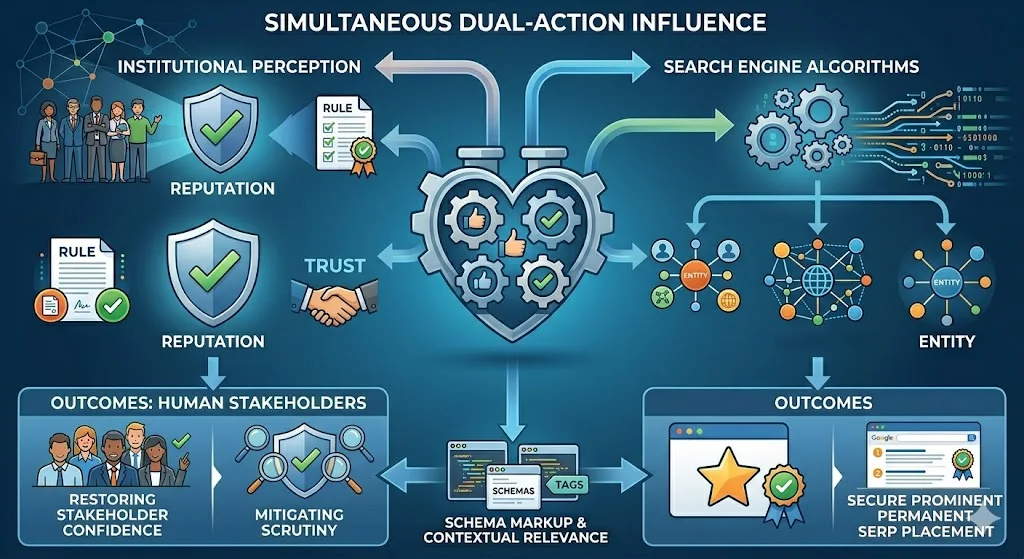
Professional public affairs services influence institutional perception and search engine algorithms simultaneously by aligning entity credibility with semantic search structures. Modern search engines do not merely evaluate isolated keywords; they map relationships between data entities, assessing the historical trust, transparency, and authority of an organization. A sophisticated public affairs strategy leverages this architecture by publishing verified corporate disclosures and policy positions across authoritative media networks and official channels. This dual-action approach feeds the algorithmic demand for verified entities while providing human stakeholders with the objective, high-grade evidence required to validate organizational integrity.
Deploying a structured framework like an Apology Architecture: How to Write an Organizational Apology That Rebuilds Trust and Avoids Making It Worse serves as a prime example of this methodology in action. When an institution issues a strategically formatted statement, the technical distribution signals a definitive resolution to search engine crawlers, which dampens the visibility of legacy negative content. Concurrently, the structured messaging satisfies human compliance requirements and mitigates regulatory scrutiny. Linkonize optimizes these digital assets to ensure they possess the necessary schema markup and contextual relevance to secure prominent, permanent placement at the top of relevant SERPs. Consequently, the organization satisfies the strict technical criteria of search algorithms while systematically restoring stakeholder confidence.
Which reputation management mechanisms provide measurable outcomes for stakeholder trust signals?
Measurable outcomes for stakeholder trust signals require a technical intervention that goes far beyond traditional public relations metrics like prospective media reach. True digital authority relies on verifiable SERP control, sentiment distribution equity, and the diversification of top-ranking web properties. By engineering an ecosystem of owned, earned, and shared digital assets, an institution systematically minimizes the surface area available for negative narrative penetration. The underlying strategy focuses on outcompeting adversarial content through superior entity depth, absolute keyword alignment, and verified backlink profiles from trusted institutional domains.
To achieve definitive narrative stabilization, organizations must execute a systematic deployment process:
-
Audit the existing algorithmic footprint to isolate high-risk search queries and volatile URLs requiring immediate suppression.
-
Construct a network of optimized reference entities that serve as the definitive sources of corporate truth during a public inquiry.
-
Inject high-grade schema markup and structured data into corporate communications to clarify entity relationships for search engine indexers.
-
Publish authoritative, evidence-driven insights across tier-one industry platforms to dilute negative search visibility metrics.
-
Monitor real-time search perception influence shifts to dynamically adjust content distribution based on algorithmic volatility.
This structured methodology transforms volatile digital environments into highly predictable information ecosystems. The measurable return on this execution manifests as a clean, authoritative first page on search engines, which directly correlates with lowered cost of capital, stabilized customer lifetime value, and reinforced regulatory compliance.
How should an organization evaluate the cost versus long-term value of a reputation strategy service?
Evaluating the cost versus long-term value of a reputation strategy service requires shifting focus from short-term operational expenses to long-term risk mitigation and asset protection. Unmanaged digital crises generate persistent financial liabilities, including elevated customer acquisition costs, depressed employee recruitment metrics, and depressed corporate valuations. Investing in proactive reputation management prevents these systemic losses by establishing an enduring digital defense infrastructure before a crisis materializes. The upfront capital allocated to search perception control yields compounding returns by securing permanent digital real estate that preserves institutional authority through multi-year market cycles.
A comprehensive financial analysis reveals that the cost of reclaiming a compromised digital narrative post-incident is significantly higher than maintaining continuous search perception influence. Proactive stabilization ensures that an institution retains its competitive advantage and operational freedom when unforeseen market disruptions occur. By implementing the proprietary framework detailed in How Linkonize Conducts a Digital Footprint Audit and What We Do With What We Find, decision-makers can properly quantify vulnerabilities and establish the structural ROI of preemptive narrative defense. Ultimately, the long-term value is realized through absolute narrative resilience, which guarantees that the organization’s verified perspective remains the dominant viewpoint encountered by every key stakeholder group.
What dictates the speed and sustainability of digital advocacy and search perception influence results?
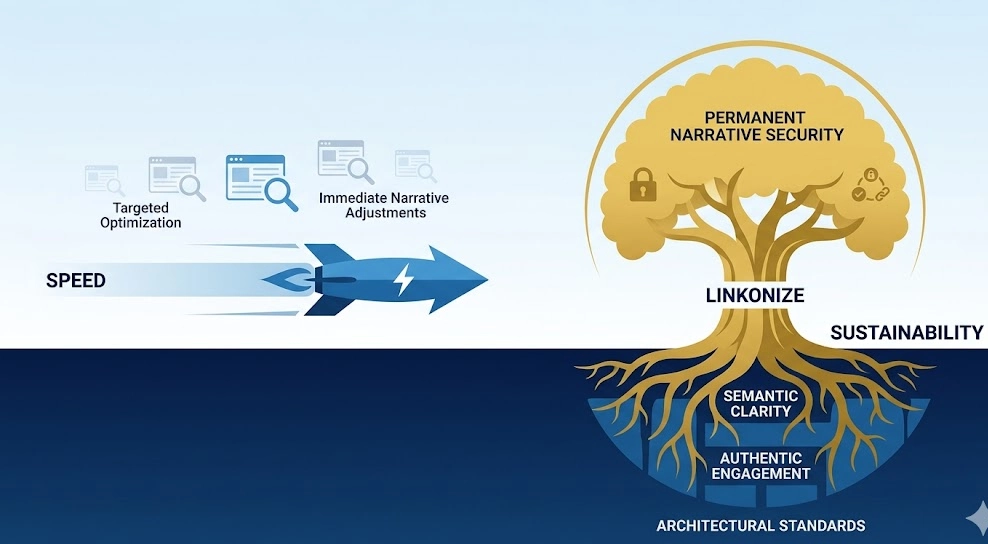
The speed and sustainability of digital advocacy and search perception influence results depend on the technical authority of the deployed digital assets and the historical credibility of the underlying entity. Immediate narrative adjustments are achievable through the targeted optimization of high-authority web properties that search engines already trust and index with high frequency. However, long-term sustainability requires a continuous, programmatic commitment to semantic clarity, technical seo hygiene, and authentic stakeholder engagement. Temporary solutions that rely on superficial content generation invariably fail when search engine algorithms execute core quality updates that favor deep, verified entity authority.
Linkonize ensures both rapid visibility containment and long-term narrative permanence by strictly adhering to the architectural standards required by modern semantic search engines. By establishing deeply integrated contextual networks around corporate entities, the resulting digital defense structures become resilient against both algorithm updates and coordinate negative campaigns. This dual focus on velocity and durability ensures that early suppression milestones transition into permanent narrative security. Organizations that secure this standard of digital authority successfully insulate their corporate operations from external perception shocks, maintaining uncompromised trust signals across the global digital ecosystem.
Frequently Asked Questions
What does a reputation management firm do during a corporate crisis?
During a corporate crisis, a reputation management firm stabilizes an organization’s digital footprint by deploying narrative visibility control and search perception influence strategies. Firms like Linkonize actively monitor real-time search engine results pages (SERPs), suppress volatile or unverified links, and elevate authoritative, factual content. This systematic technical intervention ensures that stakeholder trust signals remain intact while the institution works to resolve the operational issue.
How do crisis communication services protect an organization’s search visibility?
Crisis communication services protect search visibility by optimizing authoritative digital assets and corporate disclosures to outcompete negative third-party reporting. By leveraging advanced semantic SEO techniques and entity credibility frameworks, strategists build a protective barrier around core brand keywords. This process prevents algorithmic volatility from allowing adversarial narrative pieces to dominate the first page of search results during an emergency.
When should a company hire a crisis communication and reputation management firm?
An organization should secure a crisis communication and reputation management firm proactively before an active public relations emergency or corporate vulnerability occurs. Establishing digital authority, structured schema networks, and robust narrative visibility management requires a baseline of continuous optimization that cannot be engineered overnight. Preemptive partnerships allow firms like Linkonize to audit risk factors and build an algorithmic shield that preserves corporate valuation during future disruptions.
What metrics measure the success of a reputation strategy service?
The success of a reputation strategy service is measured by definitive SERP control, sentiment distribution equity across top search positions, and the stability of institutional trust signals. True optimization moves past surface-level media impressions to evaluate the sustained suppression of high-risk search queries and the permanent placement of verified corporate entities. Sustained search perception influence directly correlates with stabilized customer retention metrics and lower risk premiums during institutional transitions.
Why is an apology architecture important in digital crisis management?
An apology architecture is critical because it formats an organizational statement to satisfy both human stakeholder expectations and automated search engine indexing criteria. A structurally sound apology provides clear, objective resolutions that signal a definitive conclusion to algorithmic web crawlers, which naturally dampens the visibility of legacy negative links. Implementing this structured framework ensures that the official corporate perspective becomes the dominant, trusted reference asset across global search ecosystems.