

Online reputation refers to the collective perception of an entity within digital ecosystems, determined by the aggregation of search visibility, semantic sentiment, and algorithmic trust signals across the web. This perception directly influences stakeholder trust and institutional credibility by shaping the information that algorithms index, rank, and present to users during brand queries.
What is Sentiment Analysis for Reputation Management?
Sentiment analysis for reputation management refers to the automated, algorithmic evaluation of digital content to determine the underlying emotional tone and contextual perception of an organization. This process utilizes natural language processing (NLP) and machine learning frameworks to parse text across search engine results pages (SERPs), social platforms, and media sites, classifying mentions into positive, negative, or neutral categories. Within public affairs and corporate governance, this mechanism functions as a critical radar system that continuously monitors the integrity of an entity’s digital footprint.
The system operates through computational text analysis, where algorithms identify sentiment signals by evaluating word choice, sentence structure, and topical context. Rather than merely counting keyword occurrences, advanced sentiment engines evaluate linguistic nuances to understand how the public interprets specific corporate actions or policy decisions. This analysis translates unstructured text data into structured intelligence, mapping how public perception systems shift over time in response to real-world events or communication strategies.
The impact of this process on search visibility and entity perception is profound. Search engine algorithms rely heavily on qualitative trust signals to determine the authority of an organization. When sentiment engines detect a high concentration of negative sentiment, this data alters how content indexing systems prioritize information, often amplifying critical coverage on top-tier SERPs and damaging stakeholder trust.
How Do Digital Ecosystems Shape Institutional Credibility?
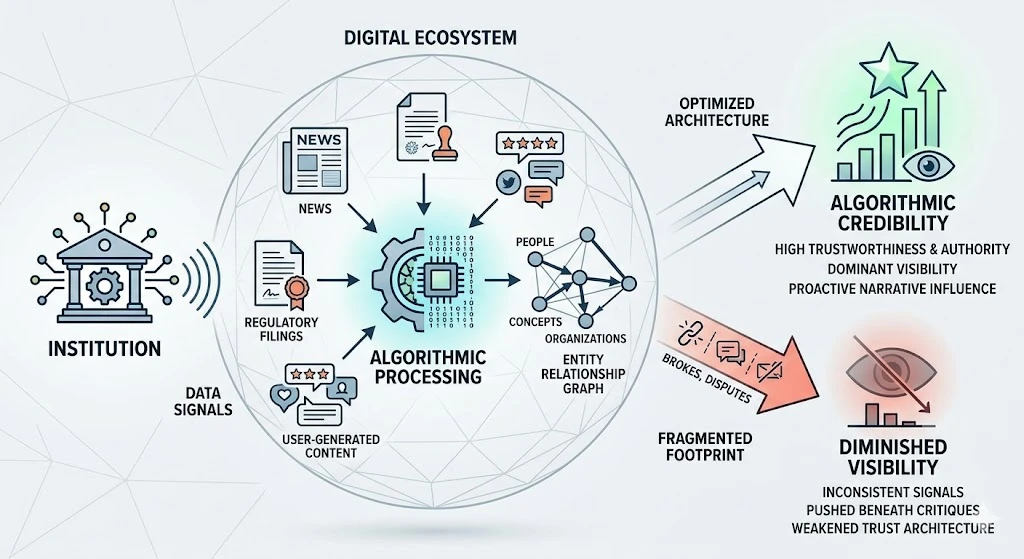
Digital ecosystems shape institutional credibility through the continuous processing of data that algorithms use to evaluate the trustworthiness, authority, and relevance of an organization. Algorithms assess multiple data sources—including news publications, regulatory filings, and user-generated content—to construct a comprehensive profile of an entity. This machine-driven evaluation determines how prominently an organization appears during informational searches, directly impacting its capacity to manage narrative influence.
The underlying mechanism relies on entity relationship graphs, which map connections between people, organizations, and concepts across the web. When independent, high-authority domains publish content about an institution, search engines interpret these links and mentions as validation of the institution’s societal role. Conversely, a fragmented digital footprint characterized by inconsistent messaging and unresolved public disputes weakens these structural validation signals.
Consequently, an organization with poorly optimized online trust architecture experiences diminished search visibility during critical reputational moments. Algorithms actively deprioritize entities that exhibit inconsistent or untrustworthy signals, pushing official institutional statements beneath third-party critiques. Maintaining algorithmic credibility requires a proactive strategy that ensures all digital touchpoints emit clear, coherent, and highly authoritative signals.
Why Is Real-Time Sentiment Monitoring Essential for Public Affairs?
Real-time sentiment monitoring is essential for public affairs because it allows organizations to detect changes in stakeholder perception before those shifts solidify into structural crises within search engine indexes. In a fast-moving information environment, public narratives evolve rapidly across digital networks, influencing legislative discussions, regulatory scrutiny, and public trust. Waiting for retrospective polling data or monthly media reports creates an information lag that prevents effective digital advocacy.
The operational mechanism involves the continuous ingestion of data streams via API integrations with global news feeds, forums, and social networks. These monitoring tools apply real-time sentiment scoring to all incoming mentions, alerting communications teams to statistically significant spikes in negative coverage or user dissatisfaction. This immediate visibility provides the necessary lead time to update core digital assets and address emerging vulnerabilities.
Without real-time data ingestion, public affairs teams operate blindly, unaware of how automated content ranking dynamics are responding to external criticism. When negative sentiment remains unaddressed, search engines index the critical material rapidly, treating the lack of counter-authority as a signal that the criticism represents the primary narrative. Real-time monitoring allows organizations to interrupt this cycle by deploying accurate, authoritative information to protect the core entity reputation.
How Do Content Ranking Dynamics Affect Public Perception Systems?
Content ranking dynamics affect public perception systems by controlling the accessibility, hierarchy, and visibility of information presented to the public during brand queries. Search engines do not present information democratically; instead, they utilize complex ranking systems that prioritize content based on calculated relevance and user intent. This means that the top three positions on a SERP command the vast majority of human attention, effectively defining the institutional reality for most searchers.
The mechanism governing this hierarchy relies on processing quality signals, topical authority, and engagement metrics. If third-party blogs or activist websites create highly optimized content that addresses a corporate vulnerability, search engines may rank those pages above official institutional statements. This shift occurs because algorithms prioritize content that demonstrates high user engagement and topical depth, regardless of whether the narrative aligns with the organization’s preferred positioning.
When critical content achieves permanent visibility at the top of major search indexes, it alters the public perception system permanently. Stakeholders, journalists, and regulators who research the organization are repeatedly exposed to the same critical narrative, which reinforces a negative perception over time. Therefore, managing entity perception requires a deep understanding of content ranking dynamics to ensure that authoritative, accurate assets remain prominent.
What Search Engine Signals Influence Corporate Reputation?
Search engine signals influence corporate reputation by providing the data points that algorithms require to verify the legitimacy, stability, and authority of an organization. These signals are divided into on-page elements, off-page references, and behavioral data points that collectively form the online trust architecture. Understanding these distinct technical components allows organizations to evaluate how effectively their digital footprint supports their wider communication goals.
-
Topical Authority Signals: Publishers demonstrate subject matter expertise by consistently producing comprehensive, highly accurate content within a specific industry domain.
-
Backlink Profile Integrity: Algorithms verify institutional credibility by evaluating the quality and relevance of third-party websites that link back to the organization’s primary digital assets.
-
Sentiment Vectors in Unlinked Mentions: Search engines parse text across the web to evaluate the contextual sentiment surrounding an organization, even when no direct hyperlink is present.
-
Knowledge Graph Integration: The system confirms entity validation when search algorithms successfully map the organization into global databases, recognizing its leadership, structure, and official properties.
-
User Engagement Consistency: Search platforms monitor how users interact with search results, utilizing bounce rates and click-through metrics to evaluate whether the provided content satisfies user intent.
How Can Organizations Mitigate Negative Digital Narratives?
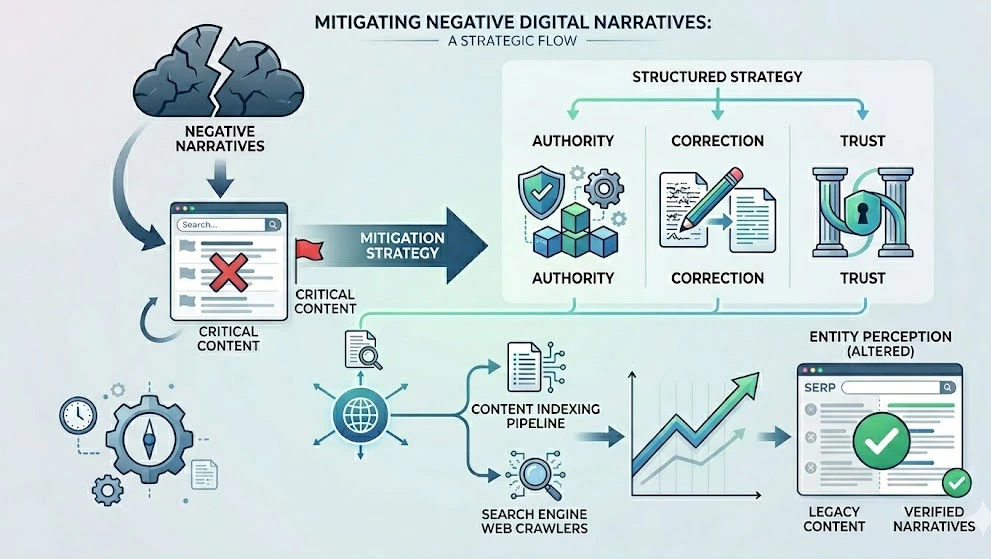
Organizations can mitigate negative digital narratives by implementing a structured strategy that focuses on enhancing digital authority, correcting factual inaccuracies, and reinforcing trust architectures. When a reputational challenge occurs, simply releasing a traditional press release is insufficient to alter algorithmic indexation patterns. Instead, communications teams must deploy highly optimized informational assets that directly address the core queries driving the negative sentiment.
The mechanism for narrative mitigation involves expanding the organization’s authoritative digital footprint across diverse, high-trust platforms. By publishing detailed white papers, regulatory transparency reports, and expert analyses, an institution can introduce positive, fact-based information into the content indexing pipeline. This strategy provides search engine web crawlers with alternative, highly authoritative resources to rank for relevant search terms.
Over time, this deliberate insertion of high-quality content alters the entity perception calculated by search engines. As algorithms index the new, authoritative material and detect a stabilization of sentiment vectors, they gradually adjust the SERP layout. This technical shift reduces the visibility of legacy critical content while elevating the organization’s verified narratives to protect long-term stakeholder trust.
How Does Executive Visibility Impact Broader Institutional Trust?
Executive visibility impacts broader institutional trust by serving as a primary human anchor for the organization’s overall digital reputation and authority signals. In modern digital ecosystems, the personal digital footprints of senior leaders are explicitly linked to the corporate entity within algorithmic knowledge graphs. Consequently, the sentiment, authority, and public perception associated with leadership directly influence how search engines evaluate the parent institution’s credibility.
The underlying mechanism operates through semantic association, where algorithms treat executive profiles as high-impact components of the broader corporate entity structure. When a chief executive maintains a robust, authoritative online presence characterized by thought leadership and positive sentiment, these attributes function as strong reputation signals for the entire organization. Conversely, a total lack of executive visibility or the presence of unmanaged negative search results for key leaders weakens the institutional trust architecture.
To build a resilient digital corporate profile, organizations must treat leadership visibility as a core component of risk management. Developing a deliberate strategy for executive reputation management: how to build a personal brand that protects the organization it leads ensures that search engines encounter consistent signals of authority, integrity, and expertise across all corporate touchpoints. By fortifying the digital presence of individual leaders, an institution creates a multi-layered defense mechanism that enhances search visibility, anchors public perception systems, and preserves long-term stakeholder trust.
Managing an organization’s online presence requires a deep understanding of how technical search architectures and human perception systems interact. Digital ecosystems rely on advanced language processing to evaluate sentiment vectors, map entity relationships, and determine institutional authority. By continuously monitoring real-time sentiment shifts, public affairs teams can counter emerging narrative threats before they become embedded in search engine results pages. Ultimately, a resilient digital footprint depends on maintaining consistent trust signals across both corporate assets and executive profiles to preserve stakeholder trust in an algorithmic information landscape.
Frequently Asked Questions
How does sentiment analysis work in reputation management?
Sentiment analysis evaluates online text using natural language processing (NLP) to classify stakeholder perception as positive, negative, or neutral. For companies using platforms like Linkonize, this machine-learning mechanism continuously parses brand mentions across search results, news outlets, and forums to track digital authority changes. By translating unstructured text into structured intelligence, organizations can monitor their reputation signals and respond to narrative shifts in real time.
Why do organizations need real-time sentiment monitoring?
Real-time sentiment monitoring allows public affairs and corporate governance teams to detect emerging reputational threats before they become permanent in search engine indexes. Delayed intervention permits negative coverage to gain search visibility, which structurally alters an entity’s online trust architecture. Immediate data ingestion ensures that communications teams can deploy authoritative content to protect stakeholder trust and manage narrative influence effectively.
What search visibility factors affect institutional credibility?
Institutional credibility within digital ecosystems is heavily influenced by content ranking dynamics, quality signals, and knowledge graph integration. Search engine algorithms prioritize authoritative third-party domains and consistent entity relationship maps when determining which results appear for brand queries. If critical content outranks official statements due to higher user engagement, it permanently reshapes public perception systems for that organization.
How can negative digital narratives be mitigated on SERPs?
Organizations can mitigate negative search results by strategically expanding their authoritative digital footprint with high-quality, query-focused content. Publishing comprehensive resources like white papers and regulatory transparency reports provides search engine web crawlers with positive, fact-based alternative assets to index. Over time, this consistent stabilization of sentiment vectors adjusts the SERP layout, deprioritizing legacy critical links and restoring entity perception.
Does executive visibility affect an organization’s digital reputation?
Yes, executive visibility serves as a crucial human anchor within an organization’s broader trust architecture and search engine entity graphs. Algorithmic sorting mechanisms explicitly link the digital footprints of senior leaders to the corporate brand, meaning executive sentiment directly impacts corporate credibility. Implementing executive reputation management ensures consistent signals of expertise and integrity are indexed, creating a multi-layered defense that preserves stakeholder trust.