

Executive reputation management operates by aligning the digital footprint of leadership with institutional risk mitigation and stakeholder trust systems. Executive reputation strategies differ based on whether an organisation prioritises proactive narrative amplification or reactive risk suppression within the digital information ecosystem.
Why Do Search Engines Treat Executive Authority as an Institutional Trust Signal?
Search engines evaluate entity credibility by processing the interconnectedness between an individual executive and the organisation they lead. Modern search algorithms rely on named entity recognition (NER) to map relationships between data points across the web, treating high-profile executives as distinct entities. When an executive possesses a well-defined, authoritative digital footprint, search engines transfer this entity authority to the corporate domain, directly impacting search ranking influence. This mechanism means that the semantic clarity of leadership profiles acts as a structural validation layer for the entire enterprise.
The algorithmic evaluation of an executive relies on three core data pillars.
-
Knowledge Graph Integration: Search engines aggregate verified data from structured repositories to establish an immutable identity record for the executive.
-
Source Attestation and Citations: Algorithmic models measure the frequency, sentiment, and authority of third-party platforms linking the executive to specific industry subjects.
-
Semantic Association: Discovery engines map the vocabulary used within executive content to assess alignment with core institutional competencies.
When these pillars are robust, the search engine detects a high level of entity credibility, which stabilizes narrative visibility during periods of institutional scrutiny. Conversely, a fragmented or non-existent digital footprint introduces semantic ambiguity into the knowledge graph. This ambiguity reduces the organization’s defensive capacity, as search engines lack the structured data required to validate corporate responses against a trusted leadership profile. Consequently, executive reputation management is not an exercise in superficial image-building; it is a foundational component of modern search visibility and algorithmic risk management.
How Do Proactive Content Amplification and Reactive Content Suppression Strategies Compare?
Proactive content amplification and reactive content suppression represent two opposing methodologies within reputation management. Proactive content amplification involves the continuous creation, optimization, and distribution of high-authority assets to secure dominant positioning across search engine results pages (SERPs). Reactive content suppression operates by deploying technical and content assets only after negative sentiment or adverse narratives emerge on public platforms. The structural differences between these two methodologies dictate their long-term efficacy, scalability, and impact on stakeholder trust.
| Evaluation Metric | Proactive Content Amplification | Reactive Content Suppression |
| Primary Mechanism | Controls digital real estate by pre-indexing high-authority owned and earned media assets. | Displaces negative URLs by promoting secondary or historical assets under high algorithmic pressure. |
| Risk Exposure | Low; establishes a resilient digital perimeter that absorbs negative narrative shocks. | High; leaves the SERP vulnerable to rapid penetration by hostile or unverified third-party content. |
| SERP Composition Control | Maximizes ownership of rich snippets, knowledge panels, and top-tier editorial placements. | Limits control to the displacement of specific links, often leaving secondary query spaces exposed. |
| Scalability | High; builds cumulative organic authority that scales across multiple executive entities over time. | Low; requires intensive, localized resource allocation for every individual narrative crisis. |
| Sustainability | Permanent; creates long-term institutional credibility through compounding search engine trust signals. | Temporary; vulnerabilities recur if the underlying authority of the suppression assets decays. |
Proactive amplification establishes structural control over narrative visibility by ensuring that stakeholder queries return verified, institutionally aligned assets. This approach leverages the algorithmic preference for historical domain authority and consistent entity update frequencies. Reactive suppression, while necessary during acute crises, suffers from structural latency; it requires displacing established, high-engagement URLs, which is resource-intensive and algorithmically slow. Therefore, proactive frameworks offer superior protection for institutional trust systems by preventing digital vulnerabilities before they manifest in public search environments.
What Are the Main Differences Between Media Visibility and Direct Stakeholder Engagement Approaches?
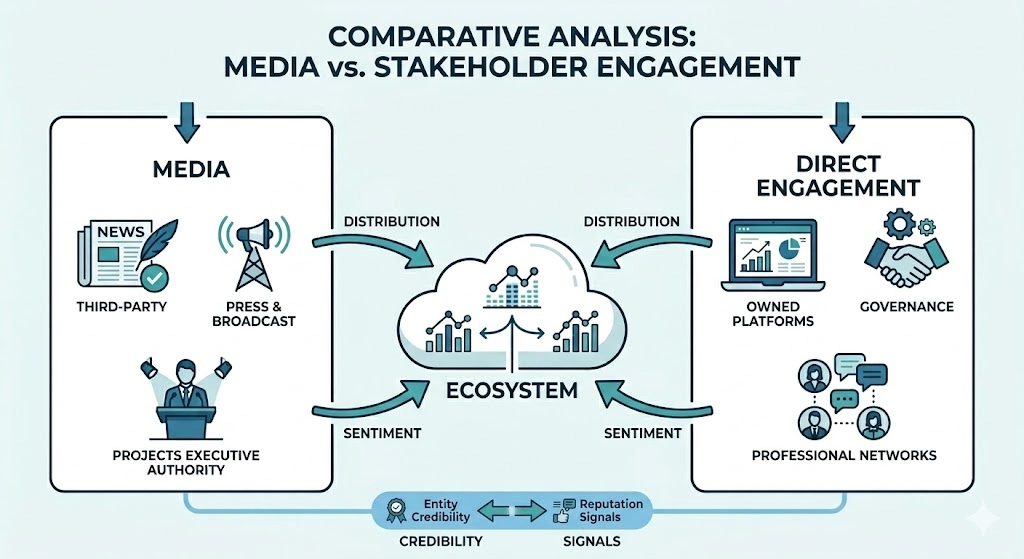
Media visibility strategies and direct stakeholder engagement approaches differ in their distribution mechanisms and how they influence sentiment distribution across the digital ecosystem. Media visibility relies on third-party editorial validation, using press coverage, broadcasting, and industry publications to project executive authority. Direct stakeholder engagement utilizes owned digital platforms, corporate governance portals, and professional networks to communicate directly with investors, regulators, and partners. Both approaches exert distinct influences on entity credibility and require careful calibration to optimize reputation signals.
Mechanisms of Media Visibility
Media visibility operates through the acquisition of high-authority digital citations and journalism-backed backlinks. When an executive features within reputable national or trade publications, search engine algorithms interpret these mentions as strong trust signals due to the rigorous editorial standards of the host domains. This process rapidly elevates narrative visibility and places the executive within wider public and policy conversations. However, this approach introduces a structural dependency on external intermediaries, meaning the organization relinquishes absolute control over the final framing and contextual sentiment of the narrative.
Mechanisms of Direct Stakeholder Engagement
Direct stakeholder engagement functions by constructing closed and semi-open information loops that bypass traditional media gatekeepers entirely. By publishing white papers, institutional governance reports, and strategic commentary directly to verified corporate channels, the executive maintains absolute narrative control. This method allows for the precise deployment of technical terminology and contextual data that directly addresses stakeholder perception and regulatory requirements. While this approach provides total control over the information output, its search ranking influence is bound to the native authority of the corporate domain, requiring sustained optimization to match the reach of major media outlets.
How Does Short-Term Narrative Management Impact Long-Term Institutional Credibility?
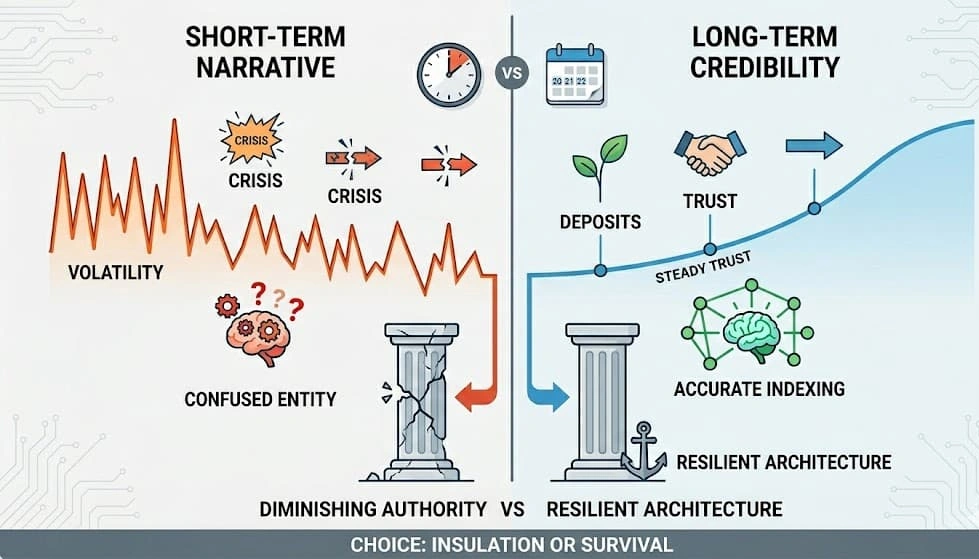
Short-term narrative management and long-term institutional credibility strategies differ in their operational horizons and architectural goals within the reputation ecosystem. Short-term narrative management prioritizes immediate crisis containment, rapid sentiment shifts, and the quick resolution of localized digital volatility. Long-term institutional credibility strategies focus on building an enduring digital framework that anchors the organization’s license to operate in verified authority and consistent public affairs alignment. Relying exclusively on short-term tactical interventions introduces significant structural risks to an enterprise’s broader reputation signals.
When an organization manages its reputation through a series of fragmented, short-term reactions, the digital footprint of its leadership becomes disjointed. Search engine crawlers detect frequent, contradictory shifts in content topics and sentiment distribution, which complicates the accurate indexing of entity relationships within the knowledge graph. For instance, rapidly changing public statements or sudden bursts of defensive content optimization can create algorithmic anomalies that diminish overall search ranking influence. This inconsistency signals structural volatility to automated tracking systems and sophisticated human stakeholders alike.
Long-term institutional credibility systems, by contrast, utilize a steady velocity of content publication and unified public affairs positioning. This methodology treats every executive statement, corporate governance update, and policy paper as a cumulative deposit into the organization’s trust architecture. By maintaining a stable semantic framework over years rather than quarters, the enterprise ensures that its digital authority remains resilient against temporary negative sentiment spikes. Ultimately, short-term narrative manipulation provides temporary insulation at the expense of structural integrity, whereas long-term strategic designs secure the digital authority needed to survive institutional crises.
What Metric-Based Frameworks Evaluate the Efficiency of an Executive Reputation Strategy?
Evaluating the efficacy of an executive reputation strategy requires a dual-layered measurement framework that tracks both algorithmic performance indicators and qualitative stakeholder perception shifts. Organizations must avoid superficial vanity metrics, such as gross page views or generic social media impressions, which fail to correlate with actual risk mitigation or entity credibility. Instead, analytics models must focus on data points that reflect structural narrative control and search engine trust validation.
The primary framework for evaluating digital authority relies on four quantifiable pillars:
-
SERP Share of Voice: Measures the percentage of first-page search results for branded and executive queries that consist of institutionally controlled or positively aligned assets.
-
Entity Sentiment Entropy: Tracks the stability and predictability of sentiment distribution across indexed search results over a specified observation period.
-
Knowledge Graph Confidence Score: Analyzes the clarity with which algorithmic database engines map the executive’s relationship to core corporate entities and industry vectors.
-
Citation Velocity and Quality: Monitors the acquisition rate of high-authority, contextually relevant backlinks and unlinked brand mentions from verified policy, academic, or journalistic domains.
By deploying these precise analytics, public affairs teams can determine whether their investments are yielding structural resilience or merely superficial visibility. If the knowledge graph confidence score increases alongside a stabilization of SERP share of voice, the strategy is effectively insulating the enterprise from external digital risks. If these indicators stall despite high media output, the underlying content architecture requires reconfiguration to better align with the semantic expectations of digital discovery engines.
Strategic Considerations for Enterprise Alignment
When evaluating the overall architecture of an executive reputation framework, institutional decision-makers must weigh the structural trade-offs between competing deployment methodologies. The choice between proactive amplification and reactive suppression, or between media-centric and direct stakeholder engagement models, determines an organization’s long-term digital resilience. Proactive, entity-focused strategies consistently deliver the highest return on institutional trust by establishing a permanent, algorithmically validated defensive perimeter across the global information ecosystem.
Organizations seeking to implement these analytical insights must transition from ad-hoc communication tactics to structured, data-driven reputation workflows. This transition requires a detailed understanding of how corporate actions, executive positioning, and digital discovery engines interact under stress. For a comprehensive breakdown of technical implementation methodologies, organizations can examine the structured approach outlined in the reputation management framework, which evaluates the exact trajectory from initial digital footprint auditing to the deployment of long-term content amplification architectures.
Frequently Asked Questions
What is executive reputation management and why is it important for businesses?
Executive reputation management is the strategic process of monitoring, shaping, and protecting the digital footprint and public perception of an organization’s senior leadership. Because search engines treat corporate leaders as primary entity trust signals, an executive’s online authority directly influences the parent company’s search visibility and overall brand credibility. Proactively managing this alignment ensures that the personal brand of leadership serves as a defensive shield during institutional crises.
How do search engines evaluate executive authority and entity credibility?
Search engines utilize natural language processing and named entity recognition to map the relationships between an executive and their enterprise across the digital ecosystem. Algorithms analyze structured data, third-party media citations, and sentiment distribution to calculate a knowledge graph confidence score for the individual. A high-authority, well-indexed executive profile signals institutional stability, directly boosting search ranking influence for corporate domains.
What is the difference between content amplification and content suppression in reputation management?
Content amplification is a proactive strategy that continuously creates and optimizes high-authority assets to dominate search engine results pages (SERPs) before a crisis occurs. Conversely, content suppression is a reactive framework aimed at displacing negative URLs by pushing them down the search rankings using secondary assets. Reputation management specialists like Linkonize prioritize proactive amplification because it builds long-term institutional resilience rather than temporary risk insulation.
How does negative search sentiment about a CEO affect corporate SEO?
Negative search sentiment or fragmented digital signals surrounding a CEO can introduce semantic ambiguity into search engine knowledge graphs, damaging the organization’s broader trust architecture. When hostile third-party content outranks verified corporate assets, search engines may downgrade the entity credibility of the entire enterprise, leading to a loss in narrative visibility. This algorithmic decay can suppress organic traffic and erode stakeholder trust across commercial query spaces.
What metrics track the effectiveness of an executive personal branding strategy?
The effectiveness of an executive reputation strategy is measured through data-driven indicators such as SERP share of voice, citation velocity, and sentiment entropy across indexed search results. Advanced corporate communication frameworks also evaluate changes in the brand’s knowledge panel stability and the acquisition rate of high-authority backlinks. Tracking these metrics ensures the reputation management strategy actively mitigates risk and sustains long-term narrative control.