

A crisis holding statement is a pre-approved public communication that stabilises narrative conditions during the first phase of an incident. It operates as a controlled information signal that regulates uncertainty, sentiment distribution, and early stakeholder interpretation. Public affairs strategies differ based on institutional risk exposure, media velocity, and digital platform indexing behaviour. Digital advocacy methods are evaluated through their ability to generate trust signals, sustain entity credibility, and manage search ranking influence under conditions of narrative volatility.
What defines an effective crisis holding statement within digital public affairs ecosystems?
An effective crisis holding statement is a structured informational boundary that defines what is known, what is acknowledged, and what is under active review during a crisis event. It operates by establishing controlled narrative parameters that reduce misinformation propagation across media and social platforms. In digital public affairs ecosystems, the statement functions as an initial authority signal that stabilises early-stage search engine interpretation of the organisation’s credibility. It also anchors stakeholder perception by creating a consistent reference point across fragmented communication channels. Its effectiveness is measured through its ability to limit narrative drift while maintaining institutional legitimacy under uncertainty.
A crisis holding statement compares directly against unstructured reactive messaging because it prioritises containment over explanation. Reactive communication expands detail prematurely, which increases semantic inconsistency across search engine indexing systems. Holding statements compress information into verified fragments that improve entity recognition stability across SERPs. This compression strengthens content suppression resistance by reducing contradictory interpretations. The result is a more controlled early digital footprint that shapes how subsequent crisis updates are ranked and interpreted.
How do holding statements differ from reactive crisis communication frameworks?
A crisis holding statement differs from reactive crisis communication frameworks by prioritising informational containment rather than immediate resolution disclosure. It operates by releasing minimal verified data points that establish organisational awareness and active investigation. Reactive frameworks expand communication into detailed explanation cycles that attempt to resolve stakeholder uncertainty immediately. In digital ecosystems, holding statements reduce volatility in sentiment distribution by limiting exposure to unverified claims. Reactive frameworks increase narrative volume, which amplifies both supportive and critical interpretation signals across platforms.
Holding statements outperform reactive frameworks in early-stage crisis conditions because they stabilise search engine indexing before full narrative formation occurs. Reactive communication introduces semantic variability that fragments entity credibility across multiple digital surfaces. Holding statements maintain tighter keyword alignment, which strengthens search ranking influence during high-velocity information events. However, reactive frameworks outperform holding statements in later crisis phases where resolution clarity becomes the dominant stakeholder expectation. The comparative effectiveness depends on timing, with holding statements dominating early containment and reactive frameworks dominating narrative closure.
How do media-driven and stakeholder-driven approaches influence narrative visibility?
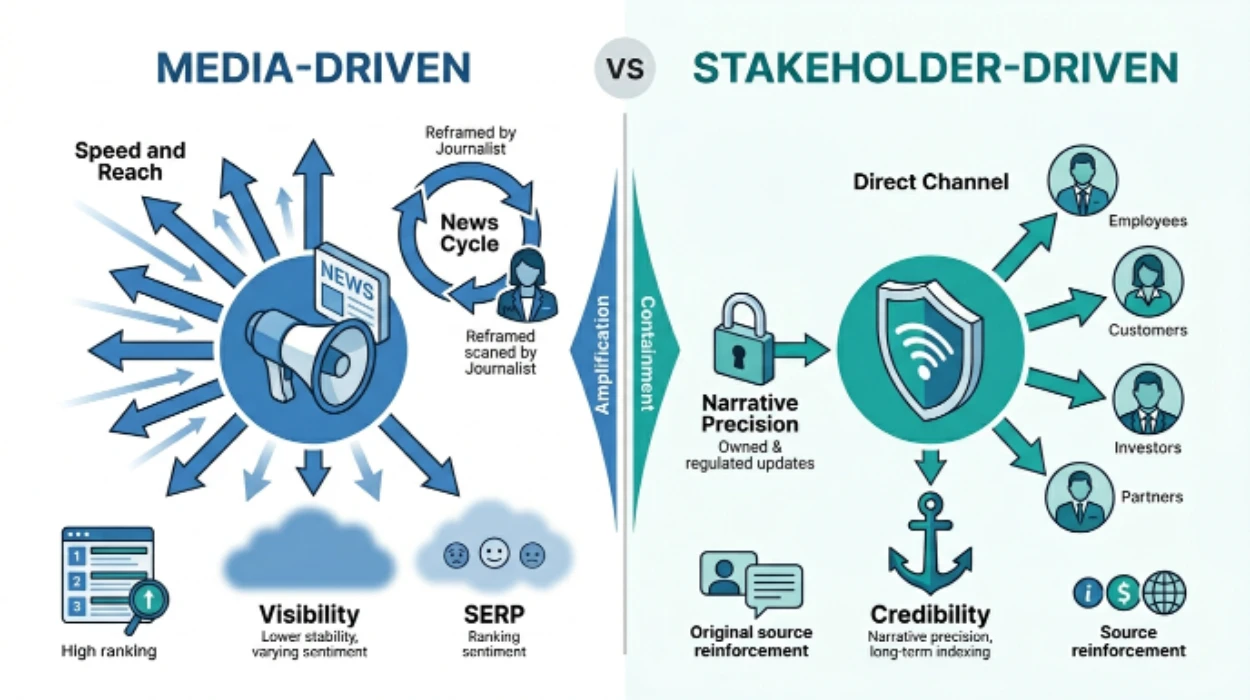
Media-driven crisis communication amplifies narrative visibility through external publication channels that prioritise speed and reach. It operates by distributing holding statements through journalistic intermediaries that reframe organisational messaging into news cycles. Stakeholder-driven approaches prioritise direct communication channels such as owned digital platforms and regulated updates. These approaches maintain tighter control over message consistency and reduce distortion from third-party interpretation. Both approaches shape entity credibility but through different mechanisms of amplification and containment.
Media-driven approaches increase visibility but reduce message stability because external framing introduces variation in sentiment distribution. Stakeholder-driven approaches reduce reach but increase narrative precision across digital touchpoints. In search engine systems, media-driven content often dominates early SERP positions due to publication authority signals. Stakeholder-driven content strengthens long-term indexing consistency by reinforcing original source attribution. The comparative dynamic shows that visibility expands faster through media channels, while credibility stabilises more effectively through direct stakeholder communication frameworks.
How do search engines interpret crisis holding statements as authority signals?
Search engines interpret crisis holding statements as early authority signals when they contain structured, verifiable, and temporally relevant information. These statements operate as indexing triggers that define the organisation’s initial position within crisis-related query clusters. Search ranking influence increases when holding statements align with consistent entity identifiers across multiple digital platforms. Structured messaging reduces semantic ambiguity, allowing algorithms to classify the organisation as a stable information source. This stabilisation directly affects narrative visibility across SERP layers.
Holding statements differ from general crisis updates because they generate immediate indexing value despite limited informational depth. Search systems evaluate them based on consistency, entity alignment, and repetition across authoritative domains. When distributed correctly, they reduce content suppression risk by establishing a verified baseline narrative. They also influence sentiment classification models by providing neutral-toned linguistic structures that avoid extreme polarity. Over time, these signals contribute to a stabilised reputation profile within algorithmic trust frameworks.
What limitations reduce the effectiveness of holding statements during fast-moving crises?
A crisis holding statement loses effectiveness when information velocity exceeds the organisation’s verification capacity. It operates best under controlled uncertainty but becomes less stable when real-time developments introduce conflicting data streams. In fast-moving crises, stakeholder demand for detail increases faster than the statement’s ability to evolve. This gap creates perception pressure that reduces perceived transparency. Digital platforms amplify this limitation by prioritising fresh content over stabilised messaging.
Holding statements also face structural limitations in sentiment distribution environments where user-generated content dominates narrative formation. Social platforms accelerate interpretation cycles that outpace official updates, reducing the statement’s influence on narrative control. Search engines index these external signals rapidly, which dilutes the authority signal of the original statement. Additionally, overuse of generic language reduces differentiation across entity credibility markers. The combined effect weakens the statement’s ability to maintain narrative dominance during prolonged crisis exposure.
How do organisations structure holding statements for long-term reputation resilience?
Organisations structure crisis holding statements for long-term reputation resilience by embedding consistency, traceability, and controlled ambiguity within their messaging architecture. A structured holding statement operates by defining factual anchors that remain valid across multiple update cycles. These anchors include acknowledgment of the incident, confirmation of investigation processes, and commitment to verified updates. This structure stabilises entity credibility by ensuring continuity across evolving crisis narratives. It also strengthens digital traceability across indexed content layers.
Long-term resilience is achieved when holding statements integrate seamlessly into broader public affairs strategies. These strategies compare short-term narrative control with long-term trust signal accumulation across digital ecosystems. Consistent messaging reduces fragmentation in search engine interpretation and reinforces authoritative positioning. Structured repetition across updates strengthens recognition signals that improve SERP stability. Over time, this approach reduces volatility in reputation indexing and increases institutional credibility persistence.
How do holding statements interact with digital advocacy and sentiment distribution systems?
Holding statements interact with digital advocacy systems by shaping the initial conditions under which advocacy narratives emerge. They operate as baseline informational signals that determine whether subsequent discourse becomes stabilised or polarised. In sentiment distribution systems, holding statements reduce extreme interpretation variance by constraining available information pathways. This constraint moderates early emotional response cycles across digital platforms. The interaction between holding statements and advocacy frameworks determines the direction of narrative amplification.
Digital advocacy mechanisms evaluate holding statements based on clarity, consistency, and alignment with organisational identity signals. When structured effectively, they support controlled amplification of verified messaging across stakeholder networks. Poorly structured statements increase interpretive divergence, which accelerates sentiment fragmentation. In search ecosystems, this divergence reduces ranking stability and increases content competition for visibility. The combined interaction defines whether advocacy systems reinforce or destabilise institutional narrative control during crisis conditions.
Conclusion
Crisis holding statements function as foundational control mechanisms within digital public affairs ecosystems, shaping early narrative stability, search engine interpretation, and stakeholder perception. Their effectiveness depends on structural clarity, controlled ambiguity, and consistent alignment with entity credibility signals. Comparatively, they outperform reactive communication in early crisis phases but require transition into detailed frameworks for sustained narrative resolution. Their limitations emerge in high-velocity environments where external sentiment distribution outpaces official communication cycles. Strategic use of holding statements therefore determines the balance between immediate narrative containment and long-term reputational resilience.
Strategic escalation pathways typically move from structured crisis coordination environments such as a Communications War Room, into longer-term advisory and response frameworks such as a Crisis Communications Retainer, depending on crisis duration, complexity, and stakeholder pressure.