

Proactive reputation management reduces crisis severity by shaping digital narratives before risk signals escalate into public exposure. It operates through structured monitoring of reputation signals, search visibility patterns, and stakeholder sentiment distribution.
Public affairs strategies differ based on how institutions prioritise early narrative control, while digital advocacy methods are evaluated through their influence on trust signals, search ranking influence, and institutional credibility across platforms.
This analysis evaluates how proactive systems reshape crisis trajectories by comparing reactive and anticipatory frameworks within digital ecosystems where visibility, authority, and perception converge.
How does proactive reputation management differ from reactive crisis response frameworks?
Proactive reputation management constructs narrative stability before disruption occurs, while reactive crisis response reorganises communication after reputational damage enters public visibility. Both approaches operate within digital ecosystems, but they differ in timing, control over narrative formation, and influence on search engine indexing behaviour.
Proactive systems operate by continuously monitoring digital footprint signals, sentiment shifts, and emerging keyword associations across media and search platforms. This enables early identification of narrative fragmentation, where isolated negative signals begin influencing perception clusters. Reactive frameworks activate only after reputational disruption becomes visible, limiting control over initial indexing and SERP composition.
The comparative difference centres on control over narrative architecture. Proactive management strengthens authority signals through consistent content reinforcement, structured messaging, and aligned stakeholder communication. Reactive response focuses on correction, clarification, and reputational repair after trust signals have already degraded.
Comparative mechanism analysis
- Mapping early sentiment distribution across platforms to detect perception drift
- Aligning stakeholder communication before search engine indexing solidifies negative associations
- Reinforcing authority signals through structured content ecosystems
- Rebuilding credibility after visibility damage through corrective messaging layers
Proactive systems reduce crisis amplification velocity by preventing negative narratives from becoming entrenched in algorithmic ranking systems. Reactive frameworks struggle with content suppression dynamics because early indexed content continues influencing search ranking influence even after corrective communication is deployed.
How do search engines interpret reputation signals during early-stage narrative formation?
Search engines evaluate reputation signals through entity consistency, content relevance, and engagement coherence across digital environments. Early-stage narrative formation determines how institutional identity becomes structured within indexing systems.
Reputation signals operate as aggregated indicators of trust, including backlinks, semantic relevance, sentiment polarity, and publication authority. Search algorithms interpret these signals to construct entity credibility profiles that influence ranking distribution across branded and non-branded queries.
Proactive reputation management stabilises early narrative formation by ensuring consistent entity representation across structured content ecosystems. This reduces semantic fragmentation, where inconsistent messaging leads to diluted authority signals. Reactive approaches intervene after indexing stabilisation, where correction requires competing against established ranking structures.
Search engines prioritise coherence over correction. Once negative narratives become embedded within SERP layers, content suppression becomes less effective than amplification of authoritative counter-narratives. This creates asymmetry between proactive and reactive reputation control.
Key interpretive mechanisms
- Evaluating entity consistency across multiple indexed domains
- Measuring engagement patterns as trust validation signals
- Weighting authoritative sources higher in ranking distribution models
- Clustering sentiment signals into entity-level reputation profiles
Proactive systems maintain narrative stability by influencing how search engines classify institutional identity at early indexing stages, reducing volatility in future ranking adjustments.
How does stakeholder engagement strategy differ between media visibility and community-led advocacy frameworks?
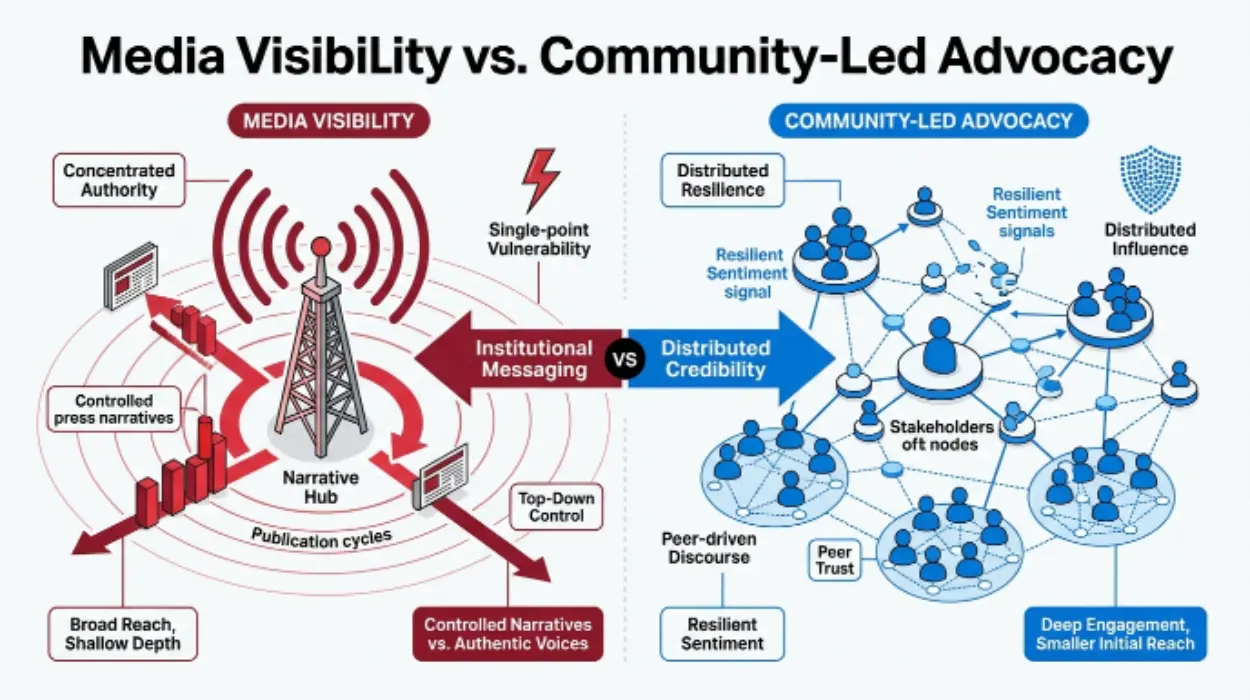
Stakeholder engagement strategies diverge based on whether visibility is driven by media amplification or distributed community participation. Media visibility frameworks centralise narrative dissemination, while community-led advocacy distributes narrative influence across multiple stakeholder nodes.
Media visibility strategies operate by controlling publication cycles, press narratives, and high-authority content distribution. This creates concentrated reputation signals that influence early perception formation. However, concentration increases vulnerability to single-point narrative disruption when negative coverage emerges.
Community-led advocacy frameworks operate through decentralised engagement channels, including forums, social platforms, and peer-driven discourse networks. These systems generate distributed sentiment signals that reduce dependency on singular media narratives, increasing resilience against targeted reputation disruption.
Comparative engagement evaluation
- Amplifying institutional messaging through media-aligned publication cycles
- Distributing narrative influence across stakeholder communities to reduce concentration risk
- Reinforcing trust signals through repeated exposure across multiple engagement nodes
- Measuring engagement depth rather than publication reach alone
Media-driven visibility strengthens short-term authority but increases exposure to rapid sentiment shifts. Community-led advocacy stabilises long-term stakeholder trust by embedding reputation signals across multiple independent discourse environments.
The most resilient engagement structures integrate both approaches, ensuring that centralised authority signals align with distributed credibility reinforcement mechanisms.
Which mechanisms reduce crisis severity through content suppression versus content amplification strategies?
Content suppression and content amplification represent two distinct mechanisms for influencing digital narrative outcomes. Suppression reduces visibility of negative content through ranking displacement, while amplification increases visibility of authoritative content to reshape perception balance.
Content suppression operates by targeting negative signals through search optimisation, structured content publication, and authority reinforcement. It does not eliminate negative content but reduces its visibility within search ranking influence systems. Its effectiveness decreases when negative content originates from high-authority domains.
Content amplification operates by increasing the density of positive or neutral content across indexed environments. This shifts sentiment distribution by saturating search results with alternative narratives that dilute negative perception clusters.
Mechanism comparison framework
- Suppressing negative visibility through ranking displacement strategies
- Amplifying authoritative narratives across multi-platform ecosystems
- Reinforcing entity credibility through structured content repetition
- Balancing sentiment distribution across SERP layers
Amplification demonstrates higher sustainability because it strengthens overall entity credibility rather than relying on competitive suppression. Suppression alone introduces instability when algorithmic updates reweight source authority. Combined approaches produce more stable narrative control by integrating visibility reduction with credibility expansion.
How do digital advocacy models influence sentiment distribution and institutional credibility over time?
Digital advocacy models shape sentiment distribution by structuring how information flows across stakeholder networks and digital platforms. These models influence institutional credibility by controlling repetition frequency, message consistency, and engagement depth across distributed audiences.
Sentiment distribution reflects aggregated emotional and evaluative responses across digital ecosystems. Advocacy models that prioritise consistent messaging reduce volatility in sentiment clustering, producing more stable perception environments. Fragmented advocacy structures generate inconsistent signals, increasing perception instability.
Institutional credibility forms through repeated validation of narrative coherence across multiple digital contexts. Search engines interpret consistency across time as a signal of authority reinforcement, strengthening entity-level trust signals.
Advocacy impact mechanisms
- Structuring message repetition across multiple digital channels
- Aligning stakeholder narratives to reduce semantic divergence
- Reinforcing authority signals through sustained content cycles
- Measuring sentiment stability as a credibility indicator
Over time, digital advocacy models determine whether institutional identity stabilises or fragments within search ecosystems. Stable advocacy systems reduce crisis amplification risk by ensuring that sentiment shifts remain incremental rather than volatile.
How is long-term authority constructed through digital footprint management and structured information governance?
Long-term authority is constructed through continuous management of digital footprint signals and structured governance of information consistency across indexed environments. Digital footprint management controls how historical and current data interact within search ecosystems.
Digital footprint management operates by identifying outdated, inconsistent, or fragmented content that influences entity credibility. Structured governance aligns this content with unified narrative frameworks that strengthen semantic clarity across platforms.
Search engines evaluate long-term authority through consistency of entity representation, relevance of associated content, and stability of engagement patterns. Inconsistent digital footprints reduce trust signals and weaken ranking influence across competitive queries.
Governance structure evaluation
- Aligning historical content with current institutional narrative frameworks
- Standardising entity representation across digital platforms
- Removing semantic contradictions that dilute authority signals
- Reinforcing structured data consistency for search interpretation
Long-term authority emerges when digital footprint signals reinforce a unified identity architecture. This reduces crisis susceptibility by ensuring that negative content does not disproportionately influence perception systems.
How do integrated public affairs strategies optimise narrative control before crisis escalation?
Integrated public affairs strategies optimise narrative control by synchronising media visibility, stakeholder engagement, and digital footprint governance into a unified reputation architecture. These systems operate across both proactive monitoring and structured response layers.
Integration ensures that communication consistency is maintained across all narrative channels, reducing fragmentation between institutional messaging and public perception. It also strengthens search engine interpretation of authority through aligned semantic signals across multiple content environments.
Integrated strategy components
- Synchronising media messaging with stakeholder communication frameworks
- Aligning digital content ecosystems to reinforce consistent entity signals
- Monitoring sentiment distribution to detect early narrative divergence
- Deploying structured governance to maintain information coherence
Integrated systems reduce crisis severity by preventing narrative disconnection across platforms. When all communication layers reinforce a unified identity structure, search ranking influence stabilises and reputation signals remain resilient under external pressure.
Conclusion
Proactive reputation management reduces crisis severity by controlling narrative formation before visibility escalates into public disruption. Reactive frameworks respond after reputational Audit enters indexed environments, limiting influence over established search ranking structures.
Comparatively, proactive systems strengthen entity credibility through early-stage signal alignment, while reactive systems focus on corrective amplification after sentiment distribution has already shifted. Stakeholder engagement models further differentiate outcomes, with centralised media visibility offering speed and decentralised advocacy providing resilience.
Strategic effectiveness depends on integration between suppression and amplification mechanisms, consistency in digital footprint governance, and alignment of public affairs messaging across all digital ecosystems. The most stable reputation architectures maintain continuous control over narrative visibility, reducing volatility in institutional perception systems.