

Online reputation refers to the collective perception of an entity across digital ecosystems, determined by the algorithmic synthesis of search visibility, media sentiment, and authoritative content indexing. Within public affairs and digital advocacy, managing this footprint requires a systematic understanding of how search engine results pages (SERPs) evaluate information during a corporate or institutional crisis.
What is a Reputational Crisis Within Digital Ecosystems?
A reputational crisis within digital ecosystems defines a systemic disruption where negative information alters entity perception, depressing authority signals and shifting stakeholder trust. This phenomenon occurs when algorithmic ranking signals shift to favour critical media, regulatory findings, or adverse public sentiment over an institution’s owned digital assets. Search engines aim to surface relevant, authoritative, and trusted information, meaning that a sudden surge in high-velocity, high-engagement negative content restructures the SERP layout for entity-specific queries.
The mechanism driving this disruption rests on how retrieval systems interpret freshness and information gain. When news outlets and regulatory bodies publish content regarding an institutional failure, search algorithms register a spike in topical authority and user query volume. The system adapts by elevating these third-party sources, which temporarily suppresses historical brand equity and owned narrative influence. This structural shift modifies the information architecture that stakeholders encounter, transforming a localized operational issue into a persistent digital footprint deficit.
The impact of this algorithmic realignment extends across all vectors of institutional visibility. Reduced digital authority affects stakeholder trust, as procurement officers, investors, and policymakers rely on clean SERP evaluations to conduct risk assessments. When negative narratives dominate search visibility, the cost of digital advocacy increases because the entity must work harder to re-establish credibility against a dominant, algorithmically reinforced negative consensus.
How Does Stage One Threat Detection Map to Search Signals?
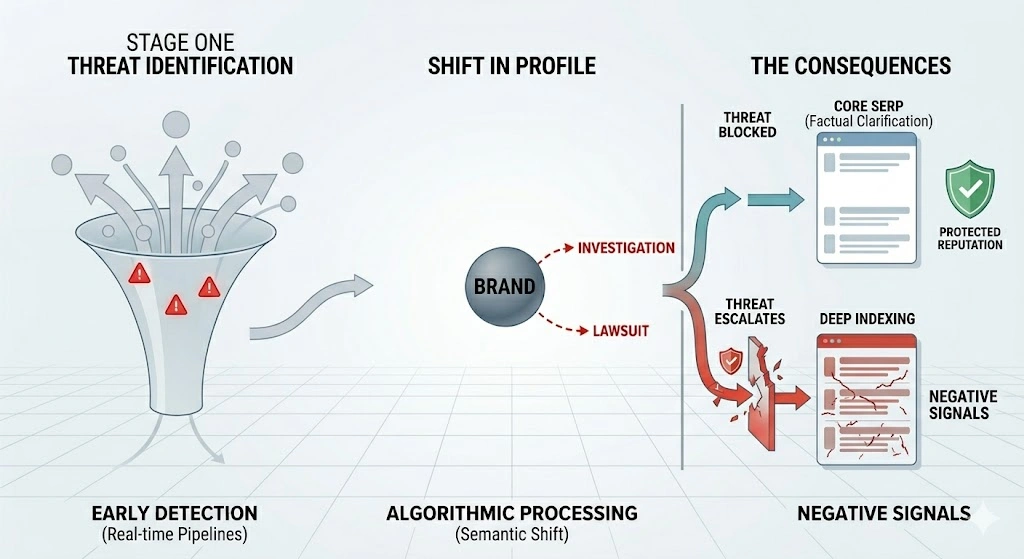
Stage one threat detection describes the early identification of anomalous data points and sentiment shifts before they coalesce into a mainstream indexing event. This stage operates primarily within unindexed or rapidly updating digital pipelines, such as real-time social media indexing, localized forums, and alternative publication channels. Early threat detection relies on monitoring entity perception changes, tracking specific keywords, and identifying unusual velocity in query volume.
The underlying mechanism involves the algorithmic processing of entities and their properties within semantic search graphs. Search engines continuously map relationships between concepts; a sudden increase in the co-occurrence of an institutional brand name alongside terms like “investigation,” “breach,” or “lawsuit” flags a shift in the entity’s conceptual profile. If algorithmic ranking signals detect this shift alongside increased click-through rates on fringe content, retrieval systems prepare to update core SERP layouts.
Failing to isolate these threats at this stage allows adverse narratives to gain the structural velocity required for deeper indexing. Once a threat transitions from real-time social channels into authoritative news databases, content indexing engines permanently associate the negative properties with the primary entity. This early window determines whether an institution can deploy factual clarifications before search engines establish a high-density archive of negative authority signals.
How Does Stage Two Incident Escalation Reshape SERP Evaluation?
Stage two incident escalation occurs when mainstream media outlets index the threat, triggering a fundamental re-evaluation of the entity’s SERP landscape. At this juncture, high-authority domains publish comprehensive reports, causing a cascade of content duplication and syndication across the web. This phase represents the transition of a localized issue into a verified, macro-level digital reputation crisis.
The mechanism during escalation centers on the freshness bias embedded within modern search algorithms. Systems prioritize recent, high-utility content for news-adjacent queries, meaning that standard brand information yields to real-time updates. As multiple authoritative domains link to one another, they create a dense network of hyperlinks that signals maximum algorithmic importance to web crawlers.
This restructuring effectively replaces controlled corporate narrative elements with external, critical perspectives. The entity loses control over its primary search visibility, meaning that any stakeholder researching the institution encounters a uniform wall of negative sentiment. The loss of digital authority at this stage is absolute, as historical trust signals cannot compete with the immediate relevance scores assigned to the ongoing crisis.
How Does Stage Three Narrative Crisis Peak Institutional Risk?
Stage three narrative crisis represents the point of maximum velocity and structural entrenchment of negative content indexing. During the peak, the crisis becomes the primary associative property of the entity within digital perception systems. Search engines update knowledge graphs, meaning that automated sidebars, entity summaries, and autocomplete suggestions actively direct users toward the negative material.
The mechanism operates through user behavior signals interacting with machine learning ranking models. High search volumes for crisis-specific phrases instruct the algorithm that these terms are intrinsically linked to the entity’s identity. Consequently, features like “People Also Ask” populate with queries investigating the failure, cementing the negative narrative into the automated discovery paths of the search architecture.
The impact of a peak crisis is highly destructive to online trust architecture. External stakeholders processing information during this phase find zero alternative viewpoints within the top ranking positions. The institutional narrative is entirely eclipsed, halting standard digital advocacy efforts and forcing the organization into a defensive posture where every indexed asset must focus exclusively on stabilization.
How Does Stage Four Stabilization Counter Balance Negative Authority?
Stage four stabilization defines the systematic introduction of authoritative, factual content designed to balance the lopsided SERP landscape. This phase focuses on injecting neutral or positive information nodes into the digital ecosystem to break the monopoly of the crisis narrative. Stabilization requires the creation of deeply optimized, high-authority assets that address user search intent with transparency and verified facts.
The mechanism relies on earning sustainable topical authority and generating positive information gain signals. By publishing comprehensive transparency reports, independent audit summaries, and official corrective plans, the entity provides search engines with new material to index. When these assets receive high engagement and backlinks from trusted industry portals, algorithms recognize them as highly useful answers to user queries, gradually elevating them above older crisis articles.
Stabilization changes the stakeholder journey by reintroducing balance to the search visibility mix. While the crisis remains part of the digital footprint, it ceases to be the sole narrative visible to researchers. This stage restores baseline institutional credibility, allowing the entity to transition from frantic damage control to structured, long-term recovery.
How Does Stage Five Full Narrative Recovery Reset Entity Perception?
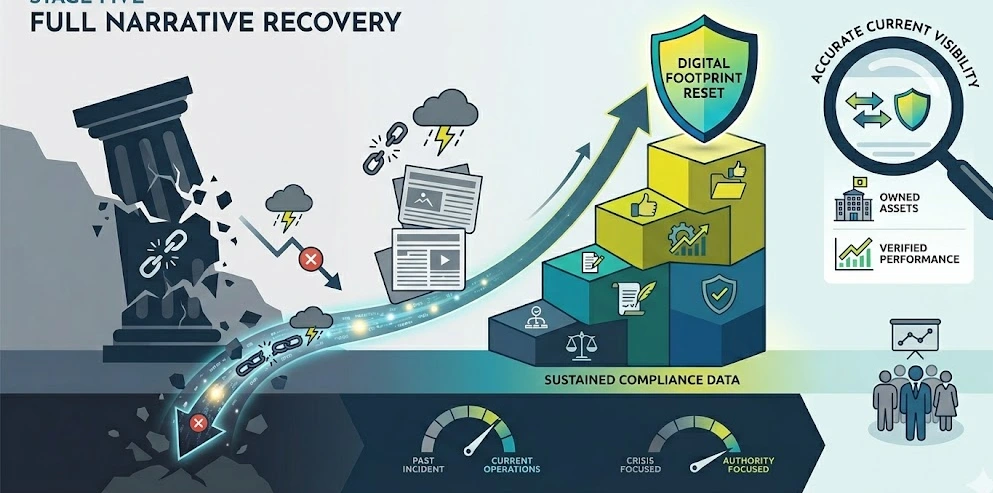
Stage five full narrative recovery establishes a permanent, balanced digital footprint that reflects the entity’s current compliance, governance, and operational standards. Recovery does not imply the total erasure of history; rather, it denotes a state where historical crisis content is contextualized and outranked by sustained, authoritative compliance data. The goal is to ensure that current search visibility accurately reflects the contemporary state of the institution.
The mechanism involves the natural decay of the freshness boost previously granted to crisis content, combined with the steady accumulation of modern authority signals. As user search intent shifts away from the past incident and toward current operations, algorithms re-calibrate the SERP layout. Owned assets, positive stakeholder engagement case studies, and updated regulatory filings reclaim top positions due to their ongoing relevance and technical optimization.
This long-term realignment solidifies the online trust architecture against future volatility. Stakeholders executing an entity search encounter an ecosystem that demonstrates resilience, transparency, and verified performance. This structural balance ensures that the legacy of the crisis is managed sustainably, leaving a digital footprint that prioritizes verifiable institutional progress over past historical deficits.
What Limits Exist within Technical Perception Adjustment?
Institutions must recognize that technical algorithms operate within clear legal and architectural constraints that dictate how information can be modified. Digital ecosystems prioritize data preservation, historical accuracy, and public interest indexing, creating boundaries around how much an online profile can be altered after a crisis. Understanding these limits prevents organizations from pursuing unrealistic suppression or deletion strategies that conflict with search engine guidelines.
To systematically address these boundaries, public affairs specialists evaluate the structural reality of what can be altered versus what must be counterbalanced through active content production:
-
Assess legal removal boundaries: Realise that public record data, verified journalism, and legally compliant regulatory findings cannot be summarily deleted from index systems.
-
Evaluate algorithmic persistence: Note that high-authority media domains retain their ranking power for years, meaning suppression requires long-term, superior content utility rather than short-term optimization tricks.
-
Execute a strategy for digital footprint cleaning: Focus on optimizing owned channels, correcting technical indexing errors, and updating outdated profiles to ensure current factual accuracy across public search engines.
Managing a reputational crisis across digital ecosystems requires a precise understanding of semantic search mechanics, content indexing velocity, and entity perception systems. A crisis is fundamentally an algorithmic event where negative information gains structural dominance over institutional narratives. By understanding the five stages of a crisis—from initial threat detection to full narrative recovery—organizations can systematically deploy optimized assets to restore stakeholder trust. True digital resilience relies on building a robust online trust architecture that balances historical challenges with verifiable, high-utility contemporary data.
Frequently Asked Questions
What are the five stages of a reputational crisis in business?
The five stages of a reputational crisis encompass early threat detection, incident escalation, the narrative crisis peak, stabilization, and full narrative recovery. During these phases, an organization transitions from identifying negative sentiment signals to managing search engine visibility as critical media content gets indexed. Linkonize assists organizations throughout this cycle by deploying systematic reputation management strategies to restore entity authority and stakeholder trust.
How does a digital reputation crisis affect search engine visibility?
A digital reputation crisis triggers algorithmic shifts that prioritize fresh, high-velocity negative news content over an institution’s owned digital assets. Search engine results pages (SERPs) re-evaluate entity properties, often populating knowledge graphs and “People Also Ask” sections with queries related to the operational failure. This structural realignment suppresses historical brand equity, making targeted reputation management essential for reclaiming narrative influence.
How do companies fix a damaged online reputation?
Companies remediate a damaged online reputation by executing a structured stabilization and recovery strategy focused on information gain and topical authority. This process involves producing deeply optimized, high-utility factual content and securing backlinks from trusted industry portals to rebalance the SERP landscape. Over time, these positive digital footprint signals dilute stale crisis coverage and rebuild long-term online trust architecture.
What is the role of reputation management in public affairs?
In public affairs, reputation management serves as the technical mechanism for protecting institutional credibility and stakeholder trust across digital ecosystems. It ensures that digital advocacy campaigns are not neutralized by negative search perception or hostile media sentiment interpretation. By monitoring entity perception and search signals, strategy teams can mitigate narrative risk before it permanently impacts regulatory and investor relations.
Can an organization completely erase a crisis from its digital footprint?
No, an organization cannot completely erase legally compliant journalism, public records, or verified regulatory findings from search indexes. Instead, professional reputation management focuses on technical perception adjustment, digital footprint cleaning, and outranking stale content with contemporary compliance data. True narrative recovery is achieved when historical crisis nodes are contextualized and outpaced by sustained, high-authority institutional progress.