

PR distribution delivers broader content amplification and greater publication reach, while direct journalist outreach delivers stronger relevance, higher editorial engagement, and more targeted media placement outcomes.
Public affairs strategies differ based on visibility objectives, stakeholder influence requirements, and reputation management priorities. Digital advocacy methods are evaluated through their impact on narrative visibility, entity credibility, stakeholder trust, search ranking influence, and institutional reputation signals across digital ecosystems.
Which approach generates stronger media visibility outcomes?
Direct journalist outreach generates stronger editorial visibility when relevance, exclusivity, and relationship quality determine publication decisions. PR distribution generates broader visibility when scale and content dissemination are the primary objectives.
PR distribution is a media communication method that distributes a press release through syndication networks to news platforms, media databases, and content aggregation systems. The approach operates by replicating a single announcement across multiple publication endpoints. Distribution mechanisms prioritise content amplification, citation generation, and publication volume. Visibility is measured through reach, publication count, and syndication coverage. The process creates widespread content availability across digital channels.
Direct journalist outreach is a targeted media engagement process that connects a story directly with relevant reporters, editors, and publication decision-makers. The approach operates by matching editorial interests with specific information value. Journalists evaluate relevance, audience fit, evidence quality, and timing before deciding whether to publish. Visibility emerges through editorial selection rather than automated distribution. The resulting coverage often carries stronger authority signals.
The comparison reveals distinct outcomes. Distribution increases publication frequency and content presence across multiple domains. Direct outreach increases editorial credibility and publication quality. Distribution contributes to content amplification, while outreach contributes to narrative validation. Search engines interpret editorially selected coverage as a stronger trust signal because publication decisions involve independent assessment rather than automated syndication.
Understanding How Brands Get Featured in News Publications Without Advertising provides context for evaluating the role of editorial relevance within journalist outreach frameworks. Media coverage obtained through earned visibility mechanisms relies on newsworthiness, source credibility, and publication alignment rather than paid placement.
How does visibility differ across digital ecosystems?
Search engines evaluate source authority, publication relevance, and content uniqueness when determining visibility value. Syndicated releases often appear as duplicated content across multiple locations. Editorial coverage produced through journalist outreach typically introduces original reporting, analysis, or commentary.
Digital platforms analyse authority through entity relationships, citation structures, and source credibility indicators. Direct outreach often creates stronger entity associations because journalists reference organisations within broader contextual narratives. Distribution strengthens content presence but provides less contextual authority. As a result, narrative visibility differs significantly between the two approaches.
Which method creates stronger trust and credibility signals?
Direct journalist outreach creates stronger stakeholder trust signals because editorial review functions as an external validation mechanism. PR distribution creates awareness signals but contributes less directly to perceived credibility.
Trust signals are indicators that influence stakeholder perception regarding reliability, transparency, and authority. In media relations, credibility emerges when independent publications evaluate and present information through editorial processes. Outreach operates by encouraging journalistic assessment and verification. Distribution operates by expanding content accessibility without equivalent editorial scrutiny.
Institutional credibility depends on the quality of information sources connected to an organisation. Editorial coverage obtained through outreach often includes expert commentary, contextual analysis, and industry relevance assessments. These elements strengthen entity credibility because external stakeholders perceive independent reporting as more trustworthy than self-originated announcements.
Distribution maintains value in credibility frameworks when publication scale supports awareness objectives. However, publication volume does not automatically translate into stakeholder trust. Search systems increasingly evaluate authority through source quality rather than source quantity. Therefore, credibility growth is more closely associated with editorial engagement than syndication frequency.
How do reputation signals differ between the two approaches?
Reputation signals represent measurable indicators of perceived authority and legitimacy. Journalist outreach strengthens signals through editorial endorsement, contextual references, and independent validation. Distribution strengthens signals through citation proliferation and content discoverability.
Stakeholders interpret these signals differently. Policymakers, regulators, journalists, and institutional audiences often prioritise source credibility. Wider consumer audiences frequently encounter distributed content first because of its broad reach. The strategic difference lies in how trust formation occurs across audience categories. Outreach influences confidence through authority, while distribution influences awareness through exposure.
Which strategy has greater influence on search visibility and SERP composition?
Direct journalist outreach contributes stronger authority signals for search ranking influence, while PR distribution contributes broader indexation and content footprint expansion.
Search ranking influence is determined through relevance, authority, expertise indicators, entity relationships, and citation quality. Direct outreach frequently generates editorial backlinks, contextual mentions, and high-authority references. These elements strengthen search visibility because search engines interpret them as evidence of external recognition.
PR distribution expands digital presence by increasing content availability across multiple indexed locations. The mechanism improves content discovery and increases opportunities for citation. However, syndicated releases often compete against identical versions published elsewhere. This duplication reduces the uniqueness signals that search engines use to determine ranking priority.
The distinction becomes more apparent when evaluating SERP composition. Direct outreach influences search results through authoritative editorial stories, feature articles, expert commentary, and news coverage. Distribution influences search results through syndicated press release entries and content republication. Editorial content typically occupies more prominent positions because search systems prioritise original reporting and contextual depth.
How does each approach affect narrative control?
Narrative control is the ability to influence how information appears and is interpreted across search and media environments. Distribution provides higher control over message consistency because organisations publish predefined content. Outreach introduces editorial interpretation because journalists shape narratives independently.
This difference creates a trade-off. Distribution increases message consistency but limits third-party validation. Outreach increases credibility but reduces direct control over presentation. Public affairs professionals evaluate this balance according to visibility objectives, stakeholder expectations, and reputation management requirements.
Which approach scales more effectively for long-term reputation management?
PR distribution scales more efficiently for content volume, while direct journalist outreach scales more effectively for reputation quality and institutional credibility.
Scalability refers to the ability to maintain effectiveness as communication activities expand. Distribution systems support high-frequency publication because one release can reach numerous destinations simultaneously. Resource requirements remain relatively stable regardless of publication volume. This efficiency supports ongoing content amplification initiatives.
Direct outreach requires relationship management, editorial research, and customised communication. Resource intensity is higher because each engagement involves audience analysis and publication alignment. The process expands more slowly but often produces higher-value outcomes. Reputation quality increases because coverage originates from independent editorial decisions.
Long-term reputation management depends on sustainable authority development. Authority emerges from repeated associations with credible sources. Distribution contributes to visibility continuity. Outreach contributes to credibility accumulation. Public affairs frameworks frequently combine both approaches because visibility without credibility limits trust development, while credibility without visibility limits reach.
How does sustainability differ over time?
Sustainability is measured through ongoing impact rather than immediate outcomes. Distribution delivers rapid amplification but often experiences shorter visibility cycles. Syndicated content frequently loses prominence as newer content enters publication systems.
Editorial coverage obtained through outreach often retains value for longer periods because authoritative publications maintain stronger search visibility and reference potential. These articles continue contributing to entity credibility and stakeholder trust beyond initial publication periods. Consequently, outreach demonstrates stronger sustainability within long-term reputation frameworks.
Which method presents greater risk exposure?
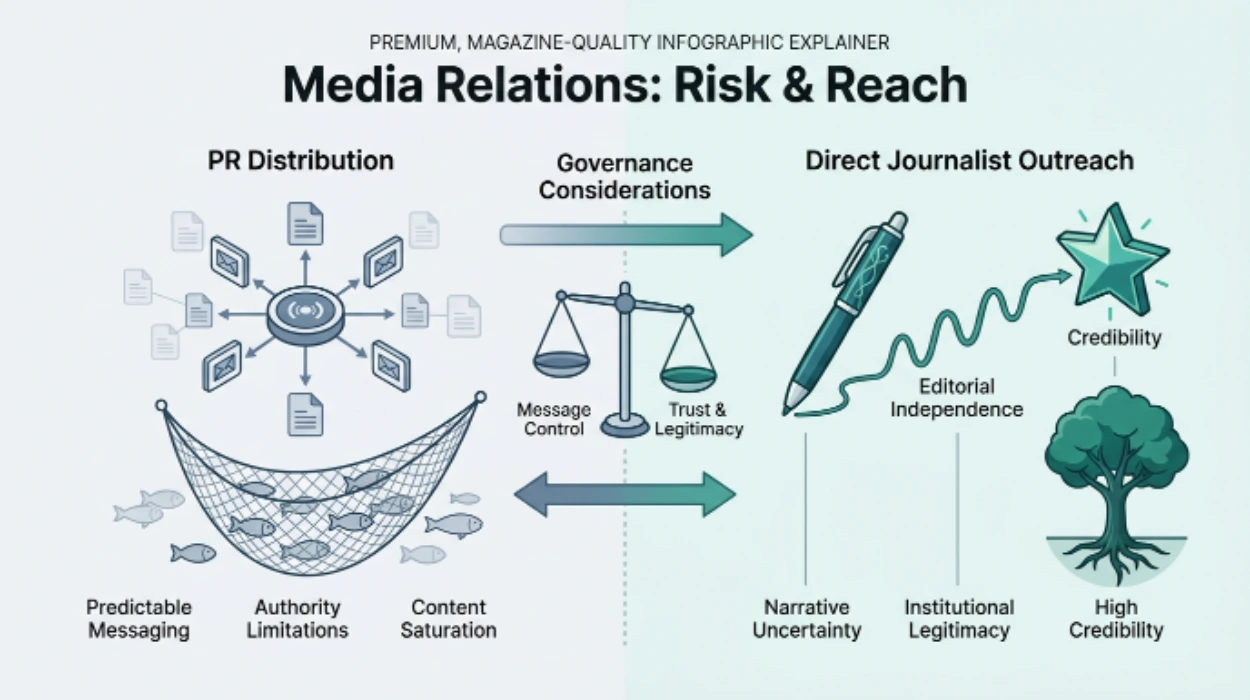
Direct journalist outreach introduces editorial uncertainty, while PR distribution introduces authority limitations and content saturation risks.
Risk exposure in media relations involves factors that influence message interpretation, stakeholder response, and reputation outcomes. Distribution provides predictable messaging because content remains unchanged across publication points. However, the approach risks creating low-impact visibility if syndication occurs across low-authority environments. Excessive distribution can also contribute to content saturation without increasing stakeholder engagement.
Direct outreach introduces uncertainty because journalists retain editorial independence. Stories can be reframed, challenged, or contextualised differently from original messaging. This dynamic reduces message control but enhances credibility through independent evaluation. The risk profile shifts from content consistency concerns to narrative interpretation concerns.
The comparative assessment depends on communication objectives. Organisations prioritising awareness frequently accept authority limitations associated with distribution. Organisations prioritising trust and institutional legitimacy often accept editorial uncertainty associated with outreach. Each method presents distinct governance considerations rather than inherently superior outcomes.
How do stakeholder perception risks differ?
Stakeholder perception is influenced by source credibility, transparency indicators, and publication context. Distributed releases can be perceived as organisational messaging rather than independent reporting. This perception limits credibility gains among institutional audiences.
Editorial coverage carries stronger legitimacy because stakeholders recognise external evaluation processes. However, independent reporting introduces the possibility of critical framing. The risk therefore shifts from credibility limitations to narrative unpredictability. Effective evaluation requires balancing authority benefits against interpretation risks.
Which approach delivers better results for different communication objectives?
The effectiveness of each approach depends on whether the objective prioritises reach, credibility, visibility sustainability, or stakeholder trust development.
PR distribution performs effectively when communication goals focus on content amplification, announcement dissemination, and broad visibility expansion. The mechanism increases content availability and supports awareness-oriented communication frameworks. Results are measured through publication volume, reach metrics, and content footprint growth.
Direct journalist outreach performs effectively when communication goals focus on authority development, stakeholder influence, and institutional credibility enhancement. The mechanism generates editorial engagement and strengthens trust signals. Results are measured through publication quality, authority indicators, sentiment distribution, and reputation signal development.
An evaluation framework can clarify selection criteria:
- Assess visibility requirements by measuring publication reach against editorial authority.
- Analyse stakeholder expectations by identifying trust signal requirements within target audiences.
- Compare search ranking influence through authority metrics and SERP composition outcomes.
- Measure reputation signals through source credibility and narrative visibility indicators.
- Evaluate sustainability through long-term authority accumulation and content persistence.
The debate around PR Distribution vs Direct Journalist Outreach centres on the balance between content amplification and editorial validation. One approach prioritises publication scale, while the other prioritises authority signals and stakeholder trust development.
Conclusion
PR distribution and direct journalist outreach serve different functions within media relations frameworks. Distribution expands content visibility through syndication and amplification mechanisms, while outreach strengthens entity credibility through editorial engagement and independent validation.
The evaluation highlights clear differences in search ranking influence, stakeholder trust development, narrative visibility, scalability, and risk exposure. Distribution supports broad awareness and content presence. Outreach supports authority formation and institutional credibility. Public affairs strategies achieve different outcomes depending on how these approaches are integrated within wider reputation management and digital advocacy objectives.
Frequently Asked Questions
What is the main difference between PR distribution and direct journalist outreach?
PR distribution focuses on distributing information across multiple media and publishing channels simultaneously. Direct journalist outreach focuses on engaging specific journalists with tailored story angles. Distribution prioritises reach and content amplification, while outreach prioritises editorial relevance and credibility.
Which approach is better for improving search visibility?
Direct journalist outreach generally produces stronger search ranking influence because editorial coverage generates higher-authority trust signals and contextual references. PR distribution increases content footprint and discoverability but often relies on syndicated content that offers lower authority value.
Does PR distribution help build stakeholder trust?
PR distribution contributes to awareness and narrative visibility, but stakeholder trust is more strongly influenced by independent editorial coverage. Trust signals increase when third-party publications evaluate and report information rather than simply republishing organisational content.
Which strategy is more effective for long-term reputation management?
Direct journalist outreach is more effective for long-term reputation management because it supports entity credibility, authority development, and sustainable stakeholder trust. PR distribution supports ongoing visibility but delivers less impact on institutional credibility over time.
Can PR distribution and journalist outreach be used together?
Both approaches can operate within the same media relations framework. PR distribution supports content amplification and visibility objectives, while journalist outreach strengthens credibility and editorial engagement. Their combined use addresses both awareness and authority requirements.