

Measuring the success of a press release distribution campaign requires evaluating media visibility, stakeholder reach, reputation signals, engagement quality, and long-term narrative impact rather than relying on publication volume alone.
Public affairs strategies differ based on communication objectives, stakeholder expectations, and institutional visibility requirements. Digital advocacy methods are evaluated through measurable trust indicators, search ranking influence, sentiment distribution, and the ability to strengthen entity credibility across digital ecosystems.
Which Metrics Provide the Most Accurate Evaluation of a Press Release Distribution Campaign?
The most accurate evaluation combines visibility metrics, engagement indicators, and reputation outcomes rather than focusing on a single performance measure.
A press release distribution campaign is a structured communication activity designed to increase narrative visibility across media platforms, industry publications, search engines, and stakeholder networks. Measurement frameworks operate by analysing how information moves through digital ecosystems and influences stakeholder perception. Traditional evaluation focuses on publication counts, whereas modern public affairs measurement evaluates authority transfer, audience relevance, and institutional credibility.
Media pickup volume is a visibility metric that measures the number of publications carrying a release. The metric provides insight into distribution reach but does not explain audience relevance or trust impact. A release appearing on low-authority websites generates different reputation signals compared with coverage from recognised industry publications. Evaluating publication quality alongside publication quantity creates a more accurate assessment framework.
Engagement metrics provide additional context. Click-through rates, referral traffic, content consumption patterns, and stakeholder interactions measure audience response after distribution. These indicators analyse whether the release generated meaningful attention or merely achieved publication. High visibility with limited engagement reflects weak narrative resonance within the target stakeholder environment.
Search performance metrics evaluate longer-term outcomes. Search engines interpret media mentions as authority signals when they originate from credible sources. Search ranking influence, branded query growth, and entity association development provide evidence of sustained visibility rather than temporary exposure. This approach measures the campaign’s contribution to institutional presence across search ecosystems.
How Does Media Pickup Compare with Stakeholder Engagement as a Success Indicator?
Stakeholder engagement provides deeper performance insight than media pickup volume because it measures audience interaction rather than publication occurrence.
Media pickup is a distribution outcome. It measures how effectively content enters media ecosystems through publication networks. The approach evaluates exposure potential and assesses whether journalists, editors, and publishers considered the release suitable for publication. This measurement framework supports visibility analysis but offers limited insight into audience response.
Stakeholder engagement is an interaction outcome. It operates by measuring behavioural responses such as website visits, document downloads, social discussion, policy inquiries, subscription growth, and direct stakeholder communication. Engagement analysis evaluates whether distributed information generated attention among relevant audiences rather than passive exposure.
The comparison highlights distinct strengths and limitations. Media pickup provides scalability because publication data is easy to collect and compare across campaigns. Engagement metrics provide contextual depth because they reveal audience interest and information processing behaviours. Publication reach without engagement indicates limited influence on stakeholder trust or perception.
From a public affairs perspective, stakeholder engagement contributes more directly to institutional credibility. Stakeholders form trust assessments through repeated interactions with authoritative information. Engagement indicators therefore offer stronger evidence of communication effectiveness than publication counts alone.
How Do Organic and Reactive Distribution Approaches Differ in Performance Measurement?
Organic distribution frameworks are measured through long-term authority growth, while reactive distribution frameworks are measured through immediate visibility outcomes.
Organic distribution is a proactive communication model. It operates by releasing information according to strategic communication objectives, stakeholder information needs, and institutional visibility priorities. Performance measurement focuses on cumulative authority development, sentiment distribution trends, and sustained narrative visibility.
Reactive distribution is a response-based communication model. It operates by addressing emerging issues, public scrutiny, stakeholder concerns, or reputational challenges. Measurement frameworks prioritise immediate reach, issue containment effectiveness, and audience response patterns during heightened attention periods.
Organic approaches generate consistent reputation signals across search engines, media platforms, and stakeholder environments. This consistency supports entity credibility and strengthens long-term search ranking influence. The primary limitation is slower visibility acceleration because authority development requires repeated information reinforcement.
Reactive approaches produce rapid exposure and immediate stakeholder awareness. They support short-term narrative management when organisations require timely information dissemination. The primary limitation is increased risk exposure because communication activity becomes associated with emerging issues rather than strategic institutional positioning.
Performance evaluation differs significantly between the two frameworks. Organic campaigns prioritise authority accumulation, while reactive campaigns prioritise visibility management. Comparing results without considering communication objectives creates inaccurate conclusions regarding effectiveness.
Which Indicators Best Measure Trust and Institutional Credibility?
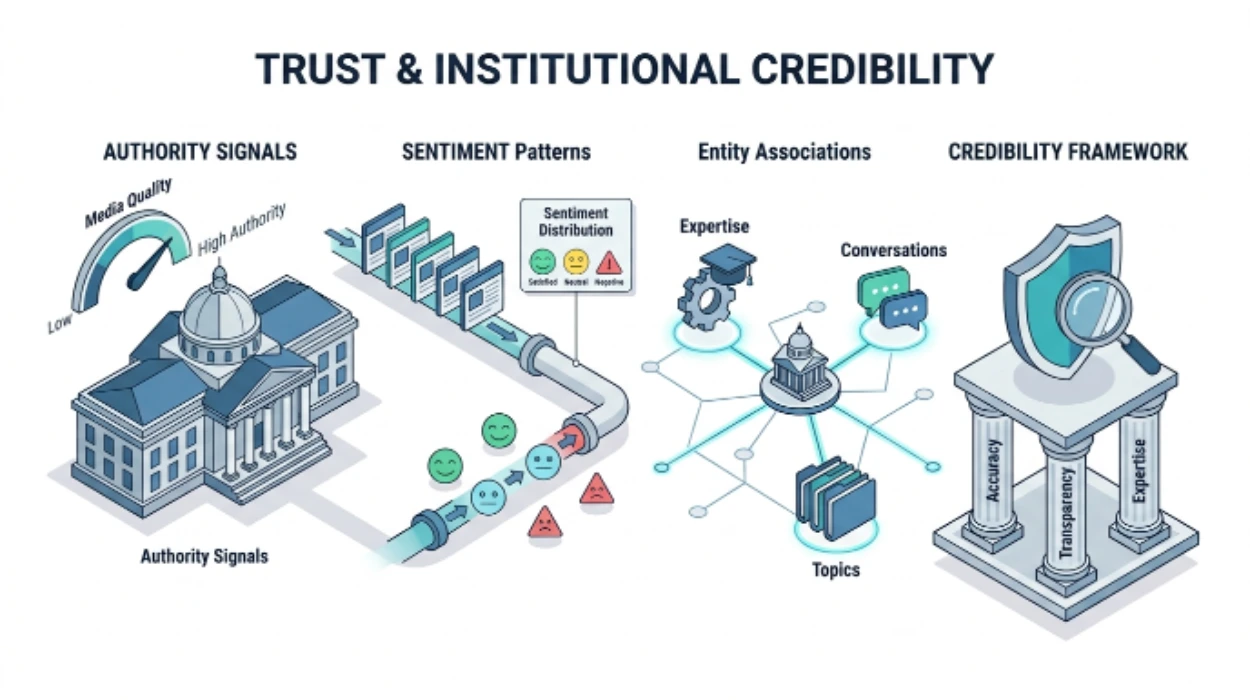
Trust and institutional credibility are measured through authority signals, sentiment patterns, source quality, and stakeholder response consistency.
Institutional credibility is a perception framework that reflects confidence in information accuracy, transparency, and expertise. It operates through repeated exposure to reliable information distributed across trusted channels. Measuring credibility therefore requires analysing both communication outputs and stakeholder responses.
Media source quality is a foundational indicator. Coverage from authoritative publications contributes stronger reputation signals than widespread distribution across low-authority platforms. Search engines interpret trusted sources as indicators of content reliability, influencing entity credibility and narrative visibility.
Sentiment distribution measures how stakeholders interpret distributed information. Positive, neutral, and negative sentiment patterns provide insight into reputation impact. Evaluation focuses on distribution balance rather than isolated mentions. Consistent neutral or positive sentiment strengthens stakeholder trust through predictable information quality.
Entity association analysis measures how institutions become connected to topics, issues, expertise areas, and public conversations. Search engines use entity relationships to understand authority and relevance. Strong entity associations indicate successful communication positioning and enhanced institutional recognition.
Trust measurement therefore extends beyond publication success. It evaluates whether communication activities strengthen credibility, reinforce expertise, and maintain consistent stakeholder confidence over time.
How Does Search Visibility Influence Press Release Campaign Effectiveness?
Search visibility extends campaign lifespan by transforming temporary media exposure into ongoing discoverability.
Press releases traditionally functioned as media communication tools. Digital ecosystems have expanded their role into search visibility assets that influence narrative accessibility across search engines. Search visibility operates by increasing the number of authoritative references associated with an institution, topic, or initiative.
Media coverage contributes to search ranking influence when authoritative websites publish information related to the release. Search engines evaluate source authority, topical relevance, and entity relationships when determining visibility outcomes. Strong media coverage therefore generates both communication and search benefits.
The comparison between direct media exposure and search visibility reveals different performance characteristics. Media exposure generates immediate awareness during publication periods. Search visibility creates sustained discoverability long after publication activity declines. This distinction affects how campaign effectiveness is measured across different timeframes.
Narrative visibility is a critical evaluation factor. Search results shape stakeholder understanding because search engines often function as primary information discovery channels. A campaign that improves search presence contributes to greater control over institutional information accessibility.
Search performance indicators include branded search growth, keyword visibility improvements, entity recognition development, and authoritative citation acquisition. These indicators measure long-term communication value rather than short-term exposure alone.
What Evaluation Framework Supports Long-Term Reputation Strategy Assessment?
A multi-layered framework provides the most reliable assessment because it measures visibility, engagement, authority, and trust simultaneously.
Reputation strategy is a long-term credibility management system. It operates by influencing stakeholder perception through consistent communication, authoritative information distribution, and trust reinforcement mechanisms. Effective evaluation therefore requires measurement beyond campaign-level outputs.
A structured assessment framework includes:
- Measure media pickup quality by analysing publication authority, audience relevance, and source credibility.
- Evaluate stakeholder engagement through referral behaviour, content interaction, and audience participation metrics.
- Analyse sentiment distribution to identify reputation trends and stakeholder perception shifts.
- Track search ranking influence to assess long-term visibility development.
- Monitor entity credibility through authority associations and topic ownership indicators.
Each measurement layer evaluates a distinct communication outcome. Media visibility measures exposure. Engagement measures attention. Sentiment measures perception. Search visibility measures discoverability. Entity credibility measures institutional authority.
The framework also supports comparison between short-term narrative management and long-term reputation development. Narrative management focuses on immediate visibility outcomes and message dissemination. Reputation development focuses on sustained trust formation and authority accumulation. Both approaches contribute value, but their evaluation criteria differ substantially.
This distinction becomes increasingly important when analysing communication assets such as What Journalists Look for Before Covering a Company Story, where editorial relevance influences media uptake, and Professional Press Release Distribution Services That Generate Media Pickups, where distribution effectiveness is often assessed through publication outcomes rather than broader reputation indicators.
Which Measurement Approach Provides the Most Reliable Assessment of Campaign Success?
Integrated measurement frameworks provide the most reliable assessment because they connect visibility outcomes with credibility and stakeholder impact indicators.
Single-metric evaluation models create incomplete performance assessments. Publication volume alone overlooks stakeholder engagement. Engagement alone overlooks authority development. Search visibility alone overlooks sentiment distribution. Effective analysis requires combining multiple measurement dimensions.
Public affairs communication increasingly operates within interconnected media, search, and stakeholder ecosystems. Success measurement therefore depends on understanding how information influences narrative visibility, reputation signals, stakeholder trust, and institutional credibility simultaneously. Campaign effectiveness emerges from the interaction between these elements rather than from isolated metrics.
Comparative evaluation demonstrates that media pickup measures exposure, stakeholder engagement measures audience response, search visibility measures discoverability, and credibility indicators measure long-term institutional value. Each metric serves a distinct analytical function within a comprehensive assessment framework.
A balanced measurement model analyses short-term communication outcomes alongside long-term reputation development. This approach provides a more accurate understanding of campaign performance, risk exposure, scalability, sustainability, and influence on stakeholder perception across digital environments.
Conclusion
Measuring the success of a press release distribution campaign requires more than counting media placements. Effective evaluation compares visibility outcomes, stakeholder engagement, search ranking influence, sentiment distribution, and entity credibility to determine overall communication impact.
Media pickup and stakeholder engagement measure different dimensions of success. Organic and reactive communication frameworks require distinct evaluation methodologies. Search visibility extends campaign value beyond publication periods, while institutional credibility indicators reveal long-term reputation effects.
The most reliable assessment framework integrates exposure metrics, engagement indicators, authority signals, and trust measurements. This approach analyses both immediate narrative visibility and sustained institutional credibility, providing a comprehensive understanding of communication effectiveness within modern public affairs and digital advocacy ecosystems.
Frequently Asked Questions
How long does it take to measure the success of a press release distribution campaign?
Campaign success can be measured immediately through media pickups, publication reach, and referral traffic. However, metrics such as search ranking influence, entity credibility, and stakeholder trust require longer evaluation periods because these outcomes develop through ongoing visibility and authority signals.
What is the most important metric for evaluating a press release campaign?
No single metric provides a complete assessment. Media coverage measures visibility, stakeholder engagement measures audience response, and search visibility measures long-term discoverability. Combining these indicators creates a more accurate evaluation framework.
How does search visibility affect press release performance?
Search visibility increases the lifespan of a press release by improving content discoverability after publication. Media mentions from authoritative sources contribute reputation signals that support entity credibility and influence search engine understanding of institutional authority.
Why is stakeholder engagement important when measuring campaign success?
Stakeholder engagement demonstrates whether audiences interacted with the information rather than simply being exposed to it. Metrics such as website visits, content downloads, and direct enquiries provide evidence of communication effectiveness and stakeholder interest.
How can organisations measure the reputation impact of a press release?
Reputation impact can be measured by analysing sentiment distribution, media source quality, search ranking influence, and changes in stakeholder perception. These indicators help evaluate whether a campaign strengthened narrative visibility and institutional credibility over time.