

Media visibility influences how organisations, institutions, and entities are interpreted across digital ecosystems. Consistent visibility across credible media sources strengthens trust signals, supports authority evaluation, and contributes to broader stakeholder perception.
Online reputation refers to the collective interpretation of an entity’s credibility, expertise, and trustworthiness across search engines, media platforms, and digital information environments. Public affairs refers to the management and analysis of relationships between institutions, stakeholders, policymakers, media systems, and public perception. Digital advocacy is the strategic communication of ideas, positions, and information through digital channels to influence awareness, understanding, and stakeholder engagement.
Why does media visibility influence trust and authority?
Media visibility influences trust and authority because search engines, stakeholders, and digital audiences use visibility as a signal for relevance, recognition, and credibility. Repeated appearances across recognised publications contribute to a broader reputation framework that affects how entities are evaluated online.
Media visibility is the degree to which an entity appears across digital publications, news platforms, industry resources, and searchable content repositories. Within digital ecosystems, visibility functions as a reputation signal that contributes to authority assessment. Search engines analyse publication frequency, contextual relevance, entity associations, and citation relationships when evaluating information quality.
The impact extends beyond awareness. Visibility contributes to stakeholder trust because consistent media references reinforce legitimacy and strengthen recognition patterns. Institutional perception becomes influenced by the quantity, quality, and context of publicly accessible information. As content indexing expands across search ecosystems, media visibility becomes part of the evidence base used in SERP evaluation.
How is brand trust formed within digital ecosystems?
Brand trust is formed through the accumulation of consistent credibility signals across search, media, content, and stakeholder interactions. Trust emerges when information remains coherent, verifiable, and accessible across multiple digital touchpoints.
Within digital ecosystems, trust refers to the perceived reliability and legitimacy of an entity. Search engines analyse content quality, source credibility, entity consistency, and external references to evaluate trust-related signals. These signals contribute to ranking decisions and influence how information appears within search results.
Stakeholders interpret trust through observable evidence. Published information, expert citations, institutional references, and media mentions contribute to trust architecture. The relationship between trust and visibility becomes evident when credible information is consistently indexed, surfaced, and associated with an entity across digital environments.
What role do search engines play in evaluating authority?
Search engines evaluate authority by analysing evidence that demonstrates expertise, relevance, credibility, and recognition within a topic ecosystem. Authority is not a singular metric but an aggregated interpretation of multiple signals.
Digital authority refers to the recognised influence and credibility of an entity within a defined subject area. Search engines assess authority through content relationships, source references, semantic relevance, and entity connections. These systems analyse how information is linked, cited, discussed, and contextualised across the web.
Authority evaluation influences search visibility because ranking systems prioritise information that demonstrates expertise and reliability. Media visibility contributes to this process when authoritative publications reinforce entity recognition. As content indexing expands, search engines continuously reassess authority based on emerging information, contextual relevance, and topical consistency.
How do digital narratives shape public perception?
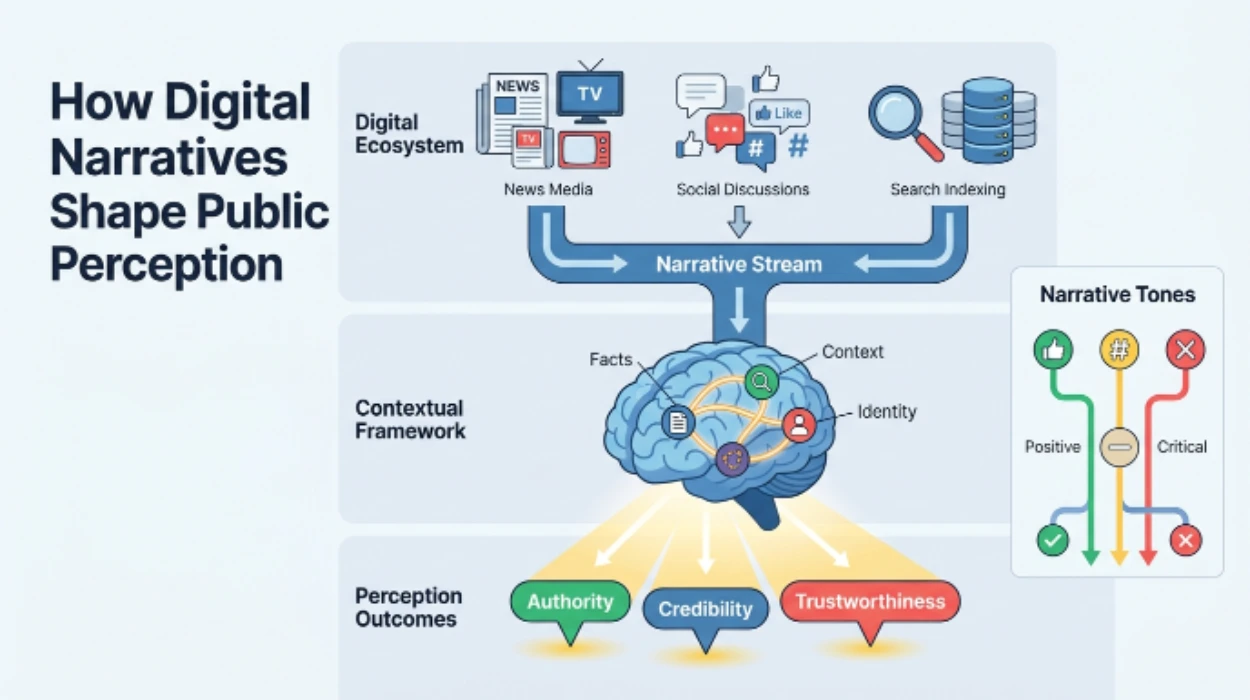
Digital narratives shape public perception by providing the interpretative frameworks through which information is understood. Narrative influence determines how stakeholders connect facts, context, and institutional identity.
A digital narrative is the collection of themes, messages, references, and associations that define an entity within digital ecosystems. Narratives emerge through media coverage, published content, stakeholder discussions, and search results. Search engines index these signals and use them to understand contextual relationships between entities and topics.
Narrative influence affects reputation because repeated associations become part of entity perception. Positive, neutral, and critical narratives all contribute to how institutions are evaluated. Visibility alone does not define perception; the context surrounding visibility determines how stakeholders interpret authority, credibility, and trustworthiness.
Why do search engine results pages affect reputation?
Search engine results pages affect reputation because they serve as primary information gateways for stakeholders seeking information about organisations, institutions, and public entities. SERPs often represent the first layer of reputation assessment.
SERP evaluation refers to the process through which search systems organise, rank, and display information according to relevance and quality signals. Search results present media articles, institutional websites, knowledge panels, social profiles, reports, and third-party references. Together, these assets create a visible reputation landscape.
The composition of search results influences stakeholder trust because users interpret rankings as indicators of relevance and credibility. High-authority publications, recognised institutions, and consistent entity references contribute to stronger digital authority signals. As a result, SERPs function as both discovery systems and perception systems.
How does media coverage contribute to institutional credibility?
Media coverage contributes to institutional credibility by providing external validation and independent visibility within public information environments. Credibility strengthens when information appears in trusted and recognised publications.
Institutional credibility refers to the perceived legitimacy and reliability of an organisation, institution, or public entity. Media publications influence this perception because they create searchable records that become part of the broader content ecosystem. These records are indexed, referenced, and evaluated by both search engines and stakeholders.
The mechanism operates through association. Credible publications transfer contextual authority through citation, analysis, and coverage. Search systems interpret these associations as evidence of relevance and recognition. Consequently, institutional credibility becomes reinforced through repeated inclusion within authoritative information networks.
What are reputation signals in digital ecosystems?
Reputation signals are measurable indicators that contribute to the evaluation of trust, authority, and credibility across digital environments. These signals help search engines and stakeholders interpret entity quality.
Reputation signals include media mentions, expert references, citation patterns, content consistency, institutional associations, and authoritative backlinks. Each signal contributes information that assists digital systems in understanding entity relevance and legitimacy. Search engines analyse these indicators collectively rather than individually.
The impact of reputation signals extends into visibility outcomes. Strong signals improve contextual understanding and support authority evaluation. Weak or inconsistent signals create ambiguity within digital ecosystems, reducing confidence in entity interpretation and affecting broader stakeholder perception.
How does content indexing influence stakeholder trust?
Content indexing influences stakeholder trust because indexed information becomes discoverable, searchable, and available for evaluation. Information that is accessible across search ecosystems contributes to transparency and credibility.
Content indexing refers to the process through which search engines collect, analyse, categorise, and store information for retrieval. Indexed content forms the foundation of search visibility and determines whether information can appear within SERPs. Without indexing, content remains largely invisible to search users.
Stakeholder trust becomes connected to indexing because discoverability enables verification. Searchers evaluate information by comparing sources, reviewing references, and analysing consistency across platforms. Indexed content therefore contributes to trust architecture by expanding access to verifiable information and supporting informed interpretation.
Why is entity perception important in reputation management?
Entity perception is important because search engines increasingly evaluate identifiable entities rather than isolated keywords. Understanding entity relationships enables more accurate assessments of authority, trust, and relevance.
Entity perception refers to how digital systems interpret and categorise organisations, institutions, individuals, and brands. Search engines analyse attributes, associations, topics, and references to build entity understanding. These relationships contribute to knowledge graphs, contextual relevance assessments, and ranking decisions.
The impact on reputation is significant because entity perception influences how information is connected across digital ecosystems. Strong entity recognition improves contextual clarity and supports authority evaluation. Weak entity recognition creates fragmented signals that reduce visibility and complicate stakeholder interpretation.
How do content ecosystems support stakeholder engagement?
Content ecosystems support stakeholder engagement by creating interconnected networks of information that facilitate discovery, understanding, and evaluation. Engagement emerges from access to relevant and credible information rather than isolated content assets.
A content ecosystem consists of media publications, institutional content, research materials, social platforms, industry resources, and search-indexed information. These elements interact through citations, references, semantic relationships, and content distribution pathways. Search engines analyse these connections to understand topical relevance and authority structures.
Stakeholder engagement becomes more effective when information is consistent across the ecosystem. Clear messaging, accurate information architecture, and authoritative references strengthen trust signals. The resulting environment improves information accessibility and supports informed stakeholder evaluation.
How does media sentiment affect authority perception?
Media sentiment affects authority perception because stakeholders evaluate not only visibility but also the tone and context associated with that visibility. Sentiment contributes to narrative interpretation and influences credibility assessments.
Media sentiment refers to the positive, neutral, or negative framing of information within published content. Search engines analyse contextual signals to understand thematic relationships and entity associations. Although sentiment alone does not determine rankings, it contributes to the broader narrative environment surrounding an entity.
Authority perception develops through the interaction of sentiment, visibility, and credibility. Consistent positive or neutral references reinforce trust signals when supported by authoritative sources. Negative sentiment introduces competing narratives that influence stakeholder interpretation and alter broader reputation frameworks.
What is the relationship between media visibility and digital authority?
Media visibility and digital authority are connected through recognition, validation, and information accessibility. Visibility provides evidence of relevance, while authority reflects the interpretation of that evidence within digital ecosystems.
Digital authority is the recognised credibility and influence of an entity within a topic area. Media visibility contributes to authority by expanding the volume of indexed references available for evaluation. Search engines analyse these references alongside content quality, topical relevance, and reputation signals.
The relationship functions through cumulative reinforcement. Increased visibility expands discoverable information, authority evaluation interprets the significance of that information, and stakeholder trust emerges from consistent credibility indicators. Together, these processes define how entities are perceived across search ecosystems and public information environments. Within broader communication strategies, topics such as Choosing Between Local, National and International PR Distribution often intersect with discussions about visibility scope, audience relevance, and authority development across different media ecosystems.
Conclusion
Media visibility matters for brand trust and authority because it contributes to the signals that search engines, stakeholders, and institutions use to evaluate credibility. Visibility influences reputation through content indexing, narrative influence, SERP evaluation, and authority assessment rather than simple exposure.
Digital ecosystems operate through interconnected perception systems where media coverage, entity recognition, reputation signals, and stakeholder trust continuously interact. Search engines analyse these signals to understand relevance and authority, while stakeholders interpret them to assess credibility and institutional legitimacy. Understanding these mechanisms provides a clearer view of how digital reputation, trust architecture, and public perception are formed across modern information environments.
Frequently Asked Questions
What is media visibility in digital reputation management?
Media visibility refers to the presence of an organisation, institution, or entity across news publications, online media platforms, and searchable digital content. It contributes to search visibility by increasing the amount of indexed information available for evaluation by search engines and stakeholders.
How does media visibility affect stakeholder trust?
Media visibility affects stakeholder trust by providing accessible and verifiable information across digital ecosystems. Consistent appearances in credible publications strengthen reputation signals and support perceptions of legitimacy, authority, and reliability.
Why do search engines consider media mentions important?
Search engines consider media mentions important because they help establish entity recognition, contextual relevance, and digital authority. Media references provide additional signals that assist algorithms in evaluating credibility and topical expertise.
What is the difference between visibility and authority?
Visibility refers to how often an entity appears across digital channels and search results. Authority refers to the perceived credibility and expertise associated with that entity. Visibility increases exposure, while authority reflects how search engines and stakeholders interpret the quality and trustworthiness of available information.
How do digital narratives influence brand perception?
Digital narratives influence brand perception by shaping the context in which information is interpreted. Repeated themes, media coverage, and search result associations create perception frameworks that affect stakeholder understanding, trust, and credibility assessments.