

Press release distribution mistakes limit media coverage by reducing narrative visibility, weakening entity credibility, and disrupting the pathways journalists, stakeholders, and search engines use to evaluate information relevance.
Public affairs strategies differ based on visibility objectives, stakeholder priorities, and institutional communication requirements. Digital advocacy methods are evaluated through their influence on reputation signals, search ranking influence, sentiment distribution, and stakeholder trust across media and digital ecosystems.
Which Press Release Distribution Mistakes Reduce Media Visibility Most Significantly?
Poor distribution decisions reduce media visibility by restricting the discovery and assessment of information by journalists, editors, industry analysts, and search systems.
Press release distribution is a structured process that operates by placing institutional announcements into media ecosystems where newsrooms, stakeholders, and digital platforms can evaluate relevance. Media visibility depends on timing, audience alignment, content authority, and distribution accuracy. When distribution mechanisms fail, media coverage declines because editorial gatekeepers receive weaker relevance signals. Search engines also interpret weak distribution patterns as indicators of limited authority and engagement value. This reduces narrative visibility across both traditional and digital channels.
One significant mistake is distributing content through broad, non-segmented channels instead of targeted media networks. A broad distribution model prioritises reach volume, while a targeted model prioritises audience relevance. Journalists evaluate content according to beat alignment, editorial priorities, and stakeholder significance. Non-segmented distribution increases information overload and decreases perceived relevance. Targeted distribution generates stronger contextual authority because the information reaches audiences already connected to the subject matter.
Another common limitation involves publishing content without evaluating newsworthiness. Newsworthiness is the perceived public, institutional, or sector relevance of information. Press releases that focus on internal achievements without broader stakeholder implications generate weaker media interest. Journalists assess whether information contributes to ongoing discussions, policy developments, market changes, or public concerns. Content lacking these characteristics produces weaker media amplification and reduced coverage potential.
How Does Targeted Distribution Compare with Mass Distribution Approaches?
Targeted distribution generates stronger media relevance signals, while mass distribution prioritises volume over contextual alignment.
Targeted distribution is a communication framework that operates by identifying specific journalists, publications, stakeholder groups, and industry audiences. Mass distribution operates by disseminating information to the largest possible audience regardless of editorial relevance. Both approaches increase information availability, but they produce different visibility outcomes. The distinction influences media uptake, stakeholder engagement, and institutional credibility.
How Does Targeted Distribution Influence Coverage Potential?
Targeted distribution improves coverage potential because journalists receive information aligned with their reporting focus. Editorial relevance functions as a primary filtering mechanism in modern newsrooms. Relevant content requires less evaluation effort and demonstrates stronger alignment with existing reporting priorities. This increases the probability of coverage and secondary amplification through digital channels. Search engines also interpret citations from relevant publications as stronger authority signals.
Targeted frameworks produce more efficient stakeholder engagement because communication reaches audiences already interested in the topic. This improves sentiment distribution by reducing irrelevant exposure and increasing meaningful interactions. Institutional communications benefit from greater precision, resulting in stronger trust signals and improved narrative visibility.
What Limitations Exist Within Mass Distribution Models?
Mass distribution expands reach but reduces contextual relevance. Journalists receiving unrelated content often disregard future communications from the same source. Repeated irrelevance weakens entity credibility and damages long-term media relationships. Search systems also evaluate engagement patterns associated with distributed content. Low interaction rates and minimal media adoption reduce perceived authority.
Mass distribution retains value for high-impact announcements with broad public relevance. However, routine organisational updates often experience visibility dilution when distributed through indiscriminate channels. The mechanism favours exposure quantity rather than coverage quality, creating weaker institutional influence over time.
Why Does Timing Matter More Than Distribution Volume?
Distribution timing influences media adoption rates more directly than distribution volume because editorial decision-making operates within defined news cycles.
Timing is the strategic placement of information within periods of maximum relevance and media attention. Distribution volume measures the quantity of recipients exposed to information. While both factors affect visibility, timing determines whether journalists can realistically engage with content. Information delivered outside active editorial windows experiences lower evaluation rates regardless of audience size.
Public affairs communication operates within predictable cycles shaped by policy announcements, regulatory developments, economic events, and institutional reporting schedules. Press releases distributed without considering these cycles compete against stronger narratives. Coverage opportunities decrease because editorial resources prioritise current developments and emerging issues.
Search visibility also reflects timing effectiveness. Search engines analyse freshness, engagement velocity, and publication relevance. Content introduced during periods of heightened stakeholder interest generates stronger interaction patterns and broader citation networks. These signals contribute to search ranking influence and narrative amplification. Poor timing weakens both media uptake and digital discoverability.
How Does Reactive Distribution Compare with Strategic Distribution Planning?
Strategic distribution planning produces more sustainable visibility outcomes than reactive communication approaches.
Reactive distribution is a communication framework that operates by responding to emerging events, criticism, or media narratives. Strategic distribution planning operates through structured content calendars, stakeholder mapping, and long-term narrative development. Both approaches influence visibility, but their effectiveness differs across time horizons.
Reactive communication provides immediate narrative intervention. Institutions use this approach to address reputation challenges, policy debates, or emerging stakeholder concerns. The mechanism focuses on rapid response and message dissemination. While effective for short-term narrative management, reactive approaches often create inconsistent communication patterns. Journalists and stakeholders receive fragmented information, reducing institutional coherence.
Strategic planning develops narrative consistency over extended periods. Content distribution aligns with organisational priorities, stakeholder interests, and media cycles. Consistency strengthens reputation signals because audiences encounter recurring themes supported by evidence and context. Search engines interpret consistent publication activity as a signal of authority and topical expertise. This improves search ranking influence and long-term visibility.
Which Approach Creates Greater Institutional Credibility?
Strategic planning generates stronger institutional credibility because credibility develops through repeated evidence of expertise, transparency, and consistency.
Reactive frameworks address immediate issues but rarely establish durable authority. Stakeholders evaluate institutions through longitudinal observation rather than isolated responses. Consistent communication improves trust signals because information appears structured, deliberate, and aligned with institutional objectives. This creates stronger entity credibility and more stable stakeholder perception.
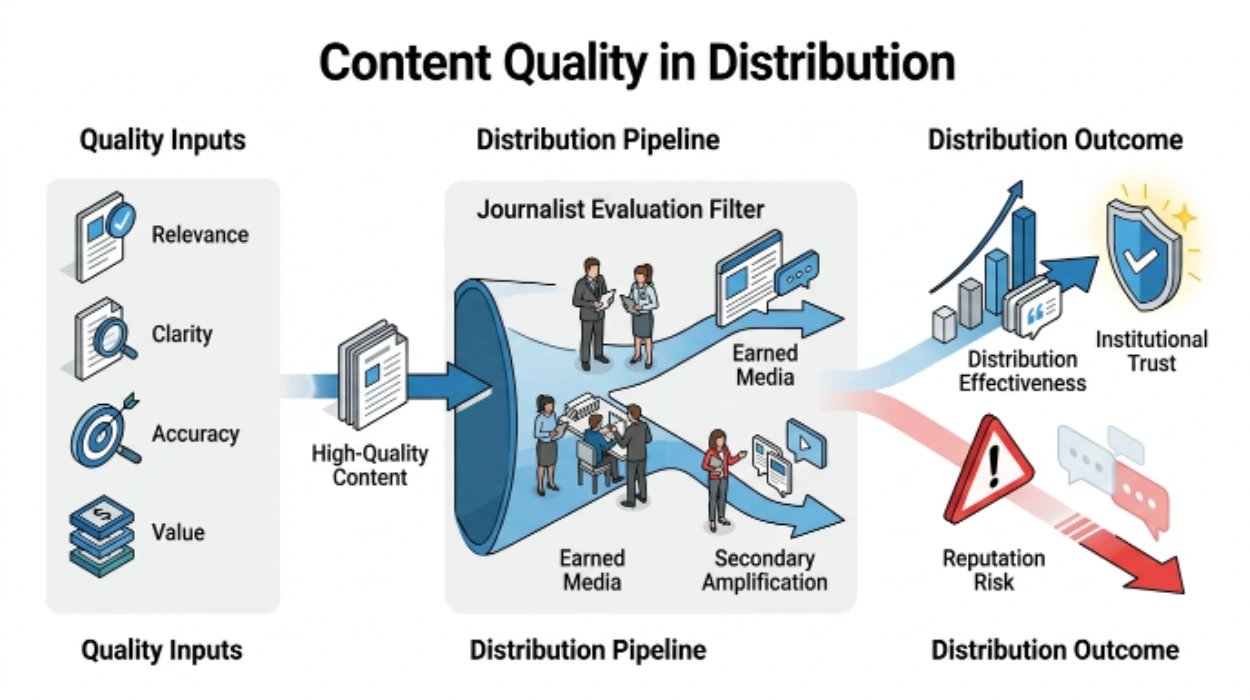
What Role Does Content Quality Play in Distribution Effectiveness?
Content quality determines whether distribution efforts translate into media coverage, stakeholder engagement, and authority development.
Content quality is the relevance, clarity, accuracy, and informational value contained within a press release. Distribution systems deliver content to audiences, but content itself determines whether journalists proceed with coverage. High-quality distribution cannot compensate for weak informational value. Conversely, strong content often generates secondary amplification through earned media and stakeholder sharing.
Journalists evaluate content according to relevance, evidence, context, and public significance. Press releases containing unsupported claims produce weaker credibility signals. Search systems also assess content depth and contextual relationships between entities, topics, and supporting information. Strong content generates citations, references, and engagement patterns that contribute to search ranking influence.
Low-quality content increases reputation risk because stakeholders interpret vague communication as a lack of transparency or expertise. This affects sentiment distribution and weakens institutional trust. High-quality content strengthens narrative visibility because media organisations can more easily incorporate the information into broader reporting frameworks.
How Do Search Engines Evaluate Press Release Distribution Signals?
Search engines evaluate distribution through authority signals, citation patterns, engagement indicators, and entity relationships.
Modern search systems no longer assess press releases solely as standalone documents. They analyse how information spreads across digital ecosystems. Distribution effectiveness influences whether content receives citations, references, media mentions, and stakeholder engagement. These signals contribute to the interpretation of authority and relevance.
Entity credibility is a central evaluation factor. Search engines identify relationships between organisations, topics, publications, and stakeholders. Press releases distributed through authoritative channels and referenced by credible sources strengthen these relationships. Strong entity associations improve visibility across search results and related information panels.
Content amplification and content suppression represent opposing visibility outcomes. Content amplification occurs when media outlets, stakeholders, and digital platforms distribute information further. Content suppression occurs when content receives limited engagement or authority validation. Effective distribution increases amplification opportunities by improving discoverability and relevance alignment. Ineffective distribution limits amplification pathways and reduces SERP representation.
Which Distribution Approach Better Supports Long-Term Reputation Strategy?
Reputation-focused distribution supports long-term institutional credibility more effectively than coverage-focused distribution.
Coverage-focused distribution measures success primarily through publication quantity. Reputation-focused distribution evaluates stakeholder trust, authority development, sentiment distribution, and narrative consistency. While both approaches seek visibility, their strategic objectives differ substantially.
Short-term coverage models prioritise immediate media placement. This approach generates temporary attention but often lacks continuity. Media mentions alone do not establish durable authority. Stakeholders evaluate credibility through repeated exposure to coherent narratives and evidence-based communication. Consequently, visibility without consistency produces limited reputational value.
Reputation-focused frameworks operate by connecting media relations, stakeholder engagement, digital advocacy, and search visibility objectives. Information distribution becomes part of a broader institutional trust system. This approach strengthens narrative visibility across multiple channels and improves resilience against negative sentiment fluctuations. Search engines also favour entities demonstrating consistent expertise and topical authority over time.
How Can Organisations Evaluate Distribution Effectiveness?
Effective evaluation requires measurement beyond media mention counts. Organisations can assess distribution performance through:
- Measure citation quality by analysing publication authority and editorial relevance.
- Evaluate sentiment distribution through positive, neutral, and negative coverage patterns.
- Analyse search ranking influence through changes in branded and topic-related visibility.
- Track stakeholder engagement using interaction depth rather than impression volume.
- Assess entity credibility through authoritative references and contextual mentions.
These metrics provide a broader understanding of communication effectiveness than simple coverage volume measurements. They also align media relations activity with public affairs and reputation strategy objectives.
Conclusion
Press release distribution effectiveness depends on relevance, timing, content quality, stakeholder alignment, and strategic consistency rather than distribution volume alone. Targeted distribution generates stronger media relevance signals than mass distribution, while strategic planning creates more sustainable authority than reactive communication frameworks. Timing influences coverage adoption rates, and content quality determines whether distribution efforts translate into meaningful visibility.
Search engines, media organisations, and stakeholders evaluate communication through authority signals, entity credibility, sentiment distribution, and narrative consistency. Short-term coverage objectives focus on immediate exposure, whereas long-term reputation strategies prioritise institutional trust, search ranking influence, and sustained narrative visibility. Understanding these distinctions enables a more comprehensive evaluation of media relations approaches within public affairs and digital advocacy ecosystems.
Within broader analysis of media visibility patterns, organisations often examine Why Some Companies Receive More Media Attention Than Others to understand the structural factors that influence coverage outcomes.
Long-term authority development also intersects with specialised distribution frameworks such as PR Distribution Agency for Thought Leadership and Brand Authority, where visibility strategies are evaluated through credibility, amplification mechanisms, and institutional trust indicators.
Frequently Asked Questions
What is the most common press release distribution mistake?
The most common mistake is distributing a press release without targeting relevant journalists, publications, or stakeholder groups. Poor audience alignment reduces relevance signals and lowers the likelihood of media coverage.
How does distribution timing affect media coverage?
Distribution timing affects whether journalists can evaluate and act on a press release during active news cycles. Content released at inappropriate times often receives less attention, regardless of its quality or relevance.
Why is targeted distribution more effective than mass distribution?
Targeted distribution focuses on audiences with a direct interest in the subject matter. This approach increases editorial relevance, strengthens stakeholder engagement, and improves the chances of content amplification through credible media sources.
How do search engines evaluate press release visibility?
Search engines assess authority signals, entity credibility, citation patterns, and engagement indicators. Press releases that receive references from authoritative sources contribute more effectively to search ranking influence and narrative visibility.
What metrics are useful for evaluating distribution effectiveness?
Useful metrics include citation quality, sentiment distribution, stakeholder engagement levels, search visibility changes, and authority-related mentions. These measurements provide a broader evaluation than media coverage volume alone.