

Companies receive more media attention when their digital authority, institutional credibility, narrative relevance, and reputation signals align with the evaluation systems used by journalists, search engines, platforms, and audiences.
Online reputation refers to the collective perception of an entity across digital ecosystems. Public affairs refers to the management and interpretation of relationships between organisations, institutions, stakeholders, and public discourse. Digital advocacy is the strategic creation and amplification of information that influences visibility, credibility, and stakeholder understanding within connected information environments.
Why do some companies attract more media attention than others?
Media attention is a function of visibility, authority, relevance, and trust within digital information ecosystems. News organisations, search platforms, and content discovery systems evaluate entities through a combination of reputation signals, content indexing patterns, audience interest indicators, and institutional credibility markers.
Media ecosystems operate through selection mechanisms. Journalists assess information value, search engines evaluate authority signals, and audiences reinforce visibility through engagement patterns. These interconnected systems create a hierarchy of attention that determines which organisations appear frequently in news coverage and which remain largely invisible.
Entity perception plays a central role in this process. Entity perception refers to the cumulative understanding of an organisation across digital environments. When a company demonstrates consistent expertise, topical relevance, and authoritative information assets, it becomes easier for media systems to identify, interpret, and reference that entity. This increased discoverability strengthens media visibility and contributes to sustained coverage patterns.
How is institutional credibility interpreted across digital ecosystems?
Institutional credibility is evaluated through consistency, transparency, expertise, and verifiable information signals. Digital ecosystems interpret credibility by analysing the quality, relevance, and interconnectedness of content associated with an organisation.
Search engines analyse content indexing patterns, source references, citation networks, and entity relationships. These systems attempt to determine whether an organisation demonstrates expertise within specific subject areas. Credibility becomes a measurable component of search visibility because algorithms evaluate trust indicators embedded within content ecosystems.
Media organisations use similar evaluation frameworks. Editorial teams assess source reliability, historical accuracy, subject-matter expertise, and narrative relevance before allocating attention. Institutional credibility therefore functions as a gateway mechanism that influences both media coverage and search performance.
Stakeholder trust emerges from the visibility of credible information. When consistent information appears across authoritative digital environments, stakeholders develop stronger confidence in the entity behind that information. This process strengthens reputation signals and reinforces future visibility opportunities.
What role do digital narratives play in media visibility?
Digital narratives define how organisations are understood within public discourse. A narrative is a structured interpretation framework that explains events, actions, expertise, or institutional positions through connected information assets.
Media attention frequently follows narrative relevance rather than organisational size alone. News systems prioritise information that contributes to ongoing discussions, emerging issues, policy developments, industry changes, or societal trends. Companies that occupy a recognised position within these narratives receive greater attention because their information helps explain broader developments.
Narrative influence affects search visibility as well. Search engines analyse topical relationships between entities, subjects, and information sources. When an organisation consistently contributes information relevant to a recognised topic cluster, its association with that narrative becomes stronger. This association improves entity recognition and increases the likelihood of visibility across search results.
Narratives also shape stakeholder interpretation. Information does not exist in isolation; it exists within contextual frameworks. The stronger an entity’s association with a recognised narrative, the easier it becomes for audiences, journalists, and platforms to understand its relevance. This clarity supports credibility assessment and strengthens digital authority.
How do search engines influence media attention?
Search engines influence media attention by determining information discoverability. Search visibility affects whether journalists, researchers, stakeholders, and audiences encounter specific organisations during information-gathering processes.
Content indexing is a foundational mechanism within this system. Content indexing refers to the process through which search engines organise and evaluate information assets for retrieval and ranking. Indexed content becomes eligible for visibility within search engine results pages (SERPs), creating opportunities for discovery.
SERP evaluation determines which sources appear most prominently for relevant topics. Search engines assess authority signals, content relevance, entity associations, and trust indicators when ranking information. Higher visibility increases the probability that journalists encounter specific sources during research activities.
Digital authority amplifies this effect. Digital authority refers to the perceived expertise and trustworthiness of an entity within a defined subject area. Organisations with stronger authority profiles often achieve greater search visibility, creating a feedback loop in which discoverability supports media recognition and media recognition reinforces discoverability.
What are reputation signals and why do they matter?
Reputation signals are observable indicators that help platforms, media organisations, and stakeholders evaluate trustworthiness and authority. These signals influence how entities are interpreted across digital ecosystems.
Reputation signals include content quality, source citations, topic consistency, authoritative references, publication frequency, and informational accuracy. Each signal contributes to a broader evaluation framework that determines entity perception.
Search systems use reputation signals to assess credibility. Algorithms analyse relationships between entities, content assets, and external references to estimate trustworthiness. Strong reputation signals improve search visibility because they provide evidence of expertise and relevance.
Media organisations interpret similar indicators when evaluating sources. Consistent publication records, authoritative subject matter coverage, and credible information assets strengthen editorial confidence. This confidence increases the likelihood of citation, quotation, and coverage.
Stakeholder trust also depends on reputation signals. Trust architecture within digital ecosystems is built upon observable evidence rather than organisational claims. Reputation signals provide that evidence and influence how audiences evaluate institutional credibility.
How does content indexing affect organisational visibility?
Content indexing determines whether information can participate in digital discovery systems. Information that is not effectively indexed has limited influence on search visibility, media discovery, and stakeholder perception.
Indexing involves the identification, categorisation, and storage of digital content within search engine databases. Once indexed, content becomes eligible for SERP evaluation. This process establishes the foundation for discoverability across search environments.
Content structure influences indexing outcomes. Clearly defined topics, logical information architecture, and strong entity associations help search systems understand content relevance. Better understanding improves retrieval accuracy and supports topical authority development.
Visibility outcomes depend on indexing quality because search engines cannot rank content effectively without accurate interpretation. Organisations with comprehensive, well-structured information ecosystems achieve stronger discoverability, creating more opportunities for media attention and stakeholder engagement.
How do authority signals shape public perception?
Authority signals define how expertise is recognised within digital ecosystems. Authority refers to the perceived ability of an entity to provide reliable and relevant information within a specific domain.
Authority signals emerge from content depth, topical consistency, citation relationships, expert references, and recognised subject-matter expertise. These indicators help search engines and audiences determine informational value.
Public perception is influenced by authority because visibility often functions as a proxy for expertise. Entities that appear consistently within search results, media coverage, and authoritative information environments are more likely to be perceived as credible sources. This perception strengthens institutional reputation and reinforces stakeholder trust.
Authority also affects narrative influence. When an entity is recognised as authoritative, its contributions carry greater interpretive weight within public discussions. This increased influence expands visibility and strengthens long-term reputation development.
Why does stakeholder trust affect media coverage?
Stakeholder trust functions as a credibility multiplier within public information ecosystems. Trust increases the perceived reliability of information, making it more valuable to journalists, researchers, and audiences.
Stakeholder trust refers to confidence in the accuracy, consistency, and integrity of an organisation’s communications and actions. This confidence is built through repeated exposure to credible information and transparent institutional behaviour.
Media organisations depend on trusted sources because credibility directly affects editorial reputation. Information originating from trusted entities requires less verification effort and carries lower reputational risk. As a result, trusted organisations often receive greater media consideration.
Trust also influences digital engagement patterns. Stakeholders interact more frequently with information they consider credible. These interactions strengthen visibility signals across platforms, increasing the likelihood of continued discovery and media attention.
How do SERPs influence perceptions of authority and credibility?
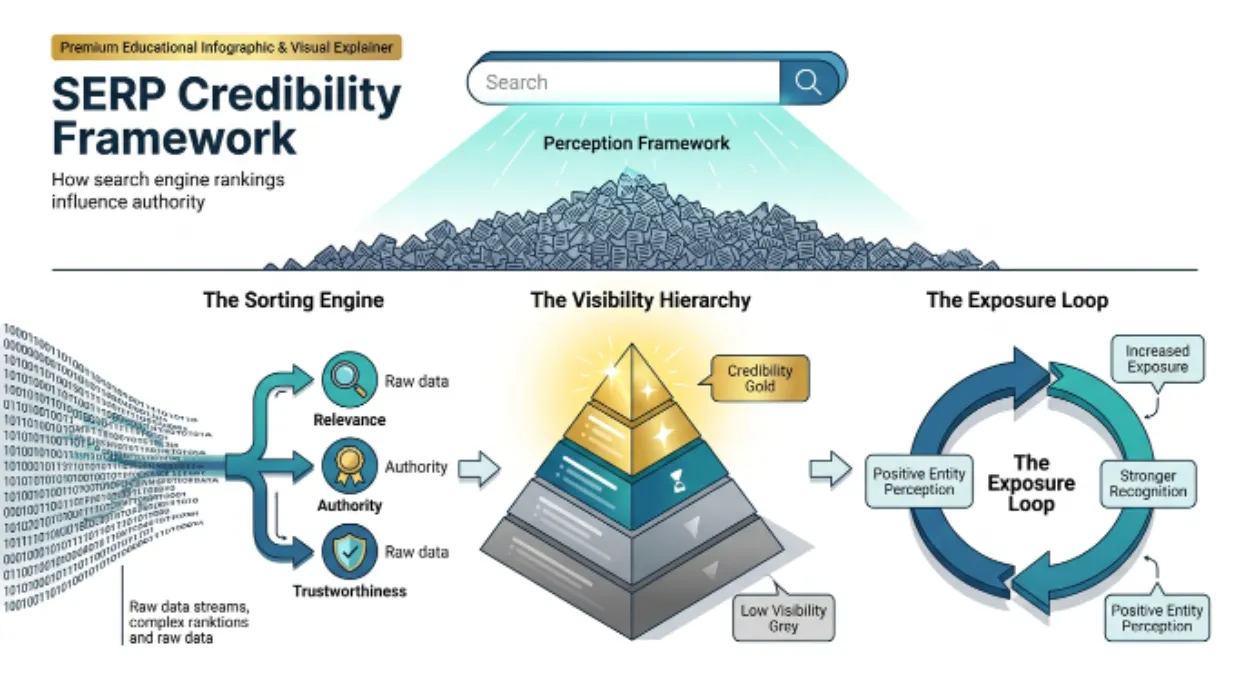
Search engine results pages function as perception frameworks. SERPs do not simply display information; they organise information according to relevance, authority, and trust evaluations.
Users frequently interpret ranking positions as indicators of credibility. Higher-ranking results receive greater attention, while lower-ranking results receive less visibility. This dynamic creates a relationship between search performance and perceived authority.
SERP evaluation analyses multiple signals simultaneously. Search systems assess relevance, authority, trustworthiness, entity relationships, and content quality before determining rankings. These assessments shape the information environment encountered by stakeholders.
Perception outcomes emerge from repeated exposure. When an organisation consistently appears in prominent search positions, stakeholders encounter its information more frequently. Increased exposure strengthens recognition, supports credibility assessment, and contributes to positive entity perception.
How do content ecosystems contribute to sustained media attention?
Content ecosystems create interconnected networks of information that support discoverability, authority development, and narrative influence. A content ecosystem consists of all indexed assets associated with an entity across digital environments.
Strong content ecosystems demonstrate topical depth. They explain subjects comprehensively, establish clear entity associations, and reinforce expertise through consistent information structures. Search engines use these characteristics to evaluate authority and relevance.
Media organisations benefit from well-developed content ecosystems because they provide context, supporting information, and subject expertise. Journalists often rely on accessible information networks when researching complex topics. Organisations with robust information ecosystems therefore become easier to discover and evaluate.
Sustained media attention emerges when authority, relevance, and discoverability operate together. Content ecosystems facilitate this interaction by strengthening reputation signals, improving content indexing outcomes, and supporting stakeholder trust formation.
What factors create long-term digital authority?
Long-term digital authority is created through consistency, expertise, credibility, and informational relevance. Authority development is cumulative rather than event-driven.
Digital authority refers to recognised expertise within search ecosystems, media environments, and stakeholder communities. This recognition develops through repeated demonstration of knowledge and reliability across relevant topics.
Three mechanisms define authority formation:
- Establish topical consistency — Maintain clear subject associations through focused information assets that strengthen entity understanding and improve search interpretation.
- Demonstrate expertise — Publish detailed, evidence-based content that explains complex topics and reinforces credibility signals across digital ecosystems.
- Strengthen information accessibility — Improve content indexing, internal information structures, and discoverability mechanisms that support search visibility and media research activities.
These mechanisms influence how algorithms, journalists, and stakeholders evaluate entities. Authority becomes embedded within digital perception systems, increasing the likelihood of visibility, citation, and ongoing media attention. Discussions around Common Press Release Distribution Mistakes That Limit Media Coverage also illustrate how information architecture and distribution practices affect discoverability, credibility assessment, and media uptake.
Conclusion
Media attention is not determined solely by organisational size, marketing activity, or publication frequency. It emerges from the interaction between digital authority, institutional credibility, narrative relevance, reputation signals, and search visibility.
Digital ecosystems evaluate organisations through interconnected mechanisms that analyse trust, expertise, relevance, and discoverability. Search engines interpret authority through content indexing and SERP evaluation, while media organisations assess credibility through source reliability and informational value. Stakeholders contribute additional perception signals through engagement and trust formation.
Understanding these systems provides a clearer explanation of why some companies receive greater media attention than others. Visibility is the outcome of how digital perception systems interpret authority, credibility, and relevance across the broader information ecosystem.