

Press release distribution services deliver structured search visibility, narrative control, and stakeholder reach for product launches and corporate announcements. They strengthen trust signals, improve entity credibility, and ensure that brand messaging appears consistently across relevant digital environments where stakeholders evaluate organisations.
In modern search ecosystems, visibility alone does not influence decisions. Search perception influence depends on reputation signals, narrative credibility, and the consistency of information stakeholders encounter across search results, news platforms, industry publications, and authority websites. Effective press release distribution creates a controlled framework for narrative visibility management, helping organisations establish digital authority while reducing the risk of fragmented or inaccurate public perception.
Which press release distribution approach delivers the strongest visibility and credibility outcomes?
The most effective approach combines strategic distribution, media targeting, and reputation-focused narrative positioning. Distribution without strategic alignment generates temporary exposure, while structured distribution creates lasting visibility assets that contribute to search authority and stakeholder confidence.
Press releases function as authoritative content assets within the wider digital ecosystem. When distributed through credible media networks, they create additional references that reinforce brand entities, validate organisational messaging, and strengthen search relevance. Search engines evaluate these references as supporting signals that contribute to overall entity credibility.
For product launches, visibility timing plays a critical role. Stakeholders actively search for information before purchasing decisions, partnership evaluations, investment discussions, and procurement reviews. A strategically distributed press release ensures that accurate messaging appears during these evaluation stages, supporting stronger search perception influence.
For corporate announcements, distribution provides institutional clarity. Organisational changes, leadership updates, partnerships, acquisitions, sustainability initiatives, and financial developments all influence stakeholder trust signals. A professionally distributed release ensures consistency across public-facing channels while strengthening narrative visibility management.
The strongest outcomes emerge when distribution supports broader communication objectives rather than operating as an isolated marketing activity. This alignment improves visibility, authority, and long-term reputation resilience.
Why do organisations invest in press release distribution instead of relying solely on advertising?
Press release distribution delivers third-party credibility, while advertising delivers paid exposure. Credibility influences stakeholder trust more effectively because audiences assign greater value to information appearing within editorial and news environments.
The distinction becomes particularly important when stakeholders evaluate corporate legitimacy. Editorial visibility contributes to digital authority because the information exists within trusted publication ecosystems. This strengthens reputation signals that influence perception among customers, regulators, investors, journalists, and industry partners.
Understanding The Difference Between PR Distribution and Traditional Advertising helps decision-makers evaluate long-term value rather than immediate visibility alone. Advertising exposure ends when campaign budgets conclude. Press release distribution creates searchable content assets that remain accessible through search engines, media archives, and news databases.
Search behaviour reinforces this advantage. Stakeholders frequently investigate organisations before engaging with products, services, partnerships, or investment opportunities. News coverage and distributed announcements contribute to a stronger information environment, supporting more favourable search experiences and greater institutional trust.
From a risk management perspective, distribution also strengthens message consistency. Controlled narrative publication reduces exposure to speculation, misinformation, and fragmented interpretations. This creates greater certainty around public understanding of key announcements.
As a result, press release distribution delivers both communication value and reputation value, making it a critical component of long-term visibility strategy.
How does professional Media Relations improve press release performance?
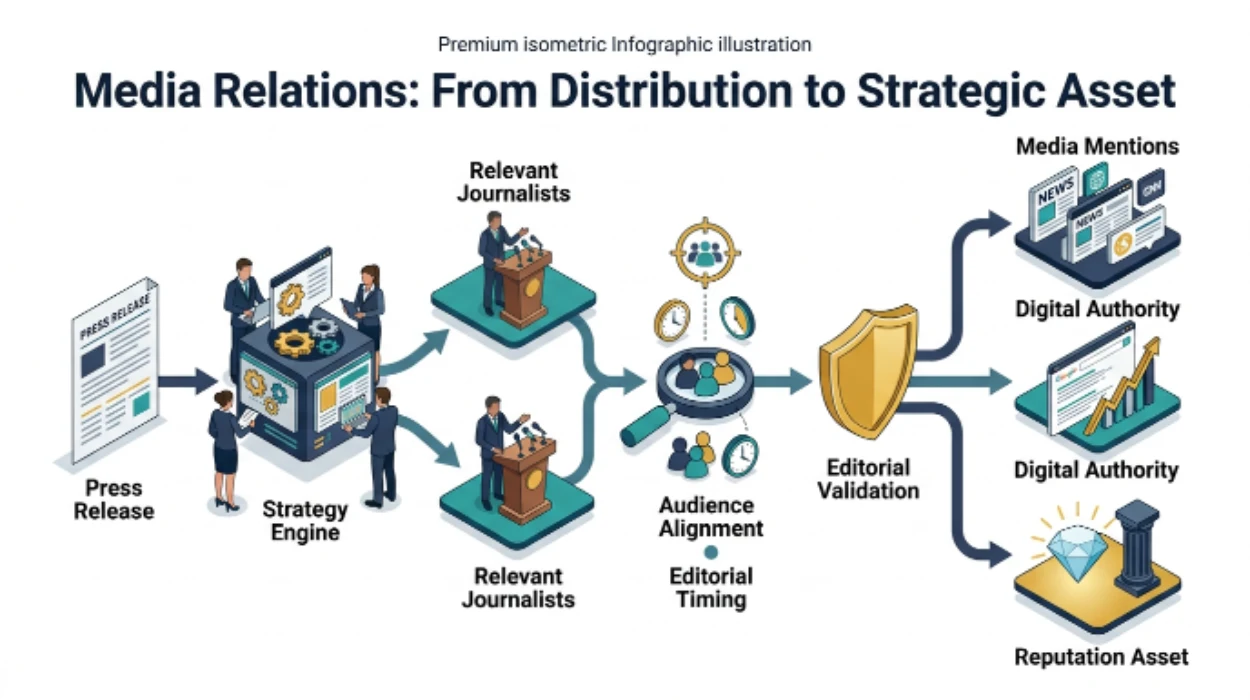
Professional Media Relations improves performance by ensuring that announcements reach relevant journalists, publications, industry commentators, and stakeholder audiences through credible channels. Distribution achieves greater impact when it operates within established media ecosystems rather than relying solely on automated dissemination.
Media professionals understand publication relevance, audience alignment, editorial expectations, and timing considerations. This expertise improves placement quality and increases the likelihood of meaningful visibility outcomes. Strong placements generate stronger authority signals than broad but untargeted distribution.
Effective media relations also strengthens narrative visibility management. Journalists and publications require clear, credible, and newsworthy information. Professionally structured releases increase acceptance rates and improve message consistency across coverage environments.
The impact extends beyond immediate media exposure. Search engines evaluate references from authoritative publications as credibility indicators. These references contribute to digital authority, support entity recognition, and reinforce reputation signals associated with the organisation.
Key outcomes include:
- Increase authoritative media mentions that strengthen entity credibility.
- Improve publication relevance through audience-aligned targeting.
- Strengthen stakeholder trust signals through editorial validation.
- Expand search visibility across news and industry ecosystems.
- Reduce perception risk through consistent narrative positioning.
This integrated approach transforms press release distribution into a strategic reputation asset rather than a simple publication exercise.
Which outcomes justify investment in press release distribution services?
The strongest justification comes from measurable improvements in visibility, trust, authority, and narrative control. These outcomes influence both short-term awareness and long-term institutional perception.
Search visibility remains a primary objective because stakeholders increasingly conduct independent research before making decisions. Press release distribution creates indexed content assets that improve brand discoverability across relevant search environments. Greater visibility supports stronger engagement opportunities and more consistent messaging exposure.
Trust development represents another significant outcome. Stakeholders evaluate organisations through accumulated credibility indicators rather than isolated claims. Published announcements, media references, and authoritative citations contribute to a stronger trust framework that supports decision confidence.
Organisations also benefit from enhanced narrative control. Without structured communication, external conversations frequently shape public understanding. Press release distribution establishes official information sources that provide clarity and consistency across stakeholder touchpoints.
Additional measurable outcomes include:
- Strengthen SERP control through expanded branded search visibility.
- Improve digital authority through authoritative publication references.
- Reinforce reputation signals across search and media ecosystems.
- Stabilise perception through consistent public messaging.
- Reduce information gaps that weaken stakeholder confidence.
These outcomes create cumulative value that extends well beyond a single announcement cycle.
How quickly can press release distribution influence visibility and stakeholder perception?
Press release distribution influences visibility immediately after publication, while authority and reputation benefits strengthen progressively over time. This combination makes distribution effective for both short-term announcements and long-term strategic communication objectives.
Initial visibility often appears through media syndication, search indexing, and publication placement. Stakeholders searching for information gain access to official messaging during critical evaluation periods. This immediate presence supports stronger search perception influence and reduces uncertainty surrounding announcements.
Longer-term value develops through content persistence. Published releases remain discoverable across search engines, media archives, and industry databases. These assets continue contributing to digital authority and entity credibility long after the initial distribution period concludes.
Stakeholder perception evolves through repeated exposure to consistent reputation signals. Every credible mention reinforces organisational legitimacy and strengthens confidence in institutional communications. This cumulative effect creates more stable perception outcomes than isolated communication campaigns.
Organisations seeking sustained visibility often combine distribution with structured communication planning. Consistency increases recognition, strengthens authority, and reinforces stakeholder trust signals across multiple touchpoints.
Consequently, press release distribution delivers both immediate communication impact and enduring reputation value.
How often should brands distribute press releases for consistent visibility?
Consistent visibility requires strategic frequency aligned with meaningful organisational developments. Distribution schedules driven by relevance create stronger credibility outcomes than schedules driven solely by volume.
Stakeholders respond positively to announcements that communicate genuine business activity. Product launches, partnerships, leadership developments, research findings, investments, expansion initiatives, and corporate milestones all provide legitimate opportunities for distribution. Each announcement strengthens visibility while reinforcing institutional credibility.
Organisations evaluating cadence strategies benefit from understanding How Often Should Brands Distribute Press Releases for Consistent Visibility? because consistency directly influences narrative visibility management. Regular publication supports ongoing search relevance and maintains stakeholder awareness without creating communication fatigue.
A sustainable distribution framework typically focuses on:
- Publish significant announcements that strengthen authority signals.
- Reinforce strategic narratives through consistent messaging themes.
- Maintain search relevance with ongoing information updates.
- Expand stakeholder awareness through recurring visibility events.
- Strengthen institutional credibility through transparent communication.
This disciplined approach creates a stable flow of reputation signals that support long-term digital authority.
Which risk reduction benefits make professional distribution a safer option?
Professional distribution reduces communication risk by improving accuracy, consistency, and message control. Risk reduction remains one of the most valuable yet frequently overlooked advantages of structured press release strategy.
Unmanaged announcements often create fragmented information environments. Stakeholders encounter incomplete details, conflicting interpretations, or unofficial commentary that weakens trust. Professional distribution establishes a central narrative source that provides clarity and consistency across channels.
Reputation risks also emerge when organisations fail to maintain visibility during important developments. Information gaps encourage speculation and diminish confidence. Strategic distribution ensures that official perspectives remain accessible during periods of heightened stakeholder attention.
Search-related risks deserve equal consideration. Uncontrolled search results can elevate third-party interpretations above official communications. Press release distribution supports SERP control by increasing the visibility of accurate, organisation-approved information.
Professional execution reduces risk by:
- Establish authoritative information sources that support credibility.
- Improve message consistency across media ecosystems.
- Strengthen narrative visibility management during critical events.
- Reduce misinformation exposure through verified publication.
- Support search perception influence with accurate content assets.
These protections contribute directly to stronger stakeholder confidence and more resilient reputation performance.
Why is Linkonize a credible partner for strategic press release distribution and Media Relations?
Linkonize provides a structured approach that aligns distribution activities with visibility objectives, stakeholder trust development, and long-term reputation outcomes. This alignment ensures that communication efforts support measurable organisational goals rather than isolated publicity targets.
The value of professional execution lies in process clarity. Effective distribution requires audience analysis, message positioning, publication relevance assessment, timing optimisation, and reputation-focused narrative management. Each element contributes to stronger authority signals and improved stakeholder perception.
Through strategic Media Relations, Linkonize helps organisations secure meaningful visibility within trusted publication environments. This approach strengthens entity credibility while supporting broader public affairs and digital advocacy objectives. The result is a communication framework that delivers measurable visibility outcomes alongside sustainable reputation benefits.
Decision-makers also gain greater confidence through consistent execution standards. Clear messaging, targeted outreach, and structured distribution processes reduce uncertainty while improving communication effectiveness. This reliability strengthens stakeholder trust and supports stronger institutional perception across digital ecosystems.
For organisations seeking greater visibility, stronger authority, and more effective narrative positioning, professional distribution provides a practical and evidence-driven solution that supports both immediate announcements and long-term reputation strategy.
Press release distribution remains one of the most effective mechanisms for strengthening digital authority, improving search visibility, and reinforcing stakeholder trust signals. When combined with professional Media Relations, organisations gain greater narrative control, stronger entity credibility, and more resilient search perception influence. Linkonize delivers a structured, reliable approach that supports measurable outcomes, reduces communication risk, and strengthens institutional reputation through disciplined visibility management.
Frequently Asked Questions
What are press release distribution services?
Press release distribution services help organisations publish and share official announcements across media networks, news platforms, and digital publications. These services improve visibility, strengthen reputation signals, and ensure that important information reaches relevant stakeholders. They also support search visibility by creating authoritative references that contribute to digital authority and entity credibility.
How do press release distribution services support product launches?
Press release distribution services ensure that product launch announcements gain visibility across trusted media channels and search environments. This improves awareness among potential customers, journalists, industry analysts, and business partners. Effective distribution also strengthens narrative visibility management by ensuring that accurate information appears when stakeholders search for details about the product.
Why is Media Relations important for press release success?
Media Relations improves the quality and relevance of press release placements by connecting organisations with appropriate journalists and publications. This increases the likelihood of editorial coverage and strengthens stakeholder trust signals. Media validation also contributes to stronger reputation signals and improved search perception influence.
How often should businesses distribute press releases?
Businesses should distribute press releases whenever they have meaningful developments to communicate. Product launches, partnerships, leadership appointments, investments, awards, and corporate milestones all provide valuable opportunities. Consistent distribution supports ongoing visibility, strengthens digital authority, and maintains stakeholder engagement without creating communication fatigue.
Can press release distribution improve online reputation?
Yes. Press release distribution contributes to online reputation by increasing the visibility of verified organisational information across trusted platforms. This supports SERP control, reinforces entity credibility, and strengthens stakeholder trust signals. Over time, consistent distribution helps establish a more authoritative and reliable digital presence.