

Identifying the right media partners requires evaluating audience relevance, authority signals, editorial credibility, and long-term visibility outcomes rather than focusing solely on reach metrics. Effective media partner selection aligns communication objectives with stakeholder expectations, search ecosystem dynamics, and reputation signal distribution.
Public affairs strategies differ based on institutional objectives, stakeholder groups, and the level of narrative visibility required across digital channels. Digital advocacy methods are evaluated through their impact on authority development, stakeholder trust, sentiment distribution, and search ranking influence within increasingly interconnected information environments.
What Criteria Best Evaluate Media Partners for Brand Goals?
The most reliable evaluation criteria include audience alignment, editorial authority, trust signals, content longevity, and visibility influence across search and media ecosystems. Media partners function as distribution entities that affect how information reaches stakeholders and how digital platforms interpret credibility signals. Their influence extends beyond immediate exposure because published content contributes to entity recognition, reputation signals, and narrative visibility. Evaluation therefore requires examining both communication outcomes and digital ecosystem effects. Media outlets with strong editorial standards often generate higher stakeholder trust and stronger authority associations. Outlets with weak credibility indicators frequently produce limited long-term visibility despite generating short-term impressions.
Media evaluation operates through measurable indicators rather than assumptions about popularity. Audience demographics explain stakeholder relevance, while domain authority, editorial consistency, and citation frequency indicate institutional credibility. Search engines analyse these signals when assessing content quality and authority relationships between entities. A publication with recognised expertise in a specific sector often contributes stronger search ranking influence than a general-interest platform with broader reach. This distinction explains why media relevance frequently outweighs raw audience size when evaluating partnership value.
How Do Audience Relevance and Authority Differ as Evaluation Factors?
Audience relevance is the degree to which a publication reaches target stakeholders, while authority reflects the publication’s recognised credibility within a subject area. Audience relevance operates by connecting messages with intended stakeholder groups, decision-makers, policymakers, investors, or industry participants. Authority operates by transferring credibility signals through association and citation patterns. These mechanisms serve different functions within communication frameworks. Relevance influences engagement quality, while authority influences perception quality.
Comparative analysis shows that highly relevant niche publications often generate stronger stakeholder engagement. High-authority national publications contribute stronger reputation signals and broader narrative visibility. The most effective media partnerships balance both factors rather than prioritising one metric exclusively. Stakeholder trust increases when communications appear within environments recognised for expertise and editorial integrity. Search ranking influence also benefits when authority and relevance coexist within the same media ecosystem.
How Do Sector-Specific Media Partners Compare with General News Outlets?
Sector-specific media partners provide deeper stakeholder alignment, while general news outlets provide broader visibility and wider narrative distribution. Each model operates through distinct mechanisms and produces different reputation outcomes. Sector-focused publications concentrate authority within defined industries or policy domains. General news outlets distribute information across diverse audience segments and stakeholder groups. Their value depends on communication objectives rather than universal superiority.
Industry publications create stronger contextual relevance because stakeholders actively seek information within specialised environments. Their editorial focus often supports detailed analysis and technical discussions. This structure improves entity credibility among informed audiences. General news platforms deliver greater exposure but frequently provide reduced contextual depth. The resulting visibility expands awareness but may contribute fewer specialised trust signals. Evaluation therefore depends on whether the objective prioritises influence within a sector or visibility across multiple audiences.
Which Model Produces More Sustainable Reputation Signals?
Sector-specific partnerships generally create more durable reputation signals because authority accumulates within a consistent thematic environment. Search engines interpret repeated associations between entities and trusted subject-matter publications as indicators of expertise and relevance. This process strengthens narrative visibility over time. Consistent exposure within specialised ecosystems also improves stakeholder trust because audiences recognise editorial familiarity and expertise.
General news exposure contributes broader awareness but often generates shorter visibility cycles. News coverage follows fast-moving publication patterns where attention shifts rapidly. The resulting impact supports immediate visibility but provides less cumulative authority development. Sustainability therefore depends on whether communications remain connected to recognised subject expertise or become dispersed across unrelated media environments.
How Does Editorial Credibility Compare with Audience Reach When Selecting Media Partners?
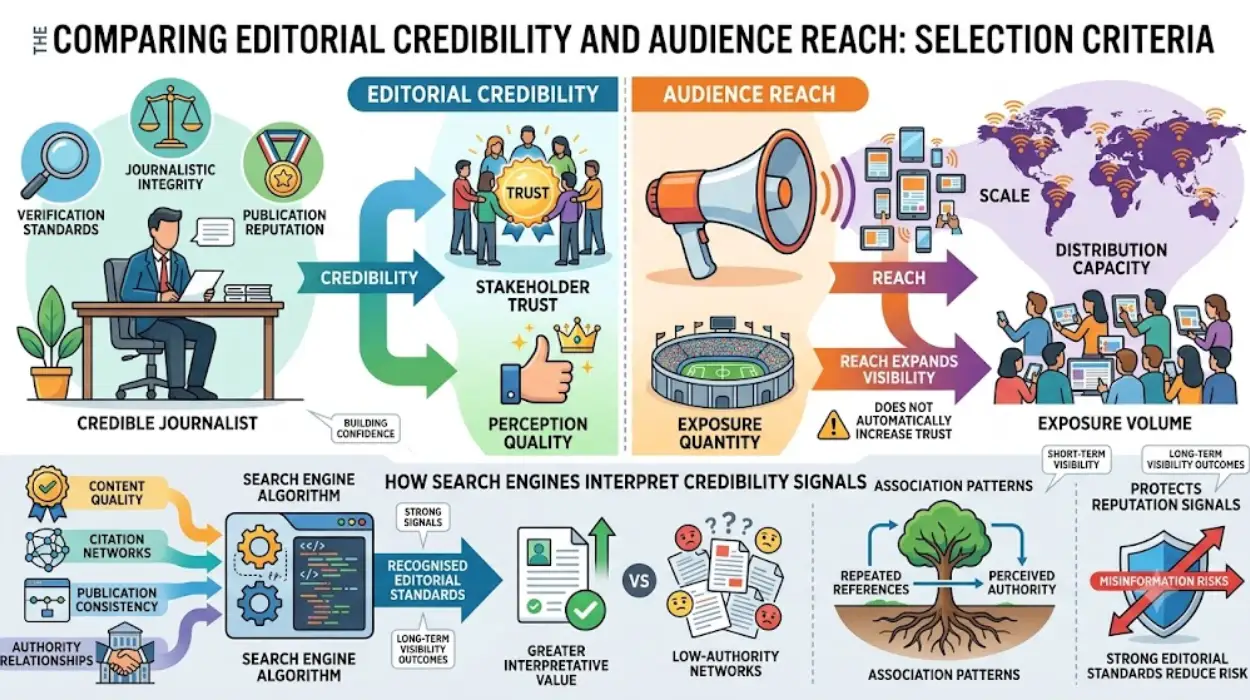
Editorial credibility influences trust formation, while audience reach influences exposure volume. Both factors contribute to communication outcomes, but they affect different stages of stakeholder perception. Editorial credibility operates through verification standards, journalistic integrity, and publication reputation. Audience reach operates through scale and distribution capacity. Comparing these mechanisms reveals distinct strengths and limitations.
Credibility directly affects stakeholder trust because audiences evaluate information sources before assessing messages. Publications recognised for rigorous editorial standards often generate stronger confidence in published content. Reach expands visibility but does not automatically increase trust. Large audiences exposed to low-credibility environments may receive information without assigning significant value to it. This distinction explains why credibility frequently determines perception quality even when reach determines exposure quantity.
How Do Search Engines Interpret Credibility Signals?
Search engines evaluate credibility through content quality, citation networks, publication consistency, and authority relationships. Media outlets with recognised editorial standards generate stronger signals because they participate in trusted information ecosystems. These ecosystems influence entity credibility and narrative visibility. Content published within trusted environments receives greater interpretative value than content published within low-authority networks.
The mechanism operates through association patterns. Repeated references across credible sources strengthen perceived authority. Strong editorial standards also reduce misinformation risks, which protects reputation signals from dilution. Organisations evaluating media partners therefore benefit from examining how search engines interpret source credibility alongside traditional communication metrics. This approach improves understanding of long-term visibility outcomes rather than focusing exclusively on short-term distribution.
How Do Long-Term Media Partnerships Compare with One-Off Campaign Placements?
Long-term media partnerships create cumulative authority development, while one-off placements focus on isolated visibility events. Both approaches influence communication performance, yet they operate through different strategic mechanisms. Ongoing partnerships build consistency across stakeholder touchpoints. One-off campaigns prioritise immediate attention within limited timeframes. The comparison reveals significant differences in sustainability and reputation development.
Long-term partnerships operate by reinforcing narratives through repeated exposure. Consistency strengthens stakeholder recognition and improves sentiment distribution stability. Search engines also identify recurring relationships between entities and authoritative publications. This contributes to stronger narrative visibility and entity credibility over time. The framework aligns closely with the principles examined in Why Strategic Media Partnerships Deliver Better Results Than One-Off Campaigns, where sustained visibility produces cumulative authority signals rather than isolated exposure events.
One-off placements provide immediate communication opportunities but offer limited continuity. Their effectiveness depends heavily on timing and contextual relevance. While they support rapid visibility objectives, they rarely establish durable credibility patterns. Reputation signals generated through isolated activity often dissipate once publication cycles conclude. Evaluation therefore favours long-term frameworks when sustainability and trust development form part of communication objectives.
What Risks Are Associated with Each Approach?
Long-term partnerships create dependency risks if media diversity remains limited. Concentrating narrative visibility within a narrow ecosystem reduces resilience and may constrain stakeholder reach. Diversification therefore remains an important evaluation criterion. Consistent monitoring of editorial changes and audience evolution also supports risk management within long-term frameworks.
One-off placements create fragmentation risks because narratives appear without continuity or reinforcement. Stakeholders may encounter disconnected messages that fail to contribute to broader reputation objectives. This structure weakens cumulative authority development and reduces efficiency within search ecosystems. Risk exposure therefore differs based on whether communications prioritise consistency or short-term visibility spikes.
How Do Organic Communication Frameworks Compare with Reactive Media Strategies?
Organic communication frameworks build visibility through planned narrative development, while reactive strategies respond to emerging events or stakeholder concerns. Each model influences reputation signals differently. Organic frameworks focus on sustained authority growth and predictable visibility patterns. Reactive frameworks prioritise responsiveness and immediate narrative management. The comparison highlights contrasting effects on credibility and stakeholder trust.
Organic communication operates by publishing relevant information consistently across trusted channels. This process establishes stable authority relationships and improves search ranking influence. Stakeholders encounter coherent narratives that strengthen institutional credibility over time. Search engines interpret this consistency as a positive indicator of expertise and reliability. The resulting visibility tends to remain stable across longer periods.
Reactive communication operates by addressing emerging developments, controversies, or reputation challenges. Its value lies in responsiveness rather than continuity. Effective reactive strategies reduce narrative gaps and prevent misinformation from dominating search results or public discourse. However, exclusive reliance on reactive frameworks often limits authority development because visibility depends on external events rather than strategic planning.
Which Framework Better Supports Stakeholder Trust?
Stakeholder trust develops more consistently through organic frameworks because trust formation relies on predictability and transparency. Continuous communication creates stable expectations regarding information quality and institutional behaviour. Stakeholders evaluate these patterns when assessing credibility. Organic strategies therefore contribute to long-term confidence and stronger reputation signals.
Reactive approaches remain important for managing emerging risks and correcting inaccurate narratives. Their effectiveness depends on speed, accuracy, and contextual relevance. Trust benefits when reactive communication complements existing authority structures rather than replacing them. The comparison indicates that balanced integration delivers stronger outcomes than exclusive dependence on either model.
What Measurement Frameworks Help Assess Media Partnership Effectiveness?
Effective measurement combines visibility metrics, trust indicators, sentiment analysis, and authority development benchmarks. Media partnership evaluation extends beyond impressions because communication outcomes involve perception, credibility, and search ecosystem performance. Measurement frameworks therefore require multidimensional analysis. Single metrics rarely capture complete performance.
A structured evaluation framework includes:
- Measure audience relevance through stakeholder engagement patterns and content interaction quality.
- Analyse sentiment distribution across earned media mentions and stakeholder discussions.
- Evaluate search ranking influence through branded search visibility and entity associations.
- Compare authority development through citation patterns and publication quality indicators.
- Track narrative visibility across search results, media coverage, and stakeholder channels.
Authority indicators, sentiment distribution, stakeholder trust signals, and narrative visibility provide stronger insight into long-term value than temporary traffic fluctuations. These metrics are frequently used when assessing the effectiveness of a Media Partnership Agency for High-Authority Brand Exposure and comparing partnership models against visibility objectives.
Which Metrics Best Reflect Long-Term Value?
Authority indicators, sentiment distribution, stakeholder trust signals, and narrative visibility provide stronger insight into long-term value than temporary traffic fluctuations. These metrics reveal whether communications influence perception and credibility beyond initial publication periods. Search ecosystem signals also demonstrate how digital platforms interpret authority relationships over time.
Short-term metrics remain useful for evaluating distribution performance, yet they provide limited information about reputation outcomes. Long-term measurement therefore focuses on cumulative effects rather than isolated engagement events. This distinction supports more accurate assessment of media partnership sustainability and strategic relevance.
Conclusion
Identifying the right media partners requires evaluating relevance, authority, credibility, sustainability, and search ecosystem influence rather than relying on audience size alone. Sector-specific publications and general news outlets perform different functions, while editorial credibility and audience reach contribute distinct communication benefits. Long-term partnerships strengthen reputation signals and stakeholder trust, whereas one-off placements focus on immediate visibility outcomes.
Organic communication frameworks support sustained authority development, while reactive strategies address emerging narrative risks. Effective evaluation therefore depends on understanding how media partnerships influence visibility, entity credibility, sentiment distribution, and stakeholder perception across digital ecosystems. Strategic assessment focuses on measurable authority and trust outcomes rather than exposure metrics alone, creating a clearer framework for analysing media partnership effectiveness.
Frequently Asked Questions
How do media partners influence brand visibility?
Media partners influence brand visibility by distributing content to relevant audiences and contributing authority signals within digital ecosystems. Their editorial credibility, audience relevance, and publication reach affect how stakeholders discover and interpret information.
What factors are most important when evaluating media partners?
The most important factors include audience alignment, editorial standards, authority within a subject area, content longevity, and stakeholder trust. These indicators help measure whether a media partnership supports long-term visibility and credibility objectives.
Why is editorial credibility important in media relations?
Editorial credibility affects how audiences and search engines interpret information. Publications with strong editorial standards generate stronger trust signals, improve entity credibility, and support more sustainable reputation outcomes.
What is the difference between long-term media partnerships and one-off campaigns?
Long-term media partnerships focus on consistent visibility and authority development over time. One-off campaigns focus on immediate exposure within a limited period. Long-term approaches generally create stronger reputation signals and narrative continuity.
How can organisations measure media partnership effectiveness?
Organisations can measure effectiveness through stakeholder engagement, sentiment distribution, authority indicators, search visibility, and narrative reach. These metrics provide insight into both communication performance and long-term reputation impact.