

Strategic media partnerships deliver better results than one-off campaigns because they create sustained visibility, stronger reputation signals, and more consistent authority evaluation across digital ecosystems.
Public affairs refers to the management of relationships, information flows, and perception systems that influence stakeholder understanding of institutions, organisations, and public issues. Digital advocacy is the structured use of digital channels, content ecosystems, and media networks to influence visibility, credibility, and stakeholder engagement within search and information environments.
Why do strategic media partnerships create stronger digital authority?
Strategic media partnerships create stronger digital authority because authority is evaluated through continuity, consistency, and repeated association within trusted information ecosystems.
Digital authority refers to the perceived expertise, reliability, and relevance of an entity across search engines, media environments, and stakeholder networks. Search systems evaluate authority through interconnected reputation signals that emerge over time rather than through isolated publications. A strategic media partnership establishes recurring visibility within recognised editorial environments, creating a stable pattern of association between an entity and authoritative information sources.
Content indexing systems analyse relationships between entities, topics, and publishing environments. When content appears consistently across trusted media channels, search engines receive stronger contextual evidence regarding expertise and topical relevance. This process strengthens entity perception by reinforcing semantic relationships between an organisation and its core subject areas.
Authority evaluation also extends beyond search engines. Journalists, policymakers, investors, researchers, and community stakeholders interpret recurring media presence as evidence of institutional relevance. Continuous exposure within credible environments contributes to stakeholder trust because visibility becomes linked to recognised information standards rather than isolated promotional activity.
How do search engines interpret long-term media relationships?
Search engines interpret long-term media relationships as indicators of sustained relevance and information consistency.
Search visibility depends on the quality, context, and frequency of information associated with an entity. Algorithms analyse content publication patterns, entity mentions, topical consistency, source authority, and engagement signals. A long-term media relationship creates recurring opportunities for content indexing and semantic reinforcement across related topics.
The mechanism operates through repeated validation. Each publication contributes additional context that helps search systems understand organisational expertise, industry relevance, and topical authority. Rather than relying on a single content asset, the search ecosystem receives multiple corroborating signals across time.
SERP evaluation frameworks increasingly focus on entity understanding. Search engines seek to identify trustworthy information sources by analysing how entities are discussed across the web. Strategic partnerships generate structured information patterns that support clearer entity recognition and stronger knowledge relationships.
One-off campaigns create limited signal duration. Once indexing, ranking, and engagement cycles decline, the influence of those signals diminishes. Long-term partnerships maintain signal generation, allowing authority assessment mechanisms to continue receiving updated evidence of relevance and credibility.
Why does consistency influence stakeholder trust?
Consistency influences stakeholder trust because trust formation depends on predictable information quality and stable narrative presentation.
Stakeholder trust refers to confidence in the reliability, competence, and credibility of an organisation or institution. Within digital ecosystems, trust is not formed through a single interaction. It develops through repeated exposure to coherent information across multiple touchpoints.
Strategic media partnerships support trust development by creating continuity in communication environments. Consistent publication standards, recurring thematic coverage, and ongoing visibility contribute to a stable perception framework. Stakeholders encounter similar messages, evidence, and expertise indicators across time, reducing uncertainty in perception formation.
Trust architecture within digital environments relies heavily on verification mechanisms. Media coverage, expert commentary, industry analysis, and referenced information collectively contribute to perceived legitimacy. Continuous participation within recognised media ecosystems strengthens these verification structures by providing repeated confirmation of expertise and relevance.
Search engines also interpret consistency as a quality indicator. Repeated alignment between entity information, content themes, and external references supports stronger confidence in content evaluation systems. This contributes to improved visibility outcomes while reinforcing stakeholder confidence in the information being presented.
How do strategic media partnerships influence digital narratives?
Strategic media partnerships influence digital narratives by shaping the information environment through ongoing topic association and contextual reinforcement.
Digital narratives refer to the collection of interconnected messages, themes, and interpretations that define how an entity is understood online. Narrative influence emerges when information repeatedly associates an organisation with specific topics, values, expertise areas, or public issues.
Search ecosystems function as narrative distribution systems. Content published across trusted platforms becomes part of the indexed information landscape. As search engines organise and rank information, they contribute to the visibility of particular narratives and interpretations.
Strategic partnerships allow narrative development through continuity. Repeated publication within relevant media environments creates thematic cohesion that strengthens topic association. Search systems recognise these recurring patterns and incorporate them into entity understanding processes.
Narrative influence also affects stakeholder interpretation. Individuals evaluate institutions based on available information, media references, expert analysis, and search results. A structured narrative ecosystem provides a clearer informational framework, making entity perception more stable and easier to interpret across stakeholder groups.
What role do media ecosystems play in institutional credibility?
Media ecosystems play a central role in institutional credibility because they influence information validation, authority recognition, and public interpretation.
Institutional credibility refers to the perceived trustworthiness and legitimacy of an organisation within public and digital environments. Credibility is established when information sources, stakeholder communities, and search systems consistently recognise an entity as reliable and authoritative.
Media ecosystems act as credibility amplifiers. Editorial standards, publication quality, fact-checking processes, and audience trust contribute to the credibility transfer effect. When institutions are consistently represented within respected media environments, their perceived legitimacy becomes reinforced through association.
Digital ecosystems evaluate credibility through interconnected signals. Search engines analyse source quality, topical relevance, content consistency, and entity relationships. Media partnerships strengthen these signals by providing recurring opportunities for credible information publication.
Institutional credibility also depends on visibility distribution. Information that appears across multiple authoritative environments receives broader recognition. This increases the likelihood that stakeholders encounter reliable representations of an institution when conducting searches, evaluating information, or researching industry topics.
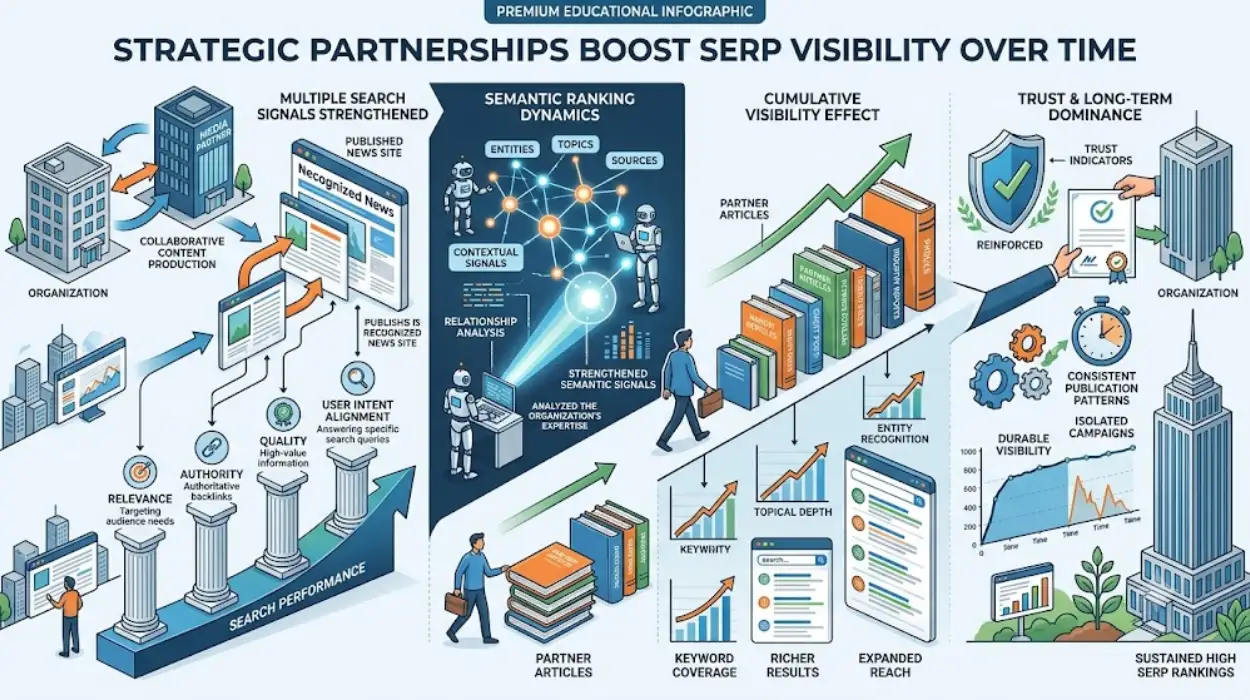
How do strategic partnerships improve SERP visibility over time?
Strategic partnerships improve SERP visibility over time because search performance is influenced by cumulative authority and relevance signals.
Search engine results pages organise information according to relevance, authority, quality, and user intent alignment. Strategic media partnerships contribute to each of these evaluation categories by creating a continuous stream of indexable content connected to recognised publishing environments.
Content ranking dynamics rely on semantic understanding. Search systems analyse relationships between entities, topics, and sources to determine relevance. Repeated publication within relevant media channels increases the quantity and quality of contextual signals associated with an entity.
The visibility effect becomes stronger as indexed content accumulates. Multiple content assets covering related themes create broader keyword coverage, stronger topical depth, and improved entity recognition. Search systems gain a more comprehensive understanding of organisational expertise and subject matter relevance.
SERP evaluation also incorporates trust indicators. Authoritative media references, consistent publication patterns, and recognised source associations strengthen confidence signals used in ranking calculations. This contributes to more durable search visibility compared with isolated campaign-based activity.
Why are reputation signals stronger in ongoing media relationships?
Reputation signals are stronger in ongoing media relationships because signal strength depends on frequency, consistency, and contextual reinforcement.
Reputation signals refer to observable indicators that influence how search engines, stakeholders, and media audiences evaluate credibility and authority. These signals include entity mentions, expert references, publication quality, sentiment patterns, and topical relevance indicators.
An ongoing media relationship generates a larger volume of interconnected reputation signals than a one-off campaign. Each publication contributes additional evidence that supports entity understanding and credibility assessment. Over time, these signals form a more comprehensive reputation profile.
Search engines use reputation signals to evaluate information reliability. Repeated positive associations with authoritative sources strengthen entity perception and improve confidence in content evaluation processes. The cumulative nature of these signals increases their influence on search visibility outcomes.
Stakeholders interpret reputation signals through a similar mechanism. Continuous exposure to credible information environments creates stronger confidence in institutional competence and relevance. This strengthens trust formation while reducing uncertainty in public perception processes.
How does digital advocacy benefit from sustained media engagement?
Digital advocacy benefits from sustained media engagement because advocacy effectiveness depends on visibility continuity, narrative persistence, and stakeholder reach.
Digital advocacy is the strategic communication of ideas, policies, positions, or expertise through digital information ecosystems. Its effectiveness depends on the ability to maintain visibility within relevant conversations and information environments.
Sustained media engagement supports advocacy objectives by ensuring continued participation in topical discussions. Search systems, media audiences, and stakeholder groups receive recurring exposure to information associated with specific issues and areas of expertise. This strengthens topic ownership and improves visibility within relevant search contexts.
Advocacy outcomes are closely connected to information accessibility. Search users often evaluate topics through SERPs, news coverage, analysis articles, and expert commentary. Strategic partnerships increase the presence of indexed content available within these discovery environments.
Digital advocacy also relies on trust architecture. Information originating from recognised media ecosystems benefits from stronger credibility assessment and broader distribution potential. Sustained engagement therefore enhances both visibility and perceived legitimacy within public information systems.
What distinguishes a strategic partnership from a one-off campaign?
A strategic partnership differs from a one-off campaign because it creates an ongoing information ecosystem rather than a temporary visibility event.
One-off campaigns focus on a specific communication objective within a limited timeframe. Their influence is constrained by publication duration, engagement cycles, and content lifespan. Once attention declines, associated reputation and visibility signals weaken.
Strategic partnerships operate through continuity. They establish recurring interactions between entities, media platforms, and stakeholder audiences. This creates an evolving content ecosystem that continuously contributes new authority, trust, and relevance signals.
The evaluation of partnership quality depends on audience alignment, editorial relevance, topical authority, publication standards, and long-term visibility potential. Understanding How to Identify the Right Media Partners for Your Brand Goals provides additional context for analysing the characteristics that contribute to stronger authority signals and stakeholder trust within digital ecosystems.
From a perception perspective, strategic partnerships create a durable framework for credibility development. Stakeholders encounter consistent information across time, strengthening familiarity, trust, and recognition. The resulting perception system is more resilient because it is supported by accumulated evidence rather than a single communication activity.
Conclusion
Strategic media partnerships deliver better results than one-off campaigns because digital authority, stakeholder trust, institutional credibility, and search visibility are cumulative processes. Search engines evaluate entities through repeated reputation signals, content indexing patterns, source authority, and contextual consistency. Stakeholders form perceptions through ongoing exposure to credible information environments rather than isolated communications.
Within digital ecosystems, authority is defined through continuity, trust is reinforced through consistency, and visibility is strengthened through sustained participation in recognised media networks. Strategic partnerships therefore contribute to stronger narrative influence, clearer entity perception, more effective SERP evaluation outcomes, and more stable institutional credibility across the broader information landscape.
Frequently Asked Questions
What is a strategic media partnership?
A strategic media partnership is an ongoing relationship between an organisation and a media platform that supports consistent content publication, visibility, and audience engagement. It creates long-term authority and trust signals across digital ecosystems rather than generating short-term exposure.
Why do strategic media partnerships improve search visibility?
Strategic media partnerships improve search visibility because they produce recurring content, repeated entity mentions, and consistent authority signals. Search engines use these signals to better understand relevance, expertise, and credibility within a topic area.
How do media partnerships influence stakeholder trust?
Media partnerships influence stakeholder trust by creating a steady flow of credible information across recognised publishing environments. Consistent visibility helps stakeholders evaluate reliability, expertise, and institutional credibility over time.
What is the difference between a one-off campaign and a strategic partnership?
A one-off campaign focuses on a specific objective during a limited period, while a strategic partnership creates continuous engagement and long-term visibility. Strategic partnerships generate cumulative reputation signals that support stronger authority and trust development.
How do digital narratives affect online reputation?
Digital narratives affect online reputation by shaping how information about an entity is interpreted across search engines, media platforms, and stakeholder communities. Consistent narratives strengthen entity perception and contribute to clearer reputation signals within digital ecosystems.