

Digital advocacy delivers measurable influence when organisations need stronger search visibility control, narrative consistency, and stakeholder trust. A structured digital advocacy strategy ensures that reputation signals, entity credibility, and narrative visibility management remain aligned across every digital touchpoint that shapes stakeholder decisions.
Stakeholders increasingly evaluate organisations through search results, social platforms, policy discussions, media coverage, and digital authority indicators before making decisions. Search perception influence now affects public trust, institutional credibility, partnership opportunities, and policy engagement outcomes. Organisations that proactively manage narrative visibility achieve stronger positioning within digital ecosystems and reduce exposure to reputation volatility. A professional digital advocacy framework ensures that stakeholder trust signals remain visible, consistent, and authoritative across the channels that influence perception.
Which digital advocacy approach delivers measurable visibility outcomes?
The most effective digital advocacy approach combines narrative visibility management, stakeholder engagement, and SERP control into a single strategic framework. This approach ensures that key messages remain discoverable, credible, and aligned with organisational objectives across digital channels.
Digital ecosystems reward consistency, authority, and relevance. Search engines evaluate entity credibility through interconnected signals generated by media mentions, stakeholder engagement, authoritative content, and social amplification. A structured digital advocacy programme strengthens these signals while improving visibility for priority narratives.
Digital advocacy works because it addresses both search algorithms and human decision-making behaviour simultaneously. Stakeholders increasingly validate information through multiple digital sources before forming opinions. When authoritative content consistently appears throughout these validation journeys, organisations strengthen digital authority and improve stakeholder confidence.
Key outcomes include:
- Strengthen entity credibility through coordinated narrative distribution across authoritative channels.
- Improve SERP control by increasing visibility for strategic messages and trusted information assets.
- Enhance stakeholder trust signals through transparent and consistent communication frameworks.
- Increase digital authority through evidence-based content and engagement strategies.
- Stabilise perception by aligning search visibility with institutional priorities.
These outcomes create sustainable advantages because they address the underlying mechanisms that influence both search visibility and stakeholder perception.
How does a professional digital advocacy service reduce reputation risk?
A professional digital advocacy service reduces reputation risk by creating structured systems for narrative monitoring, stakeholder engagement, and rapid-response communication. This process ensures that emerging issues receive immediate strategic attention before perception challenges gain momentum.
Digital reputation risk develops rapidly because information spreads across interconnected platforms without traditional communication barriers. Search results, social conversations, media commentary, and stakeholder discussions influence one another continuously. Organisations require a coordinated framework that identifies shifts in perception and responds with credible, evidence-based communication.
The value of a specialist provider becomes clear through process discipline and operational consistency. Rather than reacting to isolated incidents, organisations gain a comprehensive visibility management system designed to protect stakeholder trust signals and maintain narrative stability.
An effective process typically includes:
- Monitor search perception indicators to identify narrative changes in real time.
- Analyse stakeholder sentiment to detect emerging trust challenges.
- Deploy evidence-based responses that reinforce entity credibility.
- Coordinate messaging across channels to maintain narrative consistency.
- Measure visibility performance to validate strategic effectiveness.
This structured approach reduces uncertainty and ensures that reputation management remains proactive rather than reactive.
Why does stakeholder trust depend on digital authority and narrative visibility?
Stakeholder trust depends on digital authority because stakeholders increasingly verify credibility through digital research before making decisions. Narrative visibility determines which information influences those evaluations and ultimately shapes institutional perception.
Decision-makers rarely rely on a single source of information. They evaluate search results, professional networks, media coverage, policy commentary, and organisational content to assess credibility. Every visible asset contributes to a broader trust framework that influences perception.
When digital authority remains fragmented, stakeholders encounter inconsistent signals. This inconsistency weakens confidence and creates uncertainty around organisational credibility. A coordinated digital advocacy strategy strengthens trust by ensuring that authoritative information remains prominent throughout the stakeholder research journey.
Digital authority contributes to stakeholder trust through:
- Establishing consistent reputation signals across search environments.
- Reinforcing entity credibility through authoritative content publication.
- Supporting narrative visibility management across influential platforms.
- Improving stakeholder confidence through transparent communication.
- Increasing trust validation opportunities through discoverable expertise.
Organisations that invest in digital authority gain stronger control over how stakeholders interpret information and assess credibility.
Which outcomes justify investment in digital advocacy services?
Digital advocacy investment delivers value through visibility improvement, trust enhancement, perception stability, and long-term reputation resilience. These outcomes directly support stakeholder engagement objectives and organisational growth priorities.
The cost of unmanaged narrative environments frequently exceeds the investment required to establish strategic visibility control. Reputation challenges create communication inefficiencies, reduce stakeholder confidence, and increase resource demands during periods of heightened scrutiny.
A professional digital advocacy programme delivers measurable value because it creates assets that continue generating authority and visibility over time. Search visibility improvements, stakeholder trust signals, and digital authority indicators compound as strategic activity expands.
The strongest value drivers include:
- Improve search visibility for strategic narratives and institutional priorities.
- Strengthen stakeholder trust signals through credible information ecosystems.
- Reduce reputation risk through structured monitoring and response systems.
- Increase digital authority through sustained content and engagement strategies.
- Enhance narrative control across policy, media, and stakeholder environments.
These benefits create cumulative value because they strengthen the foundational signals that influence digital credibility.
How quickly can digital advocacy improve visibility and perception?
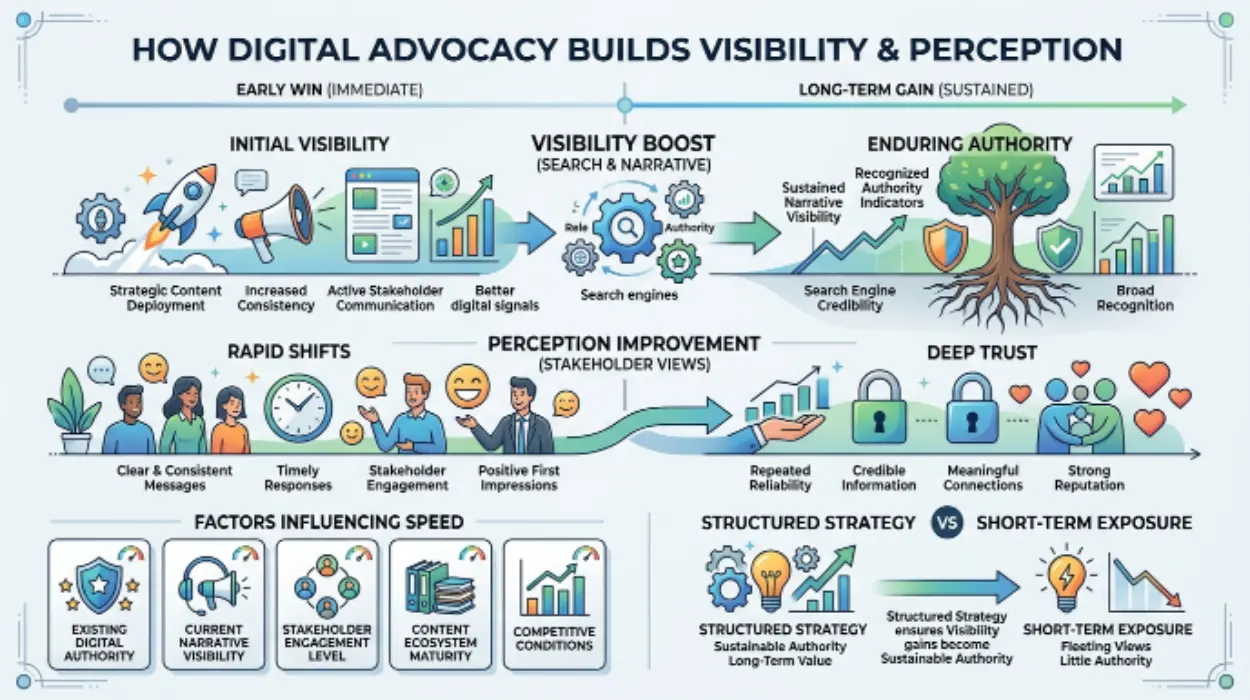
Digital advocacy generates early visibility improvements through strategic content deployment and stakeholder engagement, while long-term authority gains develop through sustained narrative visibility management. This dual-impact model creates both immediate and enduring value.
Search ecosystems respond to relevance, authority, and engagement signals. Initial improvements often emerge as organisations increase content consistency, improve stakeholder communication, and strengthen digital authority indicators. Long-term gains develop as search engines and stakeholders recognise sustained credibility.
Perception improvement follows a similar pattern. Stakeholders respond quickly to clear and consistent communication, while deeper trust formation develops through repeated exposure to reliable information and credible engagement.
The speed of impact depends on:
- Existing digital authority levels.
- Current narrative visibility performance.
- Stakeholder engagement activity.
- Content ecosystem maturity.
- Competitive visibility conditions.
A structured strategy ensures that visibility gains contribute to sustainable authority rather than short-term exposure.
What process ensures sustainable digital advocacy results?
Sustainable results depend on a repeatable framework that integrates visibility analysis, stakeholder mapping, content strategy, and performance measurement. Consistency creates the trust signals that search engines and stakeholders use to evaluate credibility.
Sustainability requires more than content publication or social engagement. Effective digital advocacy aligns every communication asset with broader perception objectives. This alignment ensures that narrative visibility remains coherent across channels and stakeholder groups.
The strongest programmes maintain clear operational processes supported by measurable objectives. This approach transforms digital advocacy from a communications activity into a strategic influence function.
A sustainable framework typically follows these stages:
- Assess current visibility performance and reputation signals.
- Identify stakeholder priorities and perception drivers.
- Develop narrative positioning aligned with organisational objectives.
- Deploy content and engagement initiatives that strengthen digital authority.
- Measure visibility, trust indicators, and stakeholder response patterns.
- Refine strategy based on evidence-driven performance analysis.
This methodology ensures continuous improvement while protecting long-term credibility.
Why does Linkonize provide a reliable digital advocacy solution?
Linkonize provides a reliable solution because effective digital advocacy requires strategic planning, process clarity, and evidence-driven execution. Reliability emerges from consistent methodologies that strengthen visibility, authority, and stakeholder trust simultaneously.
Organisations require more than communication activity. They require measurable systems that influence search perception, reinforce reputation signals, and improve stakeholder confidence. A structured approach ensures that every initiative contributes to broader credibility objectives.
The effectiveness of digital advocacy depends on aligning narrative visibility management with stakeholder decision-making behaviour. Linkonize focuses on this alignment by ensuring that strategic narratives remain visible where stakeholders actively evaluate credibility and authority.
This approach strengthens:
- Digital authority through coordinated visibility strategies.
- Entity credibility through consistent narrative positioning.
- Stakeholder trust signals through transparent communication frameworks.
- SERP control through authoritative content ecosystems.
- Reputation resilience through structured monitoring and optimisation.
These capabilities support organisations seeking greater control over how stakeholders discover, evaluate, and trust information.
When is the right time to request a digital advocacy strategy session?
The right time is before visibility gaps, narrative inconsistencies, or stakeholder trust challenges create strategic disadvantages. Proactive engagement delivers stronger outcomes because it establishes authority before reputation pressure intensifies.
Digital ecosystems reward preparation and consistency. Organisations that act early gain stronger SERP control, improved narrative positioning, and greater stakeholder confidence. Waiting until visibility challenges emerge limits strategic flexibility and increases response complexity.
Decision-makers evaluating digital advocacy solutions benefit from understanding the broader visibility ecosystem that influences stakeholder behaviour. Insights from Why Every Campaign Needs a Rapid-Response Social Media Protocol Before the Crisis Hits demonstrate how proactive communication frameworks strengthen resilience before critical issues emerge. Similarly, LinkedIn for Lobbyists: How Policy Professionals Can Build Influence Through Organic Content highlights how sustained authority-building contributes to long-term influence and credibility.
For organisations seeking stronger narrative visibility management, improved stakeholder trust signals, and measurable search perception influence, a Digital Advocacy strategy session provides a structured pathway towards greater digital authority and reputation stability.
Effective digital advocacy combines process discipline, visibility expertise, and stakeholder understanding. Organisations that prioritise narrative visibility management strengthen institutional credibility, improve search performance, and reduce reputation risk across increasingly complex digital environments. Linkonize delivers a structured, evidence-driven approach that supports sustainable authority, stronger stakeholder trust, and long-term visibility outcomes.
Frequently Asked Questions
What is a digital advocacy strategy session?
A digital advocacy strategy session is a structured consultation designed to evaluate how an organisation appears across search engines, media, and stakeholder platforms. It identifies gaps in narrative visibility, reputation signals, and digital authority. The outcome is a clear roadmap to improve SERP control, strengthen stakeholder trust signals, and align communication with decision-maker expectations.
How does digital advocacy improve search visibility and reputation?
Digital advocacy improves search visibility by strengthening entity credibility through consistent, authoritative content and coordinated messaging. It ensures that positive, evidence-based narratives appear in search results and stakeholder research journeys. This reduces misinformation risks and improves reputation signals across digital environments where decisions are formed.
How quickly can results be seen from a digital advocacy strategy?
Initial improvements in visibility and messaging consistency can appear within weeks, depending on existing digital authority levels. Stronger outcomes such as sustained SERP control and stakeholder trust improvement develop over time through consistent narrative visibility management. The process is cumulative, meaning results strengthen as engagement and authority signals increase.
Is digital advocacy suitable for public affairs and policy professionals?
Yes, digital advocacy is highly effective for public affairs and policy professionals because it directly influences how stakeholders interpret credibility and expertise. It ensures that policy positions, organisational narratives, and leadership insights remain visible across digital platforms where decisions are researched and validated. This strengthens influence and authority in policy environments.
What makes a digital advocacy strategy sustainable long term?
A sustainable digital advocacy strategy is built on continuous monitoring, content optimisation, and stakeholder engagement alignment. It maintains consistent reputation signals across platforms while adapting to changes in search behaviour and public perception. This ensures long-term stability in digital authority and reduces reputation volatility.